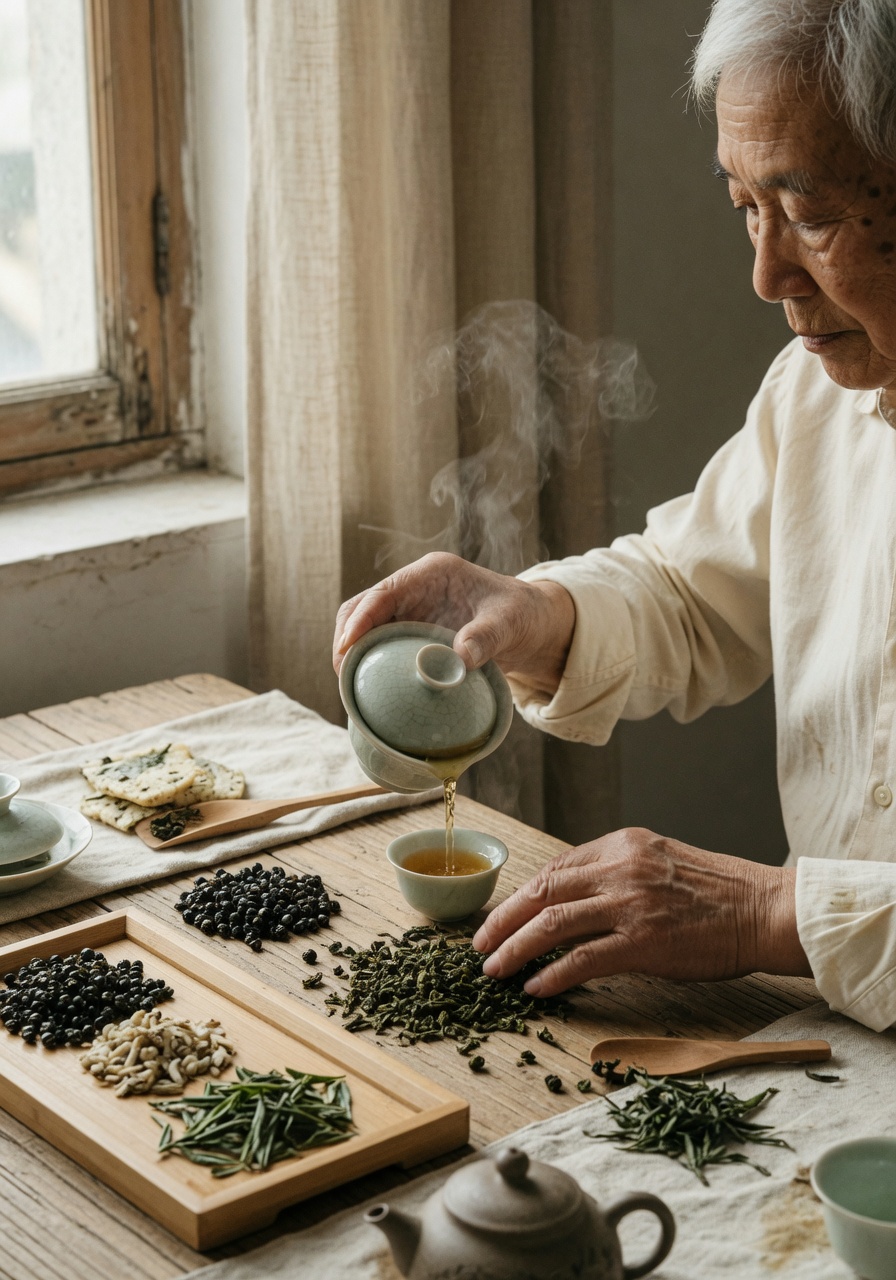
Fang Ting came to pu-erh sideways — through oolong, and through the unusual vantage point of being a northerner who learned to taste southern leaf. She grew up in Xinyang, Henan, where her family kept a small plot on the lower slopes of Shihe district and processed Xìnyáng Máojiān (信阳毛尖) every April. Her grandmother was the one who taught her that shā qīng (杀青) is not a step but a decision — that the moment you commit the leaf to heat is the moment you've chosen which tea you are making. That early lesson became the through-line of her entire career, and it sits at the center of her essay on shā qīng for pu'er versus green tea, where she traces how identical fresh leaves diverge irreversibly within the first ninety seconds of firing.
After a degree in food science at Henan Agricultural University, Fang Ting spent four years apprenticing under Liu Wenxin at a Tieguanyin cooperative in Anxi, then another two seasons in Fenghuang working with Dancong roasters. That detour through oolong is what most distinguishes her palate. She approaches pu-erh the way an oolong taster approaches a roast — listening for the relationship between leaf maturity, fire memory, and time in storage. When she began visiting Yunnan in 2014, first to Yiwu and later to Bulang and Mengku, she carried that framework with her. She is candid that being from Henan rather than Yunnan made her a slow learner of gǔshù (古树) terroir, but it also made her unsentimental about it. She trusts cupping over provenance stories.
Her signature contribution at Teamotea has been a cross-category cupping protocol used internally by shop.thetea.app and shop.puerh.app buyers — a seventeen-point comparison sheet that scores green, oolong, and young shēng on the same axes of bitterness recovery, astringency decay, and aromatic carry. The protocol is what made her the natural author for puerh.app's piece on huángpiàn (黄片), the yellow leaves long discarded by factories. Her argument there — that huángpiàn deserves its own grading scale rather than being treated as a downgrade of bud-leaf grades — has been adopted by two of the producers profiled in our producers index.
Fang Ting teaches the oolong path and the introductory pu-erh path at tea.school, and she contributes diagnostic columns to tea.doctor when readers send in samples with unidentified off-notes. She is unusually good at distinguishing wet-storage character from genuine aged sweetness, a skill she credits to a 2017 trip to a Guangdong warehouse where she cupped forty-six cakes blind across three days. She lives in Zhengzhou and keeps a small personal collection of Xinyang green from her family plot alongside Yiwu shēng from the 2008 and 2013 vintages, which she opens once a year to track how a northern green ages versus a southern shēng — a slow experiment she expects to run for the rest of her life.
Her writing is sparing, technical, and unafraid of saying when a famous mountain has produced a disappointing year. Readers who want romance about ancient trees should look elsewhere. Readers who want to understand why their cake tastes the way it does will find her useful.
Specialties
- oolong
- green tea
- pu-erh
- Henan teas
- cross-category cupping