puerh.app · sampling channel Encyclopedia · School · Atlas · Pu-erh · Equipment EN · RU · · · FR · ES · AR
pǔ·ěr Browse all →

The full encyclopedia

Every leaf, region, and tradition.

74 articles across 8 topics, written by 3 contributors.

All articles

74 pieces, latest first

  1. — 01

    2007 — the year the pu'er market crashed

    For eighteen months Yunnan ran hot — speculation, cake-flipping, factories printing tickets. Then in spring 2007 the floor dropped, and an entire category had to relearn what tea was for.

  2. — 02

    Ānchá

    Ancha is one of the most enigmatic and distinctive teas of China, standing apart even within the six-category classification system. This traditional post-fermented compressed tea from Qimen County (Keemun) in Anhui Province has a history spanning approximately three hundred years.

  3. — 03

    Ānchá

    Ancha is one of the most enigmatic and distinctive teas of China, standing apart even within the six-category classification system. This traditional post-fermented compressed tea from Qimen County (Keemun) in Anhui Province has a history spanning approximately three hundred years.

  4. — 04

    Ānhuà hēichá

    Anhua Hei Cha is a collective name for an entire family of post-fermented dark teas produced in Ānhuà County (安化县, Ānhuà Xiàn) of Hunan Province. This is one of the oldest and most significant representatives of the Hēi Chá (黑茶, Hēichá) category in China, including the famous "Three Tips" (三尖, Sān Jiān), "Three…

  5. — 05

    Ānhuà Hēi Chá

    Anhua Hei Cha is a collective name for an entire family of post-fermented dark teas produced in Ānhuà County (安化县, Ānhuà Xiàn) of Hunan Province. This is one of the oldest and most significant representatives of the Hēi Chá (黑茶, Hēichá) category in China, including the famous "Three Tips" (三尖, Sān Jiān), "Three…

  6. — 06

    Ānhuà tiān jiān hēichá

    Tian Jian is the highest grade in the "San Jian" (三尖, Sān Jiān — "Three Points") system, the historical hierarchy of loose dark teas from Anhua County, Hunan Province. This is the only representative of Anhua Hei Cha that was made exclusively from first-grade raw material and intended for the imperial court.

  7. — 07

    Ānhuà Tiān Jiān Hēi Chá

    Tian Jian is the highest grade in the "San Jian" (三尖, Sān Jiān — "Three Points") system, the historical hierarchy of loose dark teas from Anhua County, Hunan Province. This is the only representative of Anhua Hei Cha that was made exclusively from first-grade raw material and intended for the imperial court.

  8. — 08

    Brewing aged sheng — patience over precision

    A fifteen-year-old cake does not ask for a thermometer. It asks for hot water, a small pot, and the willingness to wait through three rinses before the leaf decides to speak.

  9. — 09

    Brewing young sheng without the bitterness

    Young raw pu'er punishes the lazy and rewards the precise. A short guide to leaf ratio, water, and timing — written from a decade of brewing two-year-old Bulang and Yiwu in cold Ulaanbaatar kitchens.

  10. — 10

    Bulang Shan — the bitter that becomes sweet

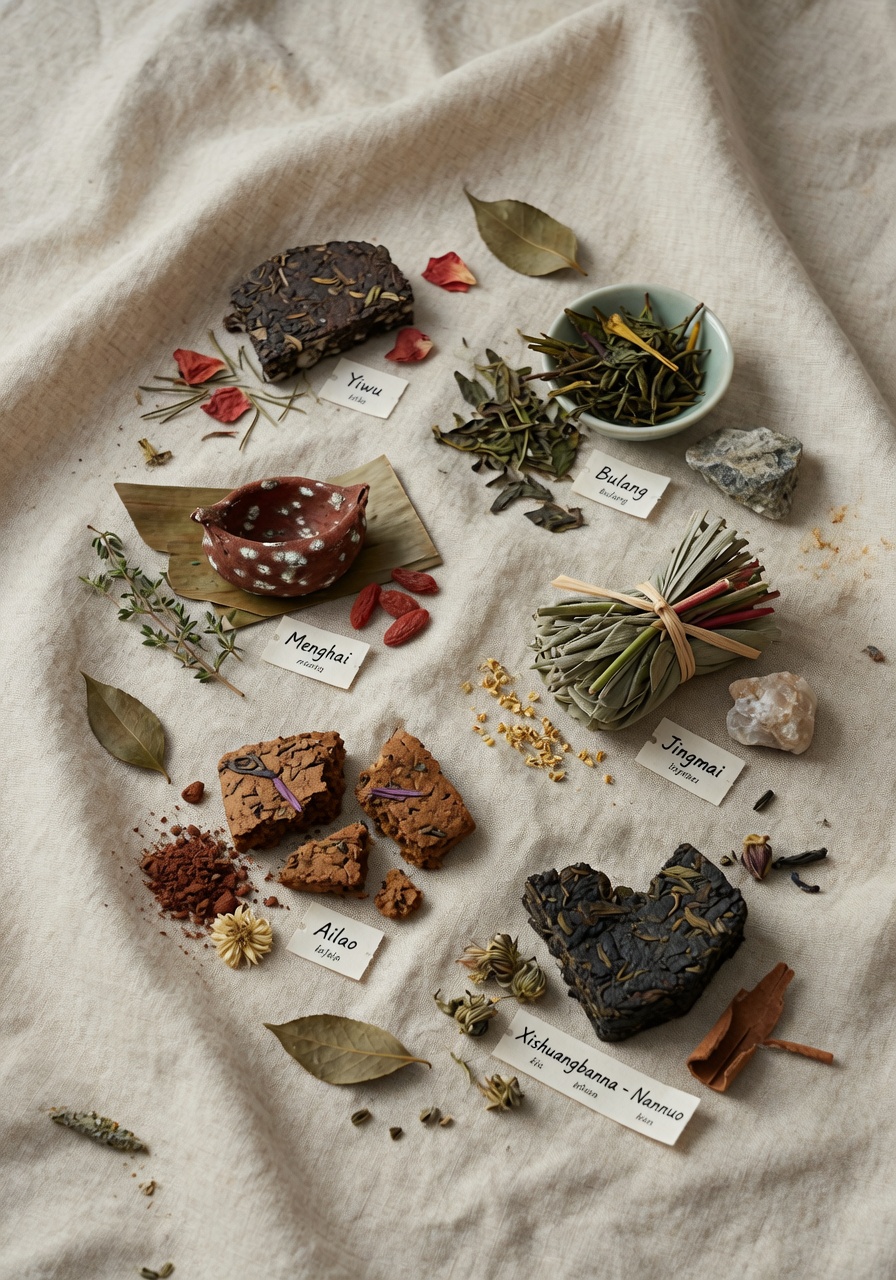
    On the southern edge of Menghai county, the Bulang people have tended tea for over a thousand years. Their leaf opens the throat with bitterness — then turns sweet, slowly, and refuses to leave.

  11. — 11

    Common defects in pu'er — and what causes them

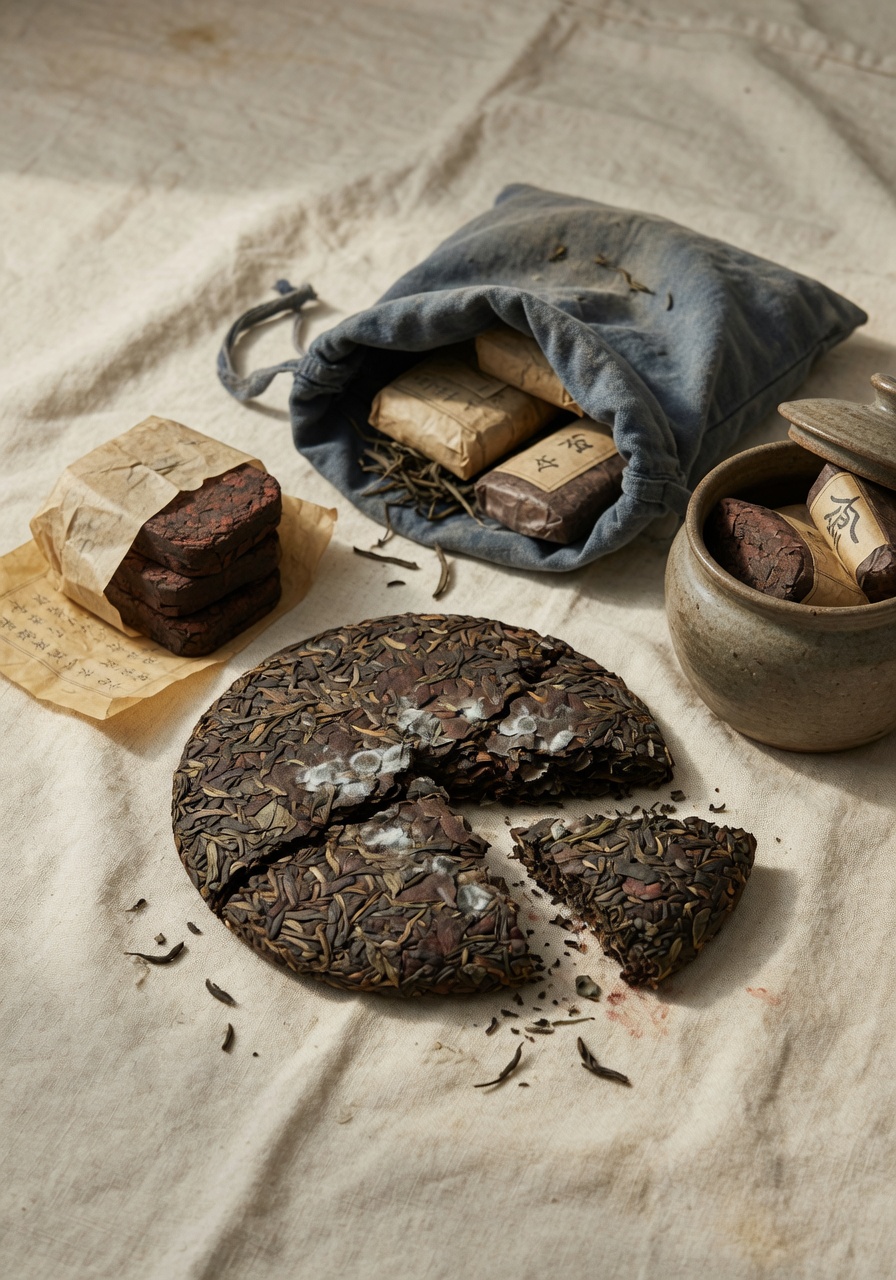
    Mustiness, sourness, fishiness, smoke that never leaves — pu'er has a vocabulary of faults that mirrors its vocabulary of virtues. Each defect points to a specific failure in processing, storage, or transit.

  12. — 12

    Continental aging — Buryatia, Mongolia, the dry north

    Pu-erh aged north of the 50th parallel behaves differently. Cold winters, single-digit summer humidity, and dry continental air slow fermentation to a crawl — and reveal what aging actually is.

  13. — 13

    Dà jīn yá shú pǔ'ěr

    Dà Jīn Yá (大金芽, Dà Jīn Yá) — "Large Golden Buds" — is a commercial grade of shu pu-erh, distinguished by a **visual characteristic: large, fleshy buds densely covered with golden-reddish down** (金毫, jīn háo).

  14. — 14

    Da Jin Ya Shu Pu-erh

    Dà Jīn Yá (大金芽, Dà Jīn Yá) — "Large Golden Buds" — is a commercial grade of shu pu-erh, distinguished by a **visual characteristic: large, fleshy buds densely covered with golden-reddish down** (金毫, jīn háo).

  15. — 15

    Dàlǐ gǎntōng chá

    Gan Tong Cha is one of the most ancient named teas of Yunnan, inextricably linked with the Buddhist monastery Gǎn Tǒng Sì (感通寺, Gǎntōng Sì) on the slopes of the Cangshan mountain range. Since the Ming era, this tea was among the three celebrated Yunnan teas alongside pu-erh and Taihua tea, and the Qīng dynasty (清代)…

  16. — 16

    Dàlǐ Gǎn Tǒng Chá

    Gan Tong Cha is one of the most ancient named teas of Yunnan, inextricably linked with the Buddhist monastery Gǎn Tǒng Sì (感通寺, Gǎntōng Sì) on the slopes of the Cangshan mountain range. Since the Ming era, this tea was among the three celebrated Yunnan teas alongside pu-erh and Taihua tea, and the Qīng dynasty (清代)…

  17. — 17

    Dry storage — the Kunming standard

    Kunming sits at 1,890 metres, averages 14°C, and rarely crosses 70% humidity. For three decades that climate has defined what dry-stored pu-erh tastes like — and what it does not become.

  18. — 18

    Evaluating an unknown cake — a 7-step protocol

    A friend hands you a 357g cake with no wrapper. The vendor's label says 'Yiwu 2008' but the price says otherwise. Here is the seven-step protocol I use before brewing a single gram.

  19. — 19

    Fú zhuān chá

    Fu Zhuan Cha is a brick-pressed dark tea (black tea) famous for its "Golden Flowers" (金花, Jīnhuā) — colonies of the fungus *Eurotium cristatum* (冠突散囊菌, Guāntū Sǎnnángjūn), which form a characteristic mushroom-honey aroma and soft, sweet texture in the liquor.

  20. — 20

    Fú Zhuān Chá

    Fu Zhuan Cha is a brick-pressed dark tea (black tea) famous for its "Golden Flowers" (金花, Jīnhuā) — colonies of the fungus *Eurotium cristatum* (冠突散囊菌, Guāntū Sǎnnángjūn), which form a characteristic mushroom-honey aroma and soft, sweet texture in the liquor.

  21. — 21

    Gōngtíng pǔ'ěr

    Gong Ting Pu-erh (宫廷普洱, gōngtíng pǔ'ěr) — "Palace Pu-erh" — **highest grade** of loose Shu Pu-erh (熟普洱散茶) in the classification system of post-fermented Yunnan teas. According to the Menghai Tea Alliance standard **T/MHC 003-2020** "Menghai Cha Pu-erh Tea", loose shu pu-erh is divided into **13 grades**: 宫廷 (Gong…

  22. — 22

    Gong Ting Pu-erh

    Gong Ting Pu-erh (宫廷普洱, gōngtíng pǔ'ěr) — "Palace Pu-erh" — **highest grade** of loose Shu Pu-erh (熟普洱散茶) in the classification system of post-fermented Yunnan teas. According to the Menghai Tea Alliance standard **T/MHC 003-2020** "Menghai Cha Pu-erh Tea", loose shu pu-erh is divided into **13 grades**: 宫廷 (Gong…

  23. — 23

    Gǔ yī hēi chá

    Gu Yi Hei Cha is a post-fermented dark tea from Yī County (黟县, Yī Xiàn) in Anhui Province, also known by its historical name Ān Chá (安茶, Ān Chá) — "Tea from Anhui." This tea, once celebrated by the Huìzhōu merchants (徽商, Huī shāng), traveled from imperial courts to pharmacies throughout Southeast Asia, where it was…

  24. — 24

    Gǔ Yī Hēi Chá

    Gu Yi Hei Cha is a post-fermented dark tea from Yī County (黟县, Yī Xiàn) in Anhui Province, also known by its historical name Ān Chá (安茶, Ān Chá) — "Tea from Anhui." This tea, once celebrated by the Huìzhōu merchants (徽商, Huī shāng), traveled from imperial courts to pharmacies throughout Southeast Asia, where it was…

  25. — 25

    Gushu / 'old tree' tea — what's real, what's marketing

    The term *gǔshù* (古树) sells more cake than any other two characters in Yunnan. Most of what's labelled gushu is not. Here's how to read the claim — botanically, contractually, and in the cup.

  26. — 26

    Huangpian — the yellow leaves nobody wanted

    The oversized, pale leaves sorted out of premium sheng cakes were once treated as waste. A generation of drinkers has quietly turned that waste into one of the most honest cups in the pu'er catalogue.

  27. — 27

    Húběi qīng zhuān

    Hubei Qing Zhuan — legend of the Wànlǐ Chádào (万里茶道, Wànlǐ Chádào — "Ten Thousand Li Tea Road"), a brick dark tea that for three centuries was the primary Chinese tea exported to Mongolia and Russia.

  28. — 28

    Húběi Qīng Zhuān

    Hubei Qing Zhuan — legend of the Wànlǐ Chádào (万里茶道, Wànlǐ Chádào — "Ten Thousand Li Tea Road"), a brick dark tea that for three centuries was the primary Chinese tea exported to Mongolia and Russia.

  29. — 29

    Jiétān hēichá

    Jietan Hei Cha is a post-fermented version of the famous Jiétān tea (碣滩茶), historically known primarily as a high-grade green tea from Hunan Province. The "碣滩茶" brand today encompasses an entire product line—green, red tea (black tea), white, and dark tea—produced from raw materials from mountain ecological…

  30. — 30

    Jiétān Hēi Chá

    Jietan Hei Cha is a post-fermented version of the famous Jiétān tea (碣滩茶), historically known primarily as a high-grade green tea from Hunan Province. The "碣滩茶" brand today encompasses an entire product line—green, red tea (black tea), white, and dark tea—produced from raw materials from mountain ecological…

  31. — 31

    Jīnguā gòngchá

    Jingua Gong Cha is a legendary representative of the pu-erh family, possessing a unique form resembling a pumpkin (南瓜, nánguā) and the status of the most valuable historical artifact in the world of Chinese tea.

  32. — 32

    Jīnguā Gòng Chá

    Jingua Gong Cha is a legendary representative of the pu-erh family, possessing a unique form resembling a pumpkin (南瓜, nánguā) and the status of the most valuable historical artifact in the world of Chinese tea.

  33. — 33

    Jīngyáng fú zhuān

    Jingyang Fu Zhuan is a legendary dark tea from Jingyang County, Shaanxi Province, dubbed the "Black Gold of the Silk Road." Its signature feature is abundant "golden flowers" (冠突散囊菌, *Eurotium cristatum*), the unique microclimate of Jingyang, and more than 600 years of history inextricably linked to the tea-horse…

  34. — 34

    Jīngyáng Fú Zhuān

    Jingyang Fu Zhuan is a legendary dark tea from Jingyang County, Shaanxi Province, dubbed the "Black Gold of the Silk Road." Its signature feature is abundant "golden flowers" (冠突散囊菌, *Eurotium cristatum*), the unique microclimate of Jingyang, and more than 600 years of history inextricably linked to the tea-horse…

  35. — 35

    Kāng zhuān

    Kàng Zhuān is the flagship of Sìchuān border tea (四川边茶, Sìchuān Biān Chá) and the main representative of the "Southern Route Border Tea" category (南路边茶, Nánlù Biān Chá). For more than a thousand years, this tea was the principal commodity on the legendary Tea Horse Road, linking Sichuan Province with Tibet.

  36. — 36

    Kāng Zhuān

    Kàng Zhuān is the flagship of Sìchuān border tea (四川边茶, Sìchuān Biān Chá) and the main representative of the "Southern Route Border Tea" category (南路边茶, Nánlù Biān Chá). For more than a thousand years, this tea was the principal commodity on the legendary Tea Horse Road, linking Sichuan Province with Tibet.

  37. — 37

    Sha qing — kill-green for pu'er vs green tea

    The pan-firing step that defines pu'er is not the same as the one that defines Longjing. Same name, same wok — different temperature, different intent, different future.

  38. — 38

    Lǎo chá tóu

    Lao Cha Tou is one of the most unusual phenomena in the world of pu-erh. It is not a separate variety nor a specially created product, but a **natural byproduct** of the wet piling process (Wo Dui, 渥堆, Wò Duī), during which tea leaves rich in pectins clump together into dense lumps that cannot be separated.

  39. — 39

    Lǎo Chá Tóu

    Lao Cha Tou is one of the most unusual phenomena in the world of pu-erh. It is not a separate variety nor a specially created product, but a **natural byproduct** of the wet piling process (Wo Dui, 渥堆, Wò Duī), during which tea leaves rich in pectins clump together into dense lumps that cannot be separated.

  40. — 40

    Lincang — the western mountains, often overlooked

    West of the Lancang river, Lincang produces more raw material than any other Yunnan prefecture — yet its name rarely sits on the wrapper. The mountains that built Xiaguan and fed Menghai deserve a closer look.

  41. — 41

    Liù'ān hēichá

    Under the name "Liu An Hei Cha" is united a little-known but historically significant tradition of dark tea from Anhui Province. Unlike the celebrated green tea Liú An Guāpiàn (六安瓜片), Anhui dark tea belongs to a different flavor and technological world — the world of post-fermentation, long aging, and medicinal…

  42. — 42

    Liú Ān Hēi Chá

    Under the name "Liu An Hei Cha" is united a little-known but historically significant tradition of dark tea from Anhui Province. Unlike the celebrated green tea Liú An Guāpiàn (六安瓜片), Anhui dark tea belongs to a different flavor and technological world — the world of post-fermentation, long aging, and medicinal…

  43. — 43

    Liù bǎo chá

    Liú Bǎo Chá is one of the most distinctive and historically significant representatives of the dark tea (黑茶) category, having evolved from a humble "workers' tea" to a cult "drinkable antique." This post-fermented tea from Guangxi with a fifteen-hundred-year history is renowned for its "four perfections" — red, thick,…

  44. — 44

    Liù Bǎo Hēi Chá

    Liú Bǎo Chá is one of the most distinctive and historically significant representatives of the dark tea (黑茶) category, having evolved from a humble "workers' tea" to a cult "drinkable antique." This post-fermented tea from Guangxi with a fifteen-hundred-year history is renowned for its "four perfections" — red, thick,…

  45. — 45

    Menghai 7572 — the recipe that anchors the category

    A four-digit code stamped on a paper wrapper has done more to define what shu tastes like than any single mountain or master. This is how 7572 became the reference point.

  46. — 46

    Menghai county — birthplace of modern shu

    A flat-bottomed valley at 1,200 m, ringed by Bulang and Nannuo mountains, where in 1973 a state factory perfected pile fermentation and changed pu-erh forever.

  47. — 47

    Mòtuō zhuānchá

    Moto Zhuan Cha is a unique Tibetan brick tea born in one of the most inaccessible and ecologically pristine corners of the planet — Moto County (墨脱县, Mòtuō Xiàn) in southeastern Tibet. It is the only representative of the dark tea (黑茶) category produced in the Tibet Autonomous Region, at altitudes from 800 to 2200…

  48. — 48

    Moto Zhuān Chá

    Moto Zhuan Cha is a unique Tibetan brick tea born in one of the most inaccessible and ecologically pristine corners of the planet — Moto County (墨脱县, Mòtuō Xiàn) in southeastern Tibet. It is the only representative of the dark tea (黑茶) category produced in the Tibet Autonomous Region, at altitudes from 800 to 2200…

  49. — 49

    Nannuo Shan — the queen of Menghai's mountains

    Nannuo is the most documented tea mountain in Xishuangbanna — Hani villages above 1,400 m, an 800-year-old tea tree felled in 1994, and a flavour profile that anchors what 'classic Menghai sheng' means.

  50. — 50

    Bing, zhuan, tuo — the shapes and why they exist

    Why does pu-erh come pressed into discs, bricks and bowls instead of loose? The answer is older than the tea itself — and it shapes how the leaf ages in your cupboard.

  51. — 51

    A working vocabulary for tasting pu'er

    Tasting notes are useless if two drinkers cannot agree on what *huí gān* means. This is a working glossary — the words I actually use at the table, with the sensations that anchor them.

  52. — 52

    Qiān liǎng chá

    Qian Liang Cha is a legendary cylindrical dark tea from Anhua County, encased in bamboo "basket" wrapping (篾篓, mièlǒu). This is one of the most impressive and distinctive compressed teas in the world: a giant cylinder approximately 1.5 m long and 0.2 m in diameter, weighing one thousand old liang (approximately 36.25…

  53. — 53

    Qiān Liǎng Chá

    Qian Liang Cha is a legendary cylindrical dark tea from Anhua County, encased in bamboo "basket" wrapping (篾篓, mièlǒu). This is one of the most impressive and distinctive compressed teas in the world: a giant cylinder approximately 1.5 m long and 0.2 m in diameter, weighing one thousand old liang (approximately 36.25…

  54. — 54

    Tribute tea under the Qing — pu'er at the imperial court

    For nearly two centuries, compressed tea from the six famous mountains of Yunnan travelled three thousand li to the Forbidden City. The tribute system shaped the cakes we still press today.

  55. — 55

    Sheng vs shu — what actually changes

    Two teas share a name, a region, and a leaf — and almost nothing else. The 1973 invention of *wò duī* (渥堆) split pu'er into raw and ripe, and the chemistry of that split still defines every cake pressed today.

  56. — 56

    Does shu age? A measured answer

    Shu was engineered in 1973 to taste like aged sheng without the wait. So does it still benefit from time in the jar — or is the work already done? A technical look at what actually changes after the pile.

  57. — 57

    Sìchuān biān chá

    The production technology of Sichuan Bian Cha has its own characteristics, related to the use of mature raw materials and the need for long-term storage and transportation of tea. The key stage is **post-fermentation**, which occurs after pressing.

  58. — 58

    Sìchuān Biān Chá

    The production technology of Sichuan Bian Cha has its own characteristics, related to the use of mature raw materials and the need for long-term storage and transportation of tea. The key stage is **post-fermentation**, which occurs after pressing.

  59. — 59

    Mould, off-flavours, sour notes — diagnosing storage faults

    A cake can survive thirty years of indifferent storage and still pour beautifully. It can also be ruined in a single humid August. This is a field guide to what goes wrong, why, and what can still be saved.

  60. — 60

    Suì yín zi

    Sui Yin Zi is one of the most unusual and controversial products in the world of modern pu-erh. These small, hard, polished-to-shine dark granules, externally resembling scattered ancient silver coins, represent a deeply processed variety of shu pu-erh, obtained from Lǎo Chá Tóu (老茶头, Lǎo Chá Tóu) — "old tea heads,"…

  61. — 61

    Suì Yín Zī

    Sui Yin Zi is one of the most unusual and controversial products in the world of modern pu-erh. These small, hard, polished-to-shine dark granules, externally resembling scattered ancient silver coins, represent a deeply processed variety of shu pu-erh, obtained from Lǎo Chá Tóu (老茶头, Lǎo Chá Tóu) — "old tea heads,"…

  62. — 62

    Sun-drying — why pu'er starts in daylight, not in an oven

    The single processing choice that separates pu'er from every other Yunnan green is also the most boring to watch — leaves on bamboo mats, sun overhead, four to eight hours. Here is why that step matters more than the price tag on the cake.

  63. — 63

    The Tea Horse Road — how pu'er travelled before trucks

    Before highways crossed the Hengduan mountains, pu'er moved on the backs of mules and Tibetan porters — a six-month journey that shaped the cake, the compression, and the taste we still chase.

  64. — 64

    Traditional wet storage — Hong Kong and Guangdong

    Before Kunming dry storage was a concept, before climate-controlled warehouses, there was a basement in Sheung Wan and a sealed room in Foshan. Wet storage made aged pu-erh a category — and remains the most misunderstood practice in the tea world.

  65. — 65

    Yixing for pu'er — when clay matters, when it doesn't

    Unglazed clay from a single county in Jiangsu shapes how pu'er tastes — sometimes profoundly, sometimes barely. Knowing which is which saves money and improves the cup.

  66. — 66

    Wo dui — the pile fermentation that defined shu

    In 1973, a team at Kunming Tea Factory wet-piled maocha under wool blankets and waited. Forty-five days later, the leaves were black, sweet, and unmistakably new. This is the story of how a chemical accident became a category.

  67. — 67

    Yǎ'ān hēichá

    Ya'an Hei Cha, better known as Ya'an Zàng Chá (雅安藏茶, Yǎ'ān Zàngchá) — "Ya'an Tibetan Tea" — is one of China's most ancient and important "border teas" (边茶, biānchá). For more than 1,300 years, it has been a vital necessity for the peoples of the Tibetan Plateau and the main commodity of the legendary Tea Horse Road…

  68. — 68

    Ya'an Hēi Chá

    Ya'an Hei Cha, better known as Ya'an Zàng Chá (雅安藏茶, Yǎ'ān Zàngchá) — "Ya'an Tibetan Tea" — is one of China's most ancient and important "border teas" (边茶, biānchá). For more than 1,300 years, it has been a vital necessity for the peoples of the Tibetan Plateau and the main commodity of the legendary Tea Horse Road…

  69. — 69

    Yiwu — forest gardens of the Laos border

    On the southern edge of Xishuangbanna, where the forest crosses into Laos, *Yì Wǔ* (易武) grows the softest, most aromatic *shēng* in Yunnan — a tea that built an empire, vanished for fifty years, and rebuilt itself from village memory.

  70. — 70

    Young sheng — drink now or wait?

    The question every collector asks within their first year. Some cakes are radiant at eighteen months; others need a decade before they stop biting. Here is how to tell which is which.

  71. — 71

    Zhòngqìng tuóchá

    Chongqing Tuo Cha is a legendary compressed tea in the form of a "nest" (沱, tuó), whose production began in 1953 at the Chóngqìng Tea Factory (重庆茶厂, Chóngqìng Cháchǎng) — the largest tea enterprise of New China.

  72. — 72

    Chóngqìng Tuò Chá

    Chongqing Tuo Cha is a legendary compressed tea in the form of a "nest" (沱, tuó), whose production began in 1953 at the Chóngqìng Tea Factory (重庆茶厂, Chóngqìng Cháchǎng) — the largest tea enterprise of New China.

  73. — 73

    Zǐyáng hēichá

    Ziyang Hei Cha is a dark tea from Ziyang County in southern Shaanxi Province, grown on ancient selenium-rich soils of the Qinba Mountains. The combination of the unique fu-zhuan process of "developing golden flowers" with naturally high selenium content in the raw material makes this tea a genuine "golden treasure of…

  74. — 74

    Zǐyáng Hēi Chá

    Ziyang Hei Cha is a dark tea from Ziyang County in southern Shaanxi Province, grown on ancient selenium-rich soils of the Qinba Mountains. The combination of the unique fu-zhuan process of "developing golden flowers" with naturally high selenium content in the raw material makes this tea a genuine "golden treasure of…

Contributors

3 writers

Amgalan Chin

Amgalan Chin

Cross-Regional Tea Expert & Technical Specialist

Amgalan Chin works the long seam between Yunnan and the dry north — the corridor along which compressed tea has moved for six centuries. Born in Ulan-Ude in 1971 to a Buryat father and a Chinese mother from Kunming, he grew up drinking brick tea boiled with milk and salt in the Mongolian style, and only later understood that the same leaf, brewed differently, was the *pǔ'ěr* (普洱) collected and argued over in southern teahouses. That double vantage — north and south, drinker and trader — became his subject. His formal training began in 1996 at the Menghai Tea Factory, where he spent three winters in the *wò duī* (渥堆) sheds learning pile fermentation under master Zou Bingliang, then one of the few remaining technicians from the 1973 development team that codified modern shu. From Menghai he moved to Yiwu in 2001, apprenticing with the Gao family in Mahei village and helping document the revival of pressed cakes from forest-garden material after the long state-factory monopoly. Those two postings — one industrial, one artisanal — frame almost everything he writes. The pair of essays "Wo dui — the pile fermentation that defined shu" and "Menghai 7572 — the recipe that anchors the category" are drawn directly from notebooks kept during that decade. Since 2009 Amgalan has split the year between a small ageing room in Kunming and a larger continental cellar outside Ulan-Ude, where roughly four tonnes of sheng sit under controlled low humidity. The Buryatia cellar is unusual — winter temperatures fall below −20 °C, summer humidity rarely exceeds 55 % — and his long study of how cakes evolve in those conditions underpins "Continental aging — Buryatia, Mongolia, the dry north" and the more diagnostic "Mould, off-flavours, sour notes — diagnosing storage faults." He is one of the few practitioners with directly comparable cakes ageing in Kunming, Guangdong and Siberia from the same 2008 and 2012 pressings. His fieldwork on producing regions is equally split. He returns to Bulang Shan each spring to press a small *máochá* (毛茶) lot with the Wei family of Lao Banzhang's outer villages, and to Yiwu in early April for the forest harvests around Guafengzhai and Mahei. The region guides "Bulang Shan — the bitter that becomes sweet" and "Yiwu — forest gardens of the Laos border" reflect twenty-plus consecutive seasons in those mountains, not a tasting tour. Amgalan teaches the pu-erh and dark-tea paths at tea.school, hosts the long-running aged-tea cohort on tea.community, and curates the aged inventory at shop.puerh.app and shop.thetea.app. He reads and writes Mandarin, Russian, Buryat-Mongolian and serviceable English; his lectures are slow, footnoted and allergic to superlatives. Students remember him for two habits — refusing to call any cake "good" without naming the storage history, and ending tastings by reboiling the spent leaf the Mongolian way, with milk and salt, to remind everyone where this leaf has been travelling since the Ming. He is currently completing a long-form study of the Tea Horse Road's northern branch, draft chapters of which appear as "The Tea Horse Road — how pu'er travelled before trucks" on puerh.app.

Chen Hui Yi

Chen Hui Yi

Senior Tea Expert (White, Green & Yellow Tea Varieties)

Chen Hui Yi grew up in Chaozhou, where the morning fog off the Hán Jiāng carried the smell of roasting *dān cōng* through her grandmother's courtyard. Her tea education, however, took a different turn. At seventeen she travelled north to Fúdǐng in Fújiàn for what was meant to be a six-week apprenticeship at a small *báichá* workshop in Diǎntóu town — she stayed for four years. There she trained under Wú Jiànlì, a third-generation withering master who taught her to read the difference between *rì guāng wěi diāo* (sun withering) and *fù shì wěi diāo* (compound withering) by the sound the leaves make when shifted on bamboo *shuǐ shāi* trays. That tactile, weather-reading approach became the spine of her practice. Chen returned to Guangdong in 2011 and built her working life along a triangle she still maintains today: the Fúdǐng gardens above 600 m in Tàimǔ Shān for *Bái Háo Yín Zhēn* (白毫银针) and *Bái Mǔ Dān* (白牡丹), the Jǐnggǔ region of Yúnnán for *yuè guāng bái* (月光白, moonlight white) from large-leaf *Camellia sinensis* var. *assamica* stock, and her own small cellar in Cháozhōu where she has been ageing pressed *shòu méi* (寿眉) cakes since 2013. The cellar is monitored to GB/T 22291-2017 storage guidance — 25 °C ceiling, relative humidity held between 55 and 65 percent — and now holds vintages from eleven consecutive harvests. Her notes on the 2014 and 2016 Fúdǐng pressings are the source material for much of her aged-white writing. On puerh.app her work sits at the intersection where collectors of *shēng* pǔ'ěr begin asking about other ageable teas. She is the author the editorial team turns to when a piece needs the long view on dry-storage chemistry, on cellulose and polyphenol behaviour across a decade, on why a 2008 *shòu méi* cake and a 2008 Yìwǔ *shēng* answer humidity so differently. Readers will find her contributions threaded through the storage guide and the comparison entries on moonlight white versus young *shēng* — both areas where the two categories share a vocabulary but diverge in chemistry. Her signature contribution to the constellation is the white-tea curriculum at tea.school, which she rewrote in 2022 around three withering archetypes rather than the older grade-based outline. She also serves as the vendor expert for white, green and yellow varieties on shop.thetea.app, where her tasting notes accompany every release, and consults on aged-white identification questions submitted through tea.doctor. She is occasionally on the road for tea.travel, leading small groups through the Tàimǔ Shān gardens in late March, timed to the first picking of *yín zhēn* buds. Chen writes in a register that assumes the reader has already drunk the tea once and wants to understand what they tasted. She prefers structural description — leaf set, withering depth, moisture gradient — to flavour metaphor, though she will yield to the latter when a tea genuinely demands it. Her northern Guangdong upbringing surfaces mainly in her patience with long sessions and her insistence that a serious white tea, like a serious *gōng fū chá* session, rewards the drinker who waits for the third or fourth steep before forming an opinion.

Fang Ting

Fang Ting

Senior Tea Expert (Oolong, Green & Puerh Varieties)

Fang Ting came to pu-erh sideways — through oolong, and through the unusual vantage point of being a northerner who learned to taste southern leaf. She grew up in Xinyang, Henan, where her family kept a small plot on the lower slopes of Shihe district and processed *Xìnyáng Máojiān* (信阳毛尖) every April. Her grandmother was the one who taught her that *shā qīng* (杀青) is not a step but a decision — that the moment you commit the leaf to heat is the moment you've chosen which tea you are making. That early lesson became the through-line of her entire career, and it sits at the center of her essay on *shā qīng* for pu'er versus green tea, where she traces how identical fresh leaves diverge irreversibly within the first ninety seconds of firing. After a degree in food science at Henan Agricultural University, Fang Ting spent four years apprenticing under Liu Wenxin at a Tieguanyin cooperative in Anxi, then another two seasons in Fenghuang working with Dancong roasters. That detour through oolong is what most distinguishes her palate. She approaches pu-erh the way an oolong taster approaches a roast — listening for the relationship between leaf maturity, fire memory, and time in storage. When she began visiting Yunnan in 2014, first to Yiwu and later to Bulang and Mengku, she carried that framework with her. She is candid that being from Henan rather than Yunnan made her a slow learner of *gǔshù* (古树) terroir, but it also made her unsentimental about it. She trusts cupping over provenance stories. Her signature contribution at Teamotea has been a cross-category cupping protocol used internally by shop.thetea.app and shop.puerh.app buyers — a seventeen-point comparison sheet that scores green, oolong, and young *shēng* on the same axes of bitterness recovery, astringency decay, and aromatic carry. The protocol is what made her the natural author for puerh.app's piece on *huángpiàn* (黄片), the yellow leaves long discarded by factories. Her argument there — that *huángpiàn* deserves its own grading scale rather than being treated as a downgrade of bud-leaf grades — has been adopted by two of the producers profiled in our producers index. Fang Ting teaches the oolong path and the introductory pu-erh path at tea.school, and she contributes diagnostic columns to tea.doctor when readers send in samples with unidentified off-notes. She is unusually good at distinguishing wet-storage character from genuine aged sweetness, a skill she credits to a 2017 trip to a Guangdong warehouse where she cupped forty-six cakes blind across three days. She lives in Zhengzhou and keeps a small personal collection of Xinyang green from her family plot alongside Yiwu *shēng* from the 2008 and 2013 vintages, which she opens once a year to track how a northern green ages versus a southern *shēng* — a slow experiment she expects to run for the rest of her life. Her writing is sparing, technical, and unafraid of saying when a famous mountain has produced a disappointing year. Readers who want romance about ancient trees should look elsewhere. Readers who want to understand why their cake tastes the way it does will find her useful.