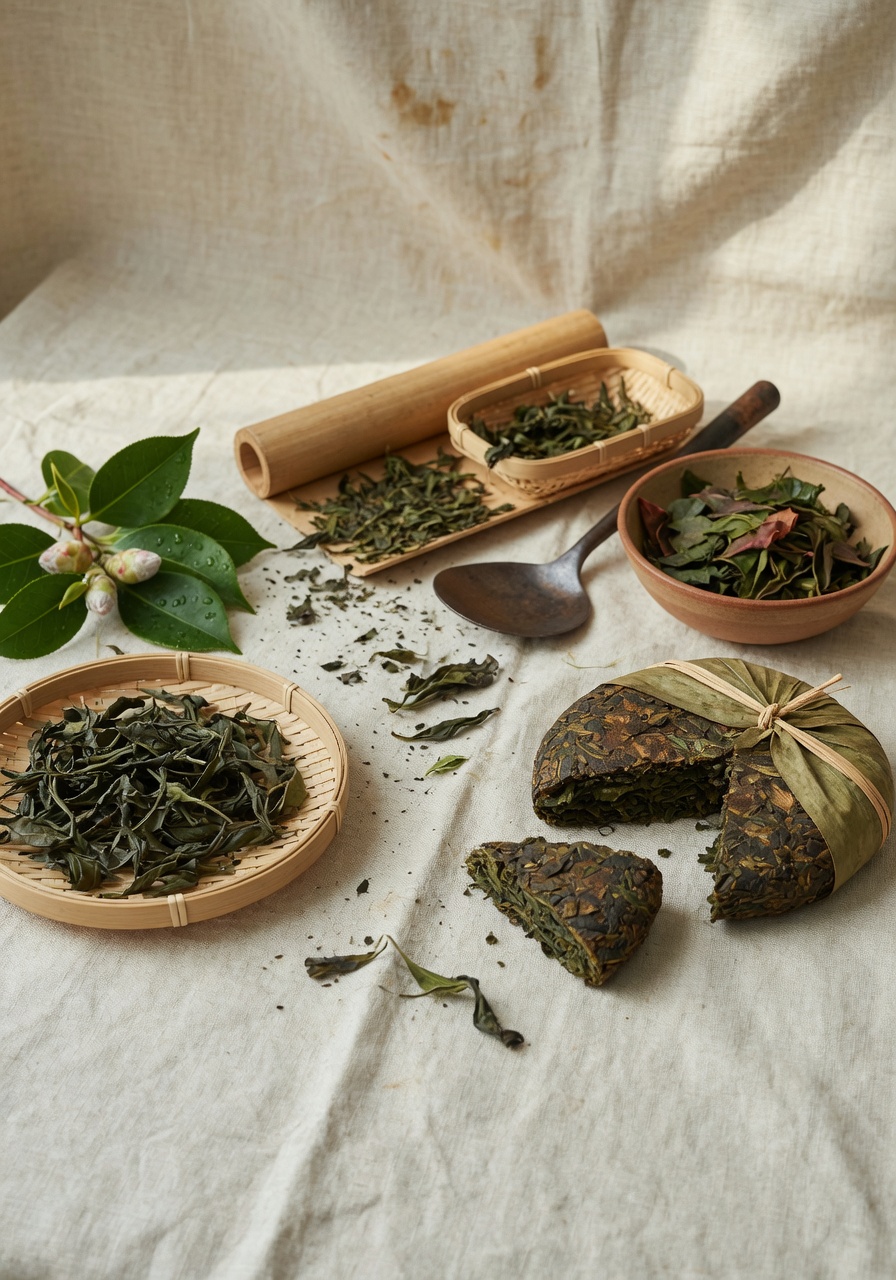
Why pu’er processing breaks the rules of every other Chinese tea
Most Chinese tea processing aims at one thing — fixing the leaf in a finished state. Lóngjǐng (龙井) is pan-fired dry; Tiě Guān Yīn (铁观音) is roasted until stable; even Bái Háo Yín Zhēn (白毫银针) is dried to a moisture content that resists change. Pu’er does the opposite. Its craft is engineered to leave the leaf alive — enzymatically dormant but microbially receptive — so that fermentation can continue for decades inside a compressed cake. Understanding this inversion is the key to everything that follows in this topic.
The pivotal step is shā qīng (杀青), kill-green, covered in detail in our article on sha qing — kill-green for pu’er vs green tea. In Lóngjǐng production the wok runs at 220–260 °C and the leaf is held there until polyphenol oxidase is fully denatured. In Yunnan, kill-green for shēng pu’er is deliberately gentler — wok temperatures closer to 160–180 °C, shorter holds, and a target leaf temperature that stuns enzymes without killing them. Residual oxidase activity, combined with native microflora carried in from the field, is what allows a 2005 Yìwǔ (易武) cake to taste fundamentally different from a 2024 one. Get this step wrong and you have either a green tea that stales, or an over-fired máo chá that will never develop.
Drying follows the same logic. Sun-drying — covered in our article on sun-drying and why pu’er starts in daylight, not in an oven — pulls moisture down to roughly 9–12 % over several hours of bamboo-mat exposure, typically at elevations between 1,400 and 2,000 metres. Solar UV and the slow temperature curve preserve the enzyme set that oven-drying would destroy. Producers like the Měngkù Róng Shì factory, founded in 1999 in Shuāngjiāng County, built their reputation specifically on sun-drying discipline through the rainy spring months.
Then comes shape. Steam-pressing into bǐng (饼, 357 g disc), zhuān (砖, brick) or tuó (沱, bowl) — surveyed in bing, zhuan, tuo — is not aesthetic decoration. The 357 g cake size traces to Qing-dynasty horse-caravan logistics on the Chámǎ Gǔdào (茶马古道, Tea Horse Road), where seven cakes formed one tǒng and twelve tǒng one jiàn — a standardised animal load. The shape also controls aging surface-area: a loose tuó breathes faster than a stone-pressed bǐng, which is why two cakes from the same máo chá batch can taste a decade apart after twenty years.
The craft has evolved, not always for the better. After 1973, the Kūnmíng Tea Factory formalised wò duī (渥堆), the wet-piling process that produces shú pu’er — a 45-to-65-day controlled microbial fermentation that compresses thirty years of aging into two months. Wò duī remains contested among traditionalists, but it standardised a category that now accounts for roughly half of Yunnan’s pressed output.
For field context on the gardens feeding these workshops, see our growing-regions topic; for the post-press life of a cake, our storage & aging guides pick up where this one ends. Sommelier-side notes on reading processing in the cup live at thetea.app, and producers selling directly from these workshops are catalogued on shop.puerh.app.