home · From fresh leaf to <em>bǐng</em> — the craft behind pu'er
Processing & craft
Sun-drying — why pu'er starts in daylight, not in an oven
Shài Qīng · 晒青
The single processing choice that separates pu'er from every other Yunnan green is also the most boring to watch — leaves on bamboo mats, sun overhead, four to eight hours. Here is why that step matters more than the price tag on the cake.
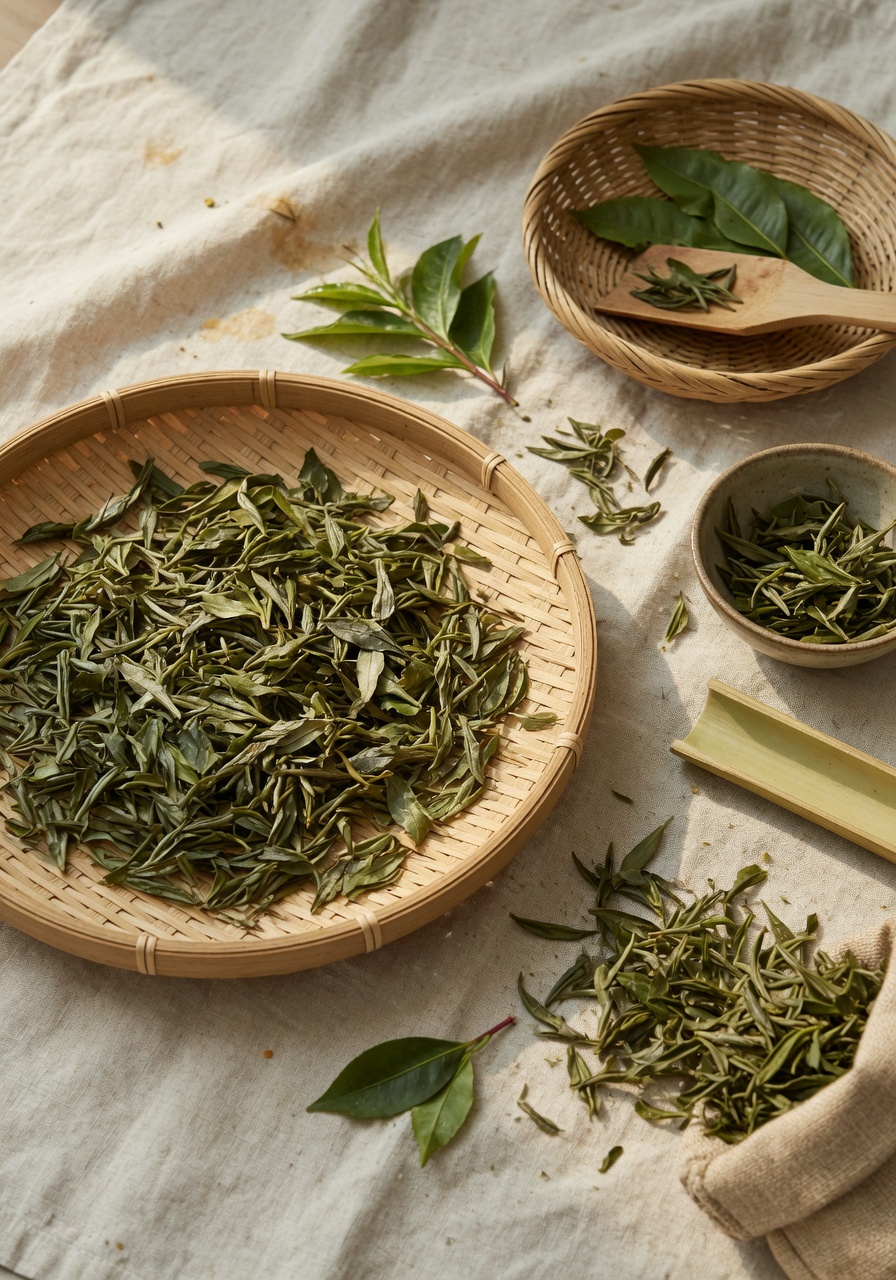
Walk into a smallholder’s courtyard in Mengsong at one in the afternoon in late March and you will see the most uneventful thing in tea: rectangles of bamboo matting, zhú xí (竹席), spread across a flat roof or a packed-earth yard, each holding maybe two kilograms of dull olive-green leaves. No one is doing anything. The tea was pan-fired in a wok an hour ago, hand-rolled for ten minutes, and now it sits in direct sunlight at roughly 1,400 metres of elevation, losing water at a rate the maker can read by touch. By sundown it will be dry enough to bag. This is shài qīng (晒青) — sun-drying — and it is the step that quietly defines what a máo chá (毛茶) is allowed to become. Drop the leaves in a hot-air dryer at 110 °C, as is standard for Yunnan green tea destined for the domestic market, and you have produced something perfectly drinkable that will not age. Leave them in the sun, even on a cold day, and you have made the only base material the GB/T 22111-2008 national standard recognises as the raw material for Pǔ’ěr chá (普洱茶). One step, two futures. The rest of this article is about what actually happens in those four to eight hours, why the temperature ceiling matters more than the duration, and why every serious gǔshù (古树) producer I have visited treats the drying yard as more sacred than the wok.
What sun-drying is, in plain mechanical terms
Sun-drying is the final moisture-removal stage of the máo chá process. After plucking, the fresh leaves are withered briefly indoors, killed-green in a wok at around 180–220 °C for six to twelve minutes (shā qīng, 杀青), hand-rolled to bruise the cells, and then spread thin on bamboo mats for solar drying. The target moisture is around 9–10 %, down from roughly 65 % at the wok stage. What makes this step distinct from every other tea-drying method in China is the temperature ceiling: leaf-surface temperature rarely exceeds 40 °C even on a hot Xishuangbanna afternoon, because evaporative cooling holds it down while water is still leaving. Compare that with the 110–130 °C of a tunnel dryer for Yunnan lǜ chá (绿茶), or the 80–90 °C of charcoal baskets used in Wuyi oolong finishing. The enzymes responsible for the slow oxidation that pu’er drinkers wait years for — polyphenol oxidase and peroxidase — are denatured at sustained temperatures above roughly 65 °C. Wok-firing knocks them down sharply but does not eliminate them; sun-drying preserves what survives. Hot-air drying finishes the job and produces a sterile, stable green tea. This is the technical reason a Yunnan sun-dried máo chá will keep transforming for forty years in a Hong Kong warehouse, and a Yunnan oven-dried green will be flat by year three.
The 40 °C ceiling that nobody writes on the bag
In a 2014 study by the Yunnan Agricultural University tea department, leaf-surface temperatures during shài qīng across forty-six smallholder yards in Menghai, Lincang and Pu’er were logged at fifteen-minute intervals through a full drying day. The mean peak was 38.2 °C; the highest single reading was 44.1 °C, recorded on a black tarp rather than bamboo. The same study found residual polyphenol oxidase activity in sun-dried máo chá at 17–23 % of fresh-leaf baseline, compared with under 4 % in oven-dried controls. That residual enzyme pool — small but non-zero — is the engine of young sheng’s first decade of transformation. Once you understand the number, the obsessive care experienced makers take with mat colour, mat material and timing stops looking like superstition.
Why the sun specifically, and not a low oven
An obvious question follows: if the goal is gentle drying under 40 °C, why not use a fan-assisted low-temperature dryer set to 35 °C and run it overnight? Several producers I have spoken with — including a third-generation maker in Mansa, Yiwu, who asked not to be named in print — have actually tried this. The result, by their account and mine after tasting the experiment in 2019, is a máo chá that is technically within enzyme specification but flat in aroma and slow to wake up in storage. Sunlight contributes more than heat. Ultraviolet exposure drives small photochemical reactions in the leaf: chlorophyll degrades partially, certain catechins isomerise, and a class of compounds responsible for the characteristic ‘sunshine smell’ — tài yáng wèi (太阳味) — develops. Researchers at the Kunming branch of the Chinese Academy of Agricultural Sciences identified elevated levels of β-ionone and several methoxyphenols in sun-dried samples versus shade-dried controls processed at identical temperature. These are the compounds that give a fresh spring máo chá its slightly resinous, hay-and-stone-fruit lift on the dry leaf. Tea masters describe it as ‘the smell of the yard.’ It cannot be faked by warm air.
What goes wrong on a cloudy day
Spring weather in Yunnan is not reliable. A maker who plucks on a bright morning and watches clouds roll in by noon faces a real decision: extend drying into a second day, finish indoors with a charcoal basket, or accept a slightly damp máo chá that may go sour in the bag. Each choice leaves a mark. Two-day drying, common in higher-altitude Lincang villages, produces a slightly muted aroma but cleaner storage behaviour. Indoor charcoal finishing — frowned upon by purists — introduces a faint smoky note that some drinkers love and others identify within three sips. The third option, bagging at 12–13 % moisture, is how you end up with the musty, sour young sheng that gives entire vintages a bad reputation.
Altitude, latitude and the working window
Sun-drying is not a uniform practice across the pu’er region. At Bulang Shan’s 1,600–1,900 metres, UV intensity is high but afternoon air is cool and dry, so the working window is roughly 10:00 to 16:00. In lower Menghai villages near 1,100 metres, humidity stays higher and makers prefer to start at 09:00 and pull leaves indoors by 15:00 to avoid evening damp re-uptake. Yiwu’s forest microclimate, with intermittent canopy shade, often produces máo chá with a longer effective drying time and a softer, slower-developing profile — one of several reasons Yiwu sheng tastes different from Bulang sheng even when the cultivar and processing are otherwise comparable.
The bamboo mat, the cement floor, and the black tarp
Surface matters more than visitors expect. The traditional substrate, zhú xí (竹席), is woven bamboo on a wooden frame raised slightly off the ground for airflow. Bamboo breathes — moisture leaving the leaf can pass through the weave rather than condensing underneath — and the surface temperature tracks ambient air closely. A cement courtyard, by contrast, acts as a heat sink that releases warmth into the evening, which can push leaves above the safe ceiling exactly when the maker has stopped paying attention. Black plastic tarp is the worst common option: it absorbs sun aggressively, can hit 55 °C by midday, and effectively pan-fries the underside of the leaf bed. Walk through any well-run village in Menghai and you will see bamboo mats. Walk through a wholesale processing yard outside Pu’er city in late April and you will see acres of black tarp. This is one of the visible markers separating careful smallholder work from volume processing, and it is one of the first things I look at when evaluating a producer for the THETEA catalogue — see thetea.app for the broader sourcing framework we use.
What sun-drying does to the cup, years later
The promise of sun-drying is delayed gratification, so the question of how it shows up in finished, aged tea is fair. In side-by-side tastings I have run with collectors in Ulan-Ude and Kunming, sun-dried máo chá pressed into cakes shows three things across a decade of aging that oven-dried Yunnan green does not. First, aromatic development: the dry-leaf nose moves from green-bean and grass at year one to dried apricot, camphor and old wood by year ten, while oven-dried material stays in a narrow band of hay and faded vegetal. Second, huí gān (回甘), the returning sweetness in the throat, deepens with age in sun-dried material and remains shallow in oven-dried. Third, the soup body thickens — that velvety mouthfeel collectors call yóu (油), oily — only in properly sun-dried leaf. Whether any of this is worth the seven-fold price premium of single-village gǔshù sheng is a separate argument, covered in the gushu-old-tree-debate piece in this section. But the mechanism is real and measurable.
Variations and edge cases
Not every Yunnan tea labelled shài qīng gets the same treatment. Some producers use a two-stage method: a primary sun-dry to roughly 15 % moisture, an overnight rest indoors for moisture redistribution, then a second short sun-dry the following morning to finish. This is common in higher-elevation Lincang work and produces a notably even máo chá. Others, particularly some Yiwu forest pluckers working with very small batches, use suspended bamboo trays that allow airflow on both sides — a method that shortens drying time by perhaps an hour. At the industrial end, some larger factories sun-dry to around 12 % then finish with a low-temperature airflow tunnel to reach the 9 % target reliably. Purists object; the cup penalty is modest if the air temperature stays under 45 °C. The processing of huangpian — the older, yellower leaves separated out before pressing — generally follows the same sun-drying protocol; see the huangpian piece for why those leaves end up worth keeping.
How to tell, in the cup, whether a tea was properly sun-dried
Three signs, in order of reliability. The dry leaf of a properly sun-dried young sheng should carry that tài yáng wèi — a faintly resinous, sweet-hay smell that survives the first year and fades by year three into something more honeyed. The first infusion, brewed at 95 °C in a gàiwǎn (盖碗) with a fifteen-second steep, should taste clean and slightly sweet at the front rather than vegetal or grassy; an oven-dried Yunnan green will taste markedly more like a standard máo fēng (毛峰) in the same parameters. The wet leaf, examined after the fifth infusion, should be supple and slightly elastic, with a colour that holds in the olive-to-bronze range rather than collapsing into uniform brown. None of these tests is definitive on its own, but together they will tell you within a few minutes whether the producer respected the drying yard. If you want to train this skill systematically, the processing module at tea.school works through six paired samples designed for exactly this distinction.
References
- GB/T 22111-2008 — Geographical indication product: Pu'er tea — Standardization Administration of the People's Republic of China
- Effect of drying methods on volatile compounds and enzyme activity in Yunnan large-leaf sun-dried green tea — Journal of Yunnan Agricultural University (Natural Science), 2014, vol. 29(4)
- Volatile aromatic compounds in sun-dried versus shade-dried Yunnan máochá — Chinese Academy of Agricultural Sciences, Kunming Institute, working paper 2017
- Pu'er Tea: Ancient Caravans and Urban Chic — Zhang Jinghong, University of Washington Press, 2014
Read next
Related articles
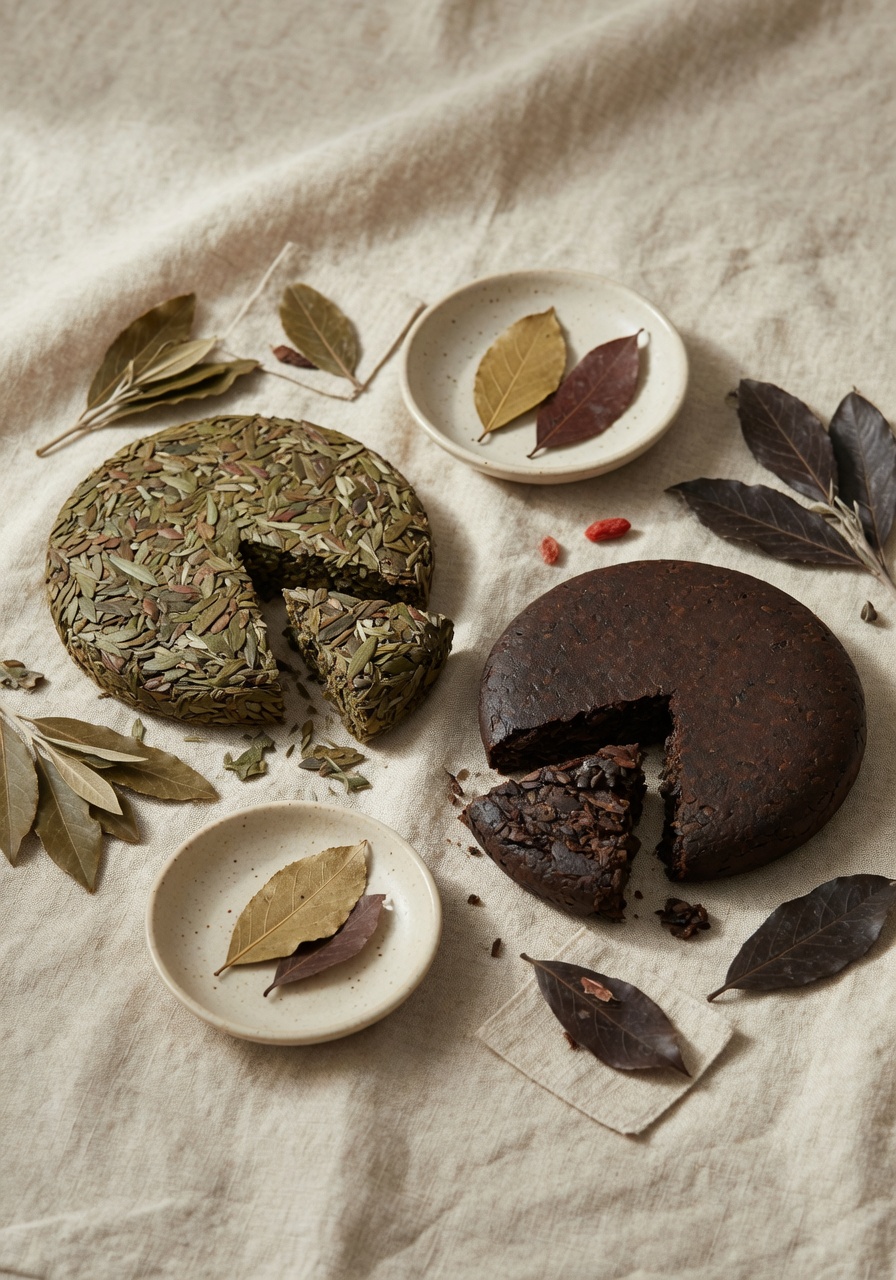
Sheng vs shu — what actually changes
Two teas share a name, a region, and a leaf — and almost nothing else. The 1973 invention of *wò duī* (渥堆) split pu'er into raw and ripe, and the chemistry of that split still defines every cake pressed today.
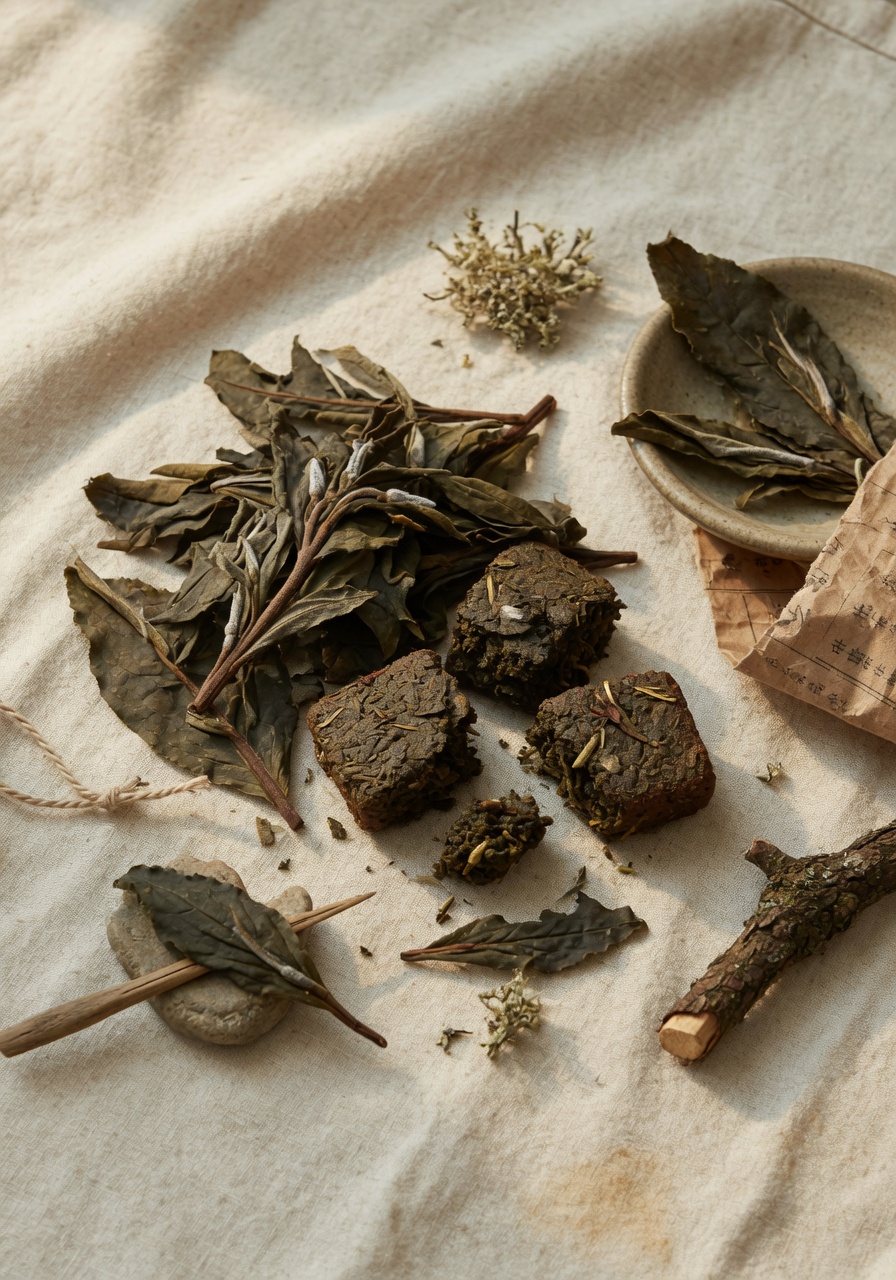
Gushu / 'old tree' tea — what's real, what's marketing
The term *gǔshù* (古树) sells more cake than any other two characters in Yunnan. Most of what's labelled gushu is not. Here's how to read the claim — botanically, contractually, and in the cup.
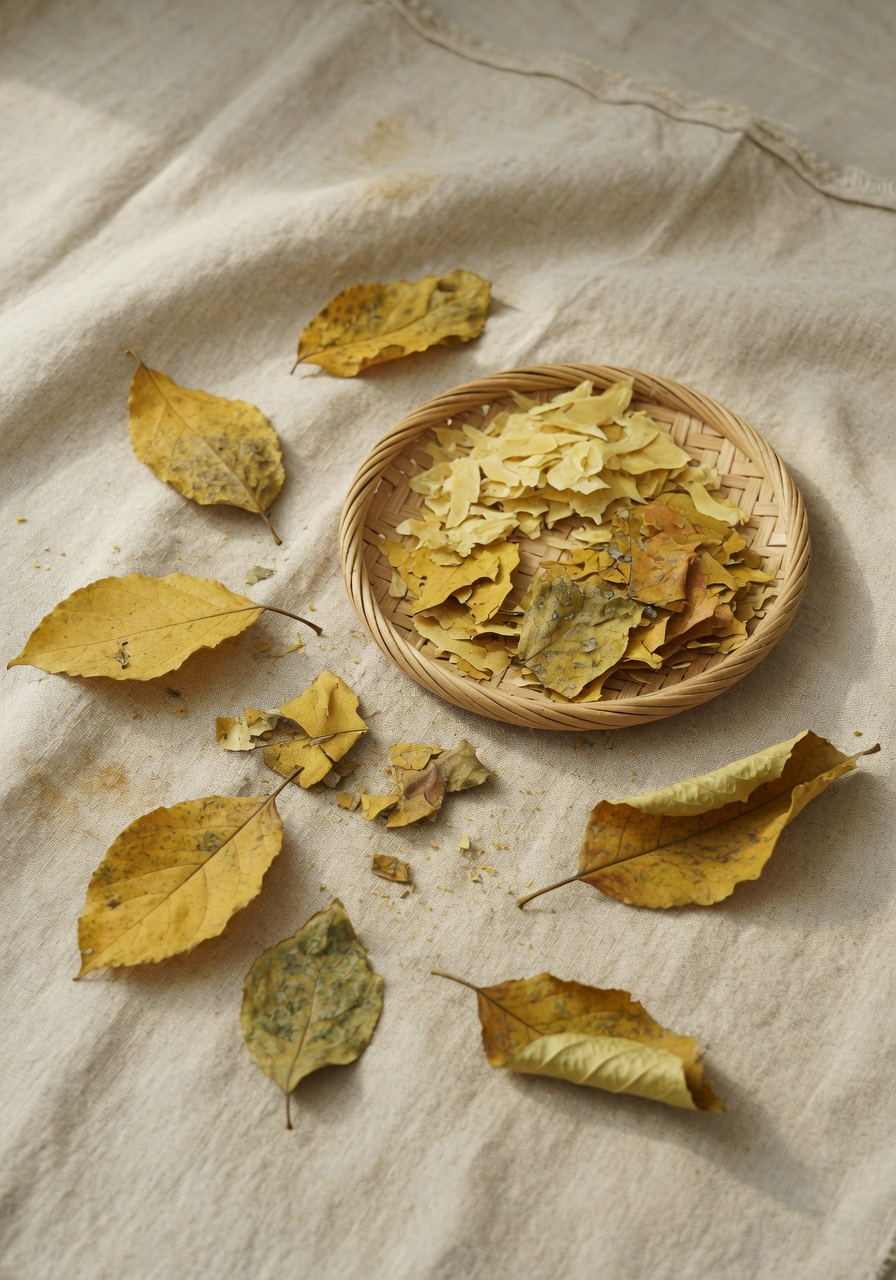
Huangpian — the yellow leaves nobody wanted
The oversized, pale leaves sorted out of premium sheng cakes were once treated as waste. A generation of drinkers has quietly turned that waste into one of the most honest cups in the pu'er catalogue.
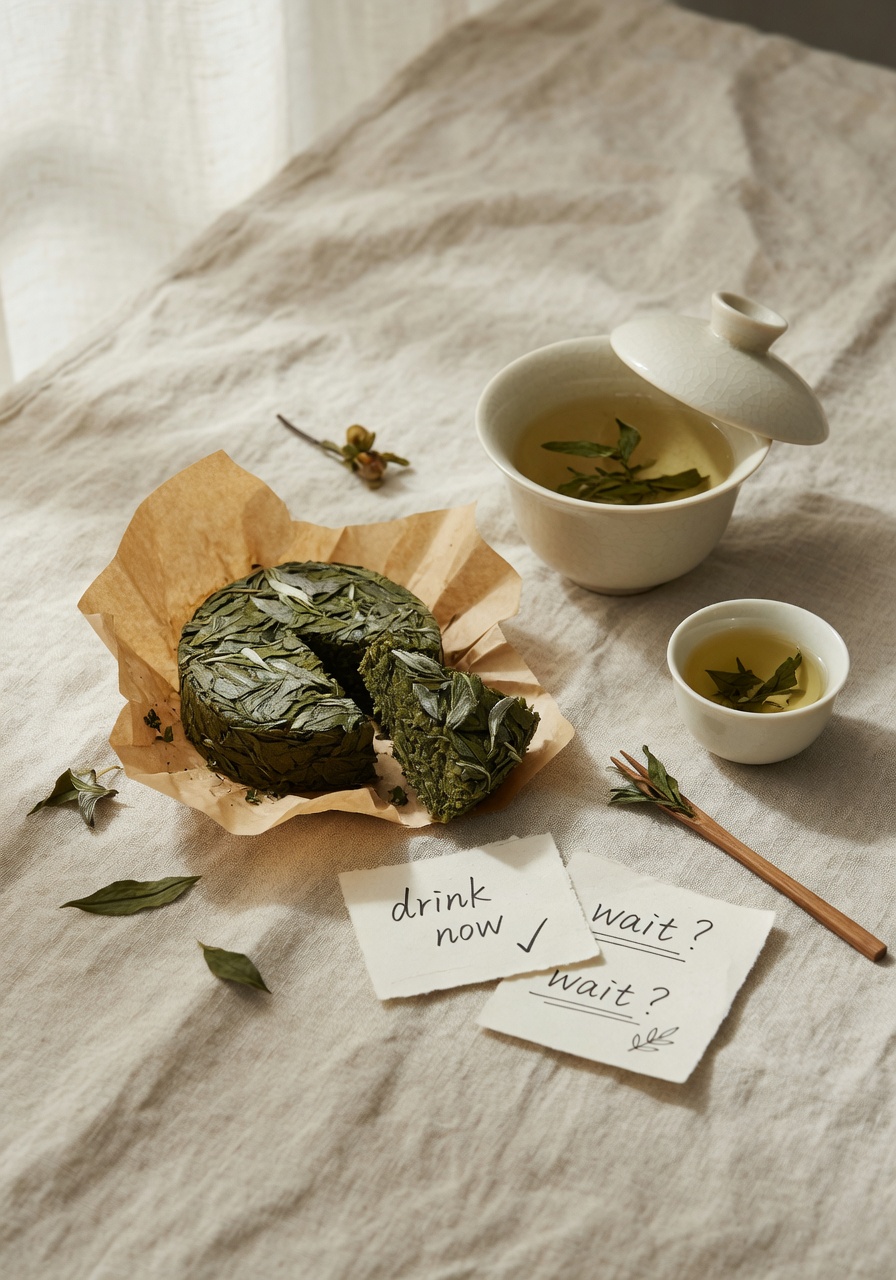
Young sheng — drink now or wait?
The question every collector asks within their first year. Some cakes are radiant at eighteen months; others need a decade before they stop biting. Here is how to tell which is which.