home · The <em>raw</em> leaf, and the long wait it asks for
Sheng pu'er · processing
Sheng vs shu — what actually changes
Shēng yǔ Shú · 生与熟
Two teas share a name, a region, and a leaf — and almost nothing else. The 1973 invention of *wò duī* (渥堆) split pu'er into raw and ripe, and the chemistry of that split still defines every cake pressed today.
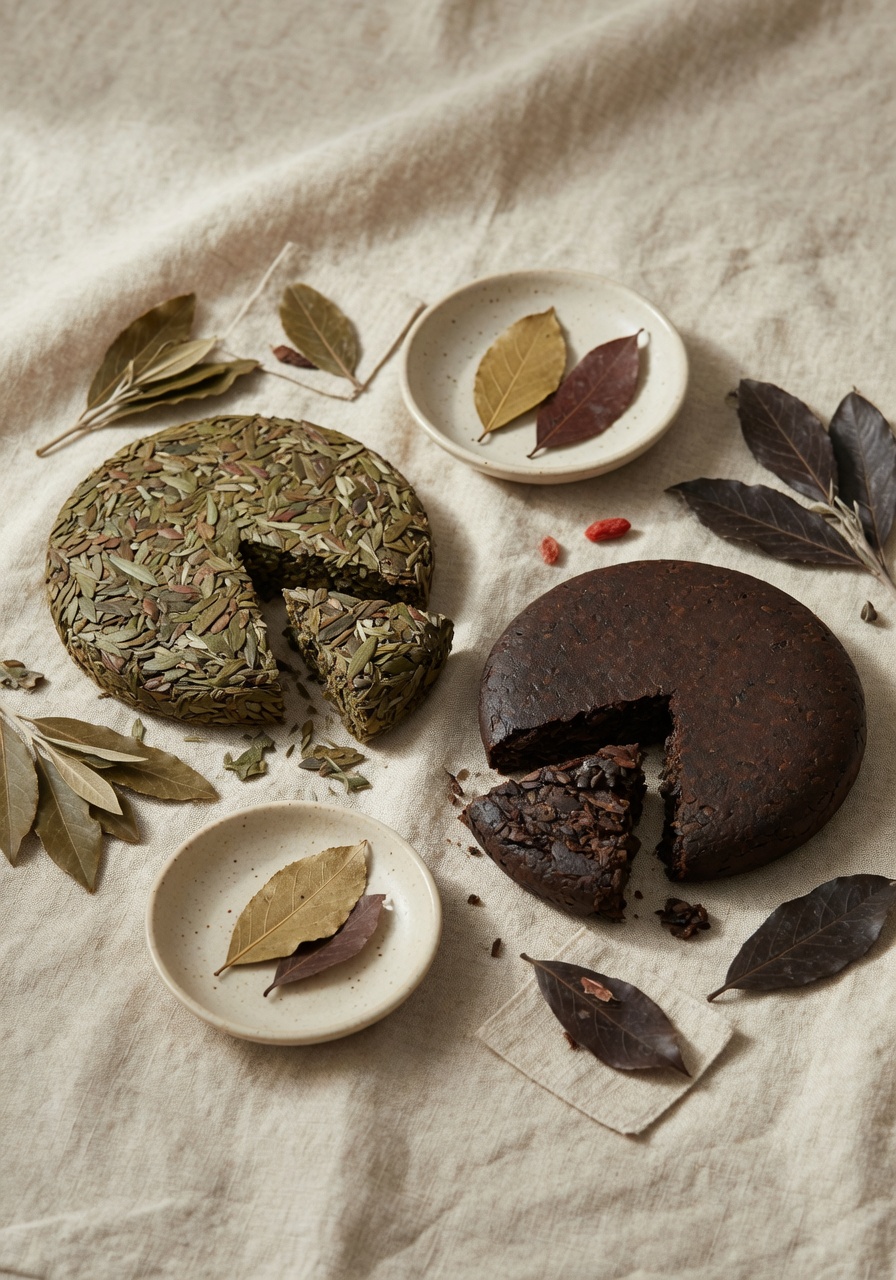
Ask a Yunnan farmer in 1972 what shú pǔ’ěr (熟普洱) tasted like and he would have stared at you. The word did not exist as a category. Pu’er meant what we now call shēng (生) — sun-dried máo chá compressed into cakes, bricks or tuó, shipped along the chá mǎ gǔ dào (茶马古道) toward Tibet and Mongolia, and slowly oxidising in saddlebags, in warehouses, in temple storerooms for years before anyone drank it. The mellow, dark, earthy pu’er that Hong Kong drinkers had grown to love by the 1950s was the product of decades of accidental, humid storage — not a deliberate style of manufacture.
In 1973 a team at the Kunming Tea Factory, working in parallel with Menghai and Xiaguan, formalised a controlled pile fermentation — wò duī — that compressed forty years of warehouse change into roughly forty-five days. The result was given a new name to distinguish it from the raw material: shú, ripe. From that moment pu’er became two teas. They look related on the shelf — both are dark, both are pressed, both come from large-leaf Camellia sinensis var. assamica grown in Yunnan — but the chemistry, the microbiology, the brewing behaviour and the aging trajectory are almost completely different. This article walks through what actually changes when you take the same máo chá and send half of it to a pile and the other half to a cake press.
The same leaf, two destinies
Both sheng and shu begin life identically. Fresh leaves — usually one bud and two to four leaves from large-leaf assamica cultivars — are picked between March and October, withered briefly, then fired in a wok or rotating drum at around 220–280 °C for six to ten minutes. This shā qīng (杀青) step deactivates the polyphenol oxidase enzyme and is deliberately gentler than the kill-green for green tea. A small residual enzyme load survives, and a measurable fraction of moisture is retained — this is what allows the leaf to keep changing for decades. After rolling, the leaves are sun-dried (晒青, shài qīng) on bamboo mats to roughly 9–12 % moisture. The finished product is máo chá, and at this point the two roads diverge.
Sheng máo chá is sorted, sometimes blended across mountains, steamed for fifteen seconds, and pressed — into a 357 g bǐng (饼), a 250 g brick, or a 100 g tuó. The cake goes into paper, into a tǒng of seven, and onto a shelf. Shu máo chá takes a long detour first: it is heaped into piles of 300 kg to 10 tonnes, wetted to about 28–32 % moisture, covered with cloth, and left to ferment for forty to sixty days while microbial activity raises the internal pile temperature to 55–65 °C. Only after that pile is finished, dried, and rested does it get pressed. The leaf that walks into the factory is the same. The leaf that comes out is, chemically, a different tea.
What wò duī actually does
Pile fermentation is not, despite the loose translation, an oxidation. It is a solid-state microbial fermentation driven primarily by Aspergillus niger, Aspergillus luchuensis, Blastobotrys adeninivorans and assorted Penicillium species, with a secondary cast of yeasts and thermophilic bacteria. A 2013 study by Lv et al. in Food Research International tracked the microbial succession through a Menghai pile and found A. niger dominant from day 12 onward, peaking around day 28 when pile temperatures reach their second crest. These fungi do three things that matter for the cup. They cleave catechins — particularly EGCG, which drops by 60–85 % during a complete pile — into simpler phenolics and theabrownins. They produce extracellular enzymes that hydrolyse cellulose and pectin, softening the leaf structure. And they synthesise a class of high-molecular-weight pigments, the theabrownins, which give finished shu its mahogany-to-black liquor and its characteristic sliding mouthfeel.
The master in charge of a pile turns it every seven to ten days, monitoring temperature with a long thermometer probe and humidity by feel. Push the pile too hot and the leaf carbonises into something sour and ashy; let it run cold and you get a half-fermented product with green astringency and rough edges. Zou Bingliang, the Menghai factory technician credited with stabilising the 7572 recipe in 1975, described the operation in a 2008 interview with Pu’er Magazine as ‘eighty percent water management, twenty percent everything else’. The whole wò duī room runs on a few centimetres of moisture and a few degrees of heat.
Why sheng cannot be rushed the same way
A sheng cake undergoes a parallel but radically slower transformation in storage. Without the deliberate water-and-heat treatment of wò duī, the dominant chemistry is slow non-enzymatic oxidation plus a low-grade microbial population that lives off the cake’s residual moisture (typically 8–11 %). Theabrownins still form, catechins still degrade, but on a timescale of years rather than weeks. A 2017 paper by Wang Qiuping et al. in Journal of Agricultural and Food Chemistry measured catechin levels in sheng cakes from 1998, 2005 and 2012, all stored in Guangzhou, and found EGCG had fallen by roughly 30 % at twelve years and 55 % at nineteen years — still well short of where a finished shu sits on day sixty. The two teas are not on the same road; they are on parallel roads with very different speed limits.
Catechins, theabrownins and the curve of bitterness
If you taste a fresh sheng máo chá alongside a freshly piled shu of the same harvest, the most obvious difference is bitterness. Young sheng can carry 18–24 % catechins by dry weight, of which 8–12 % is EGCG alone — numbers comparable to a strong Longjing. That bitterness is structurally bound up with astringency (the shōu liǎn gǎn, 收敛感), the puckering grip on the gums. Shu, by the time it leaves the pile, sits at 3–6 % total catechins, sometimes lower. The bitterness is gone, replaced by a sweetness that is partly genuine — soluble sugars rise as polysaccharides are hydrolysed — and partly perceptual, since the absence of catechin grip lets background sweetness register more clearly.
Theabrownins, meanwhile, move in the opposite direction. A young sheng might contain 2–4 % theabrownins by dry weight; a finished shu typically holds 8–14 %. These are the polymers responsible for the dark liquor, the slick body, and a meaningful share of the cardiovascular research interest in pu’er — Kunming Medical University’s 2020 review identified theabrownin fractions as the most likely active component in pu’er’s lipid-lowering effect. Caffeine, in contrast to almost everything else, stays remarkably stable: both teas hold 3.5–4.5 % caffeine across decades. The buzz of sheng versus the calm of shu is not, as drinkers sometimes assume, a caffeine difference. It is a catechin-to-theabrownin ratio difference, which alters how the caffeine is delivered to the gut and how quickly it absorbs.
How they brew, and why
Walk into a Kunming teahouse and watch how the staff handle the two teas. The shu cake gets a quick rinse, a second rinse, and then a first infusion of fifteen to twenty seconds in near-boiling water. The leaf can take it; the pile has already broken down most of what was going to break down, and aggressive brewing simply extracts the soluble pigments and sugars without releasing anything harsh. A well-made 7572 from 2008, brewed in a 120 ml gàiwǎn at 6 g, will give twelve to fifteen infusions of steady, dark, slightly camphor-and-date liquor before the leaf surrenders.
Sheng is brewed with more attention. The same gaiwan and dose, but the water is often dropped to 92–96 °C for young material to manage astringency, and infusion times are kept short — five to eight seconds for the first three rounds, lengthening only as the leaf opens. A 2010 Yiwu sheng will throw a bright golden liquor with stonefruit, honey and a long huí gān (回甘, the sweet returning aftertaste); push it too hot or too long and the same leaf becomes mouth-coating and bitter. Shu forgives. Sheng does not. For deeper brewing-parameter tables, the team at tea.school maintains a comparative chart that goes well beyond what fits here.
Vessel choices
Tradition assigns shu to thicker-walled Jiànshuǐ (建水) zitao or unglazed Yixing zǐní (紫泥), where the porous clay softens any residual pile aroma and holds heat for the long infusions. Sheng is more often brewed in porcelain gaiwan or in thinner Yixing zhūní (朱泥), which preserves the high aromatics — orchid, camphor, wildflower — that would be muted by heavier clay. None of this is law. It is the accumulated practical preference of several generations of brewers who tasted the same tea in different pots and made notes.
Aging — two completely different propositions
This is where the categories diverge most decisively. Sheng is made to age. A well-pressed sheng cake at three years old is, for most palates, an awkward adolescent — past the fresh green vigour, not yet into the developed sweetness. The same cake at fifteen years, stored in Guangdong or Hong Kong humidity, has typically lost most of its astringency, gained camphor and wood notes, deepened in liquor colour, and entered what collectors call the zhōng qī (中期, middle period). At thirty to forty years it is a different tea again, with the dried fruit, medicinal and chén xiāng (陈香, aged aroma) qualities that the 1950s Hong Kong warehouses produced by accident and that command five-figure prices today.
Shu’s aging trajectory is much flatter. The transformative work has already been done in the pile; what remains is the settling of residual pile aroma (duī wèi, 堆味) — a wet-earth, sometimes fishy note that fades over the first two to four years — and a slow further polymerisation of theabrownins. A 1996 Menghai 7572 tastes noticeably smoother than a 2020 one of the same recipe, but the gap between a five-year and a twenty-year shu is far smaller than between a five-year and a twenty-year sheng. Drinkers who collect shu generally do so to clear pile aroma, not to chase decades of development. The aging companion piece, shu aging — yes or no, walks through this in more detail.
Three quick ways to tell them apart
Outside a labelled commercial setting, distinguishing the two is usually trivial. Look at the dry leaf: sheng ranges from dark green through grey-green to copper-brown depending on age, with visible bud silver in higher grades; shu is uniformly dark chocolate to near-black, with much less colour variation. Pour the first infusion and look at the liquor: a young sheng gives pale gold to amber, a fifteen-year sheng gives chestnut to dark amber, a shu of any age gives mahogany to opaque black-red. Smell the wet leaf in the gaiwan after the first pour: sheng presents grassy, floral, fruity or — with age — camphor and wood notes; shu presents wet earth, dates, sometimes mushroom or barnyard in younger material, sweetened wood in older.
The one place this gets hard is with sheng that has been aged forty years or more in tropical storage. The leaf darkens, the liquor deepens, the catechins drop, and the cup begins to share territory with mid-aged shu. This convergence is, in a sense, the historical proof of why wò duī was invented in the first place — and why several of the older Hong Kong warehouses built their reputations on accidentally producing what the Kunming team would later try to replicate on purpose.
References
- Microbial community succession and metabolic profile of pu-erh tea during pile fermentation — Lv H. et al., Food Research International, 2013
- GB/T 22111-2008 — Geographical indication product: pu'er tea — Standardization Administration of China, 2008
- Chemistry of pu'er tea — a monograph — Zhou Hong, Yunnan Science and Technology Press, 2019
- Theabrownin from pu'er tea attenuates hypercholesterolemia via modulation of gut microbiota — Huang F. et al., Kunming Medical University review, Nature Communications, 2019
- Catechin and theabrownin dynamics in aged sheng pu'er — a longitudinal study — Wang Q. et al., Journal of Agricultural and Food Chemistry, 2017
Read next
Related articles
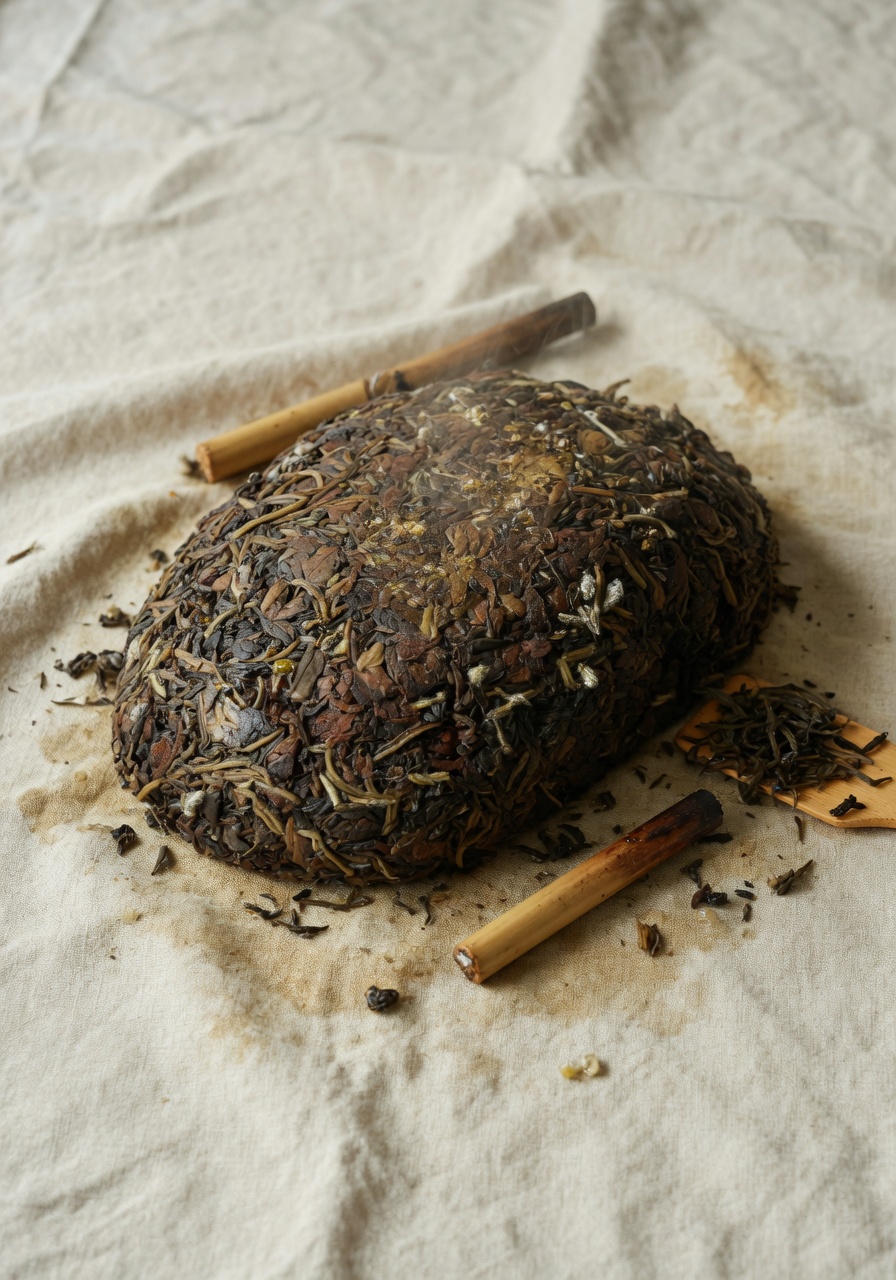
Wo dui — the pile fermentation that defined shu
In 1973, a team at Kunming Tea Factory wet-piled maocha under wool blankets and waited. Forty-five days later, the leaves were black, sweet, and unmistakably new. This is the story of how a chemical accident became a category.
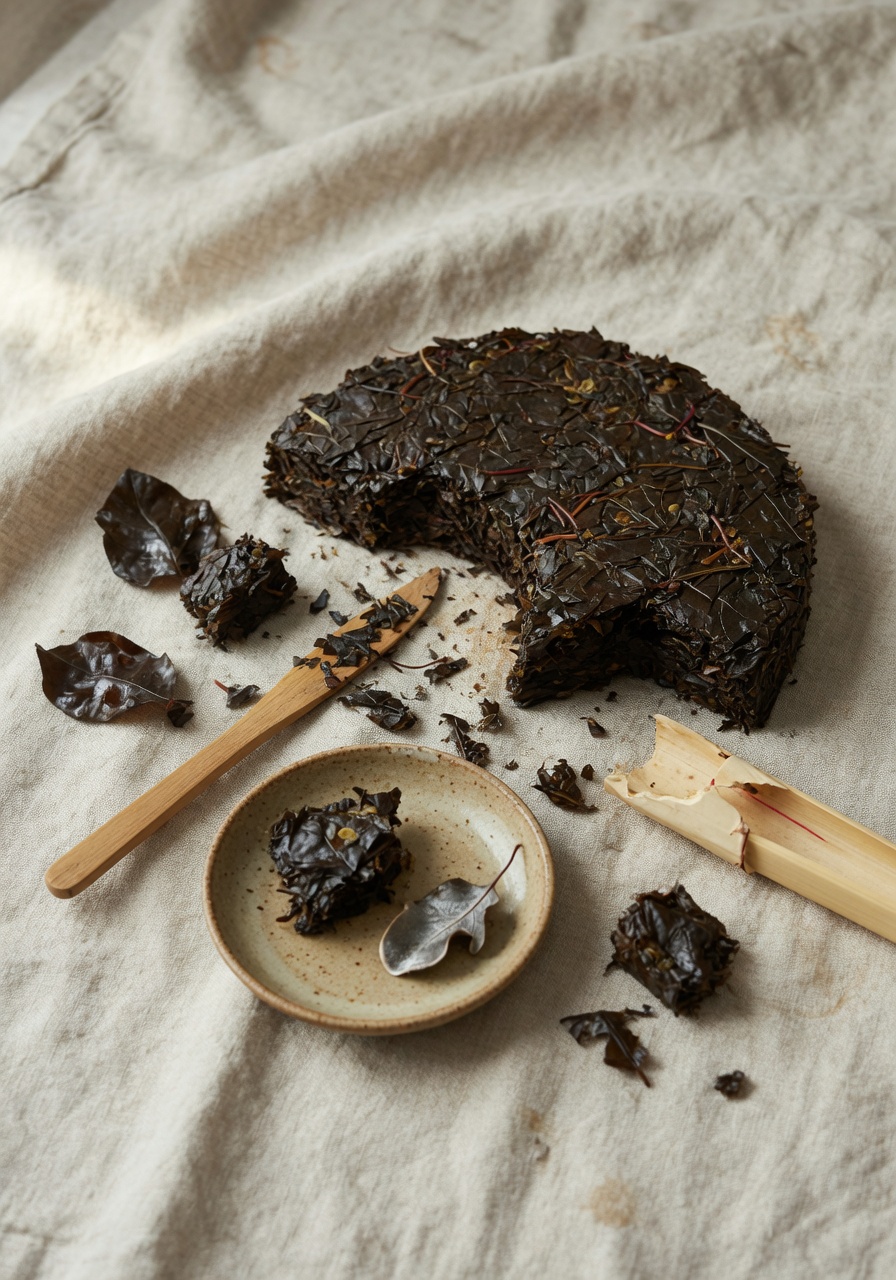
Menghai 7572 — the recipe that anchors the category
A four-digit code stamped on a paper wrapper has done more to define what shu tastes like than any single mountain or master. This is how 7572 became the reference point.
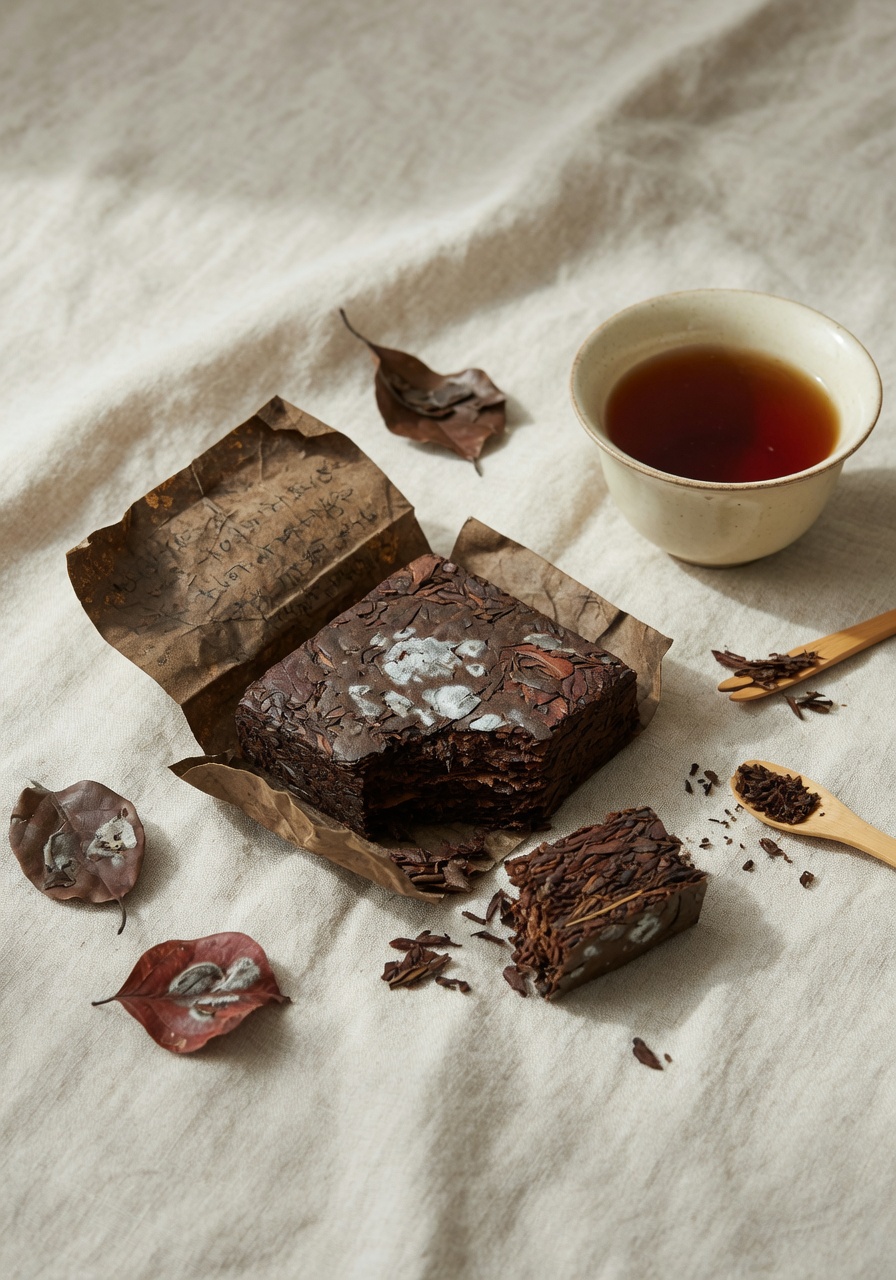
Does shu age? A measured answer
Shu was engineered in 1973 to taste like aged sheng without the wait. So does it still benefit from time in the jar — or is the work already done? A technical look at what actually changes after the pile.
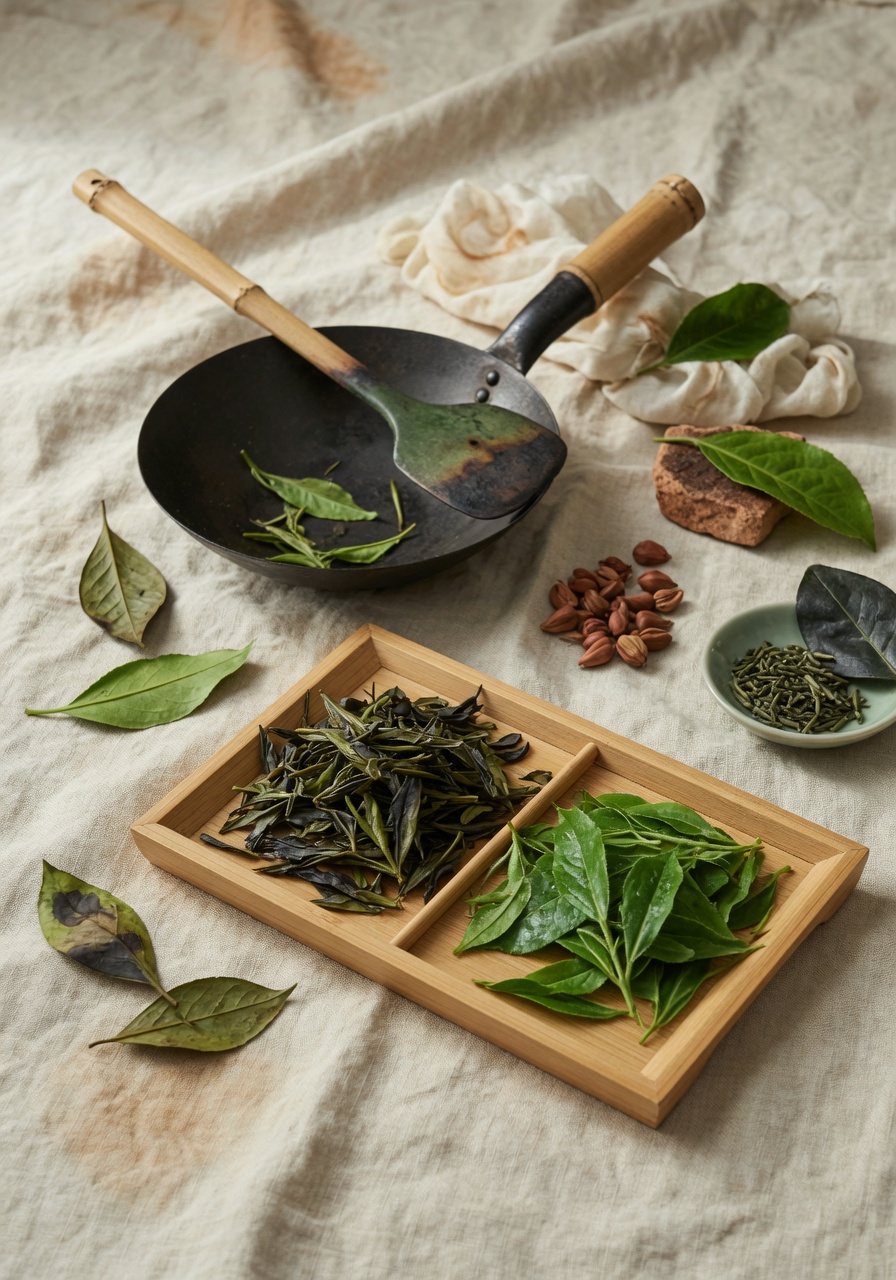
Sha qing — kill-green for pu'er vs green tea
The pan-firing step that defines pu'er is not the same as the one that defines Longjing. Same name, same wok — different temperature, different intent, different future.