home · The <em>cooked</em> half of the pu'er story
Shu pu'er — aging
Does shu age? A measured answer
Shú Pǔ'ěr · 熟普洱
Shu was engineered in 1973 to taste like aged sheng without the wait. So does it still benefit from time in the jar — or is the work already done? A technical look at what actually changes after the pile.
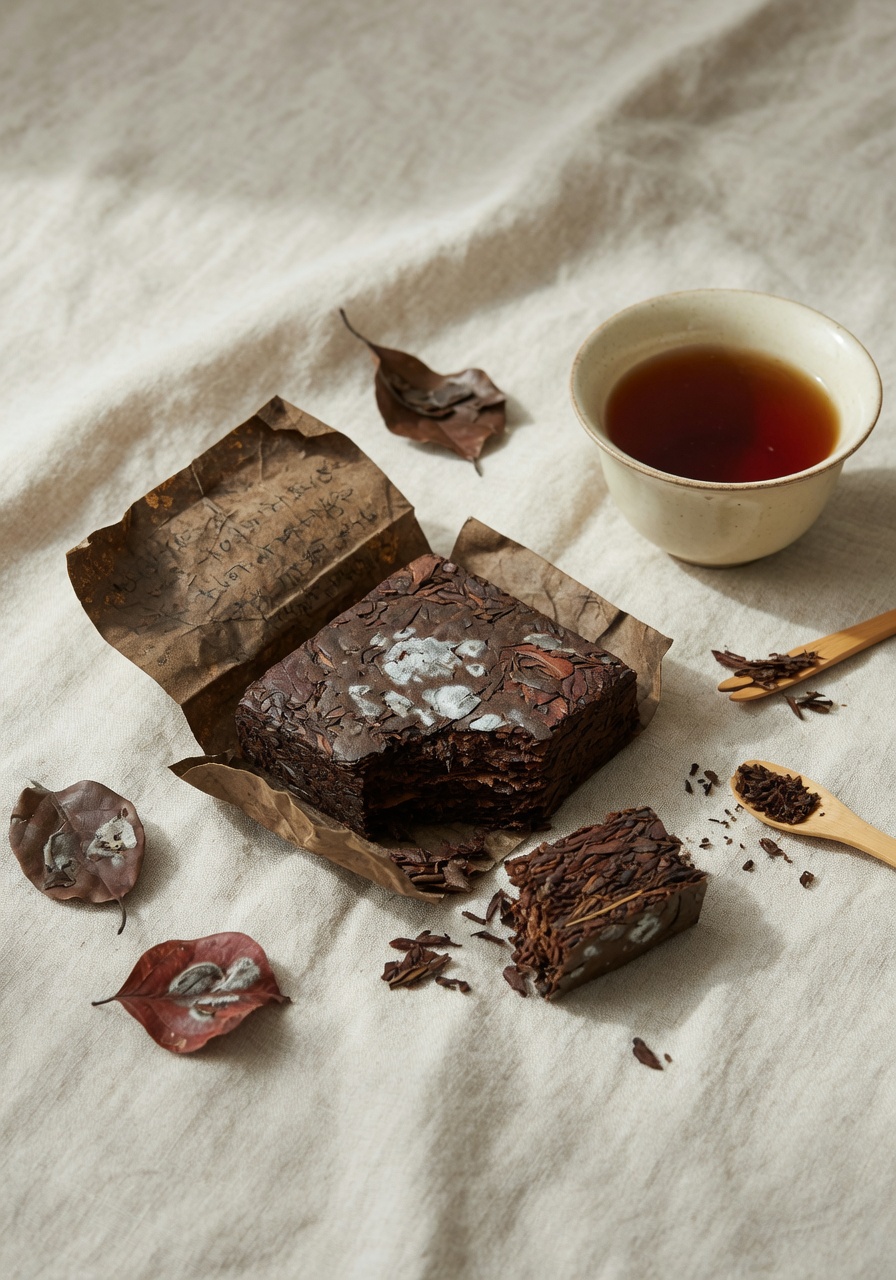
The question sounds simple and the answers online are not. One camp insists shu is finished at the factory gate — that wò duī (渥堆) compresses two decades of slow oxidation into 45 days, leaving nothing to gain from further storage. The other camp swears by 15-year-old Menghai bricks and points to specific cakes — 2003 7572, 2005 Dayi V93 — that taste demonstrably better than the same recipe pressed last spring. Both camps are partly right, which is why the question keeps coming back. From the warehouse I work with in Ulan-Ude, where roughly 400 kg of shu sits at a steady 11 — 14 °C and humidity that swings between 45 and 70 % across the year, the answer I keep arriving at is this: shu ages, but it does not age the way sheng ages. The chemistry is different, the time-scale is different, and the sensory targets are different. If you store shu hoping it will turn into 30-year-old Hào Jí (号级) sheng, you will be disappointed. If you store it expecting the off-notes of pile fermentation to fade and the body to settle into something cleaner and more transparent, you will be rewarded — provided the tea was made well to begin with. This article tries to be specific about which compounds change, on what timeline, and which cakes are worth the shelf space.
What wò duī actually does — and what it leaves behind
Pile fermentation as developed at Kunming Tea Factory in 1973 — Wú Qǐyīng and Zōu Bǐngliáng’s team, working from earlier Guangdong experiments — uses moisture (28 — 40 %), heat (internal pile temperatures of 55 — 65 °C), and microbial succession to drive maocha through 45 — 70 days of accelerated transformation. The dominant organisms are Aspergillus niger, Aspergillus luchuensis (formerly A. acidus), various Penicillium species, and a smaller population of yeasts. They break down catechins, polymerize phenolics into theabrownins, and produce the dark liquor and earthy aroma profile codified in GB/T 22111-2008. What the pile does not do is finish the tea. It leaves behind three things that continue to evolve in storage: residual moisture (typically 9 — 12 % at the moment of pressing), residual microbial activity at low levels, and a population of volatile compounds — geosmin, 2-methylisoborneol, various pyrazines — that read as ‘pile funk’ and that most drinkers want to see diminish. The pile is a sprint. Aging is the long walk back to baseline. Anyone telling you the work is done at the factory has not opened a fresh 2024 shu next to a clean 2010 shu of the same recipe — the difference in the first thirty seconds of the rinse is not subtle.
The first three years — losing the pile
The most dramatic change in shu happens between months 6 and 36 after pressing, and almost all of it is loss rather than gain. The geosmin and 2-MIB that produce that wet-basement, library-stack note are volatile; in dry storage they off-gas steadily, and in moderately humid storage (60 — 70 % RH) they are also metabolized by the residual Aspergillus still present in the leaf at low colony counts. In a blind vertical of Dayi 7572 from 2019 to 2023, tasted at the Guangzhou tea expo in late 2023, the 2019 showed clean dates and damp wood, the 2021 wet wood and faint mineral, and the 2023 was still pondy, the pile sitting on top of the leaf. That is the trajectory in three sentences. Drinkers who insist shu does not age have usually only tasted shu within this window — they are tasting the off-notes leaving, not the tea arriving. Three years is roughly the threshold at which a well-made shu stops tasting like a freshly fermented shu and starts tasting like itself.
Why factories rest cakes before release
Menghai Tea Factory, Xiaguan, and Haiwan all rest pressed shu for a minimum of 60 — 90 days before commercial release, and premium recipes are often held back six months or longer. The practice predates modern QC and has a simple logic: the cake is unpleasant to drink immediately after pressing, when steam moisture has redistributed through the leaf and the pile volatiles have re-concentrated. A 90-day rest in a controlled warehouse lets the cake equalize and lets the most aggressive funk dissipate. This is the first, smallest increment of aging, and it is built into the supply chain — you have never actually drunk a shu that was zero days old.
Years three to ten — the body fills in
Between roughly year three and year ten, shu enters a phase that sheng drinkers will find familiar in shape if not in chemistry. The pile notes are largely gone. What remains is the substrate the fermentation produced — theabrownins, theaflavins in trace, residual catechins (mostly gallated, mostly already polymerized), and the soluble polysaccharides that give shu its characteristic thickness. In this window, slow non-enzymatic browning continues. Theabrownins keep polymerizing into larger molecules, which shifts mouthfeel toward something rounder and less drying. Soluble sugars increase modestly via hydrolysis of the polysaccharide fraction. The liquor darkens from cola-red toward something closer to dark soy. Aroma moves from ‘date and wet wood’ toward ‘date, camphor, old bookshop, sometimes a faint medicinal note.’ This is the window in which a well-stored 2008 — 2012 Menghai or Xiaguan shu starts to feel like a serious tea rather than a daily drinker. Whether the change between year five and year ten is dramatic depends heavily on storage. Hong Kong traditional storage (28 — 32 °C, 80 — 85 % RH) compresses this curve and produces the classic Cantonese ‘aged shu’ profile within five years. Kunming dry storage at 20 °C and 50 — 60 % RH stretches it out so that the same transformation takes twelve to fifteen. Neither is wrong; they produce different teas.
Beyond ten years — diminishing returns, real or apparent
Past the ten-year mark, change continues but slows sharply. I have a 2003 Menghai 7572 brick in the Ulan-Ude warehouse that I open every March; the year-over-year delta is now barely perceptible — measurable on paper, perhaps, but on the palate the tea has settled into a steady state. Compare this to a 2003 sheng of equivalent storage, which is still visibly transforming. The reason is that sheng’s aging chemistry is dominated by slow oxidation of catechins that the pile fermentation has already largely consumed. Shu enters its second decade with a much smaller pool of reactive substrate. There is still polysaccharide hydrolysis. There is still slow polymerization of theabrownins. But the dramatic ‘before and after’ that sheng can deliver across twenty years is not on the table. What you get instead is a tea that has lost every trace of pile, that pours like cooking liquor, that brews twelve to fifteen infusions in a gàiwǎn (盖碗), and that tastes of old wood, date, and something hard to name — call it depth. Worth the wait? Yes, for the right cakes. Worth holding hoping for transformation? No. Hold for refinement, not for revolution.
Which shu rewards long storage
Not all shu ages equally. In my experience, three factors predict whether a cake will improve meaningfully past year ten: leaf grade (larger, more mature leaves carry more polysaccharide and age more gracefully — see the related note on huangpian), fermentation depth (lightly fermented shu, the so-called ‘seven-tenths ripe’ style, keeps more substrate for slow change), and pressing density (tight stone-pressed cakes evolve more slowly and more cleanly than loose iron-pressed ones). Recipes built on coarser blends — 7572, 7581, V93 — have a documented track record across 20+ years. Highly fermented, fine-grade shu polishes off within five years and then plateaus.
When shu goes wrong in storage
Shu is more forgiving than sheng but not immune. Above 80 % RH for sustained periods, mold colonies that were dormant can re-activate aggressively and tip the tea into sour, vinegar-tinged territory — a defect Cantonese traders call fān cāng (翻仓). Below 35 % RH, the tea simply stalls; nothing transforms, but nothing spoils either. The danger zone is humidity swings: a cake that cycles between 45 % and 85 % across seasons develops uneven microbial activity through the disc and can taste fine on one breaking and off on the next. Steady is better than ideal.
A practical answer
If a friend pushed me for a single sentence, it would be this: rest shu for at least three years before judging it, drink it freely between five and fifteen, and hold a small reserve past twenty if the cake’s pedigree justifies it. Buy enough of a recipe you trust — a tong (seven cakes, 2.5 kg) is the traditional unit — so that you can taste it at year three, year seven, and year twelve and know what you actually have. The economics favor this approach: well-stored shu does appreciate, but not at sheng’s rates, so the case for hoarding is weaker than the case for drinking. For deeper reading on storage conditions and the regional traditions behind them, tea.school has a long-form module on warehouse design, and the producer profiles on puerh.app document which factories have historically pressed shu worth the shelf-space. The honest, technical answer is that shu ages — measurably, predictably, but on its own curve. Anyone who tells you otherwise has either not tasted enough verticals or is selling you something.
References
- GB/T 22111-2008 Geographical Indication Product — Pu'er Tea — Standardization Administration of China
- Microbial diversity and dynamic succession in Pu-erh tea fermentation — Food Chemistry, 2019 — Zhang L. et al.
- Wú Qǐyīng, Pǔ'ěr Chá (普洱茶), Yunnan People's Publishing House, 2004 — Wú Qǐyīng — Kunming Tea Factory historical record
Read next
Related articles
Wo dui — the pile fermentation that defined shu
In 1973, a team at Kunming Tea Factory wet-piled maocha under wool blankets and waited. Forty-five days later, the leaves were black, sweet, and unmistakably new. This is the story of how a chemical accident became a category.
Menghai 7572 — the recipe that anchors the category
A four-digit code stamped on a paper wrapper has done more to define what shu tastes like than any single mountain or master. This is how 7572 became the reference point.
Sheng vs shu — what actually changes
Two teas share a name, a region, and a leaf — and almost nothing else. The 1973 invention of *wò duī* (渥堆) split pu'er into raw and ripe, and the chemistry of that split still defines every cake pressed today.
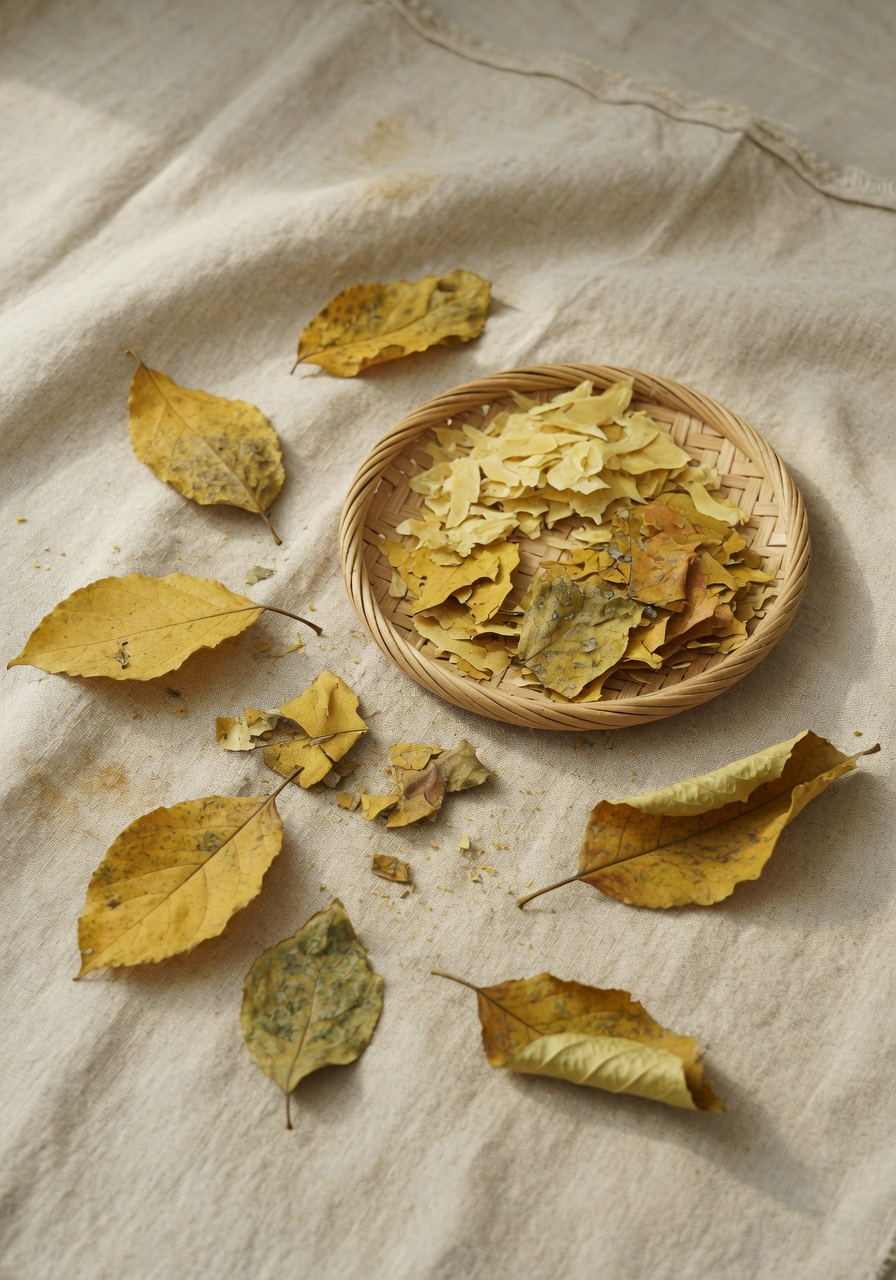
Huangpian — the yellow leaves nobody wanted
The oversized, pale leaves sorted out of premium sheng cakes were once treated as waste. A generation of drinkers has quietly turned that waste into one of the most honest cups in the pu'er catalogue.