home · The <em>raw</em> leaf, and the long wait it asks for
Sheng pu'er
Young sheng — drink now or wait?
Shēng Pǔ'ěr · 生普洱
The question every collector asks within their first year. Some cakes are radiant at eighteen months; others need a decade before they stop biting. Here is how to tell which is which.
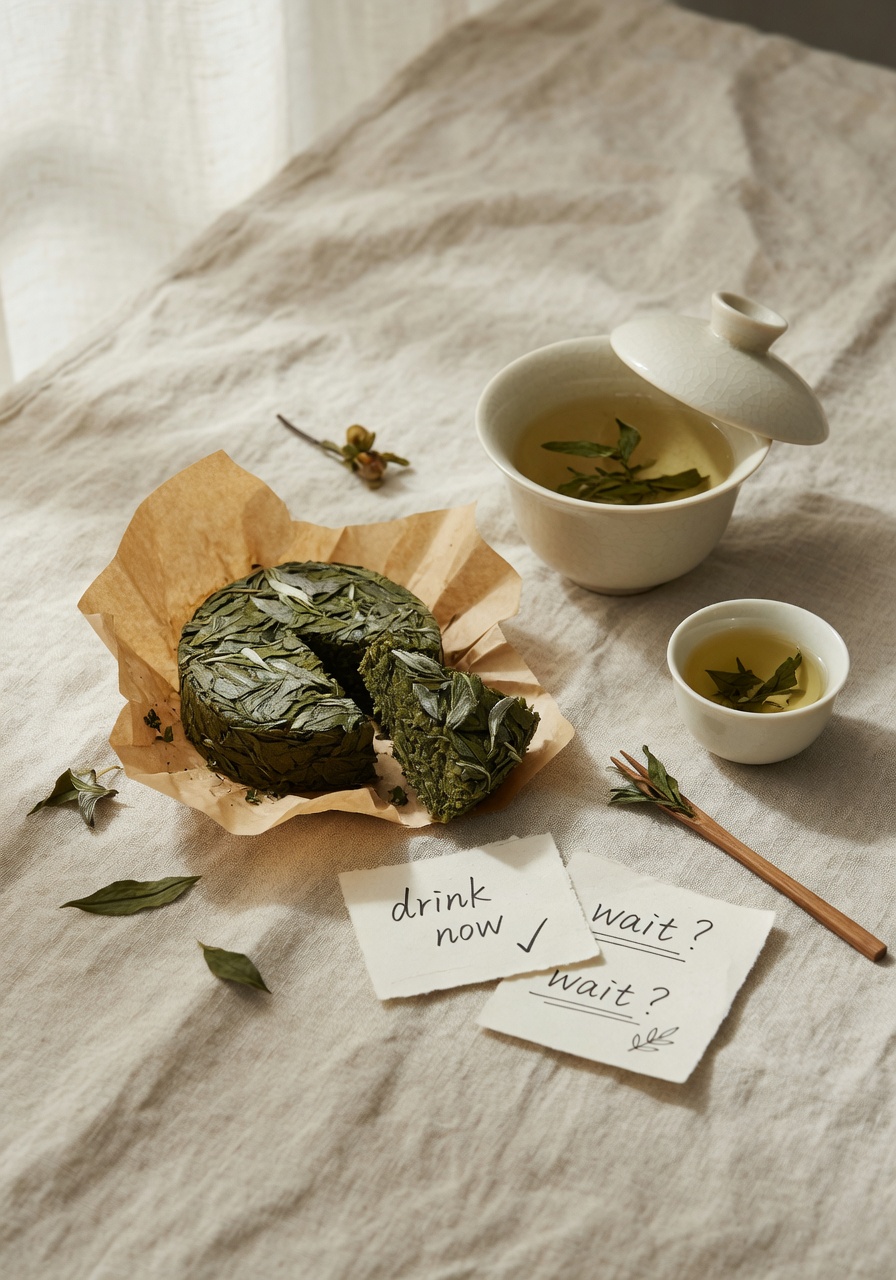
There is a particular pressure that builds inside a tea cupboard. You bought a bǐng (饼) — maybe a 2023 Yiwu autumn pressing, maybe a Bulang spring from a small Menghai workshop — and now it sits in its wrapper, asking to be opened. Conventional wisdom says wait. Five years minimum, ten if you have the patience, twenty for the patient saints. But the cake in front of you right now smells of stone fruit and warm hay, and you can hear it through the paper.
The five-year question is the wrong question, or at least an incomplete one. It assumes that all young shēng (生) follows a single arc — bitter and astringent at year one, hostile through year five, slowly approaching drinkability around year ten. That arc exists, but it describes maybe half of what gets pressed in Yunnan each spring. The other half includes teas designed to be drunk young, teas that will never improve no matter how long they sit, and teas whose first three years are arguably their most interesting window before a long quiet phase.
What follows is a working framework, built from a decade of opening cakes too early and a few opened too late. It draws on storage records from buyers in Kunming, Guangzhou and Ulaanbaatar — three climates that produce three different teas from the same starting material — and on conversations with producers who think hard about when their tea is meant to be drunk. The goal is not to give you a number. The goal is to help you read the cake in front of you.
What ‘young’ actually means
In trade conversation, ‘young shēng’ usually means anything from the current spring pressing back to roughly the five-year mark. After five years the tea starts to be called zhōng qī (中期) — middle-period — and after fifteen or twenty, lǎo chá (老茶), old tea. These categories are loose. A 2018 cake stored in dry Kunming may taste younger than a 2021 cake stored in humid Guangzhou. The calendar is a starting point, not a verdict.
What changes during these first years is mostly polyphenol chemistry. The dominant catechins in fresh máo chá (毛茶) — EGCG, EGC, ECG — slowly oxidise and polymerise into theaflavins, thearubigins and longer-chain compounds. Caffeine remains relatively stable. The sharp, mouth-coating astringency of year one softens because the catechins responsible for it are literally fewer. This is the same chemistry that GB/T 22111-2008, the geographical-indication standard for pu’er, gestures at when it distinguishes raw from ripe processing without prescribing aging time.
A tasting note from year one therefore tells you about catechin load and processing choices. A tasting note from year five tells you about how the storage environment has been negotiating with those catechins. A tasting note from year fifteen tells you about something else again — a slow Maillard-adjacent transformation that produces the camphor, old-wood and chén xiāng (陈香) notes that collectors chase.
Teas built to drink young
Not every spring pressing is a long-term project. Some are made — deliberately or not — to peak inside their first three years. Recognising these saves you both money and shelf space.
The clearest signal is processing. A shā qīng (杀青) done at slightly higher temperature, or for slightly longer, suppresses the enzymes that drive long-term aging. The resulting tea is greener, more fragrant, sweeter early — and largely finished evolving by year four. This is closer to green-tea processing than to traditional shēng, and producers sometimes call it lǜ chá huà (绿茶化), ‘green-tea-ification.’ For more on the kill-green decision, see our note on sha qing.
Autumn pressings (gǔ huā 谷花) also tend to be friendlier young. Lower polyphenol load, more floral aromatics, less of the bitterness that needs time to resolve. A 2023 autumn Nannuo can be a genuinely pleasant cup at eighteen months, even if it will never become a great fifteen-year tea.
Reading the dry leaf
Open the wrapper and look. A cake destined to age well usually shows uneven leaf — long stems, occasional yellow leaves (see huangpian), a mix of bud and mature material. The colour should be a deep olive-grey, not bright green. If the cake is uniformly emerald and tippy, you may be holding something that was processed closer to green-tea conventions. Smell it dry: aging cakes smell of hay, dried fruit, faint smoke. Drink-young cakes smell of fresh grass and orchid.
Reading the wet leaf
Brew a session and look at the spent leaves on the lid. Aging-grade material recovers a flexible, leathery hand — you can fold a leaf in half and it bends rather than tearing. The colour should be a uniform yellow-green to olive, with intact edges. Brittle, fragmented, very pale leaves indicate either high kill-green temperature or over-aggressive rolling, both of which limit aging potential.
The awkward middle years
There is a window — roughly years three through seven for most cakes in moderate storage — where shēng is genuinely difficult. The freshness has gone. The aged depth has not yet arrived. The catechins have partially oxidised but the products of that oxidation are still rough-edged. Cups taste muddled: neither floral nor woody, with a flat metallic note and an astringency that has lost its brightness without gaining sweetness.
This is the phase that gives ‘wait at least ten years’ its mythological weight. Buyers who open a cake at year five, find it dull, and conclude their tea is ruined are usually just visiting a normal way-station. The chemistry has to pass through this region to get to the other side.
There are two practical responses. The first is patience: reseal the cake, mark the date, and don’t revisit for three or four years. The second is to deliberately buy with this window in mind. A 2017 Bulang in dry storage, opened in 2024, will likely be in this difficult phase — and priced accordingly. The same cake opened in 2030 may be transformed. Vendors on shop.thetea.app and elsewhere occasionally call this ‘transition stock,’ and it can be a smart purchase if you have the storage and the patience.
Storage decides almost everything
A cake’s aging trajectory is set perhaps 40% by raw material and processing, and 60% by where it lives for the next decade. This is not an exaggeration. The same 2008 Menghai qī zǐ bǐng (七子饼), split between a Guangzhou warehouse and a Kunming apartment, will produce two recognisably different teas by 2024 — one darker, sweeter, more medicinal; the other brighter, more aromatic, still showing fruit.
Humid storage (Guangdong, Hong Kong, coastal)
Relative humidity sits in the 70–85% range for much of the year, with summer peaks higher. Temperatures average around 22–26°C. Aging is fast. A cake can taste like a fifteen-year tea by year eight. The risk is mould — particularly the wrong kinds of mould — and a flattening of the high aromatic register. Good humid storage requires active management: airflow, monitoring, occasional rotation. A dedicated room is better than a closet. For a fuller treatment, see the storage guide on tea.school.
Dry storage (Kunming, northern China, Mongolia)
Relative humidity often below 55%, temperatures cooler. Aging is slow — perhaps half the rate of Guangdong storage by my own brewing notes from cakes I have followed between Kunming and Ulaanbaatar since 2016. The tea retains aromatic complexity longer, but bitterness can hang on for years past where humid-stored cakes have resolved it. Dry-stored shēng at twenty years can still feel surprisingly young. Some collectors prefer this; others find it perpetually unfinished.
Hybrid and managed storage
Increasingly, serious collectors run two-stage programs: a few years in humid conditions to accelerate the first transformation, then a move to dry storage to preserve aromatics. This is a relatively new practice and the results are still being evaluated. My own experiments — 2015 Yiwu cakes moved from Guangzhou to Ulaanbaatar in 2020 — suggest the approach works but demands judgment about timing.
A working decision framework
When you bring home a young shēng and want to decide whether to drink it or shelve it, run through four questions in order.
First, what is the material? A famous-mountain gǔ shù (古树) cake from Yiwu, Bulang or Bingdao — see our gushu debate — is almost always worth aging, even if it drinks well young. The structural depth that justifies the price only fully emerges with time. A plantation-tea blend from an unmarked workshop is a different proposition: the ceiling is lower, and drinking it within three years often makes more sense than waiting.
Second, what was the processing? If the cake smells fresh-green and tastes overtly sweet at year one, it may not have the catechin reserve to age well. If it smells of hay and tastes bitter-into-sweet (huí gān 回甘) at year one, the reserve is there.
Third, what storage can you actually provide? Promising yourself you will age a cake for fifteen years in a centrally-heated apartment at 30% relative humidity is a recipe for a slow-aged, perpetually-young tea. Match your ambition to your conditions.
Fourth, and most often forgotten: do you actually like young shēng? Some drinkers genuinely prefer the bright, vegetal, slightly bitter character of a two-year-old cake to the deep, settled character of a twenty-year-old one. There is no rule that says you must defer pleasure. Drink what you enjoy now, age what you believe in, and resist the assumption that older is automatically better.
What I tell people who ask
Buy any given cake in threes if you can afford to. Drink one bing now, while the tea is still telling you what it was when it left Yunnan. Mark a second to open at year five, knowing it may be in an awkward place — that information is part of your education as a drinker. Save the third for at least fifteen years and forget about it.
This is not a perfect protocol. It costs more than buying singles, and storage space is finite. But it solves the five-year question by refusing it. You do not have to choose between drinking now and waiting. You can do both, on the same tea, and learn something each time you open the wrapper.
The collectors I respect most are the ones who keep tasting notes on a single cake across a decade. Not theories about how shēng ages in general, but specific records of one tea in one place. That kind of attention is what separates aging tea from hoarding it.
References
- GB/T 22111-2008 — Geographical indication product: Pu'er tea — Standardization Administration of China
- Chemical changes during the storage of pu-erh tea: a review — Zhang L., Ho C-T., Zhou J. — Journal of Agricultural and Food Chemistry, 2018
- Yúnnán Pǔ'ěr Chá Zhì (云南普洱茶志) — Annals of Yunnan pu'er tea — Yunnan Provincial Tea Association, revised edition 2014
- Storage trial notebooks, Kunming–Ulaanbaatar parallel cakes 2016–2024
- The True History of Tea — Mair V. & Hoh E., Thames & Hudson, 2009 — chapters on Yunnan and pu'er compression
Read next
Related articles
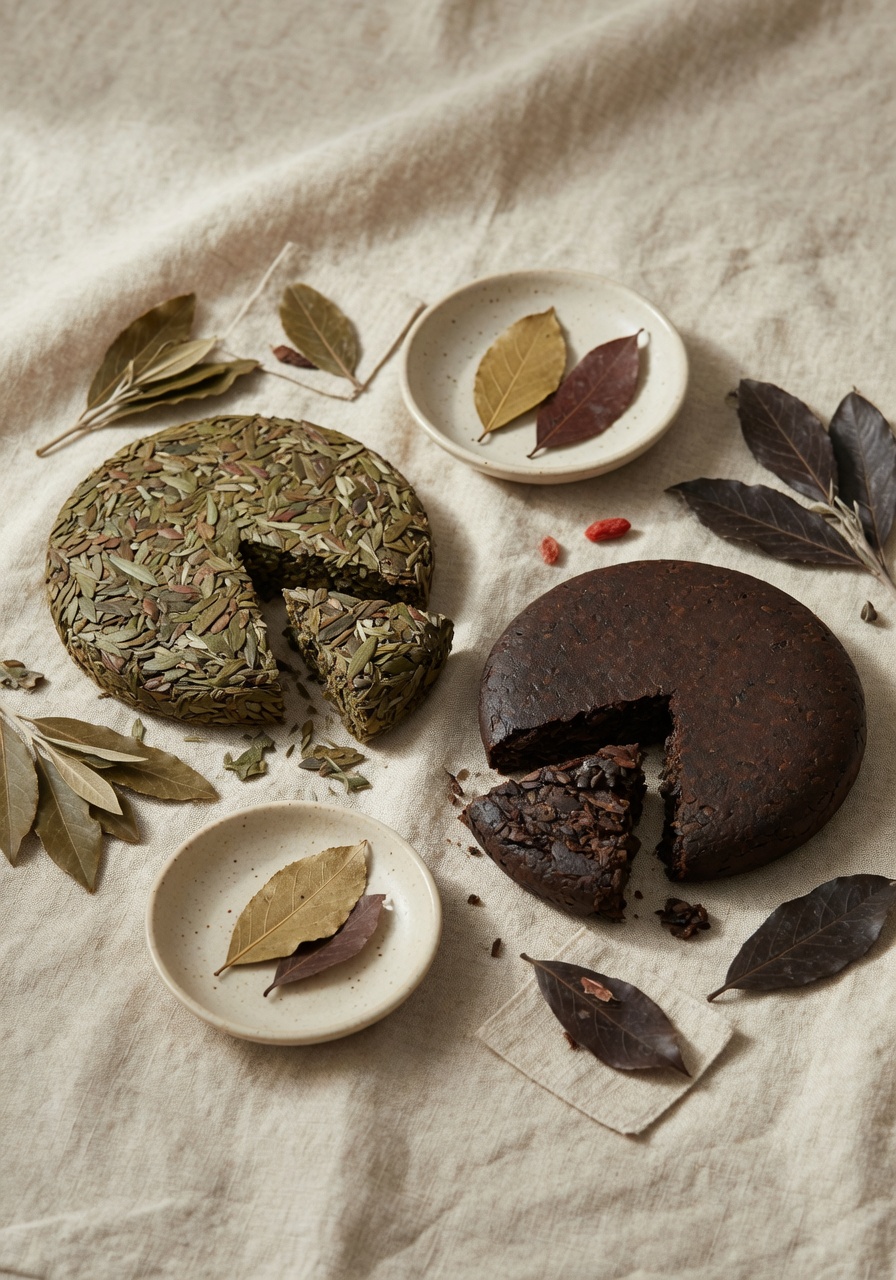
Sheng vs shu — what actually changes
Two teas share a name, a region, and a leaf — and almost nothing else. The 1973 invention of *wò duī* (渥堆) split pu'er into raw and ripe, and the chemistry of that split still defines every cake pressed today.
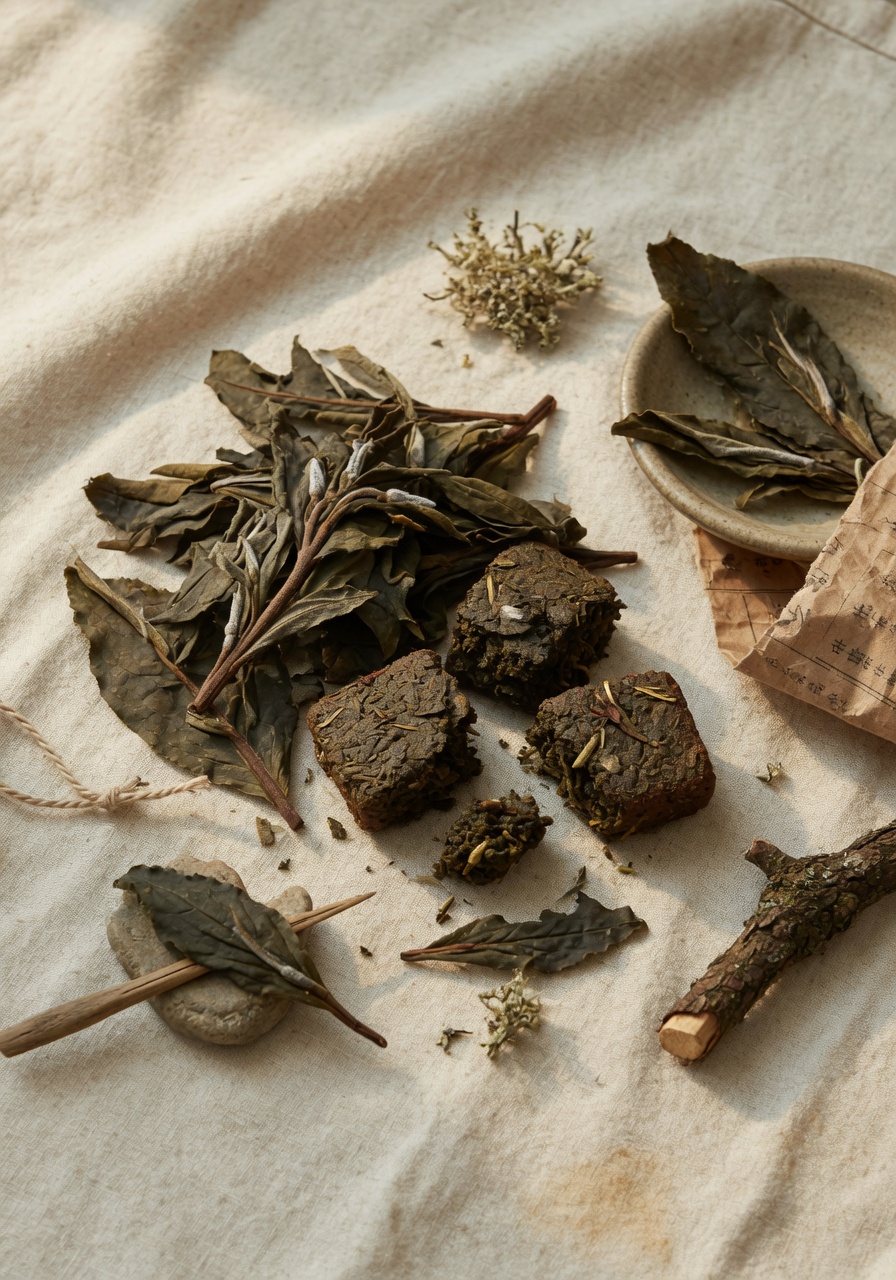
Gushu / 'old tree' tea — what's real, what's marketing
The term *gǔshù* (古树) sells more cake than any other two characters in Yunnan. Most of what's labelled gushu is not. Here's how to read the claim — botanically, contractually, and in the cup.
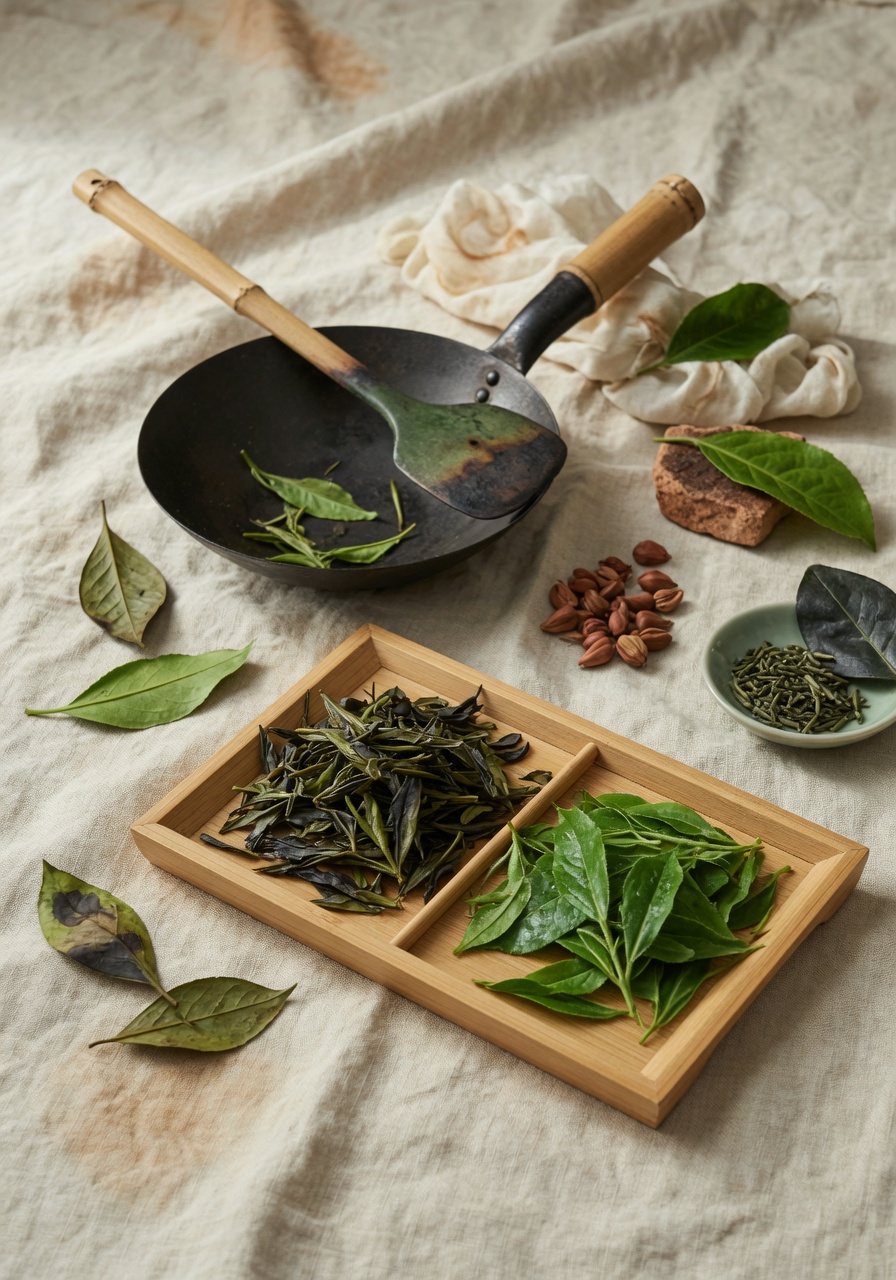
Sha qing — kill-green for pu'er vs green tea
The pan-firing step that defines pu'er is not the same as the one that defines Longjing. Same name, same wok — different temperature, different intent, different future.
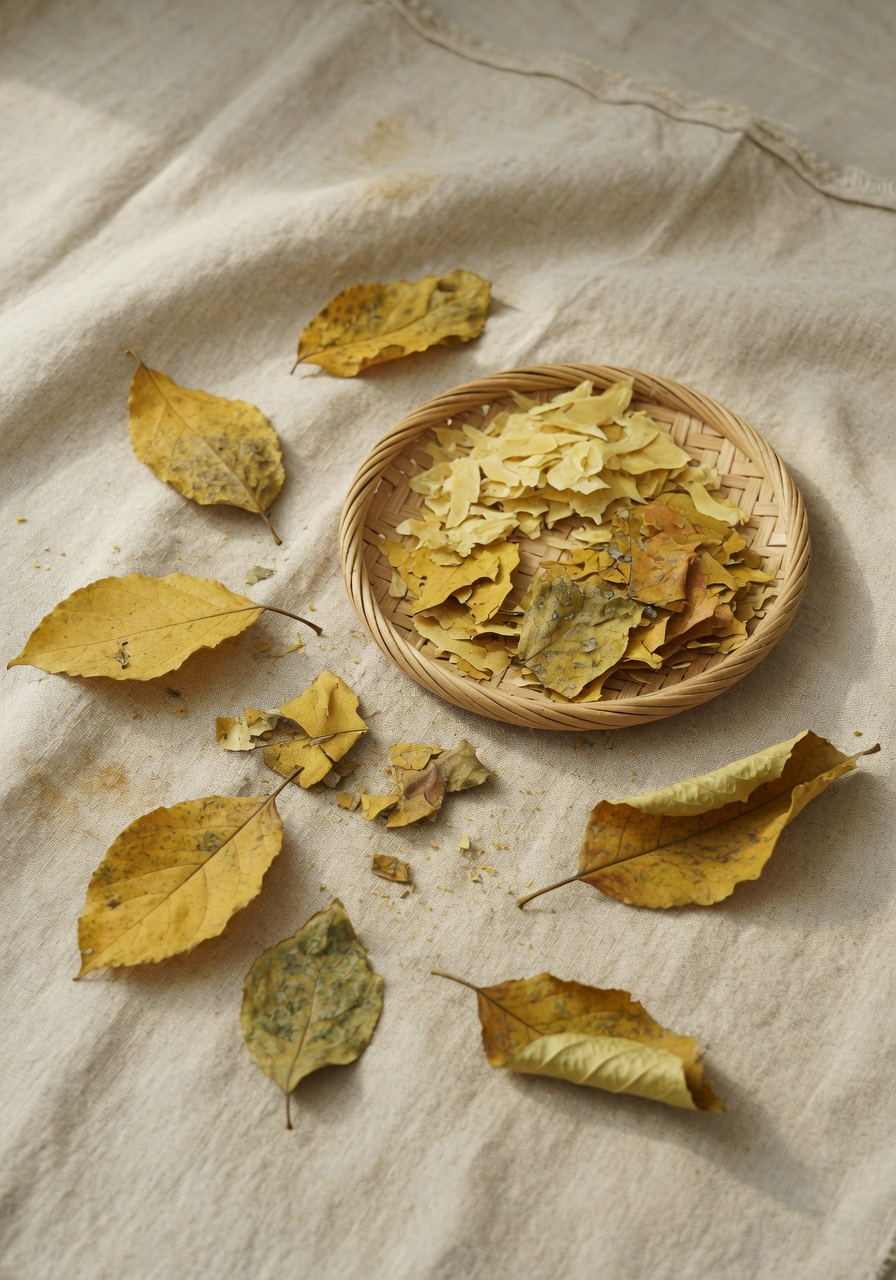
Huangpian — the yellow leaves nobody wanted
The oversized, pale leaves sorted out of premium sheng cakes were once treated as waste. A generation of drinkers has quietly turned that waste into one of the most honest cups in the pu'er catalogue.