home · Six mountains, six <em>flavours</em> — terroir in pu-erh
Yunnan regions
Bulang Shan — the bitter that becomes sweet
Bù Lǎng Shān · 布朗山
On the southern edge of Menghai county, the Bulang people have tended tea for over a thousand years. Their leaf opens the throat with bitterness — then turns sweet, slowly, and refuses to leave.
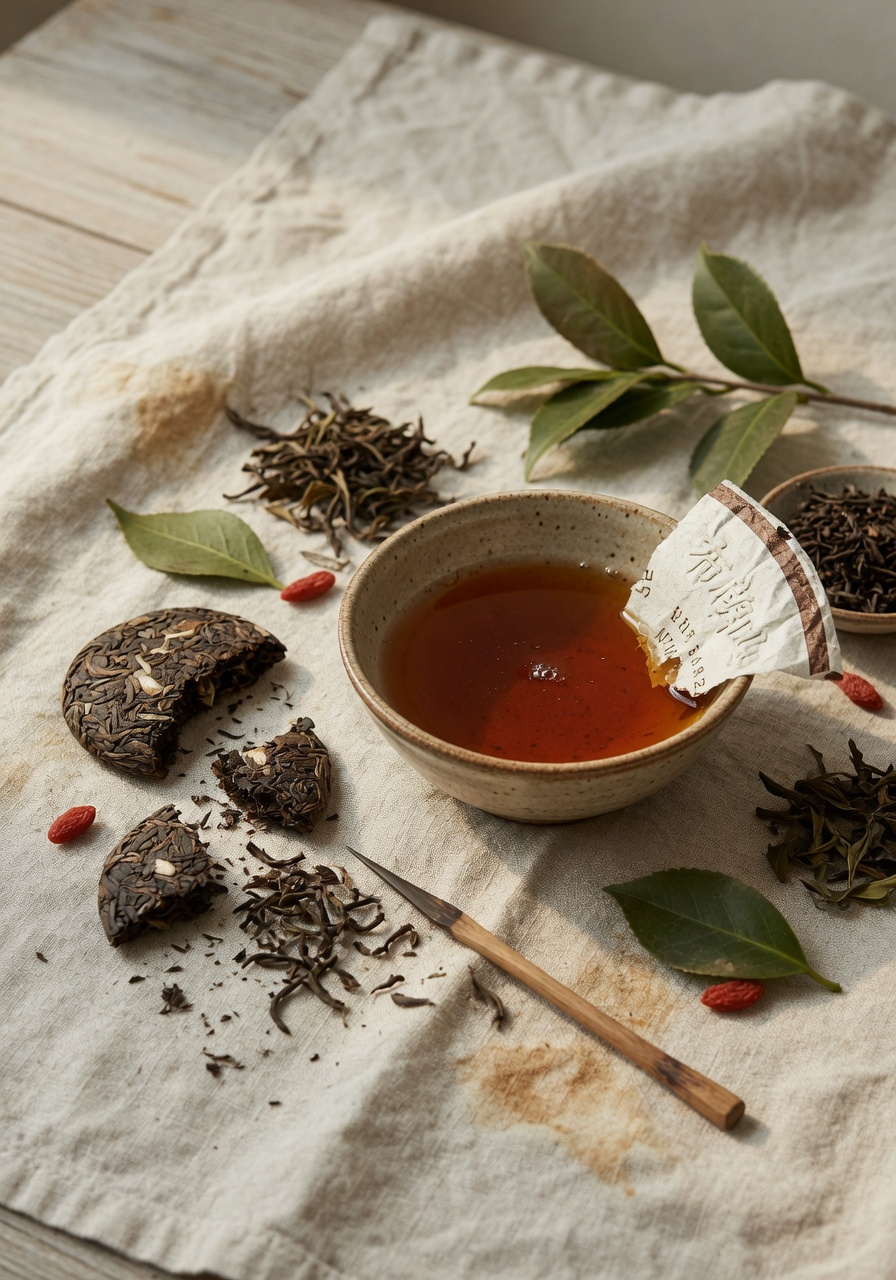
Bulang Shan sits in the south of Menghai county (勐海县), Xishuangbanna prefecture, pressed against the Burmese border at elevations between 1,400 and 2,000 metres. The administrative township covers roughly 1,000 square kilometres of forested ridge and terraced garden, and it is home to perhaps 16,000 Bulang people — an ethnic group whose oral history claims they were the first cultivators of tea in this part of Yunnan. Whether or not that claim is provable, the material evidence is hard to dismiss: ancient tea gardens around Lao Banzhang (老班章), Lao Man’e (老曼峨), Xin Banzhang and Bang Pen contain trees that local farmers and visiting researchers date variously between 200 and 800 years old. For drinkers of shēng pǔ’ěr (生普洱), Bulang has become shorthand for a specific kind of intensity — kǔ (苦) that is not a flaw but a foundation, followed by a huí gān (回甘) so prolonged it feels like a separate event. This article walks through the geography, the villages, the production calendar, and the question that every Bulang buyer eventually asks: how much of the price is leaf, and how much is the name on the wrapper?
Where Bulang sits, and why it tastes that way
Bulang Shan township borders Daluo (打洛) to the south and Bada Shan to the west, with Menghai town about 90 kilometres to the north by road. The mountain is not a single peak but a long, broken ridge of weathered granite and red lateritic soil, draining south toward the Mekong tributaries. Average annual rainfall sits around 1,300-1,500 mm, concentrated in a monsoon that runs May through October, and the dry season fog that pools in the valleys through January and February is the local explanation for the leaf’s thickness — slow growth under low light, with the tree’s photosynthate concentrated into a smaller spring flush. Soil pH measurements published in the 2018 Yunnan Agricultural University survey of Menghai tea soils ranged between 4.2 and 5.1 across the Bulang gardens sampled, comfortably inside the acidic window that camellia sinensis var. assamica prefers. The cultivar question matters too: most Bulang ancient trees are local landrace assamica with broad, leathery leaves and high polyphenol content. Tian Guoxing of the Menghai Tea Research Institute reported total polyphenols of 32-36% by dry weight in spring 2016 samples from Lao Banzhang and Lao Man’e — meaningfully higher than the 26-29% typical of Yiwu gardens at similar elevation. That single number explains a great deal. Polyphenols drive bitterness on the front of the palate; they also drive the durability of the leaf in storage. Bulang is bitter because it has the chemistry to be bitter, and it ages because it has the chemistry to age.
The villages — Lao Banzhang, Lao Man’e and the rest
Bulang Shan is not one terroir. It is a constellation of villages, each with its own micro-reputation, and the price spread between them in 2024 spring leaf ran from roughly 800 yuan per kilogram of máo chá (毛茶) at the lower end to over 12,000 yuan for verified Lao Banzhang single-tree material. Understanding which name is on a cake matters more here than almost anywhere else in Yunnan.
Lao Banzhang (老班章) — the brand that ate the mountain
Lao Banzhang is a Hani village of about 130 households sitting at roughly 1,700-1,900 metres on the northeastern slope of Bulang Shan. Its rise from regional obscurity to the most expensive village name in Yunnan happened across roughly 2005-2015, accelerated by the Dayi and Chen Sheng Hao spring purchase ceremonies that turned the village square into a televised event. The leaf is genuinely distinct — a heavy, almost resinous bitterness that breaks cleanly into sweetness within fifteen to twenty seconds, paired with a qì (气) that drinkers describe as warming and grounding. The problem is supply. Authentic Lao Banzhang spring production is widely estimated at under 50 tonnes per year of máo chá; the volume sold under the name globally is many multiples of that. Chen Sheng Hao’s 2008 partnership with the village, which now governs a substantial fraction of the legitimate harvest, is one of the few channels with credible provenance.
Lao Man’e (老曼峨) — the older village, the harder leaf
Lao Man’e is the Bulang village proper, founded by local oral tradition in 639 CE, which would make it the oldest continuously inhabited Bulang settlement on the mountain. Its tea splits into two recognised types: kǔ chá (苦茶), the bitter cultivar that drinkers either love or refuse, and tián chá (甜茶), a sweeter clone planted in the same gardens. Lao Man’e kǔ chá is the unfiltered statement of Bulang chemistry — a bitterness that can take a minute to clear, followed by a returning sweetness that some tasters find more honest than Lao Banzhang’s. Spring 2024 máo chá from old-tree Lao Man’e kǔ chá traded around 2,500-3,500 yuan per kilogram, roughly a quarter of Lao Banzhang prices for arguably comparable raw material.
The supporting cast — Bang Pen, Xin Banzhang, Man Xinlong
Beyond the two headline names, Bulang’s secondary villages offer the more honest value proposition. Bang Pen (帮盆) produces a softer, more floral profile that drinkers sometimes describe as a bridge between Bulang and Nannuo. Xin Banzhang (新班章), the Hani settlement relocated from old Lao Banzhang in the 1970s, shares cultivar stock with its famous neighbour but trades at perhaps a fifth of the price. Man Xinlong, Man’e Xinzhai and Wengweng are routinely blended into mid-tier Bulang cakes without village attribution — and at 400-900 yuan per kilogram of máo chá, they carry much of the same chemistry without the auction premium.
The processing that protects the bitterness
Bulang’s reputation rests on minimal intervention during the shā qīng (杀青) kill-green step. Local processors — and the small cooperatives that have proliferated since 2012 — generally fix the leaf in a hand-turned iron wok at 220-260 °C for 4-6 minutes, aiming for enzyme deactivation without driving off the volatile aromatics or pushing the leaf toward a green-tea profile. The leaf is then rolled by hand or in a small machine roller for 30-50 minutes, sun-dried on bamboo mats for one to two days, and stored as máo chá until pressing. The reason this matters for Bulang specifically is that overcooked sha qing destroys the very bitterness that buyers are paying for. A Bulang cake that tastes mild and floral in its first year is almost certainly either blended with non-Bulang material or pushed too hot in the wok. Genuine young Bulang sheng is a difficult drink — astringent enough to numb the tongue, with a kǔ wèi (苦味) that needs years of dry storage to integrate. See our companion piece on sha qing for pu’er vs green tea for the technical distinction. The pressing question — whether to compress as a 357 g bing, a 250 g brick, or a 100 g mini — is largely commercial. Tighter pressing slows aging; looser pressing allows oxygen and humidity in faster. For Bulang specifically, which has so much polyphenol reserve to convert, most experienced producers press firmly and accept the slower curve.
Drinking Bulang young, drinking Bulang aged
I have brewed Lao Banzhang at one year, at seven years, and at twenty-two years from the same producer’s line, and they are essentially three different teas. The one-year cake hits the back of the throat with an almost medicinal bitterness, broken by a sweetness that arrives in the mouth roughly fifteen seconds after swallowing and persists for ten or more minutes. The seven-year cake — stored in Kunming dry conditions — has lost the sharp edge of the bitterness but retains the structural intensity; the huí gān now arrives faster, and the cup carries a noticeable resinous, almost camphor note. The twenty-two-year cake, stored partly in Guangdong’s more humid climate, has converted further: the bitterness is now a memory rather than an event, the liquor is darker amber than red, and the dominant flavour is a dried-fruit sweetness with a mineral finish.
Brewing parameters that respect the leaf
For young Bulang sheng, I work with 7-8 g of leaf in a 110 ml gaiwan, water at a full 100 °C, and very short steeps — 5 seconds for the first three infusions, climbing by 3-5 seconds thereafter. Pushing the steep time on young Bulang is a punishment; the kǔ味 will overwhelm the huí gān and the cup becomes unbalanced. For aged Bulang past fifteen years, the same leaf weight tolerates longer steeps — 10-15 seconds from the start — and rewards a slightly higher leaf-to-water ratio. A pre-rinse of 5 seconds is standard for compressed cakes; some drinkers double-rinse aged material to wake the leaf. For the underlying logic see our young sheng — drink now or wait piece.
The authentication problem
More fake Lao Banzhang is sold annually than the village could possibly produce. The Menghai county government installed a checkpoint in 2018 controlling vehicle access to the village during spring harvest, partly in response to the scale of fraud, and the village’s own cooperative began issuing QR-coded provenance labels in 2019. Neither measure has solved the problem. A buyer outside China relying on retail purchase has, realistically, three credible paths to authentic material: direct relationship with a producer who maintains a documented village partnership (Chen Sheng Hao, certain Dayi premium lines, a handful of smaller specialists); auction provenance through Beijing or Hong Kong houses with clear chain-of-custody; or accepting that ‘Bulang Shan’ as a regional designation — without village specificity — is a more honest purchase than dubious single-village claims. The Russian and Mongolian markets I work with have moved noticeably toward the third option since around 2020, with serious drinkers buying clearly labelled mixed-village Bulang at 1,500-3,000 yuan per 357 g cake rather than gambling on $400 ‘Lao Banzhang’ of uncertain origin. For the broader regional context see Menghai county — birthplace of modern shu and the comparative piece on Yiwu forest gardens. Travellers planning a harvest-season visit can find logistics through tea.travel; the certification framework drinkers use to validate provenance claims is taught at tea.school.
Storage — what Bulang needs from the next twenty years
Bulang’s high polyphenol load is both why it ages well and why it demands patience. The conversion of catechins into theaflavins, thearubigins and the broader spectrum of aged-tea compounds proceeds at a rate strongly dependent on temperature and relative humidity. Kunming-style dry storage — roughly 18-22 °C and 55-65% RH — preserves the brightness of the leaf and produces a slow, clean conversion over fifteen to twenty-five years. Guangdong or Hong Kong traditional storage — 24-28 °C and 70-80% RH — accelerates the process, producing drinkable, sweet, mellow material in seven to twelve years but losing some of the structural complexity. For Bulang specifically, my preference is split storage: the first five to eight years in Kunming conditions to set the structure, then a transition to slightly more humid conditions to push conversion. The cake should be kept away from direct light, away from kitchens and other strong odours, and ideally in a closed cabinet or clay jar that buffers humidity fluctuations. Avoid plastic. The leaf needs to breathe — slowly, but it needs to breathe.
What to buy now
If you are starting a Bulang shelf in 2024 or 2025, my recommendation is not to begin with Lao Banzhang. Begin with a credible mixed-village Bulang from a producer like Yang Pin Hao, Xizi Hao or Chen Sheng Hao’s secondary lines, in the 1,000-2,500 yuan per 357 g range. Drink one cake young to understand the structure; press another two or three into long-term storage. After three or four years of working with that material, the case for stepping up to single-village or single-tree Lao Banzhang or Lao Man’e becomes either obvious or unnecessary — and either answer is the correct one. The mountain has been here for a thousand years. There is no reason to be in a hurry.
References
- GB/T 22111-2008 — Geographical indication product: Pu'er tea — Standardization Administration of China
- Survey of soil chemistry across Menghai county tea gardens (2018) — Yunnan Agricultural University, College of Tea Science
- Polyphenol profile of Bulang Shan ancient tree spring leaf, 2016 sampling — Tian Guoxing, Menghai Tea Research Institute, internal report cited in Tea Communication 2017(3)
- Pu'er Tea: Ancient Caravans and Urban Chic — Jinghong Zhang, University of Washington Press, 2014
Read next
Related articles
Gushu / 'old tree' tea — what's real, what's marketing
The term *gǔshù* (古树) sells more cake than any other two characters in Yunnan. Most of what's labelled gushu is not. Here's how to read the claim — botanically, contractually, and in the cup.
Yiwu — forest gardens of the Laos border
On the southern edge of Xishuangbanna, where the forest crosses into Laos, *Yì Wǔ* (易武) grows the softest, most aromatic *shēng* in Yunnan — a tea that built an empire, vanished for fifty years, and rebuilt itself from village memory.
Menghai county — birthplace of modern shu
A flat-bottomed valley at 1,200 m, ringed by Bulang and Nannuo mountains, where in 1973 a state factory perfected pile fermentation and changed pu-erh forever.
Young sheng — drink now or wait?
The question every collector asks within their first year. Some cakes are radiant at eighteen months; others need a decade before they stop biting. Here is how to tell which is which.