puerh.app · sampling channel Encyclopedia · School · Atlas · Pu-erh · Equipment EN · RU · · · FR · ES · AR
pǔ·ěr Browse all →

home · topic

Yunnan regions

Six mountains, six flavours — terroir in pu-erh

Yún Nán · 云南

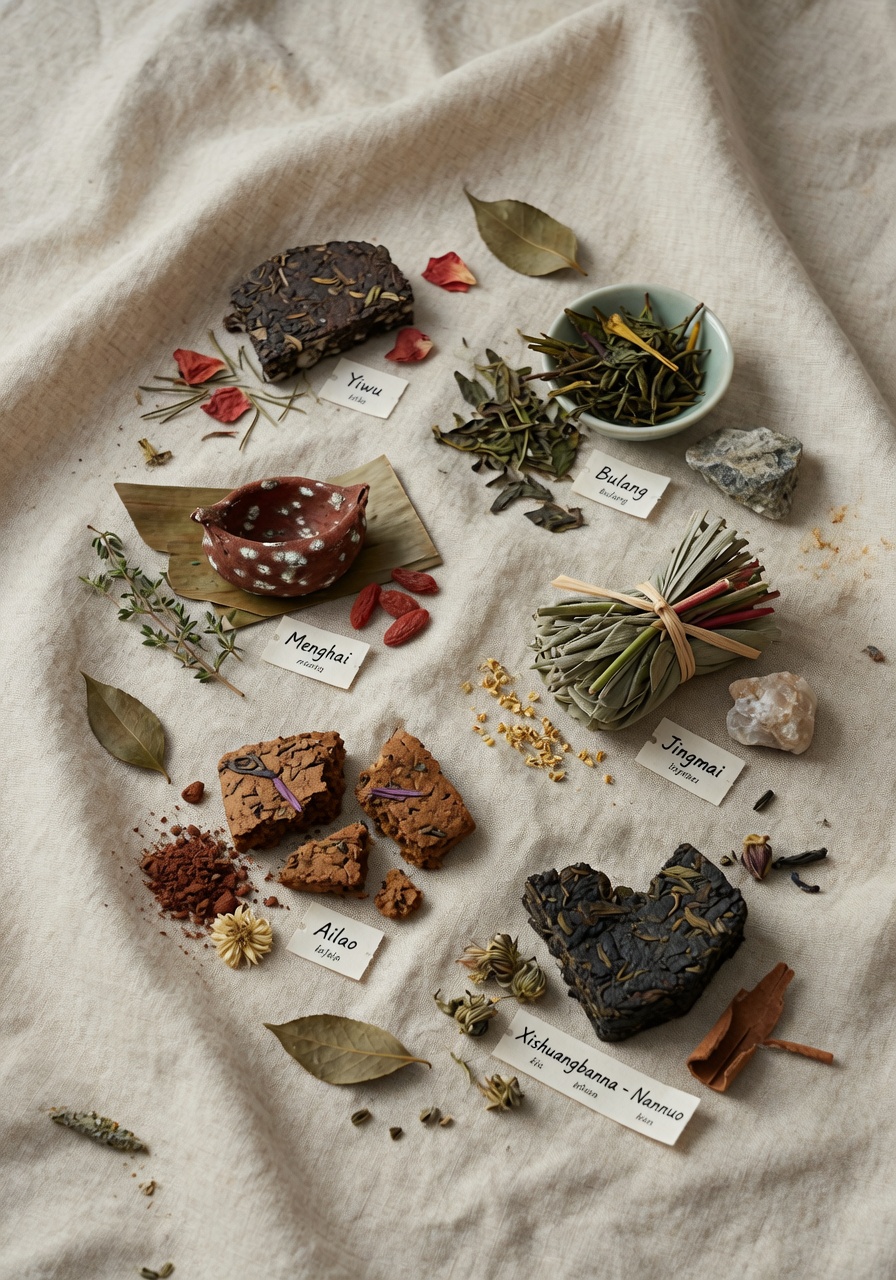
Yunnan is not one tea region but a federation of mountains, each with its own altitude, soil chemistry, varietal mix and harvest logic. A *Bulang* maocha and a *Yiwu* maocha pressed in the same week, by the same hands, will age into different teas — the leaf carries the mountain forward for forty years.

Six mountains, six <em>flavours</em> — terroir in pu-erh

Why the mountain on the wrapper matters more than the year

Pu-erh collectors learn quickly that the most useful word on a bǐng (饼) wrapper is rarely the year — it is the place. Yunnan’s tea-producing belt stretches roughly 800 km from the Burmese border in the south-west to the Vietnamese border in the south-east, crossing three prefectures (Xishuangbanna, Pu’er, Lincang) and covering elevations from 800 to 2,400 metres. Within this belt sit dozens of named tea mountains, each with its own Camellia sinensis var. assamica gene pool, its own micro-climate, and — crucially — its own flavour signature that survives compression, transport, and decades of slow oxidation.

The classical taxonomy lists the Six Famous Tea Mountains (六大茶山) of the Qing era, codified by tribute records in 1729 when the imperial court formalised pu-erh tribute from Pu’er Prefecture. Those original six all sit east of the Lancang river. Yiwu, the most aromatic of them, survives today as the benchmark for what collectors call gānxiāng (甘香) — a sweet, honeyed, low-bitterness profile that develops floral depth over fifteen to twenty years. Yiwu — forest gardens of the Laos border explores why the ancient tea trees there, many over 300 years old, produce leaf that is structurally different from plantation material: longer internodes, thicker cuticle, higher soluble sugar.

West of the Lancang, the picture inverts. Bulang Shan — the bitter that becomes sweet documents the opposite pole: high theabrownin, aggressive (苦) on the front palate, but a famously long huígān (回甘) — the returning sweetness that arrives ninety seconds after the swallow. Lao Banzhang, the most fetishised village on Bulang, sells máochá at prices that have exceeded 8,000 RMB per kilogram in recent spring harvests. Between these poles sits Nannuo Shan — the queen of Menghai’s mountains, where the Hani people have farmed tea for at least eight centuries and where the elevation range (1,400–1,900 m) produces a balanced profile that ages predictably.

Menghai county deserves its own consideration. Menghai county — birthplace of modern shu is the place where, in 1973, the Menghai Tea Factory perfected wòduī (渥堆) — the wet-pile fermentation that compressed thirty years of natural aging into sixty days. Every shú (熟) recipe in production today descends from that experiment. The factory’s 7572 recipe, first pressed in 1975, remains the reference cake for entry-level shu.

Lincang — the western mountains, often overlooked rounds out the map. Bingdao village on Mengku mountain produces leaf with a distinctive icy sweetness that has, in the last decade, rivalled Banzhang in auction prices. The region was historically dismissed because most of its leaf was sold as raw material to Menghai and Xiaguan factories rather than pressed under its own name — a fate that has now reversed.

For the collector, the practical lesson is simple: buy by mountain first, vintage second, factory third. A 2008 Yiwu gǔshù (古树) from a small workshop will outdrink a 2008 generic Menghai blend every time. The wrappers that matter are the ones that name a village. For storage logic that respects these regional differences, see our storage guide; for tasting these regional profiles side-by-side under guidance, tea.school runs comparative flights, and tea.travel organises seasonal trips to the mountains themselves.

20 articles

In this topic

  1. — 01

    Bulang Shan — the bitter that becomes sweet

    On the southern edge of Menghai county, the Bulang people have tended tea for over a thousand years. Their leaf opens the throat with bitterness — then turns sweet, slowly, and refuses to leave.

  2. — 02

    Lincang — the western mountains, often overlooked

    West of the Lancang river, Lincang produces more raw material than any other Yunnan prefecture — yet its name rarely sits on the wrapper. The mountains that built Xiaguan and fed Menghai deserve a closer look.

  3. — 03

    Menghai county — birthplace of modern shu

    A flat-bottomed valley at 1,200 m, ringed by Bulang and Nannuo mountains, where in 1973 a state factory perfected pile fermentation and changed pu-erh forever.

  4. — 04

    Nannuo Shan — the queen of Menghai's mountains

    Nannuo is the most documented tea mountain in Xishuangbanna — Hani villages above 1,400 m, an 800-year-old tea tree felled in 1994, and a flavour profile that anchors what 'classic Menghai sheng' means.

  5. — 05

    Yiwu — forest gardens of the Laos border

    On the southern edge of Xishuangbanna, where the forest crosses into Laos, *Yì Wǔ* (易武) grows the softest, most aromatic *shēng* in Yunnan — a tea that built an empire, vanished for fifty years, and rebuilt itself from village memory.

  6. — 06

    Буланшань — горькое, что становится сладким

    На южной окраине уезда Мэнхай народность булан возделывает чай уже более тысячи лет. Их лист раскрывает горло горечью — затем оборачивается сладостью, не спеша, и не желает уходить.

  7. — 07

    Lincang — западные горы, которые часто упускают из виду

    К западу от реки Lancang, Lincang производит больше сырья, чем любая другая префектура Yunnan — но его название редко появляется на обёртке. Горы, которые создали Xiaguan и кормили Menghai, заслуживают более пристального внимания.

  8. — 08

    Уезд Мэнхай — родина современного шу

    Долина с плоским дном на высоте 1 200 м, окружённая горами Булан и Наньнуо, где в 1973 году государственная фабрика довела до совершенства влажное скирдование и навсегда изменила пуэр.

  9. — 09

    Nannuo Shan — королева гор Menghai

    Nannuo — самая задокументированная чайная гора в Xishuangbanna — деревни народности хани на высоте более 1 400 м, 800-летнее чайное дерево, срубленное в 1994 году, и вкусовой профиль, определяющий, что означает «классический шэн из Menghai».

  10. — 10

    Иу — лесные сады на границе с Лаосом

    На южной окраине Сишуанбаньна, где лес уходит в Лаос, *Yì Wǔ* (易武) рождает самый мягкий и ароматный *shēng* в Юньнани — чай, построивший империю, исчезнувший на пятьдесят лет и возродившийся из памяти деревень.

  11. — 11

    布朗山 — 化苦为甘

    在勐海县南缘,布朗族人种茶已逾千年。他们的茶叶以苦涩入喉——而后慢慢转为甘甜,缠绵不去。

  12. — 12

    临沧——经常被忽略的西部山区

    澜沧江以西的临沧,产出的普洱茶原料量高居云南之冠,但其名称却很少出现在茶饼的包装纸上。这片孕育了下关与勐海的群山,值得我们仔细端详。

  13. — 13

    勐海县 — 现代熟茶的诞生地

    一个海拔1,200公尺的平坦谷地,被布朗山和南糯山环绕。1973年,一家国营茶厂在此完善了渥堆发酵工艺,从此彻底改变了普洱茶的命运。

  14. — 14

    南糯山 — 勐海群山的皇后

    南糯山是西双版纳文献记载最多的茶山——海拔 1,400 米以上的哈尼族(爱尼人)村寨、1994 年倒下的八百年茶树,以及一种确立了「经典勐海生普」意涵的风味轮廓。

  15. — 15

    易武 — 老挝边境的森林茶园

    在西双版纳的南缘,森林延伸至老挝边界,*Yì Wǔ*(易武)生长出云南最柔和、最芳香的*shēng*——这种茶曾创建一个帝国,消失了五十年,然后从村庄记忆中重建自身。

  16. — 16

    布朗山 — 化苦為甘

    在勐海縣南緣,布朗族人種茶已逾千年。他們的茶葉以苦澀入喉——而後慢慢轉為甘甜,纏綿不去。

  17. — 17

    臨滄——經常被忽略的西部山區

    瀾滄江以西的臨滄,產出的普洱茶原料量高居雲南之冠,但其名稱卻很少出現在茶餅的包裝紙上。這片孕育了下關與勐海的群山,值得我們仔細端詳。

  18. — 18

    勐海縣 — 現代熟茶的誕生地

    一個海拔1,200公尺的平坦谷地,被布朗山和南糯山環繞。1973年,一家國營茶廠在此完善了渥堆發酵工藝,從此徹底改變了普洱茶的命運。

  19. — 19

    南糯山 — 勐海群山的皇后

    南糯山是西雙版納文獻記載最多的茶山——海拔 1,400 米以上的哈尼族(愛尼人)村寨、1994 年倒下的八百年茶樹,以及一種確立了「經典勐海生普」意涵的風味輪廓。

  20. — 20

    易武 — 寮國邊境的森林茶園

    在西雙版納的南緣,森林延伸至寮國邊界,*Yì Wǔ*(易武)生長出雲南最柔和、最芳香的*shēng*——這種茶曾建立一個帝國,消失了五十年,然後從村莊記憶中重建自身。