home · Where pu-erh <em>sleeps</em> shapes what it becomes
Aging & storage
Continental aging — Buryatia, Mongolia, the dry north
Gān cāng · 干仓
Pu-erh aged north of the 50th parallel behaves differently. Cold winters, single-digit summer humidity, and dry continental air slow fermentation to a crawl — and reveal what aging actually is.
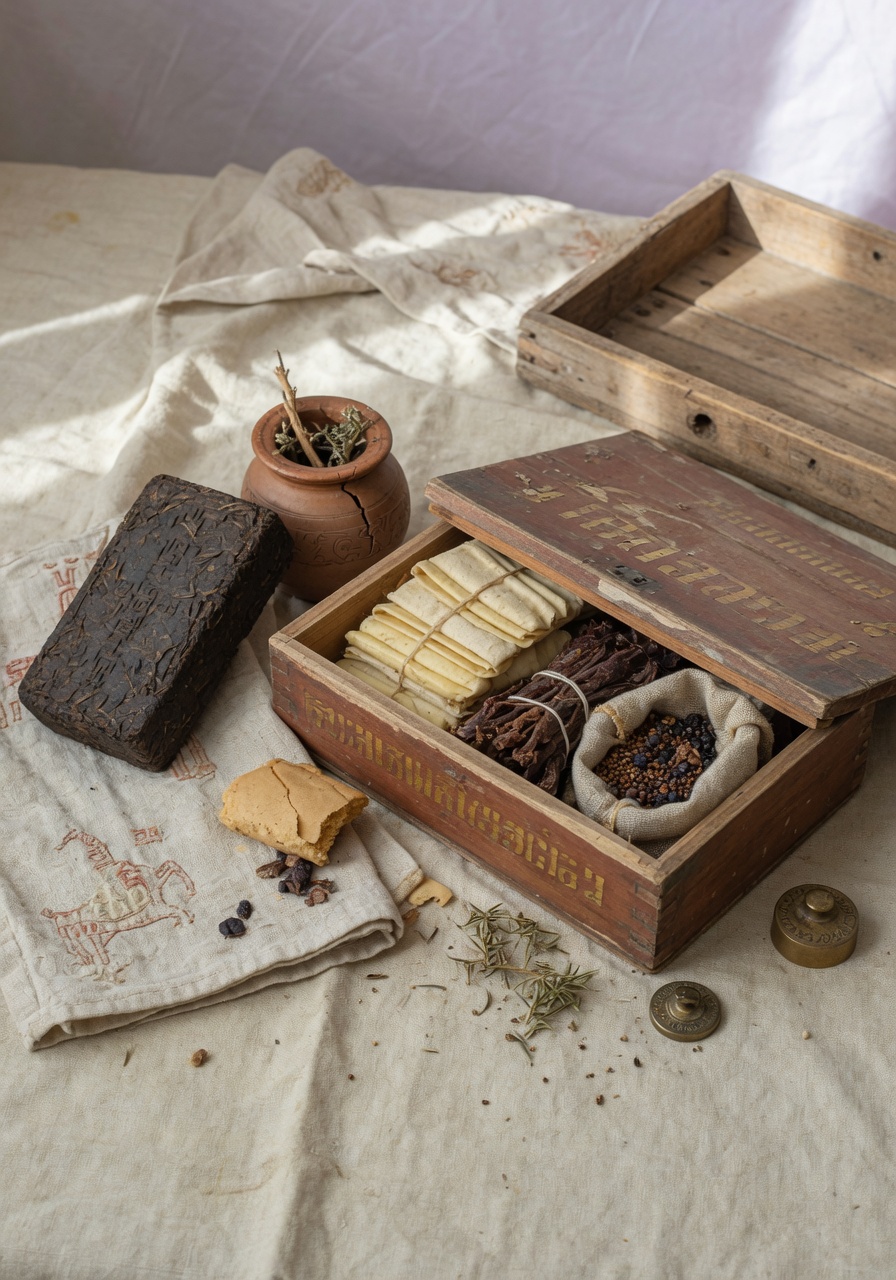
Most of what we read about aging pu-erh assumes a sub-tropical baseline. Hong Kong cellars at 80 percent relative humidity, Guangdong warehouses oscillating between 65 and 78 percent, Kunming’s so-called dry storage at a still-respectable 55 to 65 percent — these are the canonical environments, and the vocabulary of aging was built from them. Chén xiāng (陈香), cāng wèi (仓味), the slow oxidative darkening of leaf and liquor — all of it presumes moisture and warmth working on the compressed cake over years.
Then there is the dry north. Ulan-Ude in winter sits at minus 25 °C with indoor heating that drops relative humidity below 20 percent. Ulaanbaatar’s continental swing is even more brutal — minus 30 °C in January, plus 28 °C in July, and indoor air during the heating season routinely under 15 percent RH. Buryat and Mongolian households have stored compressed dark tea for two centuries along the Kyakhta caravan route, but until the last decade nobody asked what those conditions do to pu-erh specifically, as opposed to the tribute-brick hēi chá of the historical trade.
I have been tracking a working sample set of 47 cakes — shēng and shú, pressed between 2003 and 2018 — stored variously in Ulan-Ude, Irkutsk, and a private collection outside Ulaanbaatar. Some came north as gifts in the late 2000s; others I bought in Kunming and Menghai and carried back myself. What follows is not a polemic for or against dry storage. It is a working report on what happens to pu-erh when the air is colder and drier than any of the literature anticipates, and what that means for collectors who happen to live here.
What ‘continental’ actually means
The climate band that runs from Lake Baikal south through Mongolia and into Inner Mongolia is classified as Dfd and BSk in the Köppen system — subarctic and cold semi-arid respectively. The defining feature for tea storage is not the cold itself but the annual moisture deficit. Ulan-Ude averages 244 mm of precipitation a year; Ulaanbaatar averages 267 mm. By comparison, Menghai receives roughly 1,400 mm and Hong Kong over 2,400 mm. More important still is the heating season — from October to April, indoor air in any centrally heated apartment is mechanically dried by the temperature differential. A flat in Ulan-Ude that reads 22 °C indoors against minus 20 °C outdoors will sit at 12 to 18 percent RH unless humidified. This is drier than any warehouse in Yunnan, drier than Kunming in its driest month, drier in fact than most museum archives. It is the environment in which the Zhōng Chá (中茶) bricks of the 1960s caravan trade survived, and it is the environment any pu-erh collector north of the Gobi is working with whether they like it or not.
The Kyakhta precedent
From 1727 until the trans-Siberian railway diverted the trade in 1903, Kyakhta on the Russo-Mongolian border was the bottleneck through which Chinese compressed tea reached the Russian Empire. The teas were mostly Hunanese and Hubei hēi chá — not pu-erh in the modern sense, but processed and pressed under broadly similar logic. Caravans of camels carried bricks across the Gobi in waxed felt; the bricks then sat in Buryat and Russian merchant warehouses, sometimes for years, before being broken up for samovar use. The historian I. P. Sobolev documented in his 1908 survey that bricks held in Verkhneudinsk (now Ulan-Ude) for over a decade developed a ‘darkened, sweet, slightly resinous character without the mustiness of the southern stores’ — an early observation of what we would now call cold-dry aging.
What the dry north does to sheng
Young shēng under continental storage essentially pauses. The microbial fermentation that drives Guangdong-style aging requires water activity (a_w) above roughly 0.65 in the cake itself; below that, the relevant fungi and bacteria are dormant. A 357 g cake of 2015 Bulang material that I weighed in Kunming at 358.2 g (after compression rehydration) read 352.6 g after three winters in Ulan-Ude — a 1.6 percent moisture loss that pulled the leaf-core water activity well below the microbial threshold. What continues to happen is non-enzymatic: slow oxidation of catechins at the cake surface, gradual Maillard-style browning over years, volatile loss of the more fugitive aromatics. The result, tasted side by side with the same pressing kept in Guangzhou, is a tea that is paler in liquor, sharper in bitterness, with the green-vegetal high notes still very much intact after eight years. The Guangzhou sister cake by contrast had moved into stewed-fruit territory, with a noticeable softening of the kǔ (苦) bite. Neither is wrong. They are different teas now.
Bitterness that doesn’t leave
The single most consistent observation across my sample set: bitterness in continentally stored shēng persists far longer than the conventional aging curve predicts. A 2008 Menghai-region pressing that should, by Hong Kong standards, have rounded into mellow sweetness by year ten was still showing assertive kǔ in 2023. This matters practically. Collectors who buy young shēng expecting it to soften on the standard fifteen-year schedule will be disappointed. The clock here runs at perhaps a third the speed, and possibly slower. For background on why young shēng takes time anywhere, see the five-year question.
Aromatic preservation
The flip side is that the high-altitude gāo xiāng (高香) florals of mountain shēng — the orchid and honey notes of a good Yiwu or Nannuo — survive remarkably well. A 2012 Yiwu cake stored in Irkutsk still gave a clear lily-and-beeswax nose in 2023, where its Guangzhou equivalent had largely lost those top notes to the deeper chén xiāng development. For drinkers who prize the aromatic personality of a specific mountain — the kind discussed in our Yiwu and Nannuo pieces — continental storage may actually be preservative rather than developmental.
What it does to shu
Shú behaves more predictably because the heavy lifting was done in the wò duī (渥堆) pile before the tea ever left Menghai. The post-fermentation that continental storage might or might not allow is, for shu, mostly cosmetic — the smoothing out of pile-character over the first three to five years. In dry cold conditions this smoothing still happens, but more slowly and with a different endpoint. A 2010 Menghai 7572 stored continuously in Ulan-Ude tasted, in 2022, cleaner and less earthy than its Guangzhou counterpart, but also flatter in the mid-palate. The wet-pile duī wèi (堆味) that normally fades within two years in humid conditions took closer to five years here. For the question of whether shu meaningfully ages at all, see our measured answer; the short version is that continental storage makes shu behave more like a fixed-state product than southern storage does. It is what you bought, more or less, slowly losing its rough edges.
Practical storage in cold-dry apartments
The single biggest threat to pu-erh in a continental flat is not the cold or the dry air per se — it is the heating-season swing combined with kitchen and bathroom humidity spikes. A cake left on an open shelf will lose moisture all winter and then absorb a confusing mix of cooking and bath steam each evening. Stable storage requires buffering. My working setup, refined over a decade, is a sealed unfinished-wood cabinet (poplar, no varnish, no cedar) holding the cakes in their original bamboo tǒng (筒) wrappers, with a small dish of saturated potassium carbonate that holds the internal RH at approximately 43 percent. Temperature is allowed to drift with the room — 16 to 23 °C across the year — because attempting to heat-stabilise it introduces more problems than it solves.
Why not humidify aggressively
The instinct of collectors moving from Guangdong references is to humidify the storage space toward 65 percent. This is a mistake in a continental climate. Pushing internal RH that high during a minus 25 °C winter creates a brutal vapour-pressure gradient against the cold outer walls of any apartment; condensation will form somewhere, and if it forms on or near your cakes you have invented a worse problem than dry storage. The compromise figure I recommend — and which the small Ulaanbaatar collectors’ circle around the merchant D. Batbayar has converged on independently — is 40 to 50 percent RH, stable, with the understanding that aging will be slow but clean.
Air exchange and the bamboo wrapper
Conventional southern practice values some breathing of the storage space. In dry continental conditions the calculus reverses: too much air exchange just accelerates moisture loss. I keep the cabinet closed for months at a time, opening only to retrieve a cake. The bamboo tǒng of seven cakes acts as its own micro-environment, and I have measured RH inside an intact wrapped tǒng at roughly 8 percentage points above ambient cabinet RH — a useful buffer.
What this means for buying
If you live in Buryatia, Mongolia, or anywhere on the continental dry-cold band, the practical advice runs against most of the collector literature. First, buy older. A cake that already has ten years of Yunnan or Guangdong storage on it before it reaches you is worth a substantial premium, because those years are years your apartment will not give it. Second, weight the catalogue toward teas whose youthful character you actually enjoy — your shēng will retain that character for a long time. The aggressive bitterness of a young Bulang, discussed in our Bulang Shan piece, is what you will be drinking ten years from now. Third, take shú seriously as a category — the rougher edges of pile-fermentation that continental storage smooths slowly are still smoothed, and a well-chosen shu like a 7572 is among the most forgiving teas you can keep here. For deeper buying frameworks across the constellation, tea.school runs a continental-storage module each winter, and the broader storage discussion lives on thetea.app.
An open question — is this aging at all
There is a fair argument that what happens to pu-erh in Ulan-Ude is not aging in the technical sense but preservation with slow oxidative drift. The microbial signature that defines southern aging — the populations of Aspergillus, Penicillium, and Eurotium documented by Lü et al. in their 2013 study of Guangdong warehouse cakes — is largely absent or dormant here. What we get instead is something closer to how a sealed bottle of wine ages: chemistry without much biology. Whether you call this aging or not is partly semantic, but the practical point stands. Continental-stored pu-erh is its own creature, and the people drinking it — perhaps fifty thousand serious collectors across Russia and Mongolia by my rough estimate — are running, collectively, the largest accidental experiment in cold-dry pu-erh aging ever conducted. We are about twenty years into it. The results will take twenty more to read clearly.
References
- GB/T 22111-2008 — Geographical Indication Product: Pu-erh Tea — Standardization Administration of the People's Republic of China
- Sobolev, I. P. — Chaynaya torgovlya v Verkhneudinske (Tea trade in Verkhneudinsk), 1908 — Imperial Russian Geographical Society, Eastern Siberian Branch
- Lü, H.-P. et al. — Microbial communities associated with the post-fermentation of pu-erh tea — Food Microbiology, vol. 36, 2013
- Zhou Hongjie — Pǔ'ěr Chá Jì (普洱茶记) — Yunnan People's Publishing House, 2004
- Köppen-Geiger climate classification: updated world map (Beck et al.) — Scientific Data, vol. 5, 2018
Read next
Related articles
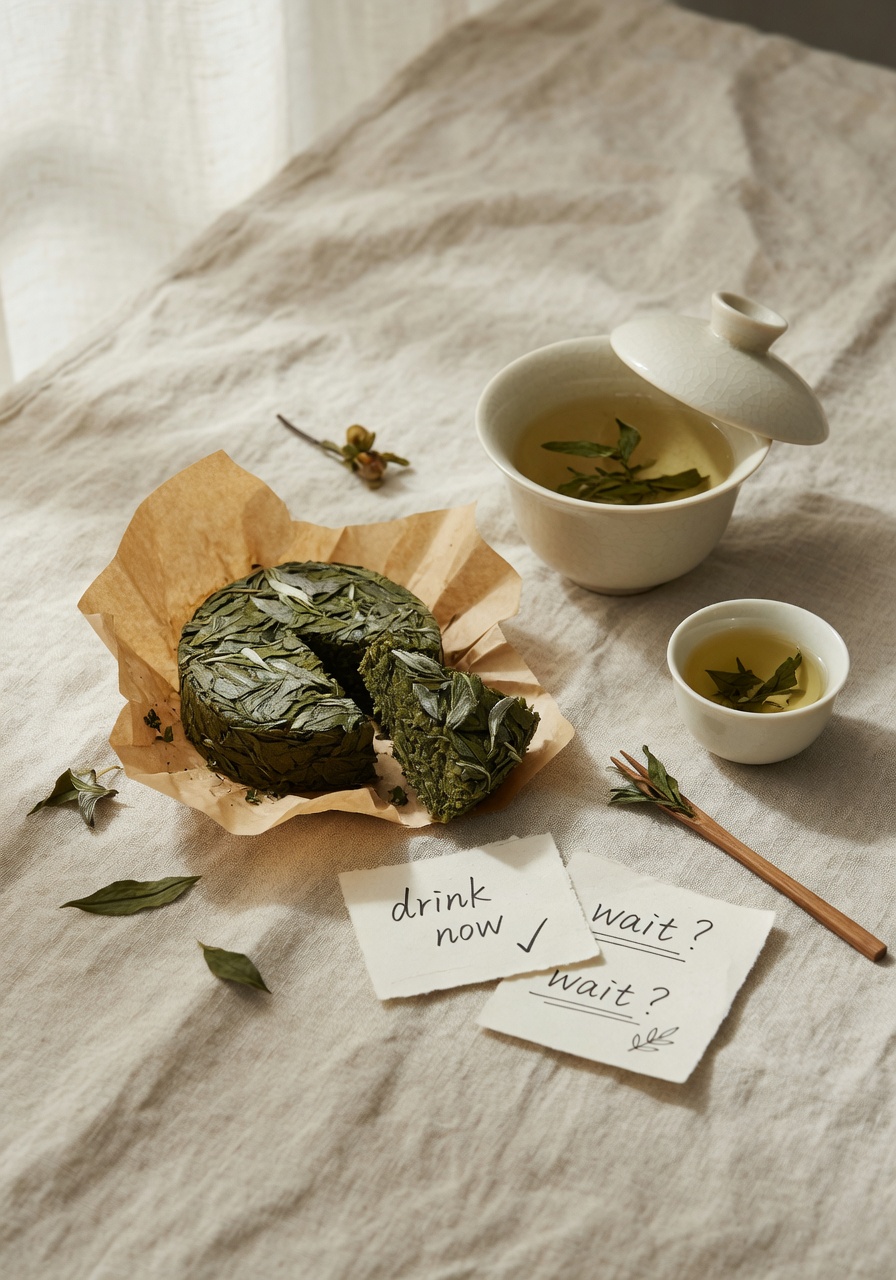
Young sheng — drink now or wait?
The question every collector asks within their first year. Some cakes are radiant at eighteen months; others need a decade before they stop biting. Here is how to tell which is which.
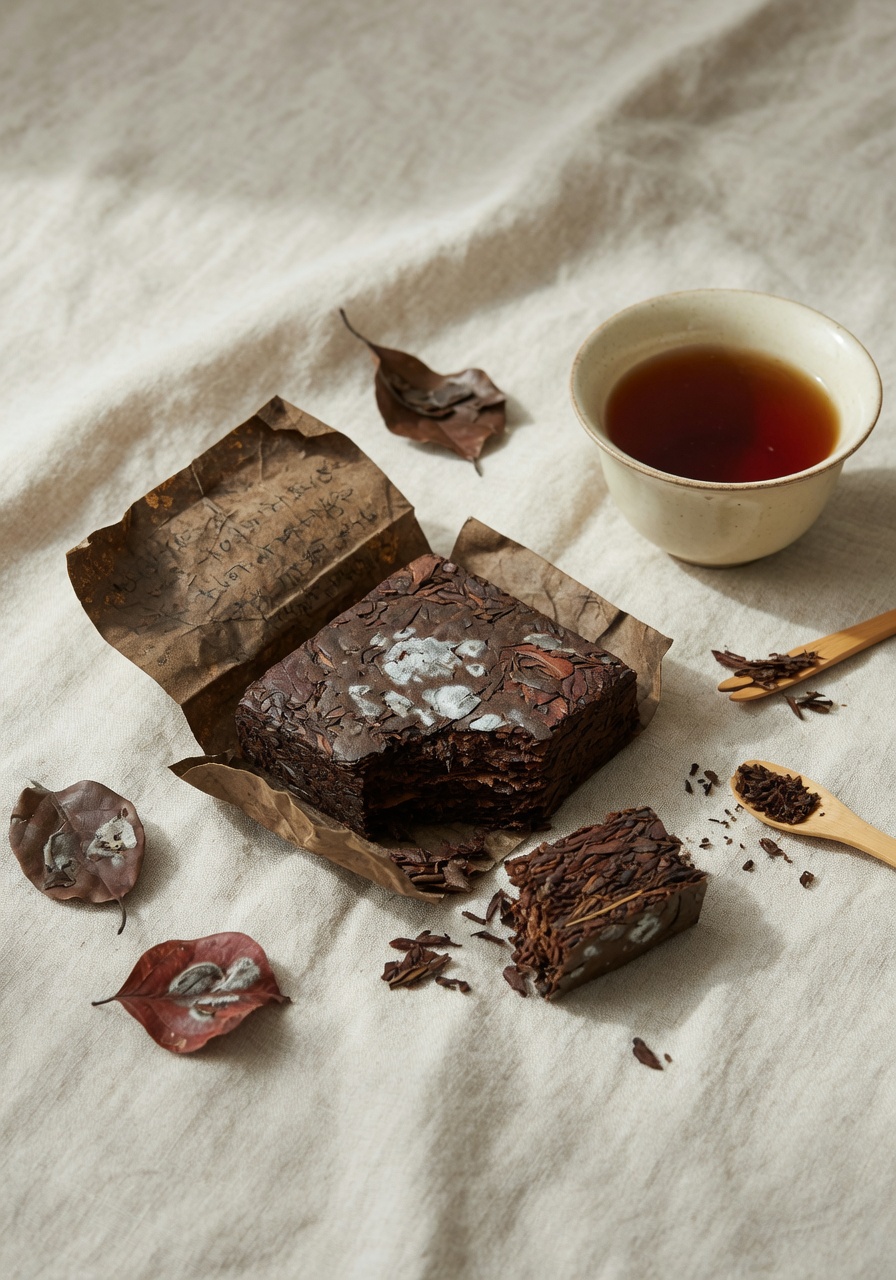
Does shu age? A measured answer
Shu was engineered in 1973 to taste like aged sheng without the wait. So does it still benefit from time in the jar — or is the work already done? A technical look at what actually changes after the pile.
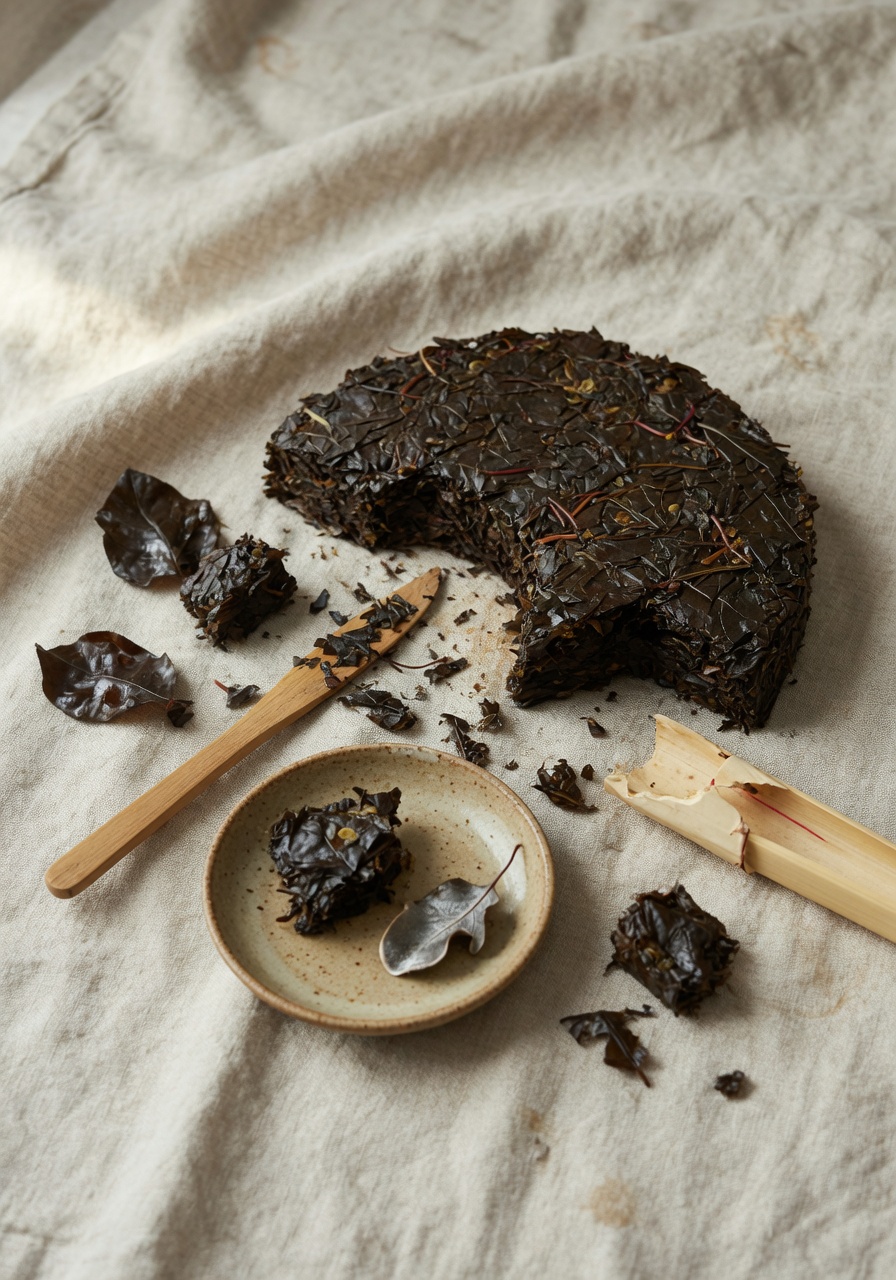
Menghai 7572 — the recipe that anchors the category
A four-digit code stamped on a paper wrapper has done more to define what shu tastes like than any single mountain or master. This is how 7572 became the reference point.
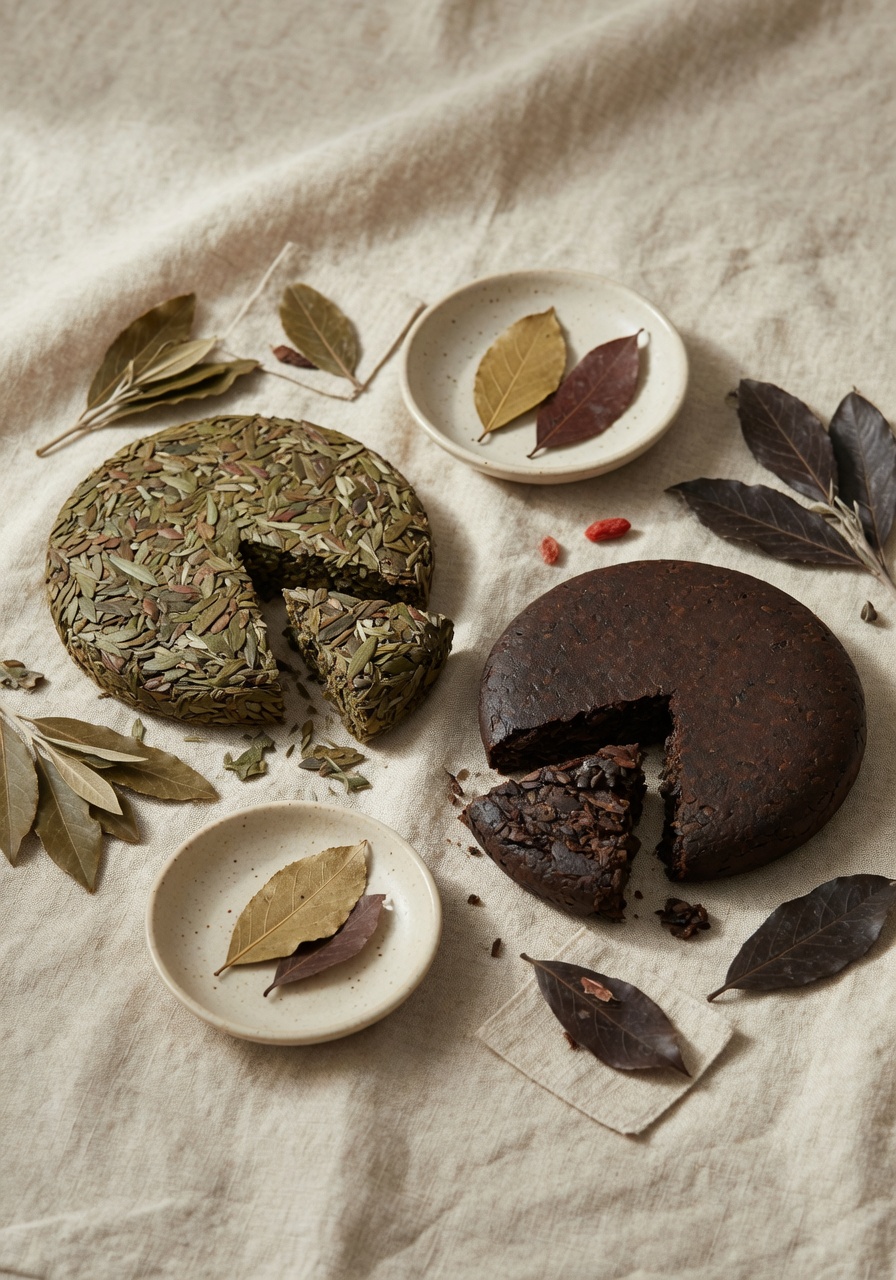
Sheng vs shu — what actually changes
Two teas share a name, a region, and a leaf — and almost nothing else. The 1973 invention of *wò duī* (渥堆) split pu'er into raw and ripe, and the chemistry of that split still defines every cake pressed today.