Five climates, five philosophies, one leaf
Pu-erh is the only Chinese tea whose finished value is determined as much by the warehouse as by the garden. The leaf leaves the press alive — microbially, enzymatically, chemically — and the next twenty to fifty years of temperature, humidity and airflow decide whether it becomes a deep camphor-and-date elder or a thin, sour disappointment. The traditions that govern this second life did not emerge from theory. They emerged from the geography of the tea trade between roughly 1950 and 1995, when Hong Kong was the only large buyer of aged cake and Yúnnán factories produced for export rather than domestic taste.
The cleanest articulation is the Kunming model, covered in dry storage — the Kunming standard. Sitting at 1,890 metres on the Yúnnán plateau, the city averages 60–65% relative humidity and rarely exceeds 24 °C. Aging is slow, oxidative, aromatic — sweet-grass and stone-fruit notes preserved for decades, bitterness only gradually retreating. This is the storage profile favoured by Yúnnán producers themselves, codified loosely in the post-2008 wave of GB/T 22111 quality discussions, and increasingly the reference standard for collectors who distrust transformation they cannot control.
At the other pole stands the Hong Kong tradition, the subject of traditional wet storage — Hong Kong and Guangdong. From the 1950s onward, Cantonese merchants in cellars off Sheung Wan and Western District accelerated aging by keeping cakes at 80%+ humidity and 28–32 °C, sometimes for two to three years before a finishing period in drier conditions. The result — thick, woody, medicinal, with the distinctive chén xiāng (陈香) of properly retreated leaf — defined what ‘aged pu-erh’ meant for an entire generation. The Lam Kie Yuen and Yee On warehouses produced cakes that still anchor auction catalogues. Guangdong added its own subtropical variant: less aggressive, more naturally humid, often blamed (sometimes fairly) for the sour edge that taints poorly managed stock.
Further north the variable inverts. Continental aging — Buryatia, Mongolia, the dry north traces what happens when pu-erh enters the historic caravan zone — Kyakhta, Ulan-Ude, Ulaanbaatar — where winter humidity drops below 30% and indoor heating is fierce. Transformation almost halts. Cakes from the 1990s stored continuously in Ulan-Ude can still taste close to their pressing year, which collectors variously consider preservation or arrested development. This is the storage philosophy of patience without intervention, and it has quiet allies in northern China and Inner Mongolia.
Taiwan occupies an interesting middle: humid enough for transformation, cool enough for control, and home to the curatorial generation that re-introduced aged Hong Kong stock to the mainland market in the late 1990s.
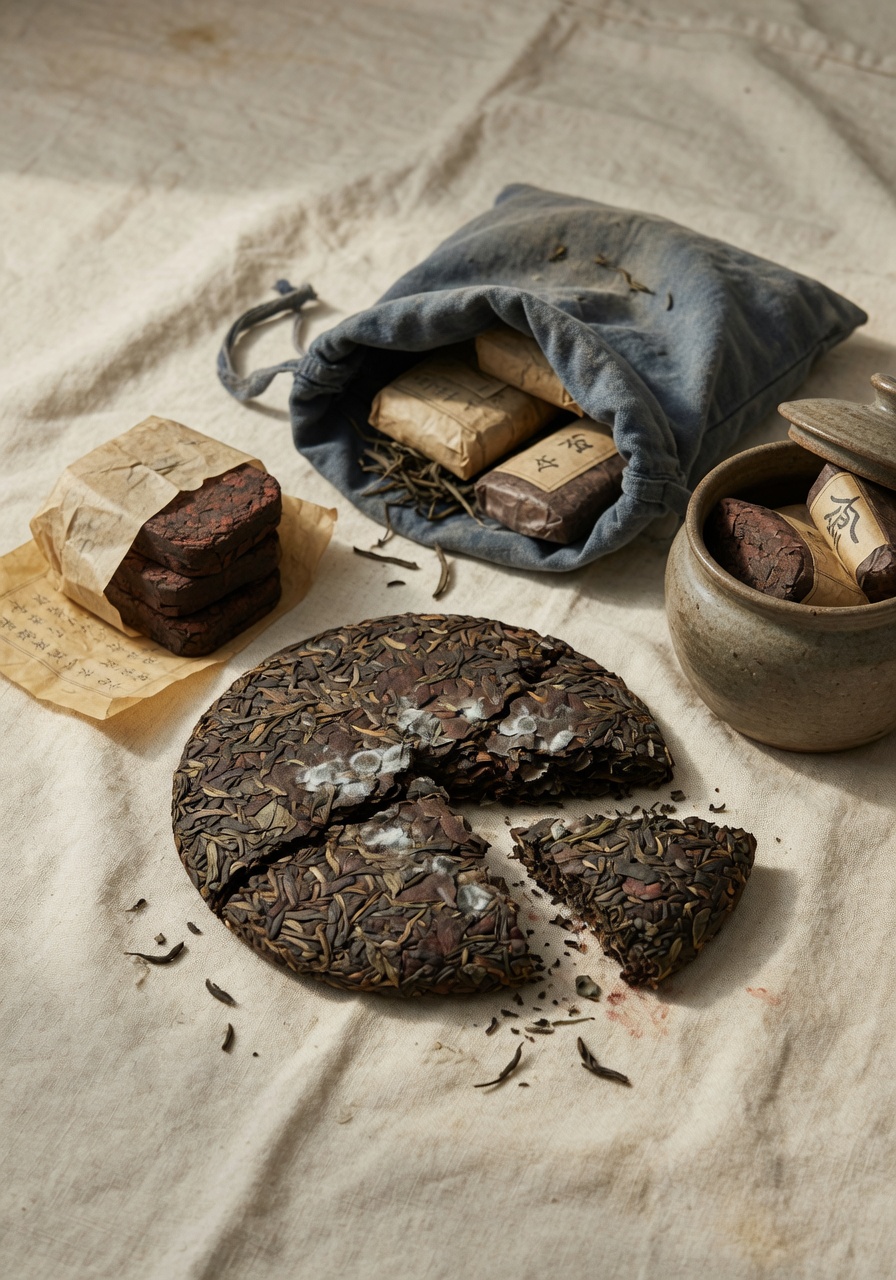
Not every cake survives the journey. Mould, off-flavours, sour notes — diagnosing storage faults is the required companion reading, because the line between successful wet storage and ruined leaf is narrower than the market admits. White bloom is usually benign jīn huā (金花); black mould and persistent ammonia are not.
For practical storage at home, see the storage protocols on tea.school and the climate-by-climate buying notes on shop.puerh.app. The choice of tradition is, in the end, a choice about time: how much of it you have, and how much transformation you are willing to outsource to a warehouse you will never visit.