home · Where pu-erh <em>sleeps</em> shapes what it becomes
Aging & storage
Mould, off-flavours, sour notes — diagnosing storage faults
Cún chá · 存茶
A cake can survive thirty years of indifferent storage and still pour beautifully. It can also be ruined in a single humid August. This is a field guide to what goes wrong, why, and what can still be saved.
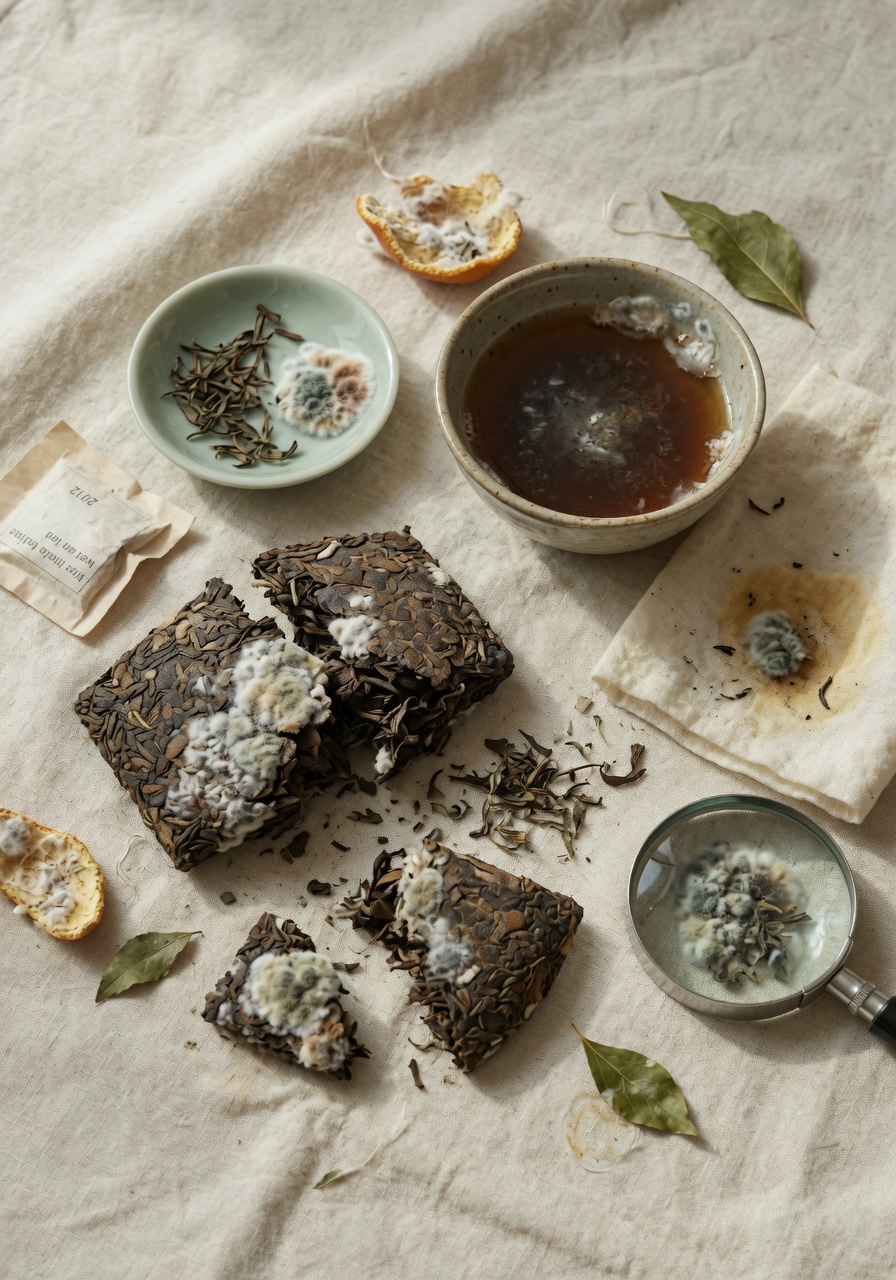
Storage faults are the most expensive mistakes in pu-erh. A single damp summer in the wrong cupboard can erase a decade of careful aging on a cake that cost more than the cupboard itself. Yet the literature on faults is thin — most writing on storage describes ideals (Kunming dry, Guangdong traditional, Hong Kong wet) without naming what failure looks like at the rim of each style. The aroma of fresh mushroom on a 2007 Menghai brick is not necessarily a fault; the same aroma on a 2019 Bulang almost certainly is. Context decides.
This guide works from observation backward. We start at the cake — what you see, smell, and taste on the first rinse — and walk back to the storage condition that produced it. The five faults treated here are visible mould (霉, méi), sour notes (酸, suān), warehouse smell (仓味, cāng wèi) that refuses to fade, flat or dead tea (无味, wú wèi), and off-flavours absorbed from neighbours — cardboard, cedar, kitchen, perfume. Some are reversible with patient re-storage. Some are not. Knowing which is which is the difference between a salvage and a loss.
The framework here comes from a 400-cake reference cellar run across the Russian–Mongolian border, where winter humidity drops below 25 % RH and summer crosses 70 %. Continental storage forces you to learn the failure modes early, because the cellar moves between dry-storage and traditional-storage conditions every season whether you intend it to or not.
What ‘fault’ means — and what it doesn’t
Pu-erh tolerates a wider range of storage than almost any other tea. Sheng has been recovered from a leaking warehouse roof in Sham Shui Po and from a bone-dry Kunming attic where the cake had not been turned in twenty years. Both produced drinkable tea. So the word ‘fault’ here is reserved for conditions where the leaf has been altered in a way that the drinker — most drinkers — would describe as unpleasant, or where the alteration cannot be undone.
Three categories help. First, cosmetic faults: surface mould bloom, slight wrapper staining, foxing on the nèi fēi (内飞). These look alarming but often brush off and brew clean. Second, reversible faults: heavy warehouse smell, transient sourness, flat profile from over-dry storage. These respond to months or years of corrective storage. Third, terminal faults: deep penetrating mould, ammonia notes that signal protein breakdown, kerosene or perfume contamination from neighbours. These do not come back.
The Chinese national standard for dark tea, GB/T 22111-2008, sets sensory thresholds for finished pu-erh but is silent on aged tea — there is no official rubric for what ‘too far’ looks like after twenty years. The market has filled the gap with vocabulary: a tea is described as 烧仓 (shāo cāng, ‘burnt warehouse’), 反青 (fǎn qīng, ‘returned green’), or 有杂味 (yǒu zá wèi, ‘has off-notes’). These are diagnostic terms, not insults — and learning them is half the work.
Mould — surface bloom versus penetrating rot
Mould is the fault people fear first and misidentify most often. A grey-white powdery dusting on the outer leaves of an older cake is almost always jīn huā (金花)-adjacent or a benign surface mycelium that brushes off with a soft brush, leaves no taint in the cup, and is a normal feature of traditional Hong Kong and Guangdong storage. The wrapper may show brown foxing spots; the inner leaves are unaffected. This is the tea most Western drinkers encounter as ‘wet-stored’ and learn to read as a stylistic choice rather than a fault.
Penetrating mould is different. It appears as black, blue-green, or rust-orange colonies that have struck into the cake rather than sitting on its surface. Break the cake open: if the discolouration follows the compression layers inward, the mould has fed on the leaf itself. The smell is sharp, ammoniac, sometimes resembling damp basement carpet or rotten wood. There is no salvaging this. Aspergillus and Penicillium species useful in fermentation give way to spoilage organisms when humidity holds above 80 % RH at temperatures above 30 °C for weeks at a time — exactly the conditions of a sealed cardboard box in a hot subtropical July.
The brush test
A standard diagnostic in Guangzhou tea markets: brush the surface gently with a clean dry tea brush over white paper. Surface bloom releases a fine pale dust that the paper catches. If the leaf colour underneath is unchanged and the bing’s interior smells clean when you press your nose against a freshly broken edge, the cake is sound. If brushing reveals a deeper layer of discoloured leaf, or if the smell at the break is sour-ammoniac rather than woody-earthy, set the cake aside. Tea master Chan Kam Pong, in his 2010 First Step to Chinese Puerh Tea, recommends a simple confirmation: rinse twice with boiling water and smell the wet leaves. Sound aged tea smells of camphor, old wood, dried jujube. Mould-rotted tea smells of the warehouse it died in, and the smell does not rinse out.
What humidity ranges actually do
Below 55 % RH, mould activity essentially stops; aging slows dramatically and the leaf risks drying past the point where post-fermentation can resume. Between 60 % and 70 % RH, the tea ages cleanly — this is the Kunming-style target. Between 70 % and 80 %, you are in Guangdong traditional territory: faster transformation, surface bloom common, mostly benign. Above 80 % sustained, spoilage risk rises sharply, especially if temperature also climbs above 28 °C. Hong Kong warehouses historically pushed into this zone deliberately, but with airflow, turning schedules, and operators who had decades of judgement. Replicating it in a domestic cupboard without those controls is how cakes die.
Sour notes — the most reversible fault
Sourness in young sheng is sometimes a processing trace from short shā qīng (杀青) or under-dried mao cha, but in aged tea it almost always points to storage. The classic profile: a cake stored in a sealed plastic bin or a too-tight ceramic jar with insufficient air exchange, in conditions warm enough to drive fermentation but without the oxygen turnover that carries volatile acids away. The result is a sharp citric or vinegar edge that hits the front of the palate on the first three steepings and lingers as a metallic tang on the gums.
The encouraging news: this is the fault most likely to fade. Move the cake into a breathable container — a zǐ shā (紫砂) jar, an unglazed clay pot, a paper-lined wooden box — in a room with stable airflow and 60–65 % RH. Check it every six months. Most lightly soured cakes recover within one to two years; the volatile acids dissipate as the cake equilibrates with cleaner air. Heavily soured tea, especially shu that went sour during wò duī (渥堆) and was pressed anyway, will not recover, but that fault originates at the factory rather than in your cupboard.
A reference point from the cellar logs: a 2015 Bulang sheng sealed accidentally in a vacuum-pack carton for fourteen months developed a noticeable sour front. Returned to open storage in a Yixing jar at 62 % RH and 19 °C average, it tested clean at the eighteen-month follow-up. The lesson is mechanical, not mystical: pu-erh needs to breathe.
Warehouse smell that won’t leave
Traditional Hong Kong and Guangdong storage produces a recognisable signature — earthy, woody, faintly mushroomy, sometimes with a basement note. In a well-managed warehouse, this cāng wèi (仓味) reads as character. The cake is then ‘aired out’ (退仓, tuì cāng) for one to three years in drier conditions before sale, allowing the strongest notes to dissipate and the underlying tea to emerge. Done well, the result is the rich, sweet, deep liquor that defines mature traditional storage.
Done poorly — or skipped entirely — the warehouse smell dominates every steeping and refuses to lift. The cup smells of wet cardboard. The aftertaste is muddy rather than sweet. The leaves, even after ten minutes of steeping, refuse to give a clear liquor. This is cāng wèi that has crossed into fault: either the warehouse phase ran too long, or the airing-out was insufficient, or the cake was rushed to market while still loaded with volatile compounds. Home airing-out — six months to two years in a clean, dry, well-ventilated space — recovers most of these cakes. A small minority are permanently flat; the warehouse held them too long and the aromatic compounds the tea once had are simply gone.
Flat tea — when dry storage goes too dry
The opposite failure is rarer but real. A cake stored for fifteen years in 40 % RH conditions, in a sealed mylar bag, or in an unheated continental attic where winter humidity drops to 20 %, develops what Yunnan tasters call 反青 (fǎn qīng) or simply describe as 死茶 (‘dead tea’). The leaf looks fine, the wrapper is pristine, and the cake brews — but the liquor is thin, the aroma minimal, and the huí gān (回甘, returning sweetness) that should have developed never arrived. The post-fermentation processes that turn young sheng into aged tea need moisture to proceed; deprived of it, the leaf has merely sat.
Some of this can be recovered by moving the cake into more humid storage and waiting two to four years, but tea that has been bone-dry for over a decade often does not respond fully. The compounds that should have transformed have instead oxidised slowly into something muted. This is the failure mode that makes pure-Kunming purists nervous, and the reason most experienced collectors keep at least part of their cellar in the 65–70 % RH band where transformation actually happens. The trade-off — slower aging in cleaner conditions versus faster aging with mould risk — is the central decision of any storage program, and it is covered in more depth at puerh.app’s regional storage guides and the cross-referenced material at tea.school’s storage curriculum.
Off-flavours from neighbours
Pu-erh is a sponge. The same property that lets it ripen for fifty years lets it absorb anything sharing its airspace. The classic contaminations: cardboard (from the shipping carton it was never removed from), cedar (from a cigar humidor doubled as tea storage), kitchen oils (from a cupboard above the stove), perfume (from a closet shared with clothes), and — most catastrophically — petroleum products from a basement that also held paint thinner or two-stroke fuel. None of these come out.
Quarantine before integration
New cakes arriving from a different warehouse should be aired separately for one to three months before joining an established cellar. This serves two purposes: it lets foreign warehouse signatures fade, and it prevents a contaminated cake from spreading its problem to clean stock. A simple wooden shelf in a spare room, with the new cakes unwrapped from any shipping plastic and stood on edge, is sufficient. Smell each cake weekly. If a foreign note is still present after eight weeks, isolate longer or accept that the cake will need to be drunk young rather than aged with others.
The cardboard problem
Most pu-erh ships in cardboard cartons of seven cakes (tǒng, 筒, traditionally bamboo). Modern cardboard contains adhesives, sizing, and sometimes recycled paper with residual print inks. Leaving cakes in their shipping cartons for years is a common mistake; the cardboard smell migrates into the wrapper and then into the leaf. The traditional bamboo tǒng breathes and shares no off-notes; a clean wooden shelf or a paper-lined cabinet does the same job. If you receive tea in cardboard, remove it within the first month and store the cardboard elsewhere — or recycle it.
A diagnostic workflow
When a cake brews badly and storage is suspected, work through the checks in order. First, look: examine the dry cake for visible mould, surface bloom, water staining on the wrapper, or unusual discolouration. Note which you see and where. Second, smell the dry cake at a freshly broken edge — not the wrapper, the leaf itself. Clean aged tea smells of camphor, wood, dried fruit, sometimes leather; faulty tea smells sour, ammoniac, mushroom-damp, or chemical. Third, rinse twice and smell the wet leaves and the lid of the pot. Volatile faults are loudest here. Fourth, taste: note where the fault sits on the palate. Sourness lives on the front and sides of the tongue; warehouse heaviness sits in the throat; off-flavour contamination tends to ride the aroma rather than the taste.
Match the findings to the fault catalogue above and decide: salvage, isolate, drink young, or discard. The hardest discipline is the last one — accepting that a cake is past saving and not pouring it on guests who don’t know better. A drinker who learns to identify and respect storage faults becomes faster at evaluating new purchases, more confident at managing their own cellar, and — eventually — better at telling the difference between character and damage. That distinction is the entire craft of aged pu-erh, and it is learned cake by cake.
References
- GB/T 22111-2008 — Geographical indication product: Pu-erh tea — Standardization Administration of China
- First Step to Chinese Puerh Tea (2010) — Chan Kam Pong (陳光普), Wushing Books, Taipei
- Microbial diversity during pile-fermentation of Pu-erh tea — Lv H., Zhang Y., Lin Z., Liang Y., Food Research International, 2013
- Pu'er Tea: Ancient Caravans and Urban Chic — Zhang Jinghong, University of Washington Press, 2013
- Storage and aging of Pu-erh tea: chemical and sensory changes — Ku K. M., Choi J. N., Kim J., Park J. H., Journal of Agricultural and Food Chemistry, 2010
Read next
Related articles
Young sheng — drink now or wait?
The question every collector asks within their first year. Some cakes are radiant at eighteen months; others need a decade before they stop biting. Here is how to tell which is which.
Does shu age? A measured answer
Shu was engineered in 1973 to taste like aged sheng without the wait. So does it still benefit from time in the jar — or is the work already done? A technical look at what actually changes after the pile.
Wo dui — the pile fermentation that defined shu
In 1973, a team at Kunming Tea Factory wet-piled maocha under wool blankets and waited. Forty-five days later, the leaves were black, sweet, and unmistakably new. This is the story of how a chemical accident became a category.
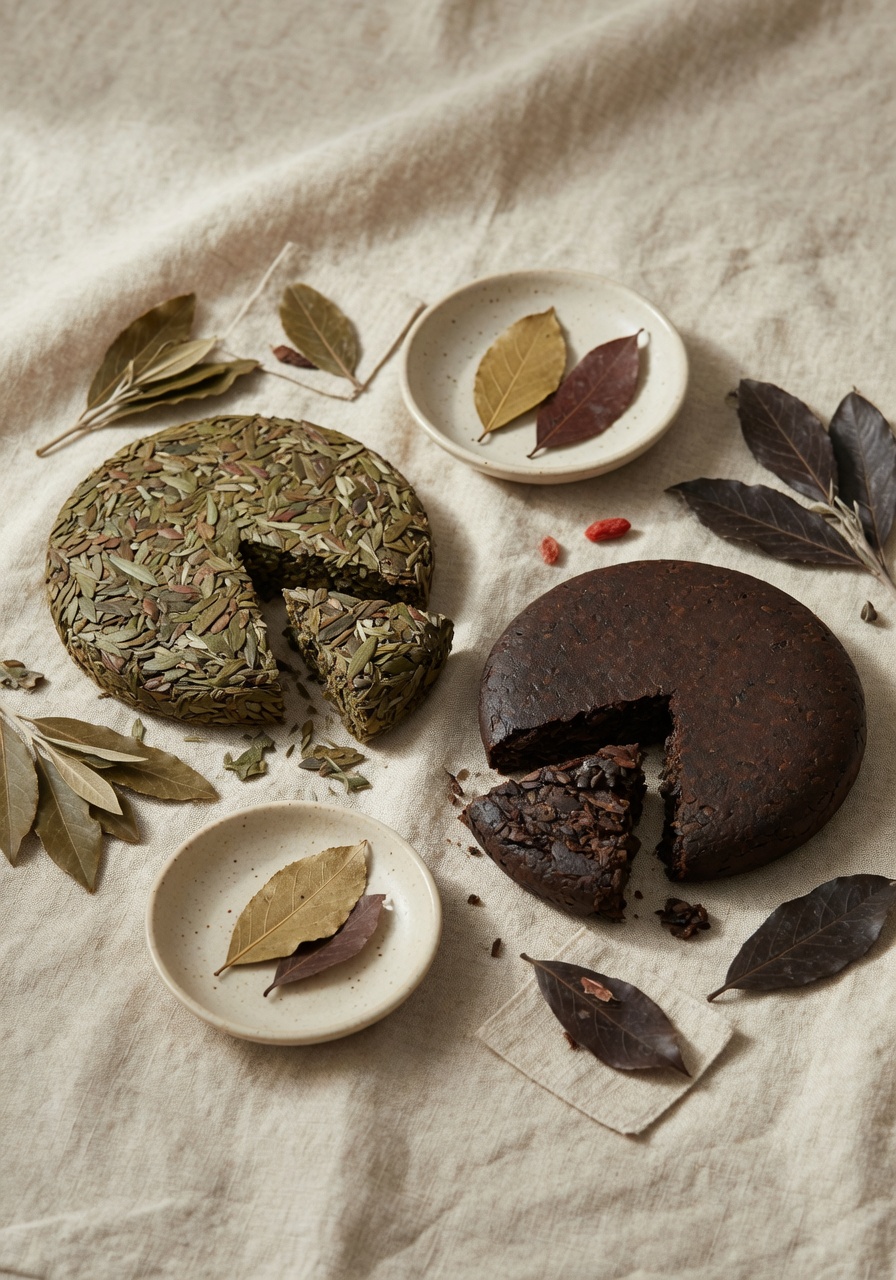
Sheng vs shu — what actually changes
Two teas share a name, a region, and a leaf — and almost nothing else. The 1973 invention of *wò duī* (渥堆) split pu'er into raw and ripe, and the chemistry of that split still defines every cake pressed today.