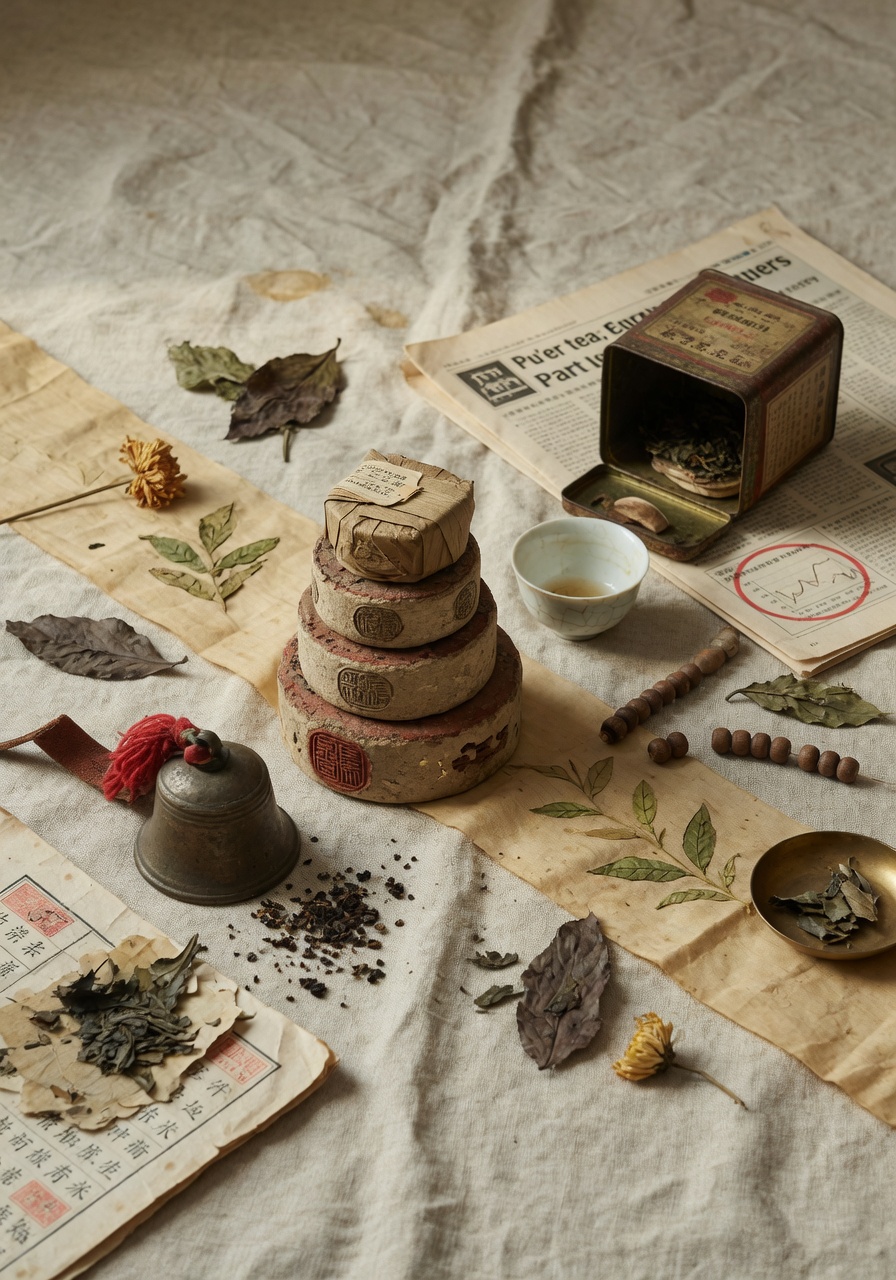
From mule caravan to speculative asset
Pu’er did not begin as a connoisseur’s tea. It began as a logistics problem. The leaves of the broadleaf Camellia sinensis var. assamica, harvested across the six famous mountains around Yiwu and Yibang in southern Yunnan, had to travel — first to the prefectural town of Pu’er (today’s Ning’er) for taxation and trade, then onward to Tibet, Beijing, and beyond. Compression into cakes and bricks was a packing decision before it was an aesthetic one. The slow microbial transformation that today’s collectors prize was, originally, an accident of the road.
That road is the subject of The Tea Horse Road — how pu’er travelled before trucks. The Chámǎ Gǔdào (茶马古道) was not a single highway but a braided network linking Xishuangbanna to Lhasa via Dali and Lijiang, with secondary spurs into Burma and Laos. Caravans of fifty to a hundred mules took roughly four months to reach the Tibetan plateau, and the tea that arrived had fermented gently in saddlebags soaked by rain and warmed by altitude. The route remained commercially active until the Burma Road and later highway construction in the 1950s rendered the mules obsolete.
The imperial dimension arrived earlier. Under the Qing, pu’er was formally inscribed on the tribute lists — see Tribute tea under the Qing — pu’er at the imperial court. The Pǔ’ěr Fǔ Zhì (普洱府志), the prefectural gazetteer compiled in 1763, records specific quotas: spring buds from designated mountains, pressed into tuó and bǐng of regulated weight, escorted to Beijing for the Qianlong emperor’s table. This is the period that fixed the cultural prestige of single-mountain leaf — a prestige that producers like Mansong and Yiwu still trade on today.
The modern story is shorter and more violent. Through the 1990s, Hong Kong and Taiwanese collectors quietly accumulated aged sheng from state factories — Menghai, Xiaguan, Kunming — at prices that bore some relation to the cost of warehousing. After 2003, mainland buyers entered the market, and prices for both aged stock and fresh maocha tripled, then tripled again. The collapse came fast: 2007 — the year the pu’er market crashed documents how wholesale prices fell roughly seventy percent between April and July, bankrupting wholesalers across Guangzhou’s Fangcun district and leaving warehouses full of cakes nobody wanted.
What emerged afterward is the market we have now. Speculation did not disappear; it relocated to gushu (古树) single-tree productions from villages like Lao Banzhang and Bingdao, where spring 2024 maocha cleared 30,000 RMB per kilogram. The state factory cakes that once anchored the trade have become reference points rather than blue chips. In that sense the post-2007 correction was healthy — it forced the industry to distinguish drinking tea from financial instruments, and it pushed serious buyers toward provenance over brand.
This topic page collects our long-form work on that arc. For the agronomy and processing that underlie it, see our processing & taxonomy section. For the contemporary trade in finished cakes, our sister site shop.puerh.app tracks current prices, and tea.travel covers the surviving caravan towns as visitable destinations.