home · Six centuries of <em>pu'er</em> — caravans, courts, and crashes
History & culture
2007 — the year the pu'er market crashed
*Pǔ'ěr pàomò* · 普洱泡沫
For eighteen months Yunnan ran hot — speculation, cake-flipping, factories printing tickets. Then in spring 2007 the floor dropped, and an entire category had to relearn what tea was for.
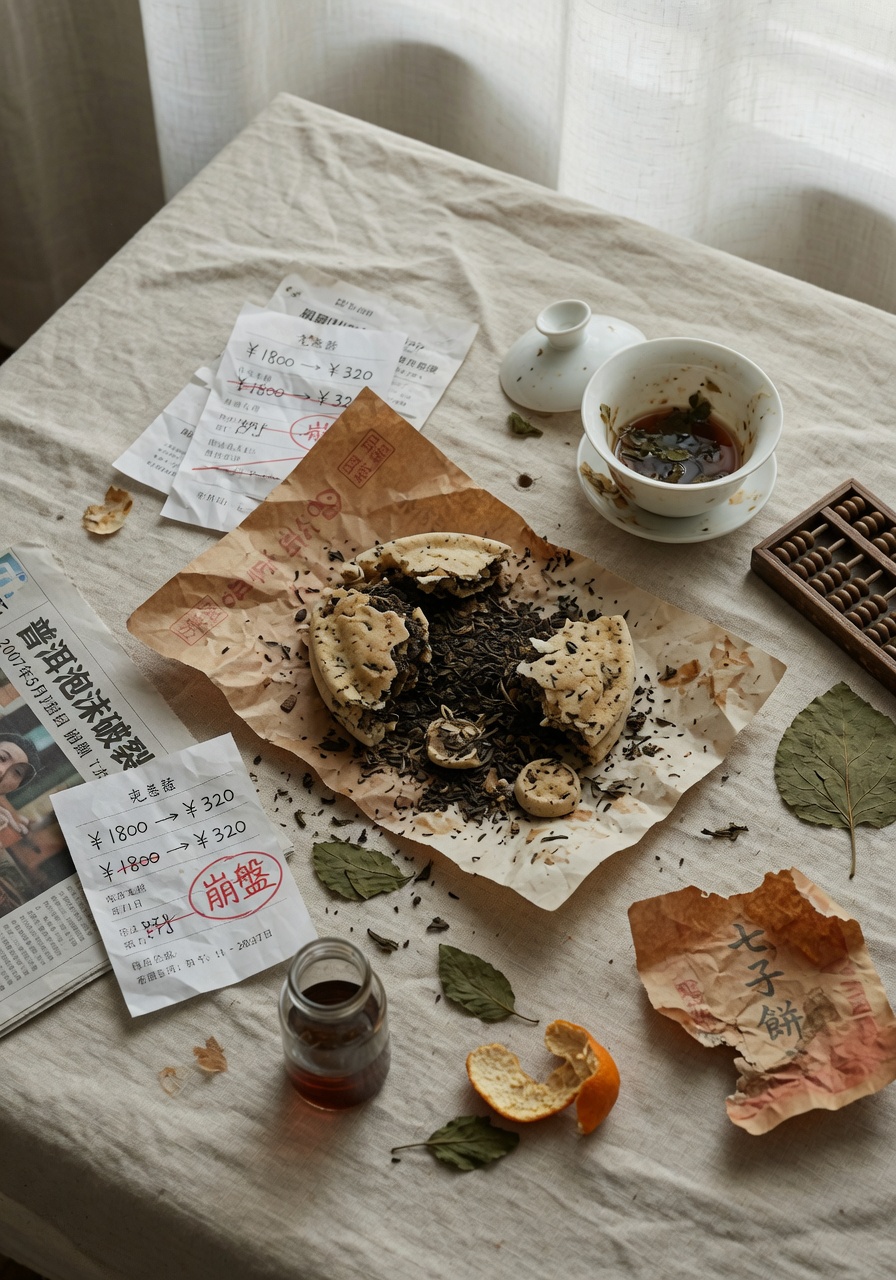
There is a photograph that circulated widely on Chinese tea forums in 2008 — a Guangzhou warehouse in Fangcun, fluorescent light, pallets of Dà Yì (大益) cakes stacked from floor to ceiling, and a man sitting on a stool with his head in his hands. By the time the photo was taken, the wholesale price of a standard 357 g 7542 cake had fallen from roughly ¥220 in April 2007 to under ¥40 by autumn. Some recipes lost 80% of their paper value inside a single quarter. Producers who had borrowed against expected orders found themselves with finished cakes, no buyers, and bank officers calling daily.
The 2007 crash is the single most important commercial event in the modern history of pu’er, more consequential than any harvest year or recipe revision. It ended a speculative bubble that had inflated since roughly 2003, killed several mid-sized factories outright, and reshaped how the category is bought, stored, and discussed today. It also produced a generation of drinkers — including me, working out of Ulan-Ude in 2007 buying tea overland from Kunming — who learned the difference between a tea you drink and a tea you trade the hard way.
This article reconstructs what happened, why, and what the category looked like on the other side. The story is not only about money. It is about what happens when a slow craft — chén huà (陈化), the decades-long maturation of compressed leaf — collides with quarterly returns and bank credit. For the deeper background on how the category formed before this period, see the entry on the Tea Horse Road era on thetea.app and our companion piece on Menghai county.
The setup — how Yunnan got hot
The bubble had a clear starting point. In 2003 the State Administration for Industry and Commerce ratified the geographic indication for pu’er, a process completed in the GB/T 22111-2008 standard that would formally define the category. The recognition was bureaucratic, but its effect on capital was not. For the first time, pu’er had a legal definition tied to Yunnan terroir, which meant a story investors could underwrite. Hong Kong and Taiwanese collectors — who had quietly been the main buyers of aged Menghai and Xiaguan cakes since the 1980s — were joined by mainland money from Guangdong, then Shanghai, then everywhere. Between 2004 and early 2007, the price index for Dà Yì 7542 rose roughly seven-fold. Xiàguān (下关) tuocha, Liming, Haiwan — all followed the same curve.
What made pu’er specifically vulnerable to speculation was its central premise: the tea is supposed to improve with age. That premise — true within limits, see sheng vs shu — gave the asset a built-in narrative for holding rather than drinking. You could store a cake the way you store wine, except cheaper, lighter, and without temperature control if you were careless. Wholesalers in Fangcun, Guangzhou’s tea market district, began trading paper tickets against pallets they never physically moved. By 2006, a freshly pressed cake from a name factory could change hands four or five times before reaching anyone who intended to brew it.
The role of Menghai Tea Factory
Měnghǎi Chá Chǎng (勐海茶厂) — privatised in 2004 and rebranded under the Dà Yì mark — was the engine of the boom. Recipes like 7542 (sheng) and 7572 (shu, covered in our Menghai 7572 article) were the blue-chip instruments. Each year’s batch carried a four-digit lot number and a production sequence, and these became tradable units the way vintage Bordeaux futures are. The factory’s output capacity in 2006 was reportedly above 8,000 tonnes, much of it pre-sold to distributors who flipped allocations on signing.
Cash, credit, and counterfeits
Three factors accelerated the run. First, mainland Chinese consumer credit was unusually loose in 2005-2006, and pu’er was sold as a hedge against inflation. Second, several Yunnan local banks extended working-capital loans to factories using inventory as collateral — meaning the banks were long pu’er too. Third, counterfeit cakes flooded the market: by some estimates 60-70% of cakes sold as Dà Yì in Guangzhou in late 2006 were fake. When trust began to erode in early 2007, there was no way to discriminate quickly, and buyers walked away from the entire stack.
Spring 2007 — the break
The collapse was not a single moment but a cascade across roughly six weeks. The trigger most often cited is the post-Spring Festival re-opening of Fangcun market in late February 2007, when fresh stock from the 2006 autumn harvest hit shelves alongside enormous unsold inventory from the previous year. Prices had climbed so steeply in the preceding twelve months that even the marginal buyer — the speculator buying to flip — could no longer find a next buyer at a higher price. The structure failed the way pyramid structures fail: silently, then all at once.
By mid-April, wholesale 7542 had lost roughly half its February value. By June, two-thirds. The Yunnan provincial government convened emergency meetings in Kunming; several factory directors were quietly removed. Smaller producers in Lincang and Pu’er prefecture — many of which had expanded capacity in 2005-2006 on the assumption that demand would continue — went bankrupt or were absorbed. Lǎo Tóngzhì (老同志) under Zou Bingliang weathered the storm, as did Xiaguan, but dozens of newer brands disappeared. The maocha (rough tea) market in Menghai collapsed in parallel: leaf that had sold at ¥600/kg from Bulang in spring 2007 was changing hands at ¥80 by autumn. Farmers who had cut down lower-yielding gǔshù (古树) trees to plant younger, denser bushes — a story we cover in the gushu debate — found themselves with the wrong tea at the wrong moment.
What got destroyed, what got revealed
The financial damage was severe but bounded. Estimates from the Yunnan Tea Association suggest the total wholesale value of pu’er inventory fell from roughly ¥15 billion in spring 2007 to under ¥4 billion by year end. Several hundred small factories closed. The Menghai brand itself, however, recovered within eighteen months — partly because genuine buyers (drinkers, not flippers) returned at the new lower prices, and partly because the factory tightened its distribution network and clamped down on counterfeits with holographic seals introduced in 2008.
More interesting than the destruction was the revelation. The crash exposed what had been hidden by the rising tide. It became visible that most of the cakes traded between 2004 and 2007 had never been opened, never tasted, never assessed for storage. It became visible that a significant fraction of ‘aged’ tea on the market — sold as 1990s or even 1980s Menghai — was wet-stored Guangdong product of much more recent vintage, artificially aged in humid Hong Kong-style warehouses to mimic decades of natural change. It became visible that the relationship between price and cup quality had decoupled completely, and that many high-priced cakes were unpleasant to drink.
The return of the drinker
Through 2008 and 2009 a quieter market emerged — collectors and small vendors who actually opened cakes, brewed them, and wrote about what they tasted. Western forums like Half-Dipper and the early generation of Chinese-language tea blogs date from this period. The phrase hē chá (喝茶), ‘drink tea’, became a kind of corrective slogan against the speculative habit of cún chá (存茶), ‘store tea’. This was also when serious discussion of single-mountain teas — Yiwu, Bulang, Nannuo, Bingdao — began to displace the previous obsession with factory recipe numbers, a shift visible across our regional articles.
The second boom — gushu and the singles era
By 2010 the market had recovered, but it had also changed character. The new premium was not factory recipes but single-origin, old-tree material — gǔshù (古树) cakes from named villages: Lao Banzhang, Bingdao, Xikong, Mansong. The 2007 crash had punished generic inventory; the recovery rewarded provenance. A 357 g cake of authenticated 2008 Lao Banzhang spring pressing that sold for around ¥800 in 2009 was being asked at ¥30,000+ by 2017. In effect, speculation had not been eliminated — it had migrated up-market, attaching itself to scarcer and more verifiable material.
The consequence for ordinary drinkers was complicated. Mid-tier sheng — well-made village blends from Menghai, Lincang, and the Yiwu area — became, for several years after 2007, genuinely affordable and genuinely good. Many drinkers who entered the category in 2008-2012 still consider that window the best buying period in modern memory. Conversely, the upper tier separated and never returned to earth. For practical guidance on navigating young sheng in the post-crash market, see our piece on the five-year question.
What 2007 means for buyers today
Three lessons survive. First, age is necessary but not sufficient. A poorly made or poorly stored cake does not become good by sitting on a shelf for fifteen years — it becomes an old bad cake. The market between 2004 and 2007 absorbed enormous tonnage of indifferent leaf on the assumption that time would fix it; much of that tea is now circulating as ‘aged’ inventory and is, frankly, not worth drinking. Second, storage history matters as much as production year. The dry-stored Kunming cake and the wet-stored Hong Kong cake of the same vintage are different teas with different cup profiles, and the price difference often reflects this honestly only at the higher end of the market.
Third — and this is the lesson I find most useful, fifteen years into selling pu’er across the Russian-Mongolian border — the category is healthiest when the people buying it are people who intend to drink it. Speculation does not destroy pu’er, but it distorts the signals. After 2007, the signals got cleaner for a while. They are murkier again now. If you are building a personal collection, the discipline that protects you is the same one that protected drinkers in 2007: open the cakes, brew them, take notes, and value what is in the cup over what is on the wrapper. For deeper reading on storage decisions, the tea school at tea.school has a course on Yunnan-region storage that I helped review in 2022.
References
- GB/T 22111-2008 — Geographical Indication Product: Pu'er Tea — Standardization Administration of the People's Republic of China
- Yunnan Tea Industry Development Report 2008 — Yunnan Tea Association (云南省茶叶协会)
- Zhang Jinghong, Puer Tea: Ancient Caravans and Urban Chic (2014) — University of Washington Press
- Menghai Tea Factory annual production records, 2003-2008 — Dà Yì Group archives, partial republication in Pu'er Magazine (普洱杂志) issue 47
- Half-Dipper archive, 2008-2010 entries on Fangcun market conditions — Hobbes (independent blog)
Read next
Related articles
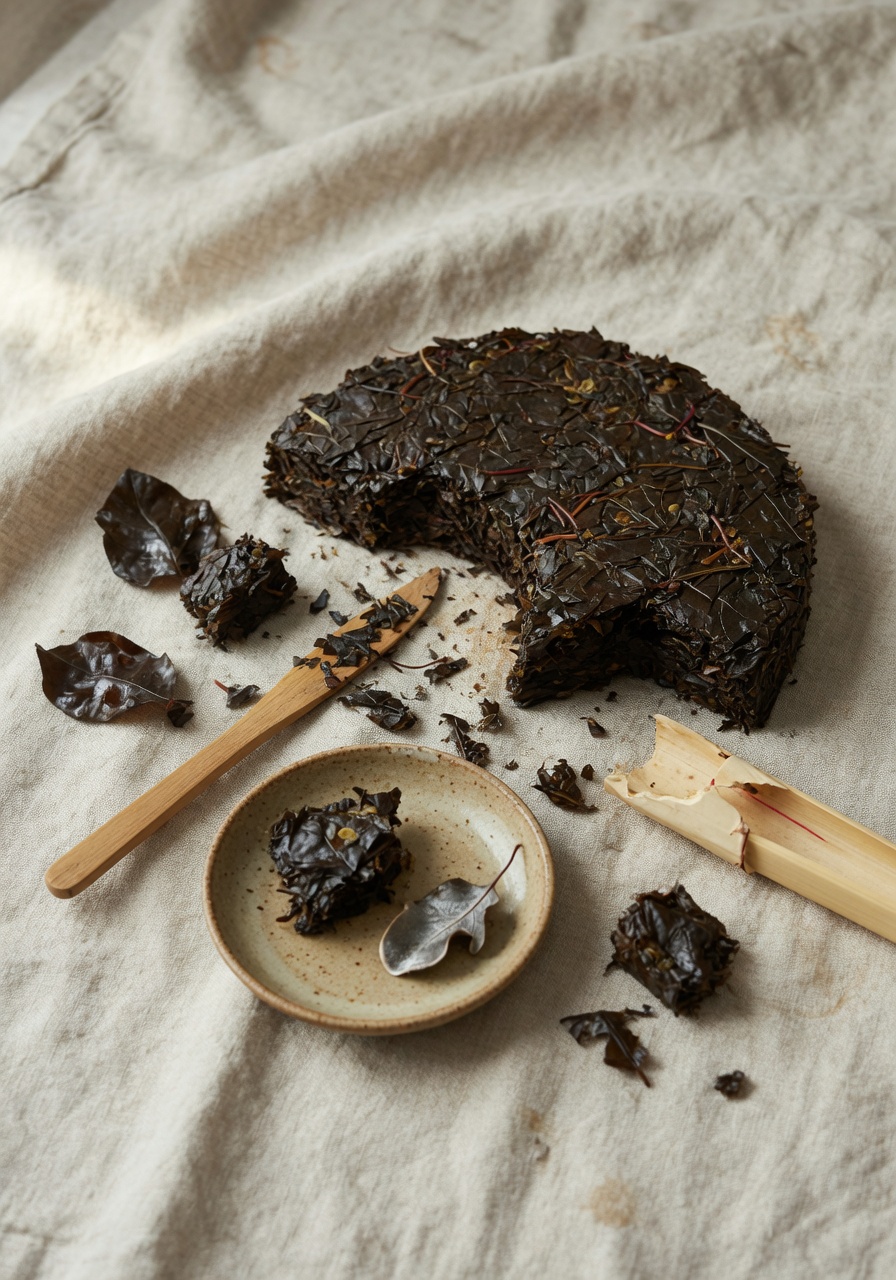
Menghai 7572 — the recipe that anchors the category
A four-digit code stamped on a paper wrapper has done more to define what shu tastes like than any single mountain or master. This is how 7572 became the reference point.
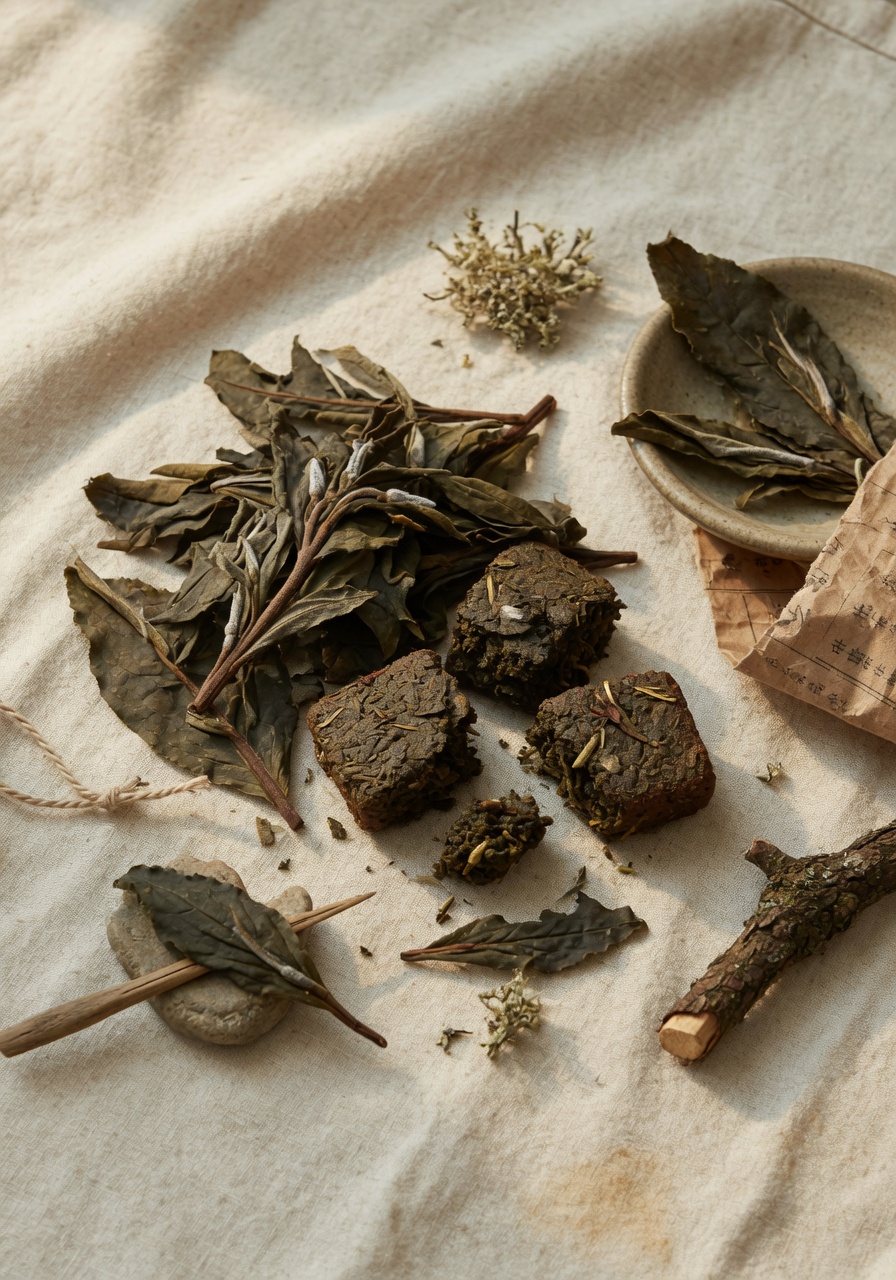
Gushu / 'old tree' tea — what's real, what's marketing
The term *gǔshù* (古树) sells more cake than any other two characters in Yunnan. Most of what's labelled gushu is not. Here's how to read the claim — botanically, contractually, and in the cup.
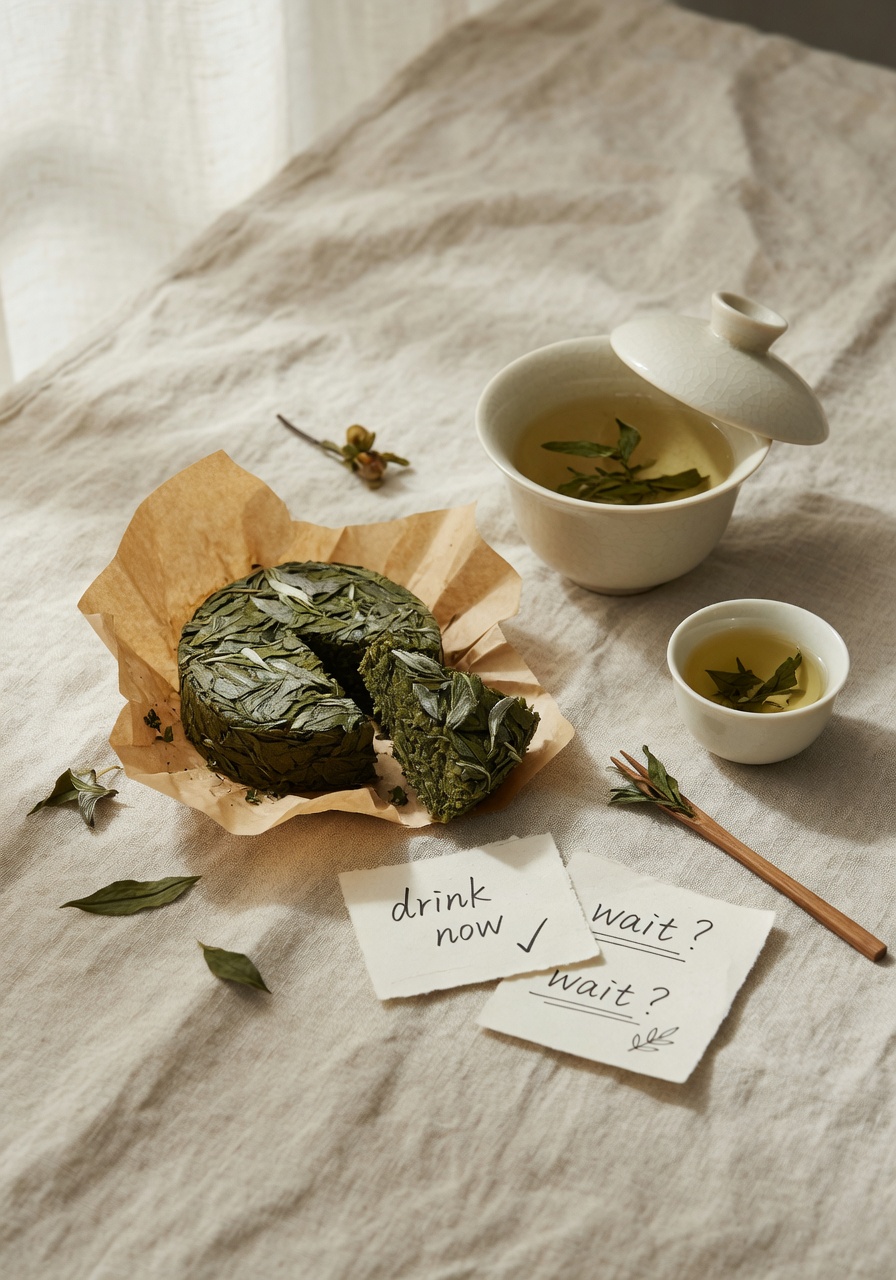
Young sheng — drink now or wait?
The question every collector asks within their first year. Some cakes are radiant at eighteen months; others need a decade before they stop biting. Here is how to tell which is which.
Menghai county — birthplace of modern shu
A flat-bottomed valley at 1,200 m, ringed by Bulang and Nannuo mountains, where in 1973 a state factory perfected pile fermentation and changed pu-erh forever.