home · Six centuries of <em>pu'er</em> — caravans, courts, and crashes
History & culture
Tribute tea under the Qing — pu'er at the imperial court
*Gòng Chá* · 贡茶
For nearly two centuries, compressed tea from the six famous mountains of Yunnan travelled three thousand li to the Forbidden City. The tribute system shaped the cakes we still press today.
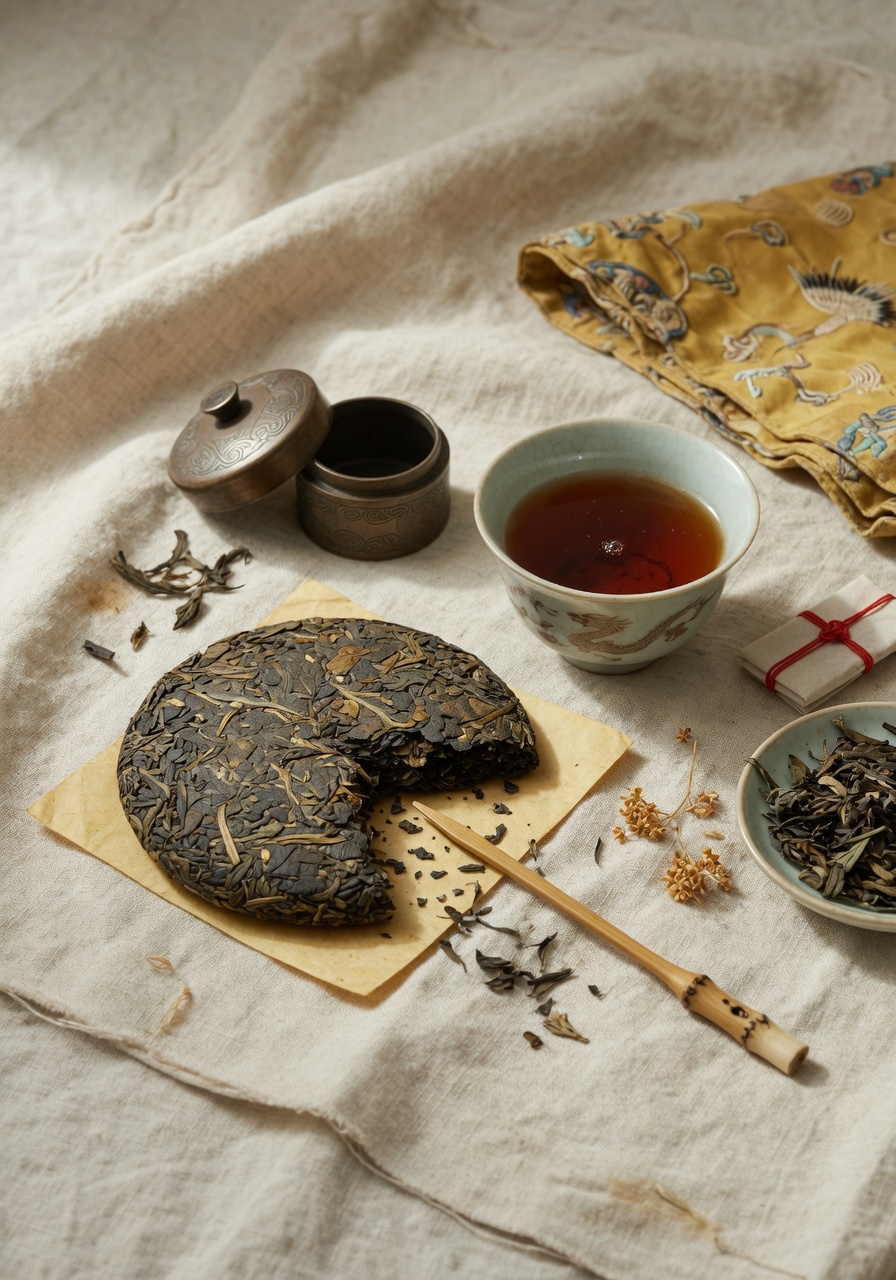
Most stories about pu’er begin in the 1970s with the wò duī (渥堆) pile-fermentation experiments at Kunming and Menghai. That telling skips two hundred years of imperial pressure that determined why pu’er is round, why it weighs what it weighs, why it travels in stacks of seven, and why the leaves come from a handful of mountains in Xishuangbanna rather than the much larger growing zones of Lincang or Pu’er prefecture proper. The Qing court did not invent pu’er — Tang and Song records mention compressed tea from the southwest — but the Qing tribute system, gòng chá (贡茶), turned a regional caravan good into a court luxury with codified specifications, sealed warehouses, and named gardens whose reputations still anchor today’s market. From the late Kangxi reign (around 1729, when Yunnan’s tea districts were formally brought under Qing administration) to the abolition of tribute in 1908, the imperial household consumed pu’er continuously. The Qianlong Emperor wrote poetry about it. The Empress Dowager Cixi reportedly drank it after heavy meals. Lhasa monasteries received it as diplomatic gift. And the merchants of Yiwu and Yibang grew rich, then poorer, then rich again, riding the slow collapse of the system into the Republican period. This article traces what the tribute requirement actually demanded — in kilograms, in cake counts, in tax silver — and how those demands left a permanent mark on the shape, the storage habits, and the geography of the tea we now call sheng pu’er.
Before the Qing — pre-tribute caravan tea
Yunnan tea travelled north long before the Manchu court existed. Tang-era texts from the ninth century, including Fan Chuo’s Mán Shū (蛮书, c. 863), record that the Mang barbarians of the Yin Sheng region drank tea boiled with pepper, ginger and cassia — a description that almost certainly refers to broad-leaf Camellia sinensis var. assamica from what is now southern Yunnan. By the Ming, caravans were carrying compressed tea along the Chá Mǎ Gǔ Dào (茶马古道), the tea-horse road, trading it to Tibetan kingdoms for horses needed by Han armies on the northern frontier. The tea was not yet pu’er in the codified Qing sense. It was simply tuán chá (团茶), ‘lump tea’, compressed for transport because loose leaf would not survive twelve weeks on a mule’s back across the Mekong gorges. What changed under the Qing was administrative. In 1729 (Yongzheng 7), the court established the Pu’er Prefecture (普洱府) and placed the six famous mountains — Yōulè, Gémǎng, Mǎngzhī, Mànzhuàn, Yǐbāng and Mànsā (later Yiwu) — under direct fiscal supervision. Tea from these specific mountains, processed to specific standards, became tribute. Everything else became commercial caravan tea, taxed but not court-bound.
The tribute specification — what the court actually asked for
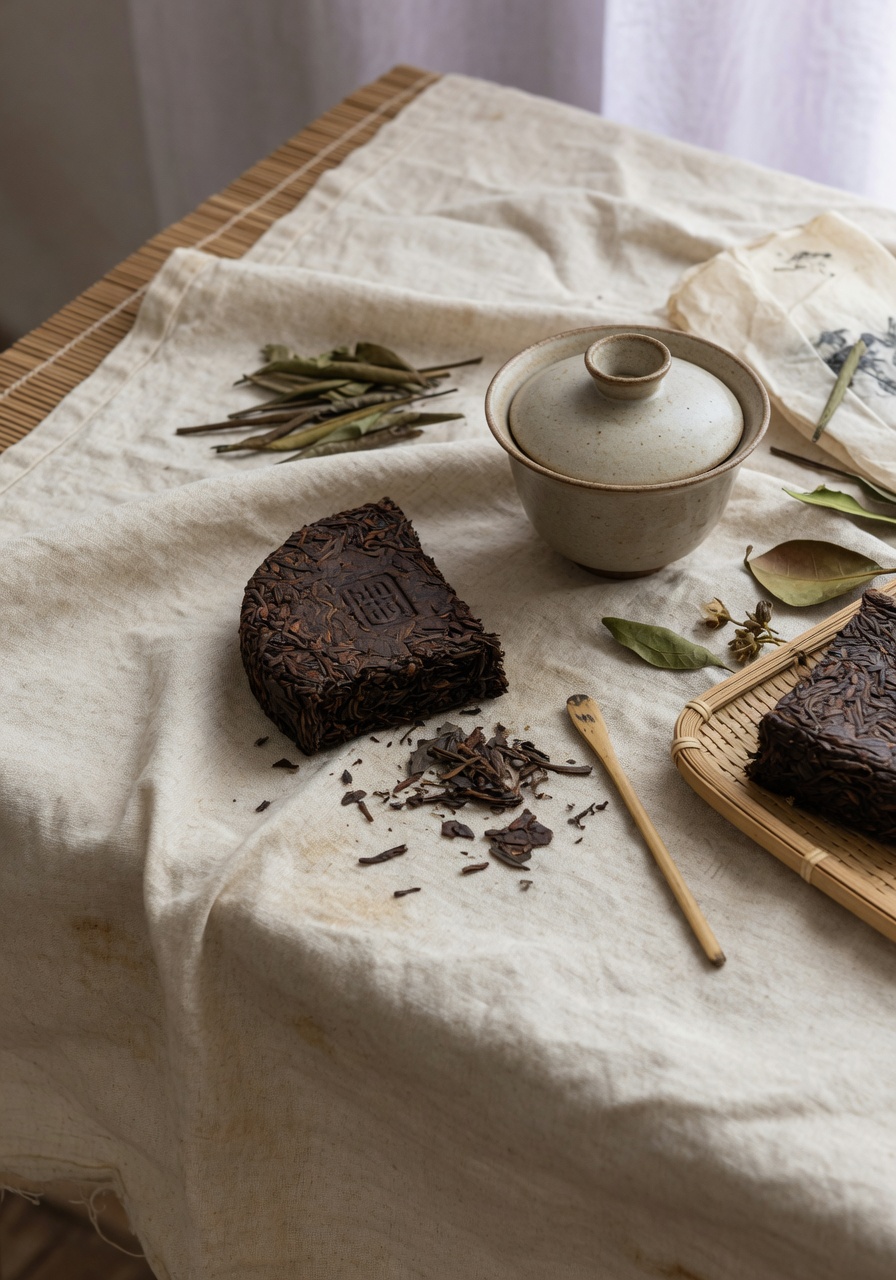
Tribute pu’er was not a vague category. The Pǔ’ěr Fǔ Zhì (普洱府志, Pu’er Prefecture Gazetteer) of 1850 records eight specific forms required annually: five-cheng tea (五成茶), bud tea (芽茶), woman tea (女儿茶, picked by unmarried women from the youngest spring buds), buds in cotton bags, brick tea, tuó tea, fragrant pillow tea, and tuán chá in graded sizes. The total annual obligation reached roughly 6,600 jin — about 3,960 kilograms — by the mid-Qianlong period, split between consumption inside the Forbidden City and re-gifting to Mongol nobles, Tibetan lamas and visiting embassies. The famous seven-cake stack (qī zǐ bǐng chá, 七子饼茶) traces directly to this tribute logic. Each cake weighed seven Chinese ounces, seven cakes wrapped in bamboo husk made one tǒng (筒), twelve tǒng made one mule load of roughly 30 kilograms — the maximum a Yunnan mule could carry up the Wuliang range without breakdown. The number seven was practical (it divided cleanly into the standard caravan unit) and auspicious, and the format was never afterwards abandoned. When the Menghai Tea Factory standardised modern pu’er weights in 1957 it kept the 357-gram cake — a metric rounding of the original seven-Chinese-ounce specification.
Woman tea and the early-spring bud grade
The highest tribute grade, nǚ’ér chá (女儿茶), came from the first flush of single buds picked between Qīngmíng (around 5 April) and Gǔyǔ (around 20 April). The name has been romanticised — the gazetteer simply notes that the lightest, most delicate work fell to unmarried young women in the picking households. The buds were sun-dried, lightly steamed and pressed into small tuó shapes weighing about four Chinese ounces. Surviving samples from the Palace Museum in Beijing, examined in a 2007 inventory, included tightly compressed bud-only tuó that had hardened almost to wood after two hundred years of dry Beijing storage. Two were brewed for the inventory team. The liquor was reportedly thin, woody, faintly camphorous — a useful data point for anyone arguing about the upper limit of dry-stored sheng ageing.
The six famous mountains as protected origin
Yongzheng-era tribute regulations effectively created the first protected-origin system in pu’er. Tea offered as gòng chá had to come from named gardens on the six mountains east of the Mekong: Yōulè, Gémǎng, Mǎngzhī, Mànzhuàn, Yǐbāng and Mànsā. Tea from west of the river — Bulang, Nannuo, the Menghai plain — was commercial only, and sold at a discount of 30 to 40 percent per jin in Simao market records of the 1780s. This east-bank premium persisted into the Republican period and explains why Yiwu and Yibang names still carry the most weight in today’s auction catalogues, while the equally old gardens of Bulang Shan and Nannuo Shan only gained reputation after 1950.
The caravan route — Yiwu to Beijing in 100 days
Once pressed and stamped with the producing hào (号, trade-house seal — Tongqing Hao, Songpin Hao, Chesun Hao among the famous), tribute tea began a journey that took, in good weather, between ninety and one hundred and twenty days. From Yiwu the caravans climbed northwest to Simao (modern Pu’er city), then to Kunming, then through Qujing into Guizhou, across Hunan, up the Grand Canal from Yangzhou, and finally overland to the capital. Mules carried the load to Kunming; from Kunming northward it transferred to porters and river boats. Records from the Tongqing Hao archive — partially preserved at the Yunnan Provincial Museum — show that the 1842 tribute shipment lost 14 percent of its weight to monsoon humidity in Hunan, which the merchants had to make good from their own stock. The slow, humid transit was the first lesson the trade learned about what we now call shēn fā (陈化), post-production transformation. Tea that left Yiwu green and astringent arrived in Beijing already softened, darker in liquor, with the camphor and dried-fruit notes that the court came to expect. In effect, the journey itself was the first deliberate wet-storage protocol — a fact Hong Kong storage merchants of the 1950s were well aware of when they began their own warehouse practice. For more on how that transit shaped modern aging theory, see our storage guide and the related discussion at tea.school.
Court use — how the Qing actually drank pu’er
Inside the Forbidden City pu’er had three uses, each documented in Imperial Household Department (nèi wù fǔ, 内务府) records. First, daily consumption by the emperor and senior consorts, typically as a digestive after the heavy meat-heavy Manchu cuisine. The Qianlong Emperor’s medical diary records pu’er prescribed for jī zhì (积滞, food stagnation) on at least forty-six occasions between 1751 and 1789. Second, ceremonial use during New Year audiences with Mongol and Tibetan delegations, where bricks and tuó were presented as imperial favour. Third, re-gifting to foreign embassies — the famous British Macartney mission of 1793 left Beijing with two cases of ‘Pu-erh tea cakes’ which George Staunton later described in his journal as ‘a coarse dark leaf, pressed into round flat loaves, of strong earthy flavour, much esteemed by the Tartars’. Court brewing technique was not the small-pot gōng fū style we associate with Chaozhou. Imperial records describe pu’er broken into chunks, boiled briefly with a knob of fresh ginger, sometimes with milk added in the Mongol fashion. This boiling-with-milk preparation survived in Mongolia and Buryatia into the twentieth century — a continuity that any cross-regional specialist working between Yunnan and the steppe still encounters today.
The Tongqing Hao era — the great trade houses
The economic peak of tribute-era pu’er came in the late nineteenth century, between the Tongzhi restoration (1862) and the Boxer disaster (1900). During these decades roughly thirty named hào operated in Yiwu town alone, the largest being Tóngqìng Hào (同庆号, founded 1736), Sòngpìn Hào (宋聘号), Chēshùn Hào (车顺号), Tóngxīng Hào (同兴号) and Yuán Chāng Hào (元昌号). Their pressed cakes survive in small numbers in Hong Kong and Taiwanese collections and define the upper market — a single 1920s Tongqing Hao cake sold at China Guardian’s Beijing auction in November 2019 for 1.04 million yuan, approximately 2,900 yuan per gram. These cakes were tribute-grade leaves from the original six mountains, processed in the traditional way (sun-dried máo chá, light stone-press, bamboo-husk wrap), then stored — accidentally rather than by design — in the humid warehouses of Hong Kong and Malaysia for sixty to ninety years. Their flavour, often described as camphor, aged wood, ginseng broth and a sweetness compared to old rancio sherry, is the reference point against which all aged sheng is judged. Whether modern gushu production from the same villages can reach the same end-state in fifty years is the central speculative question of the contemporary collector market.
Why the system collapsed
The tribute system ended in 1908 with the abolition of formal gòng chá requirements, but the real collapse came in the 1930s. Three factors compounded. The opening of the Burma Road in 1937 redirected trade flows. The Sino-Japanese war cut off the Beijing and Hong Kong markets. And a series of village-level diseases in Yiwu in 1942 — possibly typhus, possibly huí guī rè (relapsing fever) — killed or scattered much of the picking workforce. By 1949 only three of the great Yiwu hào still operated, and within a decade all were absorbed into the state cooperative system that became the Menghai and Kunming tea factories.
What the tribute era left us
Four practical inheritances are still visible in any modern pu’er pressing. First, the 357-gram round cake, descended from the seven-Chinese-ounce tribute specification. Second, the seven-cake bamboo-husk tǒng, sized to the mule load. Third, the reputational primacy of the six famous mountains east of the Mekong — Yiwu cakes still command a 40 to 60 percent premium over equivalent-leaf cakes from west-bank villages of similar age and elevation. Fourth, and most importantly, the empirical knowledge that compressed sheng changes character over time in warm humid conditions. The Qing court did not theorise post-fermentation; it simply observed that pu’er arriving in Beijing in October tasted better than pu’er drunk fresh in Yunnan in April. Hong Kong storage merchants of the 1950s, Taiwanese collectors of the 1990s, and the engineers who designed the 1973 wò duī protocol all built on this observation. The pile-fermentation that produced shu pu’er was, in effect, an attempt to compress the hundred-day caravan journey into a forty-five-day controlled fermentation. For collectors today the practical lesson is simpler. When you cut into a 1990s Yiwu cake and find that bright, slightly resinous, camphor-edged liquor that everyone is chasing, you are tasting the end-point of a system the Qing court designed without ever intending to.
References
- Pǔ'ěr Fǔ Zhì (普洱府志, Pu'er Prefecture Gazetteer) — Compiled under Daoguang reign, 1850; reprint Yunnan People's Press, 1998
- GB/T 22111-2008 — Geographical Indication Product: Pu'er Tea — Standardisation Administration of China
- Mán Shū (蛮书) by Fan Chuo, c. 863 CE — Tang dynasty ethnographic text; critical edition Zhonghua Shuju, 1962
- Zhou Hongjie, *Pǔ'ěr Chá Jì* (普洱茶记, A Record of Pu'er Tea) — Yunnan Science & Technology Press, 2004
- Yang Kai, *Chá Mǎ Gǔ Dào Yán Jiū* (茶马古道研究, Studies on the Tea Horse Road) — Yunnan University Press, 2009
- China Guardian Autumn Auction 2019, Lot 4137 — Tongqing Hao c. 1920 — China Guardian Auctions, Beijing, November 2019
Read next
Related articles
Yiwu — forest gardens of the Laos border
On the southern edge of Xishuangbanna, where the forest crosses into Laos, *Yì Wǔ* (易武) grows the softest, most aromatic *shēng* in Yunnan — a tea that built an empire, vanished for fifty years, and rebuilt itself from village memory.
Gushu / 'old tree' tea — what's real, what's marketing
The term *gǔshù* (古树) sells more cake than any other two characters in Yunnan. Most of what's labelled gushu is not. Here's how to read the claim — botanically, contractually, and in the cup.
Sheng vs shu — what actually changes
Two teas share a name, a region, and a leaf — and almost nothing else. The 1973 invention of *wò duī* (渥堆) split pu'er into raw and ripe, and the chemistry of that split still defines every cake pressed today.
Menghai county — birthplace of modern shu
A flat-bottomed valley at 1,200 m, ringed by Bulang and Nannuo mountains, where in 1973 a state factory perfected pile fermentation and changed pu-erh forever.