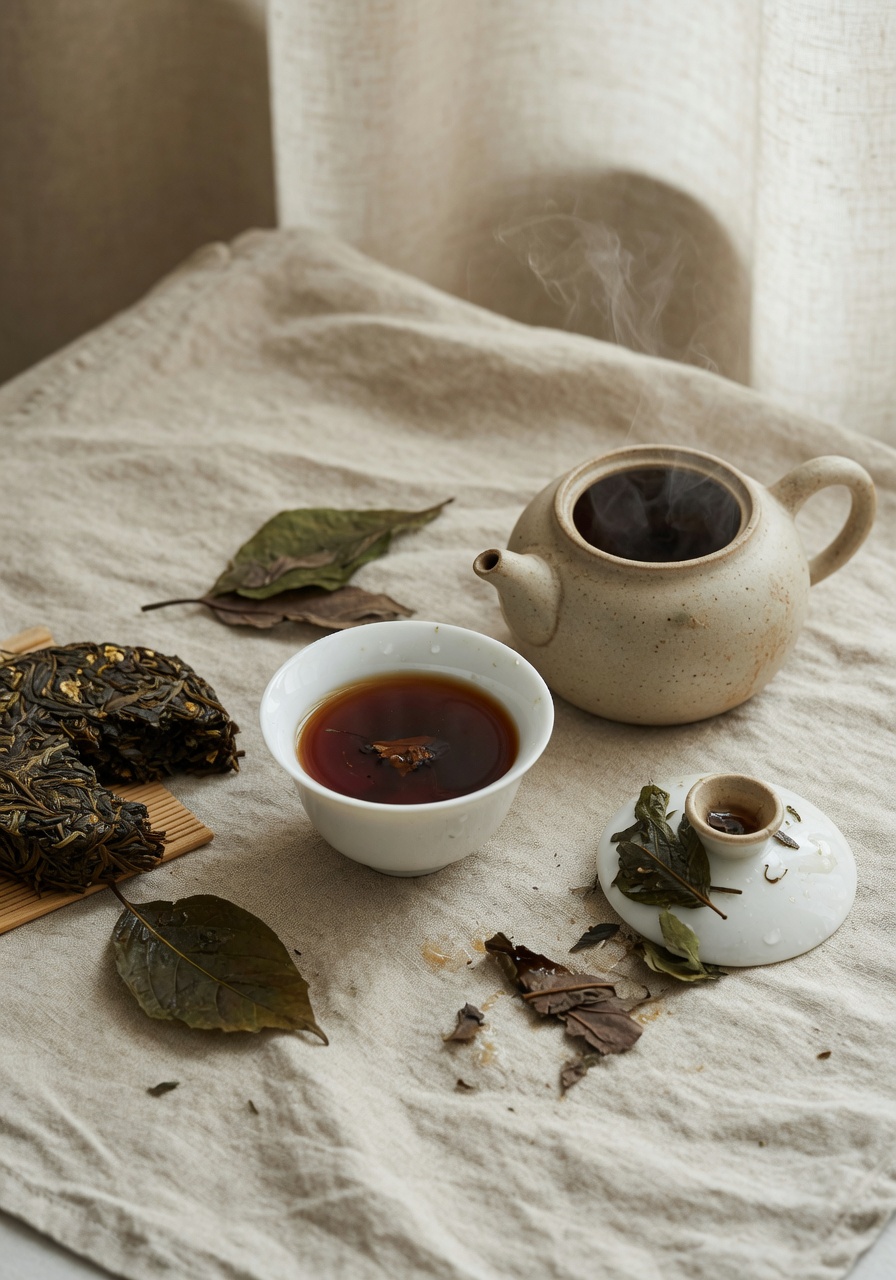
Four variables, one leaf
The Chinese verb for brewing tea — pào chá (泡茶) — literally means to steep, to soak. The word is deliberately undramatic. In Yunnan villages around Yiwu and Menghai, where most of the leaf in your cake originated, brewing is closer to cooking rice than performing ceremony: you do it three or four times a day, you know what your water tastes like, and you stop measuring once your hands learn the weights. Everything written below tries to compress those hands’ worth of knowledge into something portable.
Pu’er brewing splits along three axes. The first is age. A 2024 shēng (生) cake from Lao Banzhang is loaded with catechins and caffeine that bite if extracted carelessly — see Brewing young sheng without the bitterness for the short-flash, high-leaf-ratio approach that tames it. A 1998 dry-stored Yiwu, by contrast, has already done most of the work for you; the tannins have polymerised, the volatiles have shifted toward camphor and old wood, and what you need is heat and time, not technique. Brewing aged sheng — patience over precision walks through why a 30-second first steep on aged leaf is not a mistake but the point.
The second axis is shēng versus shóu (熟). Ripe pu’er, invented at the Kunming Tea Factory in 1973 (commercialised through Menghai Tea Factory shortly after), tolerates — and often requires — boiling water held at a full rolling boil throughout the session. The wet-piling process has already broken down the leaf’s structure; you cannot over-extract a shou the way you can over-extract a sheng. Young sheng wants water just off the boil, around 92–96 °C depending on altitude. Aged sheng, again, wants the full 100 °C.
The third axis is vessel. Porcelain gaiwan is the neutral instrument — it shows you exactly what the leaf is doing, which is why every tea-school curriculum, from tea.school’s introductory module onward, teaches gaiwan first. Yixing clay (宜兴) is the editorial instrument: it rounds, it absorbs, it remembers. Vessel choice — Yixing for pu’er — when clay matters, when it doesn’t argues that zhū ní (朱泥) clay genuinely transforms aged shou, but a young sheng you are still evaluating belongs in glass or porcelain where nothing is hidden.
Three brewing modes matter in practice. Gongfu — 6–8 g per 100 ml, ten-plus short infusions — is the diagnostic mode, the one that tells you what a tea actually is. Grandpa style — a pinch of leaf in a tall glass topped up all day — is how most older Yunnanese drinkers actually brew, and it works astonishingly well for mid-aged sheng. Boiling — the zhǔ chá (煮茶) method, leaves dropped into a simmering kettle — is reserved for spent gongfu leaves, for lǎo chá tóu (老茶头, ripe-tea nuggets), and for genuinely old (25+ years) material that has nothing left to lose.
Water is the silent fifth variable. Soft, low-mineral spring water (TDS roughly 30–80 ppm) lets pu’er speak; municipal water with chloramine flattens everything. If your tap water tastes of anything other than water, filter it. For deeper coverage of vessels, kettles, and water itself, tea.equipment maintains a working reference catalogue updated quarterly.