home · author
The team
Chen Hui Yi
Senior Tea Expert (White, Green & Yellow Tea Varieties)
Guangdong
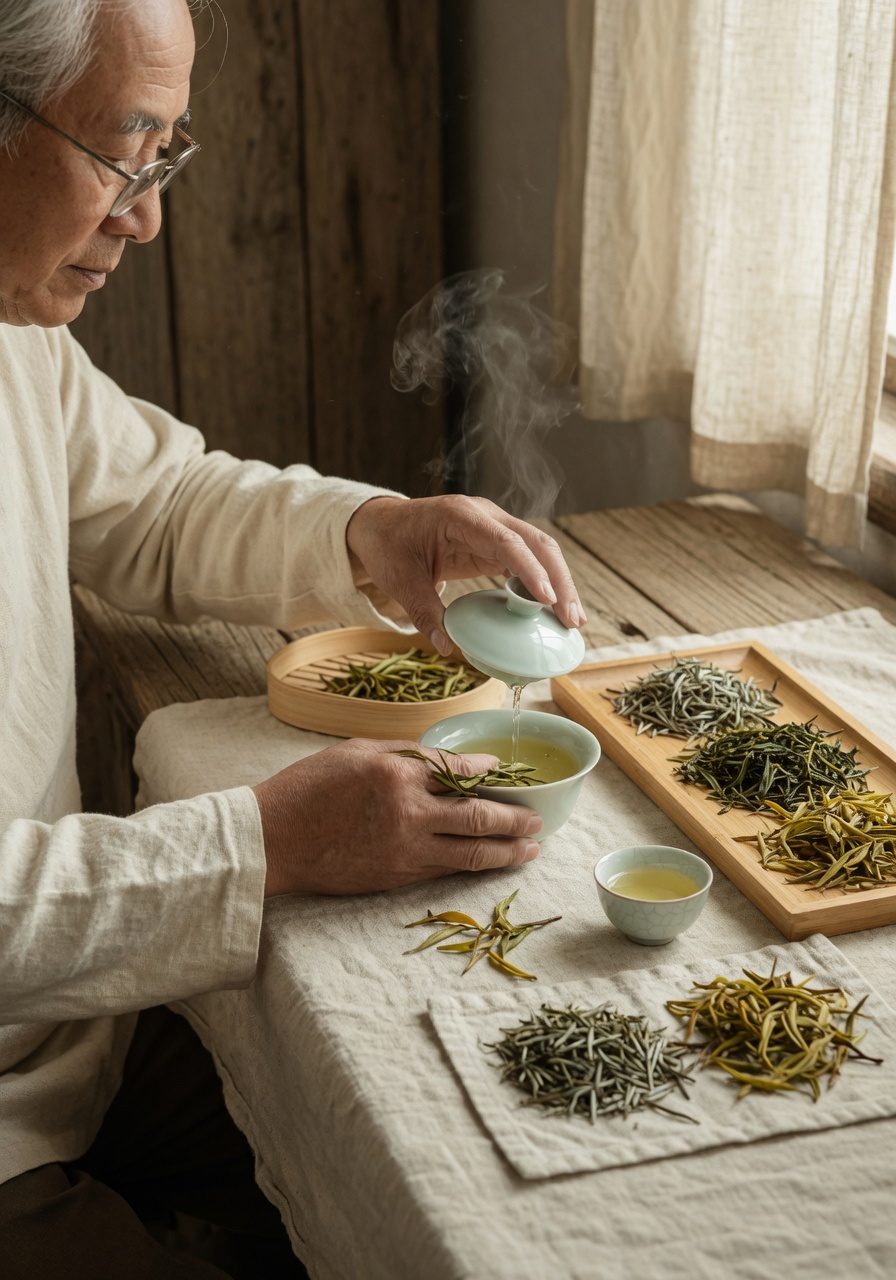
Chen Hui Yi grew up in Chaozhou, where the morning fog off the Hán Jiāng carried the smell of roasting dān cōng through her grandmother's courtyard. Her tea education, however, took a different turn. At seventeen she travelled north to Fúdǐng in Fújiàn for what was meant to be a six-week apprenticeship at a small báichá workshop in Diǎntóu town — she stayed for four years. There she trained under Wú Jiànlì, a third-generation withering master who taught her to read the difference between rì guāng wěi diāo (sun withering) and fù shì wěi diāo (compound withering) by the sound the leaves make when shifted on bamboo shuǐ shāi trays. That tactile, weather-reading approach became the spine of her practice.
Chen returned to Guangdong in 2011 and built her working life along a triangle she still maintains today: the Fúdǐng gardens above 600 m in Tàimǔ Shān for Bái Háo Yín Zhēn (白毫银针) and Bái Mǔ Dān (白牡丹), the Jǐnggǔ region of Yúnnán for yuè guāng bái (月光白, moonlight white) from large-leaf Camellia sinensis var. assamica stock, and her own small cellar in Cháozhōu where she has been ageing pressed shòu méi (寿眉) cakes since 2013. The cellar is monitored to GB/T 22291-2017 storage guidance — 25 °C ceiling, relative humidity held between 55 and 65 percent — and now holds vintages from eleven consecutive harvests. Her notes on the 2014 and 2016 Fúdǐng pressings are the source material for much of her aged-white writing.
On puerh.app her work sits at the intersection where collectors of shēng pǔ'ěr begin asking about other ageable teas. She is the author the editorial team turns to when a piece needs the long view on dry-storage chemistry, on cellulose and polyphenol behaviour across a decade, on why a 2008 shòu méi cake and a 2008 Yìwǔ shēng answer humidity so differently. Readers will find her contributions threaded through the storage guide and the comparison entries on moonlight white versus young shēng — both areas where the two categories share a vocabulary but diverge in chemistry.
Her signature contribution to the constellation is the white-tea curriculum at tea.school, which she rewrote in 2022 around three withering archetypes rather than the older grade-based outline. She also serves as the vendor expert for white, green and yellow varieties on shop.thetea.app, where her tasting notes accompany every release, and consults on aged-white identification questions submitted through tea.doctor. She is occasionally on the road for tea.travel, leading small groups through the Tàimǔ Shān gardens in late March, timed to the first picking of yín zhēn buds.
Chen writes in a register that assumes the reader has already drunk the tea once and wants to understand what they tasted. She prefers structural description — leaf set, withering depth, moisture gradient — to flavour metaphor, though she will yield to the latter when a tea genuinely demands it. Her northern Guangdong upbringing surfaces mainly in her patience with long sessions and her insistence that a serious white tea, like a serious gōng fū chá session, rewards the drinker who waits for the third or fourth steep before forming an opinion.
Specialties
- white tea
- green tea
- yellow tea
- yinzhen
- shou mei
- bai mu dan
- moonlight white
- aged whites