home · The <em>raw</em> leaf, and the long wait it asks for
Sheng pu'er — material grades
Huangpian — the yellow leaves nobody wanted
Huáng Piàn · 黄片
The oversized, pale leaves sorted out of premium sheng cakes were once treated as waste. A generation of drinkers has quietly turned that waste into one of the most honest cups in the pu'er catalogue.
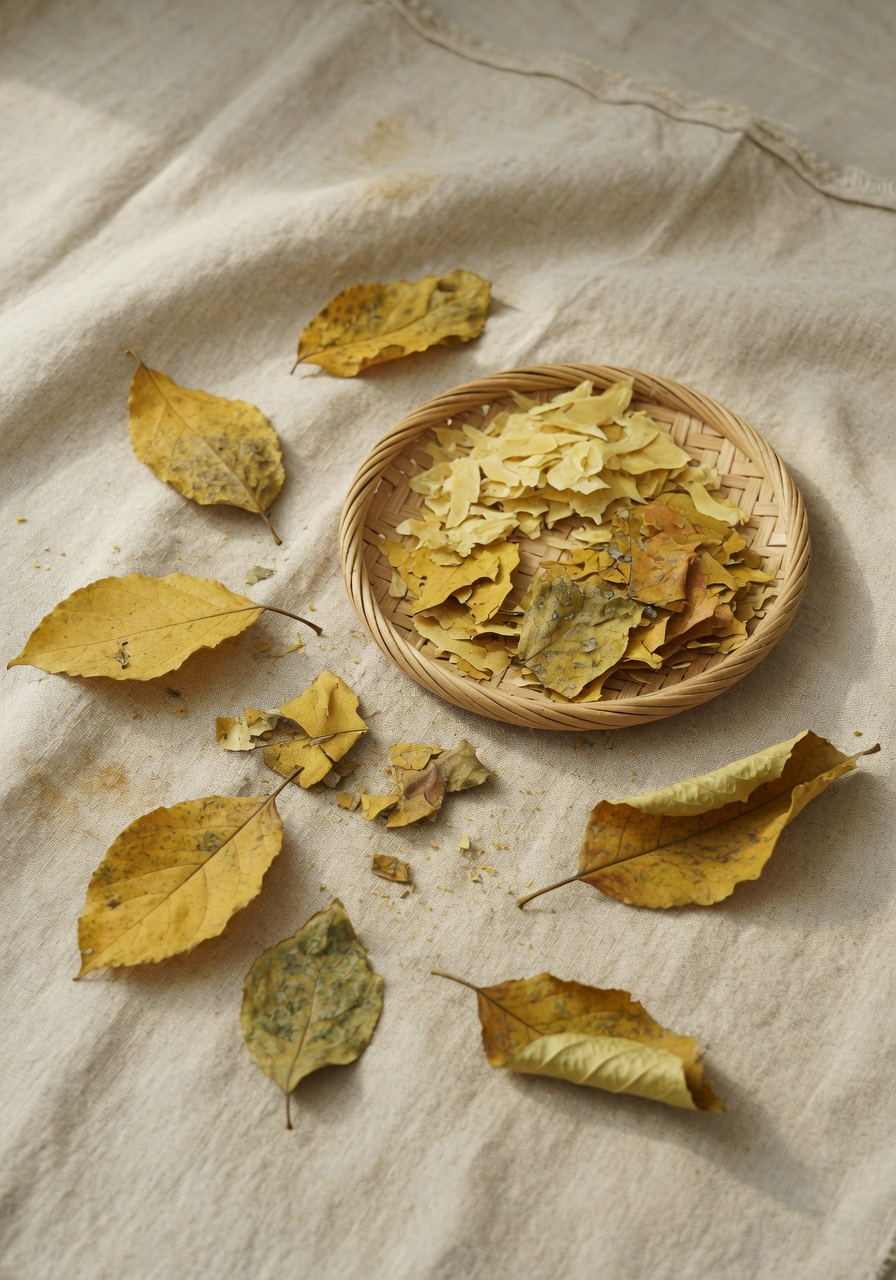
Walk through any sorting room in Menghai or Mengku during the spring rush and you will see them — broad, pale, almost parchment-coloured leaves piled in shallow bamboo trays beside the conveyor. They are huáng piàn (黄片), literally ‘yellow flakes’: the mature, oversized leaves that workers pick out of the máochá (毛茶) before it is weighed, graded and pressed into 357-gram bĭngchá. For most of the twentieth century these leaves were a problem. State factories like Menghai Tea Factory and Xiaguan rejected them because they refused to compress neatly, they broke the uniform appearance of a finished cake, and the official grading standard for raw material — codified in GB/T 22111-2008 and refined again in 2017 — penalised batches with too many of them. The leaves went home with the sorters, were brewed in clay kettles over the kitchen fire, or sold by the kilo to anyone who would haul them away. Then, sometime in the late 1990s, drinkers in Kunming and Guangzhou started asking for them by name. Today a careful huangpian from a single old-tree garden in Bulang or Yiwu can cost more per gram than the premium cake it was sorted out of. This article asks how that inversion happened, what huangpian actually is at the leaf level, and why a category that began as factory waste now occupies its own shelf in the cabinet of any serious sheng drinker.
What huangpian actually is
Huangpian is not a cultivar, not a region and not a processing style. It is a sorting outcome. When fresh leaf comes off the shāqīng (杀青) wok and is rolled, sun-dried and dumped into the máochá heap, the resulting mass is heterogeneous: tight twisted buds, dark green middle leaves, stems, and a small fraction of older, larger leaves that the picker took along with the bud-and-two. Those older leaves — typically the third, fourth or fifth leaf down the shoot — have more lignified cell walls, less chlorophyll relative to carotenoids, and a lower moisture content at harvest. In the wok they cook faster and dry paler. In the roller they refuse to twist tightly; they fold or crack instead. By the time the máochá is spread on the sorting table they are visibly different: broad, flat, the colour of straw or weak tobacco, sometimes with a green vein running through a yellow blade. The sorter pulls them out by hand or with a winnowing tray. What is left behind goes into the cake. What is removed is huangpian. The standard grading vocabulary for sheng máochá — tè jí (special grade) through grade nine — does not formally include huangpian as a tier; it is what falls outside the tiering, which is precisely what makes it interesting once you start drinking it on its own terms.
Why the colour shifts
The yellow tone is partly chemistry, partly process. Older leaves contain proportionally less chlorophyll-a, which degrades first under heat, and proportionally more lutein and other carotenoids, which survive shāqīng and read as yellow on the dried blade. They also accumulate more soluble sugars and fewer of the bitter polyphenolic compounds — particularly EGCG — that dominate young bud material. Research from the Yunnan Agricultural University tea chemistry programme (Zhou et al., 2015) measured roughly 18-22% total polyphenols in third-and-fourth-leaf material from Mengku old-tree gardens, versus 28-32% in single-bud material from the same trees on the same day. Less polyphenol, more sugar, more lignin — a chemical profile that maps directly onto the cup you eventually pour.
From waste stream to standalone product
The shift began informally. Sorters at Menghai and at smaller Yiwu workshops had always taken huangpian home — it was a perk of the job, like the broken biscuits a baker keeps. Through the 1980s and into the early 1990s the leaves were brewed strong and casual, the way a Henan farmer brews the last twigs of a green-tea harvest. The first time huangpian appeared in a commercial catalogue with a real price tag was, by most accounts, the late 1990s in Guangzhou’s Fangcun tea market, where merchants from the wholesale stalls began pressing small 100-gram bricks of selected huangpian and labelling them by mountain. The story is familiar to anyone who follows the wider pu’er trade — see the historical chronology on thetea.app for the same pattern with broken-leaf grades — but huangpian has a specific tipping point: the 2003-2005 sheng boom, when premium máochá prices in Yiwu tripled in two seasons. Drinkers who could no longer afford a standard cake from a famous village discovered that the huangpian sorted out of that same village cost a fraction and carried, in muted form, the same terroir signature. The leaves that had been swept off the floor became the affordable doorway into single-origin sheng.
The ‘lao huangpian’ market today
Lǎo huáng piàn (老黄片) — aged huangpian — is now a small but established sub-category. A 2019 survey of the Kunming Xiongda tea market by the journal Pǔ’ěr magazine counted 47 vendors offering huangpian as a labelled SKU, up from fewer than ten in 2010. Prices in spring 2024 for a properly stored, ten-year-old Bulang huangpian sat roughly between 280 and 600 RMB per 357 g cake — still well below a comparable bĭngchá from the same garden, but no longer a bargain-bin curiosity. The most sought-after pieces come from single-garden, single-day pickings where the sorter sets aside the huangpian deliberately, rather than pooling it from a week of mixed harvest.
How it tastes — and why drinkers fell for it
Brewed side by side with the cake it was sorted from, huangpian tells a quieter story. The aroma off the wet leaf in a preheated gàiwǎn is honeyed rather than floral — closer to dried longan or stewed apricot than to the green-orchid lift of a young Yiwu bud. The first infusion is pale gold, almost transparent. The mouthfeel is soft, sometimes almost watery in the first steep, then thickening from the third onward as the lignified cells finally release their sugars. There is very little of the kǔ (苦, bitter) and almost none of the sè (涩, astringent grip) that marks young single-bud sheng. What you get instead is sweetness, a long huí gān (回甘, returning sweetness at the back of the throat), and a curious staying power: a good huangpian will give eight or ten infusions of progressively deeper amber liquor before it fades. Fang Ting, who has worked with both Henan green-tea sorting lines and Yunnan pu’er material, puts it directly: ‘Huangpian is the part of the tree that has already lived a year longer. You taste the time.’ That sentence is the answer to why a generation of drinkers, including many tea-school students working through the curriculum on tea.school, now keep a cake of huangpian on the shelf as their everyday brew — not as a substitute for premium sheng, but as a different reading of the same garden.
Processing — same wok, different fate
Huangpian undergoes the same six-step máochá processing as the rest of the harvest: picking, withering, shāqīng in the wok at roughly 180-220 °C for three to six minutes, rolling, sun-drying on bamboo mats, and sorting. The divergence is at the sorting table, not before. This matters because it means huangpian carries the same fingerprint of pan-firing skill as the cake it came from: a clumsy shāqīng that leaves grassy notes will show up in the huangpian too, and a clean kill-green that preserves the enzyme work for slow aging will benefit the huangpian equally. For more on why this step is uniquely consequential for sheng — and how it differs from the shāqīng used for Longjing or Maofeng — see the dedicated piece on shāqīng for pu’er linked in the related articles. Some small workshops in Yiwu now run a separate, lower-temperature shāqīng specifically for huangpian, on the theory that older leaves cook faster and need a gentler hand. The practice is not standardised and not covered by GB/T 22111, but it is becoming more common among the boutique producers profiled on shop.puerh.app.
Pressed or loose
Historically huangpian was sold loose, by the jīn (500 g), in cloth sacks. Pressing it was considered impractical: the broad flat leaves trap air, the resulting cake is bulky and uneven, and the surface tends to flake. Since around 2010 a growing number of producers — Xizihao and Chen Sheng Hao among them — have pressed huangpian into 200- or 357-gram cakes anyway, partly for the convenience of long-term storage, partly because compression slows the loss of volatile aromatics. Loose huangpian stored in a paper-lined jar in Kunming conditions tends to fade in three to four years; the same material pressed into a cake will still be aromatic at ten.
Aging — does it follow the same curve
This is the open question. Sheng bĭngchá ages on a well-documented trajectory: bitter and floral at year one, awkward and hay-like through years three to seven, then opening into the deep camphor-and-stonefruit register that defines mature sheng from year fifteen onward. Huangpian, by contrast, starts soft and sweet. It does not have the same reservoir of bitter polyphenols to convert. What it does have is a high concentration of soluble sugars and a relatively high proportion of cellulose and pectin, which behave differently under slow oxidation. In practice, well-stored huangpian tends to deepen in colour and gain a denser, almost syrup-like body within five to eight years, then plateau. It does not develop the medicinal, camphoraceous profile of aged premium sheng. It becomes, instead, a richer version of itself — more amber, more honeyed, less pale. Whether that constitutes ‘aging’ in the connoisseur sense is a matter of definition. The argument is laid out in more detail in the companion essay on young sheng and the five-year question.
Buying huangpian — what to check
Three things separate good huangpian from the genuine sweepings-off-the-floor version. First, single-origin provenance: a labelled garden and a labelled picking date. Pooled huangpian from a season’s worth of mixed material will brew muddy and inconsistent. Second, the visual texture of the dry leaf — it should be broad and intact, not crumbled. Crumbled huangpian usually means it has been handled too many times or stored under pressure, and the cup will be thin. Third, the absence of stems. A small amount of chá gěng (tea stem) is unavoidable, but huangpian sold cheap is often padded with stem and even with the woody base of the shoot, which adds bulk and subtracts flavour. The 2017 revision of GB/T 22111 specifies a maximum stem content of 3% for the lowest official grade of sheng máochá; serious huangpian vendors hold themselves to a similar or stricter limit even though they are not formally required to. If you are starting a small comparative tasting — and this is the cleanest way to learn the category — pick three huangpian from three different mountains (Bulang, Yiwu, Lincang work well as a triangulation), all from the same harvest year, and brew them side by side in identical gàiwǎn at 95 °C, five seconds for the first three infusions. The differences will teach you more about Yunnan terroir, leaf-age-stripped of bud sweetness, than a year of reading.
References
- GB/T 22111-2008 (revised 2017) — Geographical Indication Product: Pu'er Tea — Standardisation Administration of China
- Zhou H., Li X., Wang J. — 'Polyphenol and carotenoid distribution across leaf positions in Yunnan large-leaf cultivar (Camellia sinensis var. assamica)' — Journal of Yunnan Agricultural University, vol. 30(4), 2015, pp. 612-619
- '黄片市场调查' (Huangpian market survey), 2019 — Pǔ'ěr magazine (《普洱》杂志), Kunming, issue 11/2019
- Zhou Hong-jie — Pǔ'ěr Chá: Lìshǐ yǔ Wénhuà (Pu'er Tea: History and Culture) — Yunnan Science & Technology Press, 2nd ed., 2012, chapters 4-5
- Interview with Fang Ting, recorded for puerh.app editorial archive — Teamotea editorial, March 2024
Read next
Related articles
Young sheng — drink now or wait?
The question every collector asks within their first year. Some cakes are radiant at eighteen months; others need a decade before they stop biting. Here is how to tell which is which.
Gushu / 'old tree' tea — what's real, what's marketing
The term *gǔshù* (古树) sells more cake than any other two characters in Yunnan. Most of what's labelled gushu is not. Here's how to read the claim — botanically, contractually, and in the cup.
Sha qing — kill-green for pu'er vs green tea
The pan-firing step that defines pu'er is not the same as the one that defines Longjing. Same name, same wok — different temperature, different intent, different future.
Yiwu — forest gardens of the Laos border
On the southern edge of Xishuangbanna, where the forest crosses into Laos, *Yì Wǔ* (易武) grows the softest, most aromatic *shēng* in Yunnan — a tea that built an empire, vanished for fifty years, and rebuilt itself from village memory.