home · The <em>cooked</em> half of the pu'er story
Shu pu'er · Menghai recipes
Menghai 7572 — the recipe that anchors the category
Měnghǎi qī wǔ qī èr · 勐海 7572
A four-digit code stamped on a paper wrapper has done more to define what shu tastes like than any single mountain or master. This is how 7572 became the reference point.
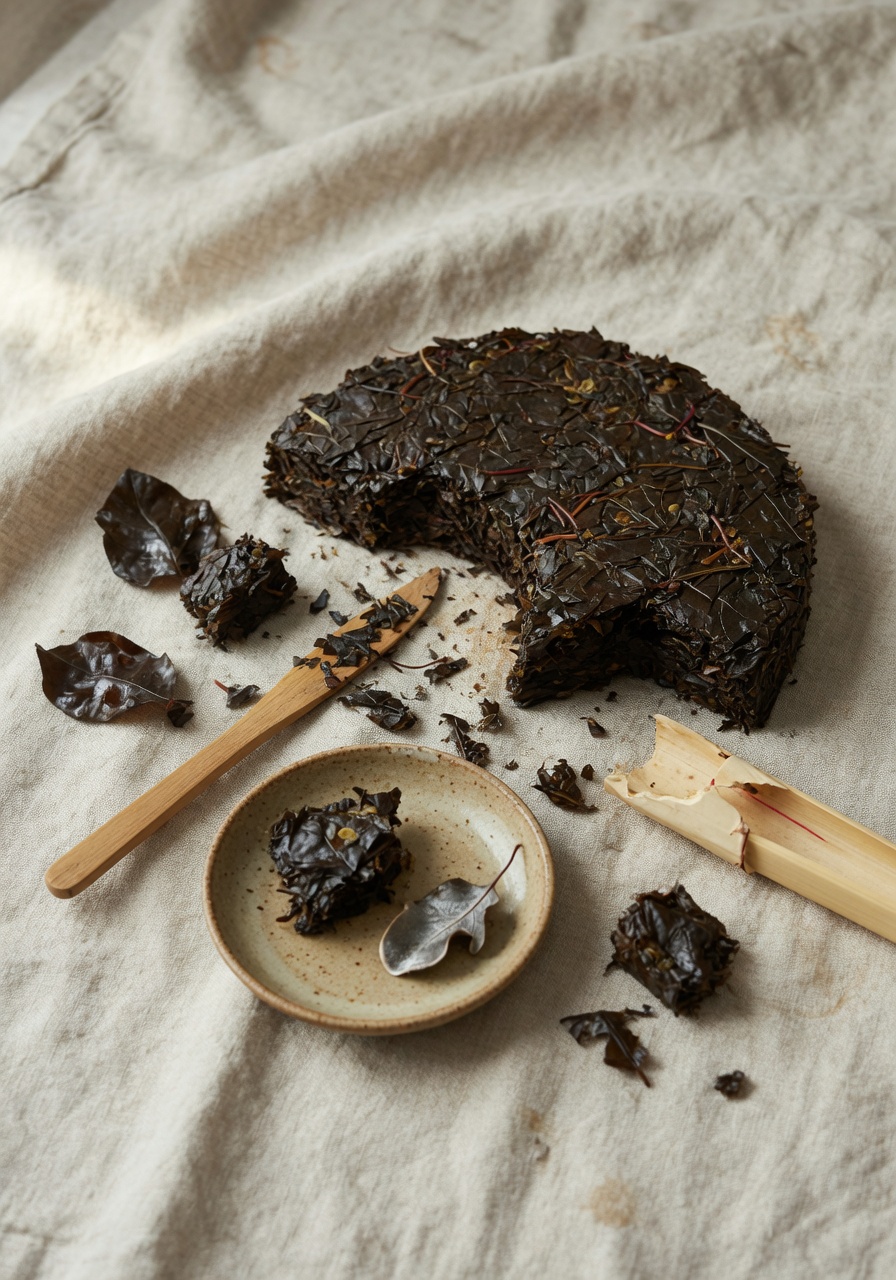
Every category needs a benchmark — the bottle the sommelier pours blind to recalibrate the palate, the recording the producer queues up before a new mix. For shu pu’er (熟普洱), that benchmark is Měnghǎi qī wǔ qī èr — Menghai 7572. Pressed by the Menghai Tea Factory (勐海茶厂, now part of Dayi/TAETEA) using a blend recipe codified in 1975, it is the cake against which every other ripe is measured, consciously or not. Tasters in Guangzhou warehouses, vendors in Kunming’s Kangle market, Russian buyers ordering by the jiàn (件, 84-cake bamboo crate) — they all know the profile: a medium-grade blend, level 3 to level 7 leaves, pressed at 357 g, with a pile-fermentation that lands on the sweet, woody, slightly cocoa side of the spectrum rather than the heavy cāng wèi (仓味, storage funk) of cheaper ripes.
The digits are not a year. They are a recipe code, set in 1976 when Menghai standardised its export numbering: 75 for the recipe year, 7 for the blend grade, 2 for the factory. Twelve months earlier, in 1973–1974, Kunming and Menghai had together finalised the wò duī (渥堆) pile-fermentation method that made shu possible at all. 7572 was the first recipe to lock that method into a repeatable industrial product. Half a century later, the cake is still in production, still the most-pressed shu on earth — and still the cleanest single answer to the question, what does ripe pu’er taste like.
What the four digits actually mean
The Menghai numbering system was not invented for romance. It was invented for export paperwork. When the China National Native Produce and Animal By-Products Import and Export Corporation, Yunnan Tea Branch (中国土产畜产进出口公司云南茶叶分公司, abbreviated CNNP) standardised factory codes in 1976, each compressed tea got a four-digit mǎhào (唛号, mark number). The first two digits indicate the year the recipe was first formulated. The third digit indicates the average grade of the leaf blend on a scale of 1 (finest, all bud) to 9 (coarsest, large stem-bearing leaf). The fourth digit identifies the factory: 1 for Kunming, 2 for Menghai, 3 for Xiaguan, 4 for Pu’er (Simao), and so on. So 7572 reads cleanly: a 1975 recipe, grade-7-average blend, pressed at Menghai. Its sister cake 7542 — the sheng benchmark — shares everything but the cooking. Same factory, same blend logic, two years earlier, raw rather than ripe. That symmetry is not coincidence. When the Menghai technicians, working under director Zou Bingliang (邹炳良), needed a public face for the new pile-fermented process, they reached for the recipe structure they already trusted and cooked it. The unblended sheng version had been in production since 1973; the cooked twin entered the catalogue in 1975 and went into industrial-scale export in 1976.
The blend — why grade 7 and not grade 3
Buyers new to shu often assume that finer is better — that a cake of pure bud-tip would represent the pinnacle of the category. It does not. Pile-fermentation chews through young leaf. The 60-day wò duī process Zou Bingliang formalised raises the heap to 55–65 °C and holds it there through three or four turnings; tender bud material, with its low cellulose and high amino-acid content, dissolves into mush and loses its structure. The leaves that survive — and emerge with the woody, sweet, slightly camphorous character that defines good shu — are the mature, fibrous, level 3 through level 7 leaves harvested from third- and fourth-flush pickings on plantation gardens around Bulang, Bada, and Nannuo. The 7572 blend is built around grade 5 as the core, with grade 3 on the surface for visual appeal and grade 7 and 8 forming the structural interior. This is why the cake looks the way it does — darker, smaller leaf on the face, coarser and stalkier when you pry it open. It is also why 7572 ages.
Surface vs interior — the sǎ miàn principle
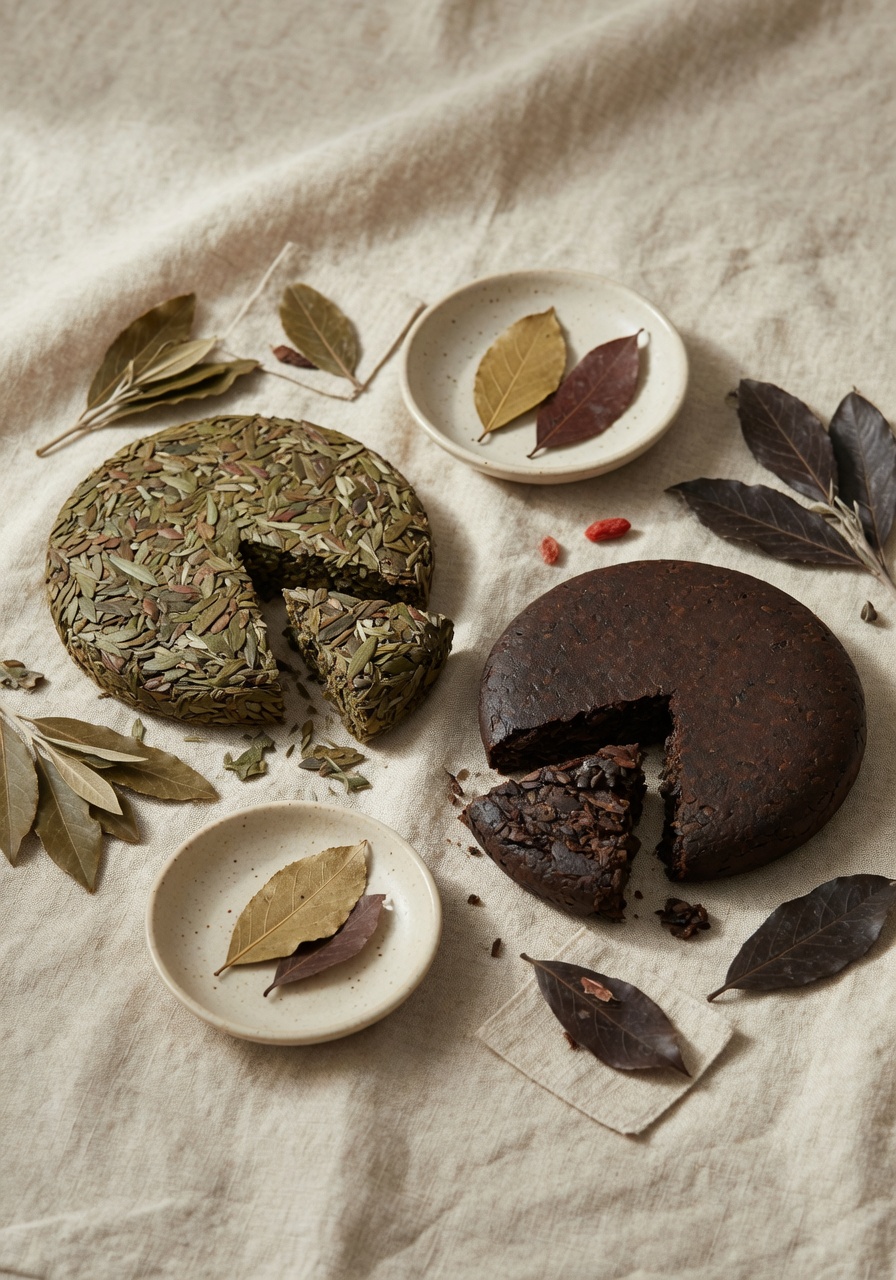
Menghai presses 7572 using the sǎ miàn (撒面) technique: a small handful of higher-grade leaf scattered on top of the mould before the bulk blend is added, then pressed so the fine grade ends up on the visible face of the cake. Tradition calls for roughly 10 % surface leaf and 90 % interior blend. This is not deception — every Menghai buyer knows it — but a structural choice. The fine surface leaf gives a softer first three infusions; the coarser interior carries the body through steepings 6 to 15. Pry a 7572 cake apart and you can see the difference: a thin lighter band on each face, denser dark material beneath.
Why coarser leaf cooks better
Tea-stem and mature leaf carry more cellulose, more lignin, and crucially more soluble sugars per unit weight than bud tips. During wò duī, the Aspergillus niger and Blastobotrys adeninivorans communities that dominate the pile metabolise those sugars and produce the gallic-acid-rich, low-bitter, sweet-woody flavour signature shu buyers want. Pure-bud shu — sometimes sold as gōngtíng (宫廷, palace grade) — exists, but it tastes thin and short. The 7572 blend was engineered for the chemistry, not for the optics.
The 1975 pile and the people behind it
The names that matter here are Zou Bingliang (邹炳良) and Lu Guoling (卢国龄), the technical director and deputy director at Menghai Tea Factory through the 1970s and 80s. They inherited the wò duī method from a 1973 collaboration between Kunming Tea Factory’s Wu Qiying (吴启英) and Menghai’s own observers, then refined it for Menghai’s leaf base. The 1975 trial that produced the first 7572 batch ran in pile number 3 of the Menghai fermentation hall, using approximately 10 tonnes of grade-5 maocha from the Bulang collection station. The pile was turned four times across 52 days. Final moisture before drying was logged at 14 %. That batch shipped to Hong Kong via the CNNP Guangzhou office in spring 1976; trade records held by the Yunnan Provincial Archive list the price as 4.82 yuan per kilogram FOB. For comparison, 7542 sheng of the same year shipped at 3.91 yuan. The premium reflected the labour cost of the 60-day pile.
Why Hong Kong drank it first
Mainland Chinese consumers had no taste for ripe pu’er in 1976. The product existed for the Hong Kong restaurant trade — yum cha parlours that needed an inexpensive, dark, smooth tea to serve in volume with dim sum. Hong Kong wholesalers like Nam Kee (南記), Lam Kie Yuen (林奇苑), and Ying Kee (英記) bought 7572 by the tonne and aged it for two or three years in warehouses on Sheung Wan and in Tsuen Wan before retail. That warehouse storage — humid, dim, roughly 26 °C — became part of the recipe’s identity. A 7572 pressed in 1976 and drunk in 1980 was a different cake from one drunk in 1976; the trade understood this and priced accordingly. The aging-storage tradition documented at puerh.app and tea.school both trace back to this Hong Kong middle step.
What 7572 tastes like — a working description
A current-production 7572 — say a 2021 batch tasted in 2024 after three years of dry Kunming storage — opens with a clean rinse the colour of weak coffee. The first proper infusion (5 g per 100 ml gaiwan, boiling water, 10 seconds) is mahogany, glossy, with no surface oil and no sediment. The aroma off the wet leaf is wet bark, raw cocoa nib, and a faint sweetness like dried date. In the mouth: medium-bodied, soft tannins, a sweetness that arrives on the back of the tongue around the 15-second mark and stays. No fishy note, no compost note — those are markers of a poorly-managed pile or excess humidity in storage. Through steepings 4 to 8 the cocoa fades and a woody-sweet zhāng xiāng (樟香, camphor note) emerges; through 9 to 14 the liquor lightens to honey-brown and the texture turns syrupy. A good 7572 will give 15 to 18 infusions before the leaf is spent. The spent leaves should be uniformly dark brown, supple, and intact — if they crumble to mud, the pile was over-cooked.
How to spot a fake
7572 is among the most-counterfeited cakes in the trade. Three quick checks: the Dayi/TAETEA neifei (内飞, embedded ticket) sits inside the cake, not on top of the wrapper, and is printed with a slight relief you can feel with a fingernail; the press should leave a small dimple in the centre back, not a deep crater; and the wrapper paper, since 2006, uses cotton-fibre stock with a faint horizontal grain visible against light. Batch codes printed on the wrapper edge follow the pattern 4-digit-year + 3-digit-batch + 1-digit factory — 2101 means first batch of 2021, factory 2 (Menghai). Cross-reference with the Dayi anti-counterfeit code online before paying premium prices on a vintage cake. Shop.puerh.app maintains a current authentication checklist.
Does 7572 age?
Yes, but the curve is shallower than for sheng. The pile-fermentation has already done the bulk of the oxidative and microbial transformation. What remains, over years of dry storage, is a slow mellowing — the woody edge softens, the cocoa deepens toward dark chocolate and dried fig, and the texture becomes more viscous. Hong Kong traditional-storage 7572 from the late 1990s, tasted today, shows almost no astringency and a pronounced chén xiāng (陈香, aged aroma) that resembles old library books and damp stone. Dry-stored Kunming or Beijing cakes of the same vintage retain more brightness and read closer to sweet wood. Neither is wrong. The category has room for both, and the question of whether to wet-store or dry-store is the subject of a separate piece — see shu-aging-yes-or-no on this site. What is settled is that 7572 rewards patience: a five-year-old cake is meaningfully better than a one-year-old cake. A fifteen-year-old cake, if stored well, is a different drink entirely.
The recipe as cultural object
7572 is no longer just a tea. It is a unit of account. Auction houses in Guangzhou quote prices in ‘cakes of 7572 equivalent’. Tea schools, including tea.school’s pu’er module, use a current-year 7572 as the calibration tea for new students learning to taste shu. Russian and Mongolian buyers — the market I work most closely with — use the cake as the floor reference: anything that does not at least match 7572 in body and clean finish at the same price point is dismissed. The Menghai factory itself produces roughly 2,000 tonnes of 7572 annually, more than any single recipe in pu’er’s history. That scale is what makes it a benchmark: it is the one cake every serious buyer has tasted, in multiple vintages, across multiple storage conditions. When a tea-master says a new pile ‘leans 7572,’ every listener in the room knows precisely what is meant. No other recipe in any tea category — not Da Hong Pao, not Tieguanyin, not even Longjing — has achieved that kind of shared vocabulary. The 1975 decision to lock the recipe and the 1976 decision to scale it for export together built the reference standard for half a tea category. Five decades later, it still holds.
References
- GB/T 22111-2008 地理标志产品 普洱茶 (Geographical Indication Product — Pu'er Tea) — Standardization Administration of China
- Zou Bingliang, 'The Establishment of the Menghai Pile-Fermentation Method, 1973–1976' — Yunnan Tea Industry Yearbook, 1998 edition
- Yunnan Provincial Archive — CNNP Export Records, 1975–1978 — Yunnan Provincial Archive, Kunming, file series 67-3
- Zhang Jing-hong, *Puer Tea: Ancient Caravans and Urban Chic* — University of Washington Press, 2014
- Dayi Tea (TAETEA) Anti-Counterfeit Verification System — Yunnan Dayi Tea Group Co., Ltd.
- Chen Jie, 'Microbial Succession in Pu-erh Tea Pile-Fermentation' — Food Chemistry, vol. 358, 2021
Read next
Related articles
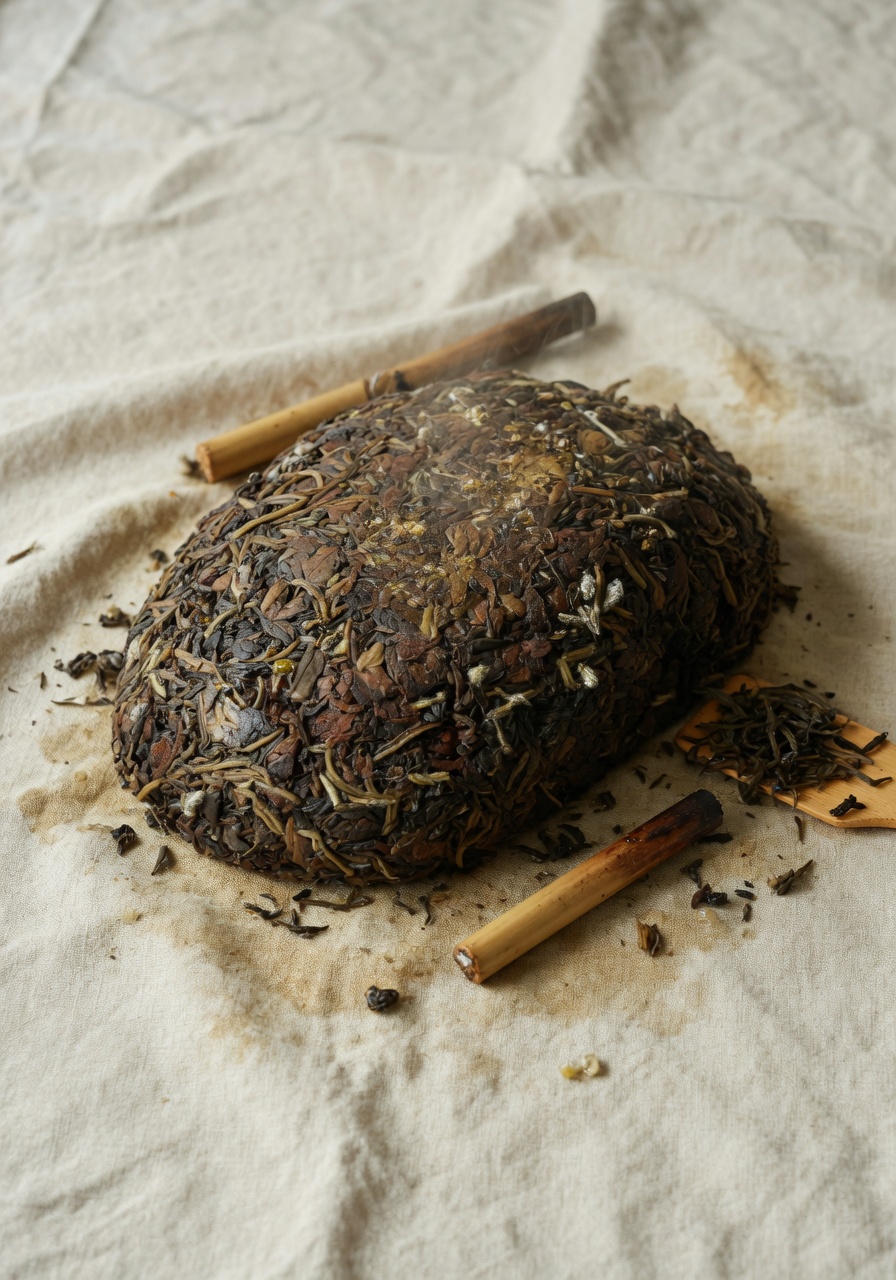
Wo dui — the pile fermentation that defined shu
In 1973, a team at Kunming Tea Factory wet-piled maocha under wool blankets and waited. Forty-five days later, the leaves were black, sweet, and unmistakably new. This is the story of how a chemical accident became a category.
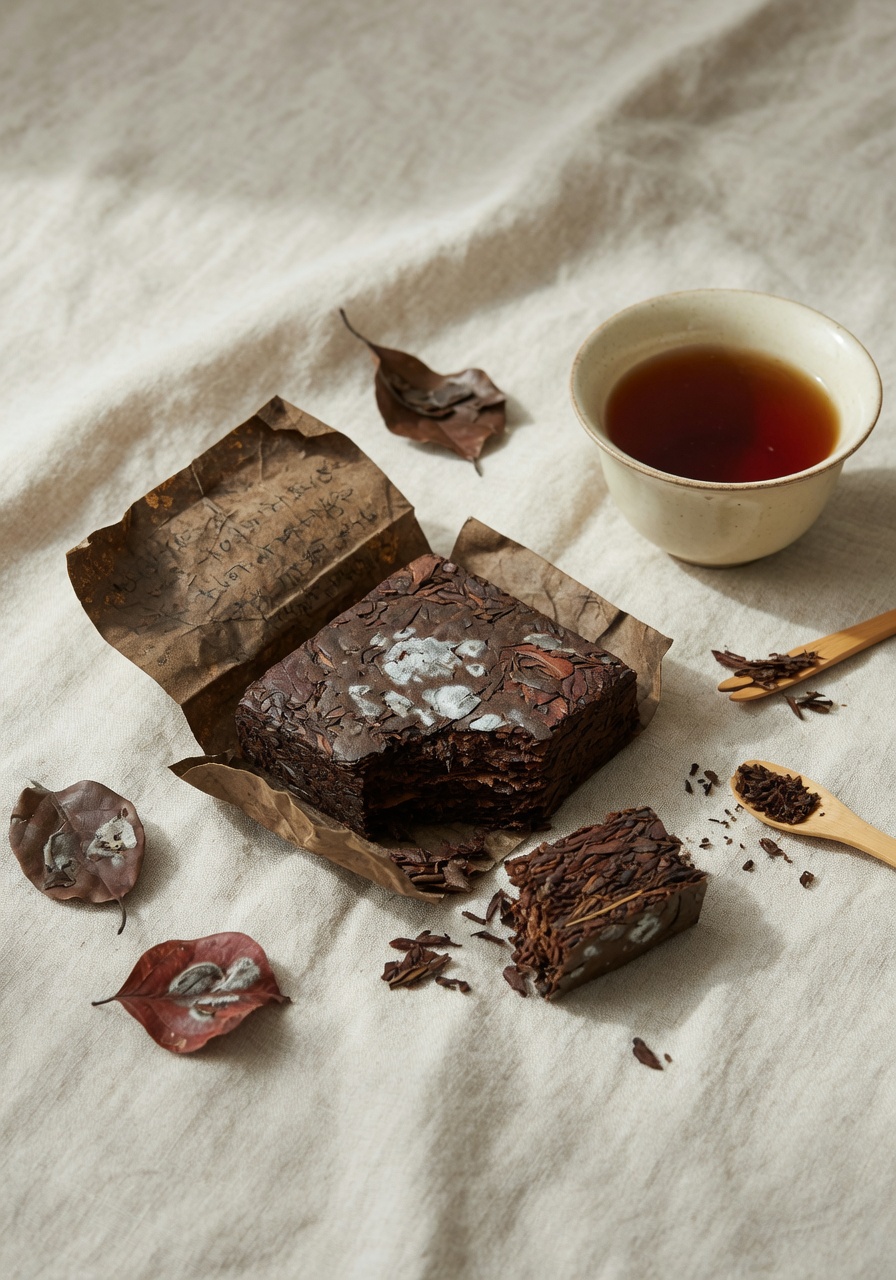
Does shu age? A measured answer
Shu was engineered in 1973 to taste like aged sheng without the wait. So does it still benefit from time in the jar — or is the work already done? A technical look at what actually changes after the pile.
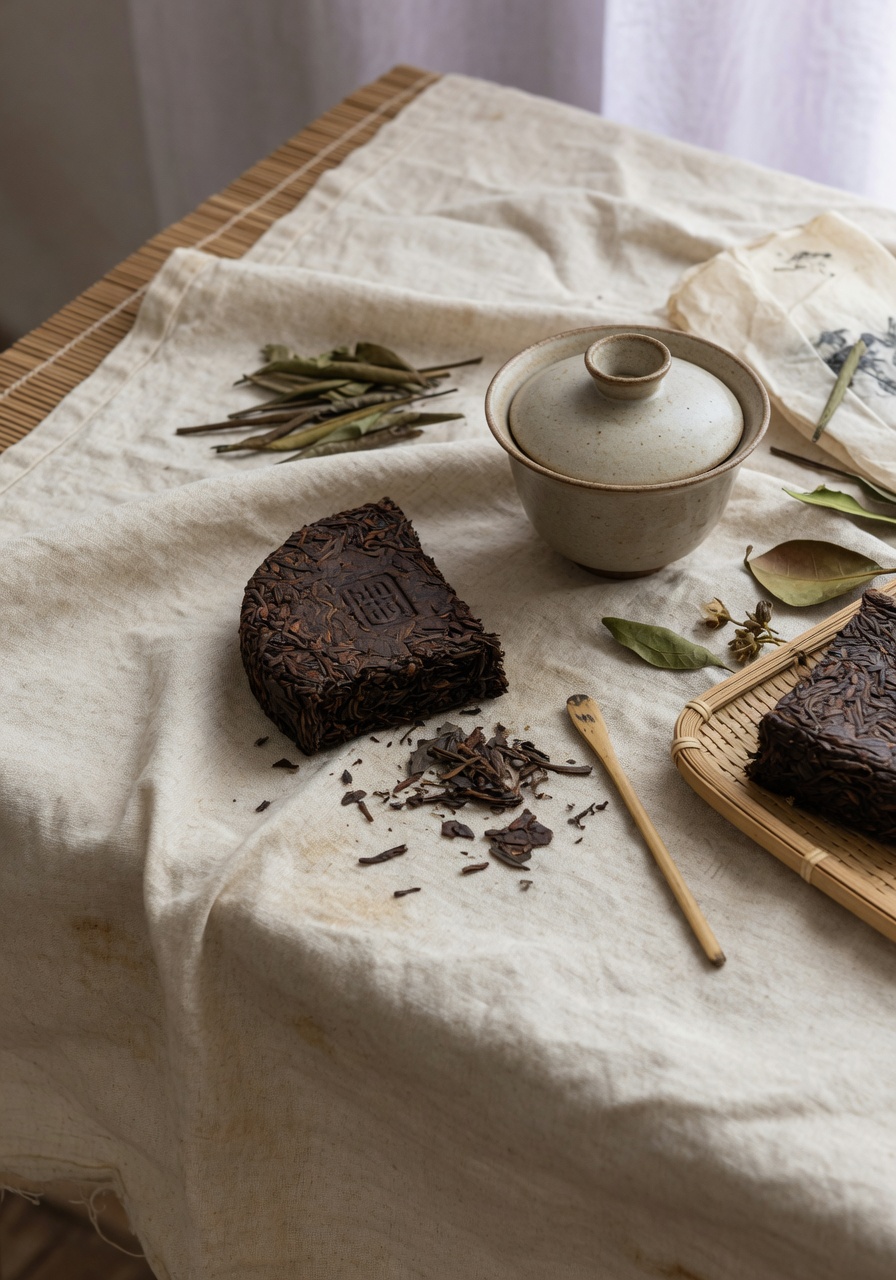
Menghai county — birthplace of modern shu
A flat-bottomed valley at 1,200 m, ringed by Bulang and Nannuo mountains, where in 1973 a state factory perfected pile fermentation and changed pu-erh forever.
Sheng vs shu — what actually changes
Two teas share a name, a region, and a leaf — and almost nothing else. The 1973 invention of *wò duī* (渥堆) split pu'er into raw and ripe, and the chemistry of that split still defines every cake pressed today.