home · The <em>cooked</em> half of the pu'er story
Shu pu'er · processing
Wo dui — the pile fermentation that defined shu
Wò Duī · 渥堆
In 1973, a team at Kunming Tea Factory wet-piled maocha under wool blankets and waited. Forty-five days later, the leaves were black, sweet, and unmistakably new. This is the story of how a chemical accident became a category.
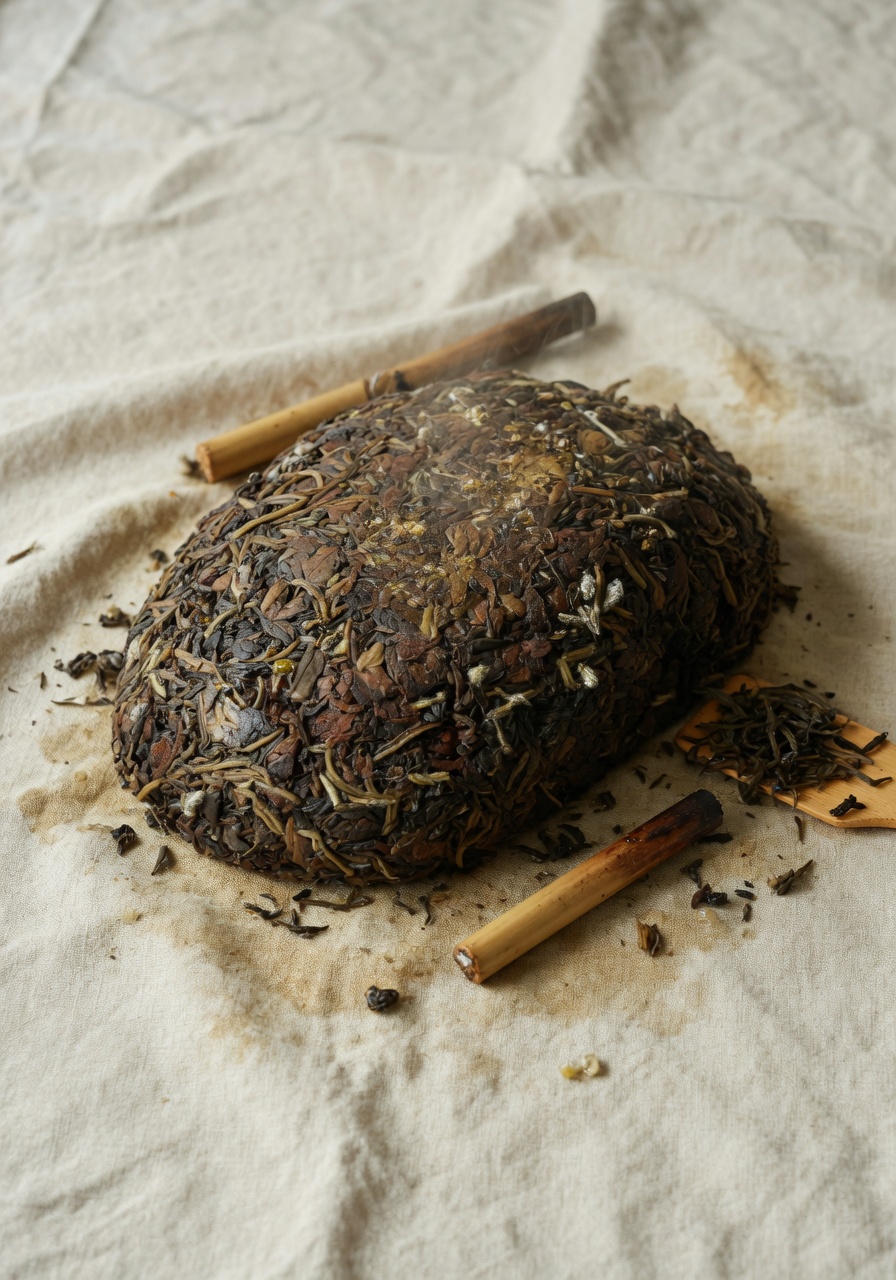
Wò Duī (渥堆) — literally ‘wet pile’ — is the controlled microbial fermentation that converts raw Yunnan maocha into shú pǔ’ěr (熟普洱). It is the single processing step that distinguishes ripe pu’er from every other tea in the Chinese taxonomy, and it is barely fifty years old. Before 1973, all pu’er was sheng — green-killed, sun-dried, compressed, and aged slowly in Hong Kong and Guangdong warehouses where humidity and time did the work that wò duī now does in six weeks.
The motive was commercial. By the late 1960s Hong Kong wholesalers were buying Yunnan maocha, holding it in basement godowns for ten to fifteen years, and selling the aged, mellowed result at margins Yunnan never saw. Beijing wanted that value chain redirected to the producer. In 1973 the Yunnan Provincial Tea Import and Export Company sent technicians from Kunming, Menghai, and Xiaguan to Guangzhou to study the Cantonese ‘wet storage’ method, then to develop a faster, factory-controlled equivalent at home. The team that returned to Kunming Tea Factory under Wú Qǐyīng (吴启英) ran the first successful pile in late 1973 and early 1974. That pile is the origin point of every shu cake currently on the market.
This article walks through what wò duī actually is — the microbiology, the variables a factory controls, the failure modes, and why a Menghai pile in July tastes different from a Kunming pile in November. It assumes you already know the difference between sheng and shu; if you don’t, start with sheng vs shu — what actually changes.
What wo dui actually does
Wò duī is not oxidation. The maocha that enters the pile has already been shā qīng (杀青) — pan-fired to deactivate polyphenol oxidase — so the enzymatic browning that drives black tea production is no longer available. What happens in the pile is microbial: a succession of filamentous fungi, yeasts, and bacteria metabolize the leaf’s catechins, polysaccharides, and proteins into a different chemical landscape. Theaflavins and thearubigins climb. Catechin content, which can sit at 18-24% of dry weight in fresh maocha, drops below 8% in finished shu. Gallic acid rises sharply. Statins (lovastatin in particular) appear at measurable levels — one of the reasons shu shows up in cardiovascular literature far more than sheng does.
The dominant organism, in pile after pile sampled across Menghai, Lincang, and Kunming, is Aspergillus niger — the black mold that also drives koji and citric acid fermentation. Liú Qínjìn’s 2005 survey at Yunnan Agricultural University identified A. niger, A. glaucus, Penicillium, Rhizopus, and several yeast species cycling through the pile in roughly that order as temperature and moisture shift. Temperature is the visible signal: a well-built pile rises from ambient to 55-65 °C within four to six days, plateaus, then declines as the carbohydrate substrate is consumed. A pile that fails to heat is a pile that has failed, full stop.
The sensory result is what every shu drinker recognizes — the loss of astringency and grassy top notes, the appearance of woody-sweet, earthy, sometimes camphor or date-like aromatics, and a soup color that runs from deep mahogany to near-black. Done well, wò duī delivers in 45-60 days an approximation of what natural aging delivers in 15-20 years. Done poorly, it produces the wet-cardboard, fishy, or sour notes that gave early shu its reputation problem.
The 1973 origin and what came before
The mythology of the 1973 trip is consistent across the three factory accounts. Wú Qǐyīng from Kunming, Zou Bingliang and others from Menghai, and Xiaguan representatives traveled to Guangdong in April 1973, studied the Cantonese fā shuǐ (发水, ‘water-issuing’) technique used to artificially age maocha for the Hong Kong market, and returned with notes. The Cantonese method was crude — wet the leaves, stack them, wait — and the result was inconsistent. Wú’s contribution was systematization: defined water-to-leaf ratio, defined pile geometry, scheduled turnings, and temperature monitoring. The first commercial Kunming shu reached Hong Kong in 1974 under the wrapper that collectors now call 73 hòu zhuān (73厚砖) and 73 qīng bǐng (73青饼) — though the second name is misleading since the cakes were ripe, not sheng.
Menghai Tea Factory, under Zou Bingliang and later refined by others, developed its own pile protocol in parallel and by 1975 had standardized the recipe numbering system — 7572, 7581, 7452, 8592 — that still organizes shu production today. The first two digits are the recipe year (1975), the third is the average leaf grade, the fourth is the factory code (2 = Menghai, 1 = Kunming, 3 = Xiaguan). For the specific case of 7572, see Menghai 7572 — the recipe that anchors the category.
Why Hong Kong storage was the reference point
Cantonese wholesalers had been holding Yunnan maocha for decades in unventilated basement godowns where summer humidity ran above 85% and temperatures sat in the high twenties. The leaves slowly fermented — the same A. niger and Aspergillus species that now drive wò duī, just operating on a slower clock and at lower temperatures. The flavor target for 1973 was explicitly to reproduce that ‘Hong Kong taste’ (港仓味) in finished form at the factory gate. Modern dry-stored sheng aged over twenty years tastes different from 1970s wet-stored Hong Kong material precisely because the microbial communities differ; wò duī sits closer to the wet-stored profile than to the dry-stored one.
The variables a factory controls
A pile is built from 5 to 15 tonnes of maocha. Smaller piles — under three tonnes — generally fail to generate and hold the necessary core temperature; larger piles are difficult to turn evenly. Water is added at 22-40% of leaf weight depending on season, leaf grade, and target style. Higher water and tighter piling produce heavier, sweeter, more thoroughly fermented shu; lighter water and looser piling produce the so-called qīng fā (轻发, ‘light fermentation’) style that retains some of the original maocha character and can continue developing in storage.
Pile geometry matters more than novices expect. The standard shape is rectangular, 1-1.5 m high, covered with a heavy cotton or burlap cloth that traps moisture and CO₂. The cloth is removed for turnings — fān duī (翻堆) — scheduled at roughly days 7, 14, 21, 28, and 35, though the exact rhythm depends on how fast the pile is heating. Each turning aerates the leaves, redistributes moisture from the wet bottom to the drier top, and resets the microbial succession. Core temperature is monitored with long-stem thermometers driven into the pile; a reading above 65 °C is the signal to turn immediately, since sustained heat above that threshold kills the productive Aspergillus community and lets thermophilic bacteria take over, producing the off-flavors that ruin a batch.
Water source is its own subject. Menghai factories use water from the Nan Lei River drainage; Kunming piles use municipal supply or well water. Some smaller producers in Lincang have experimented with adding starter cultures or recycled water from previous successful piles — a practice that is technically common in industrial fermentation but controversial inside the tea world, where the prevailing aesthetic still favors a ‘natural’ pile.
Light vs heavy fermentation as a style choice
A pile run for 35-40 days at moderate water produces shu that is recognizably ripe but retains structural tannin and some bitterness — material that benefits from five to ten years of further dry storage. Menghai 7572 has historically been run on the lighter side. A pile run for 55-65 days at higher water produces fully fermented, ready-to-drink shu with maximum sweetness, minimum bitterness, and limited aging potential. Both are legitimate; the choice is commercial. Drinkers who want the slow-developing style should read does shu age? A measured answer.
Why Menghai piles taste different from Kunming piles
Elevation, ambient humidity, and resident microflora differ. Menghai sits at 1,300 m with year-round humidity above 75%; Kunming sits at 1,900 m and is markedly drier. A Menghai pile reaches working temperature faster and stays there longer; a Kunming pile needs more added water and more careful insulation. The resident Aspergillus strains in the two factory environments have been selected over fifty years of continuous production and are no longer interchangeable. This is the same terroir-of-the-factory argument that explains why a Lambic brewery cannot be moved out of the Senne valley without changing the beer.
Failure modes
The pile fails in three characteristic ways. First, suān (酸) — sour. This is lactic and acetic bacterial overgrowth, usually caused by too much water and insufficient aeration. The leaves emerge with a sharp vinegar note that does not age out. Second, méi (霉) — mold in the bad sense. Visible white or green colonies of Penicillium or unwanted Aspergillus flavus indicate the pile has gone sideways biologically; A. flavus in particular produces aflatoxins and is the reason shu has periodic food-safety scares in the press. A correctly run pile, dominated by A. niger, does not produce detectable aflatoxin levels — multiple GB/T survey studies since 2010 have confirmed this — but a badly run pile can. Third, shēng (生) — undercooked. The pile failed to heat, the fermentation stalled, and the result tastes like wet hay. This is mechanically the most common failure for inexperienced producers attempting small piles.
The industry-wide quality jump that occurred between roughly 2005 and 2012 — when shu went from a category most serious drinkers dismissed to one widely respected — is largely a story of failure-mode reduction. Better temperature monitoring, better water control, better isolation of pile rooms from outside contamination, and the gradual retirement of the old loose ‘whatever works’ protocols. Mengku, Haiwan, Xiaguan, and the dozens of mid-size Menghai-area factories that emerged in this period now produce shu that is reliably clean from the first wash, which was not generally true in 1995.
Reading a finished pile
Loose shu maocha straight from the pile is graded, sorted, and then either sold as sǎn chá (散茶, loose ripe) or pressed into the familiar 357 g cakes, 250 g bricks, and tuocha. Before pressing, the leaves typically rest for one to three months — sometimes longer — in a ventilated room. This ‘pile-off’ period (退堆, tuì duī) lets residual moisture equilibrate, lets the harsh fresh-fermentation notes dissipate, and lets the remaining microbial community settle. Shu pressed too soon after the pile finishes carries a distinctive ‘pile flavor’ (堆味, duī wèi) — a wet, slightly fishy, slightly ammoniated note — that takes one to three years of storage to clear.
For the drinker, the signs of a well-fermented pile are: consistent dark brown to black dry leaf without green patches; soup that runs deep red-brown and clear, not muddy; an aroma profile of wet wood, dates, mushrooms, or camphor without sourness or barnyard notes; a mouthfeel that is thick and viscous rather than thin and dilute; and spent leaves that remain pliable and intact rather than shredded and mushy. The last test is diagnostic — over-fermented piles produce leaves that fall apart under finger pressure because the leaf cellulose itself has been degraded.
For a broader survey of how wò duī fits into the wider Chinese dark-tea family — liù bǎo, fú zhuān, qiān liǎng — see the dark tea overview on thetea.app and the producer-level fermentation deep dive on tea.school. The pile-fermentation logic generalizes; the specific microbial communities and target flavor profiles do not.
Where the science is still open
Despite fifty years of production and twenty years of serious academic study, several aspects of wò duī remain underspecified. The exact microbial succession varies pile to pile in ways that have not been fully mapped. The role of yeasts versus filamentous fungi in flavor production is debated — some researchers argue yeasts contribute most of the sweet-fruity aromatics, others emphasize the Aspergillus role. Whether starter cultures should be standardized, as they are in soy sauce and sake production, or whether the ‘wild’ pile environment is itself part of the product, is a live commercial and aesthetic question. The Yunnan Provincial DB53 local standards address process minimums but stop short of mandating microbial inputs.
The aging trajectory of shu is also less settled than the trade pretends. A well-made shu from 2005 does taste different from the same recipe in 2024 — softer, sweeter, less duī wèi, more integrated — but whether shu develops the genuine complexity gain that aged sheng develops, or merely smooths out, is contested. My own working position, after fifteen years of comparative tastings across Russian and Mongolian collections, is that lightly fermented shu in the 2000-2008 vintage band has aged into something genuinely interesting, while heavily fermented modern shu mostly just smooths. But the data is thin, the sample is biased toward what survived in collectors’ cabinets, and any honest answer admits we do not yet know.
References
- GB/T 22111-2008 Geographical Indication Product: Pu-erh Tea — Standardization Administration of China
- Microbial succession and chemical changes during pile fermentation of pu-erh tea — Liú Qínjìn et al., Yunnan Agricultural University, Journal of Tea Science, 2005
- Aspergillus niger dominance and aflatoxin survey in commercial pu-erh ripe tea — Mǒ Hǎiyǔ et al., Food Control vol. 50, 2015
- Wú Qǐyīng — Mother of Ripe Pu-erh: oral history and process documentation — Yunnan Tea Import and Export Company archive, interview transcripts 1998
- DB53/T 103-2006 Yunnan Provincial Standard: Pu-erh Tea Processing Specification — Yunnan Provincial Bureau of Quality and Technical Supervision
- Chemical and sensory differentiation of wet-piled versus naturally aged pu-erh — Zhōu Hóngjié, Tea Research Institute, Chinese Academy of Agricultural Sciences, 2018
Read next
Related articles
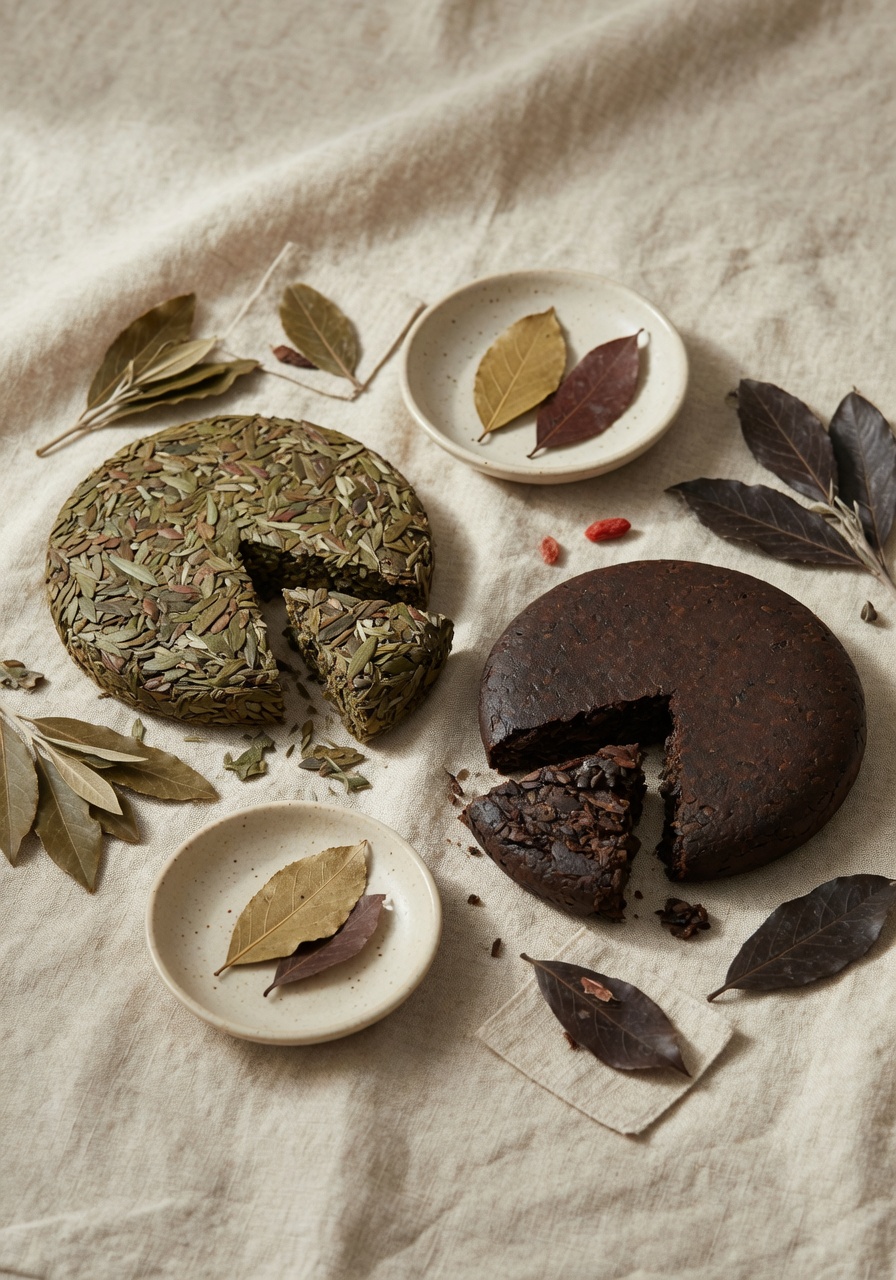
Sheng vs shu — what actually changes
Two teas share a name, a region, and a leaf — and almost nothing else. The 1973 invention of *wò duī* (渥堆) split pu'er into raw and ripe, and the chemistry of that split still defines every cake pressed today.
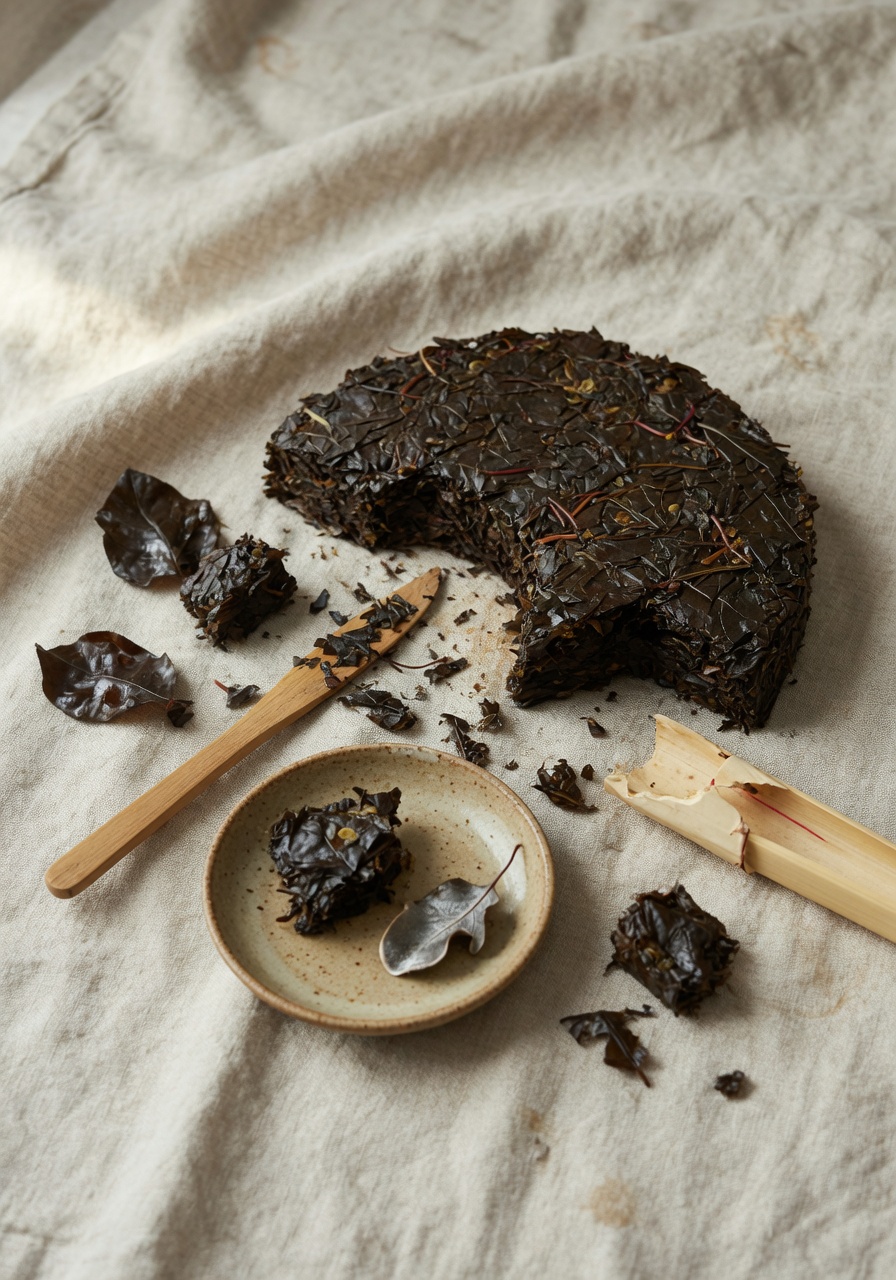
Menghai 7572 — the recipe that anchors the category
A four-digit code stamped on a paper wrapper has done more to define what shu tastes like than any single mountain or master. This is how 7572 became the reference point.
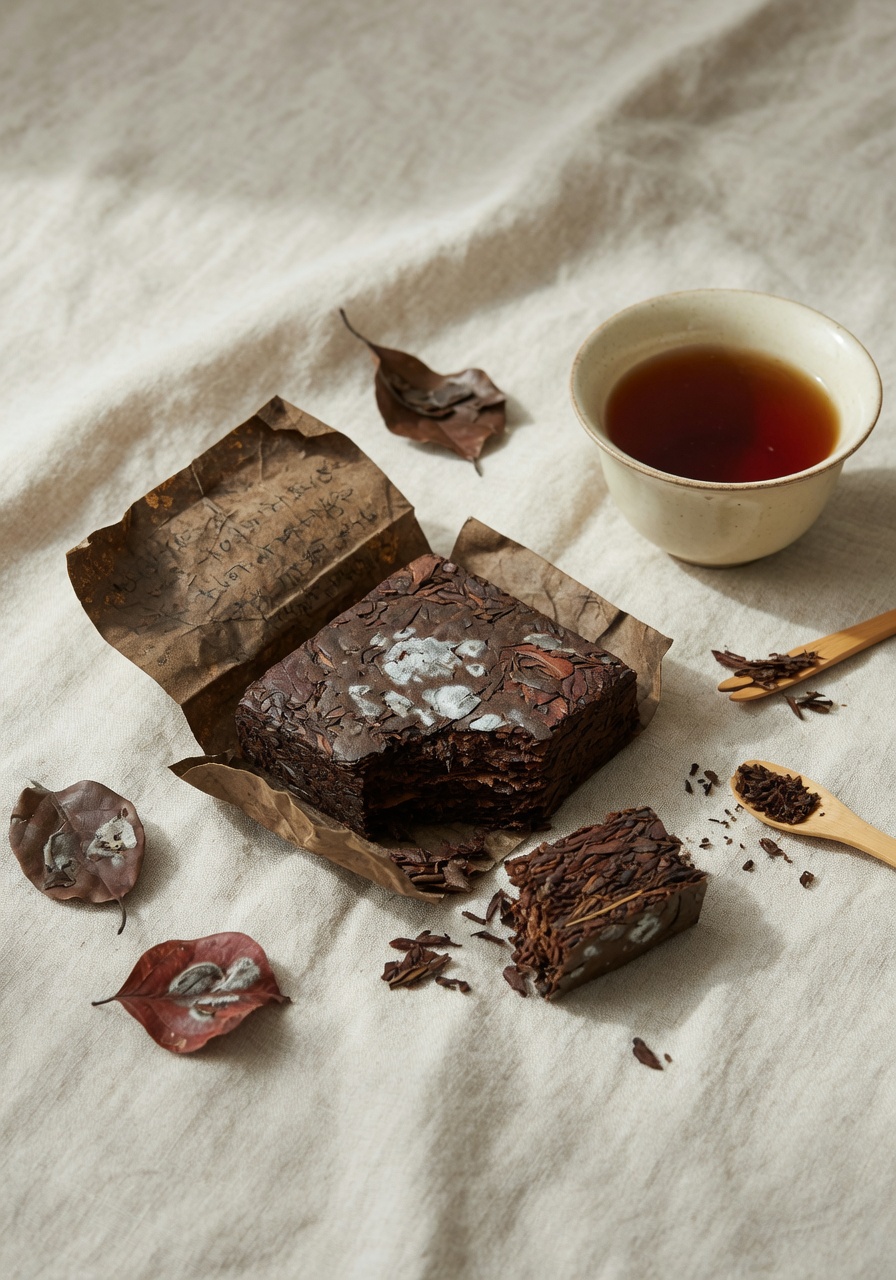
Does shu age? A measured answer
Shu was engineered in 1973 to taste like aged sheng without the wait. So does it still benefit from time in the jar — or is the work already done? A technical look at what actually changes after the pile.
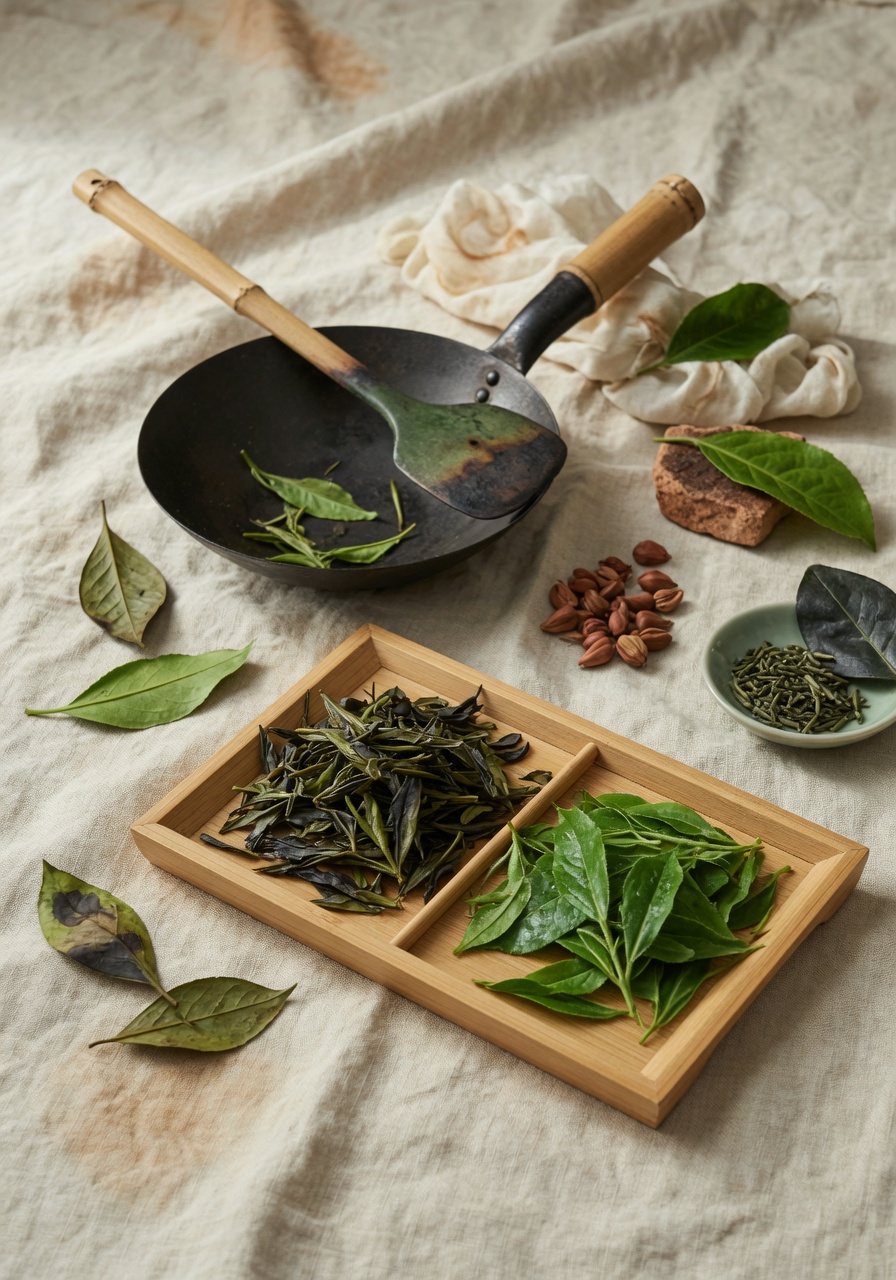
Sha qing — kill-green for pu'er vs green tea
The pan-firing step that defines pu'er is not the same as the one that defines Longjing. Same name, same wok — different temperature, different intent, different future.