home · Learning to <em>taste</em> a cake before you trust it
Tasting & evaluation
Common defects in pu'er — and what causes them
Pǔ'ěr cháyè quēxiàn · 普洱茶叶缺陷
Mustiness, sourness, fishiness, smoke that never leaves — pu'er has a vocabulary of faults that mirrors its vocabulary of virtues. Each defect points to a specific failure in processing, storage, or transit.
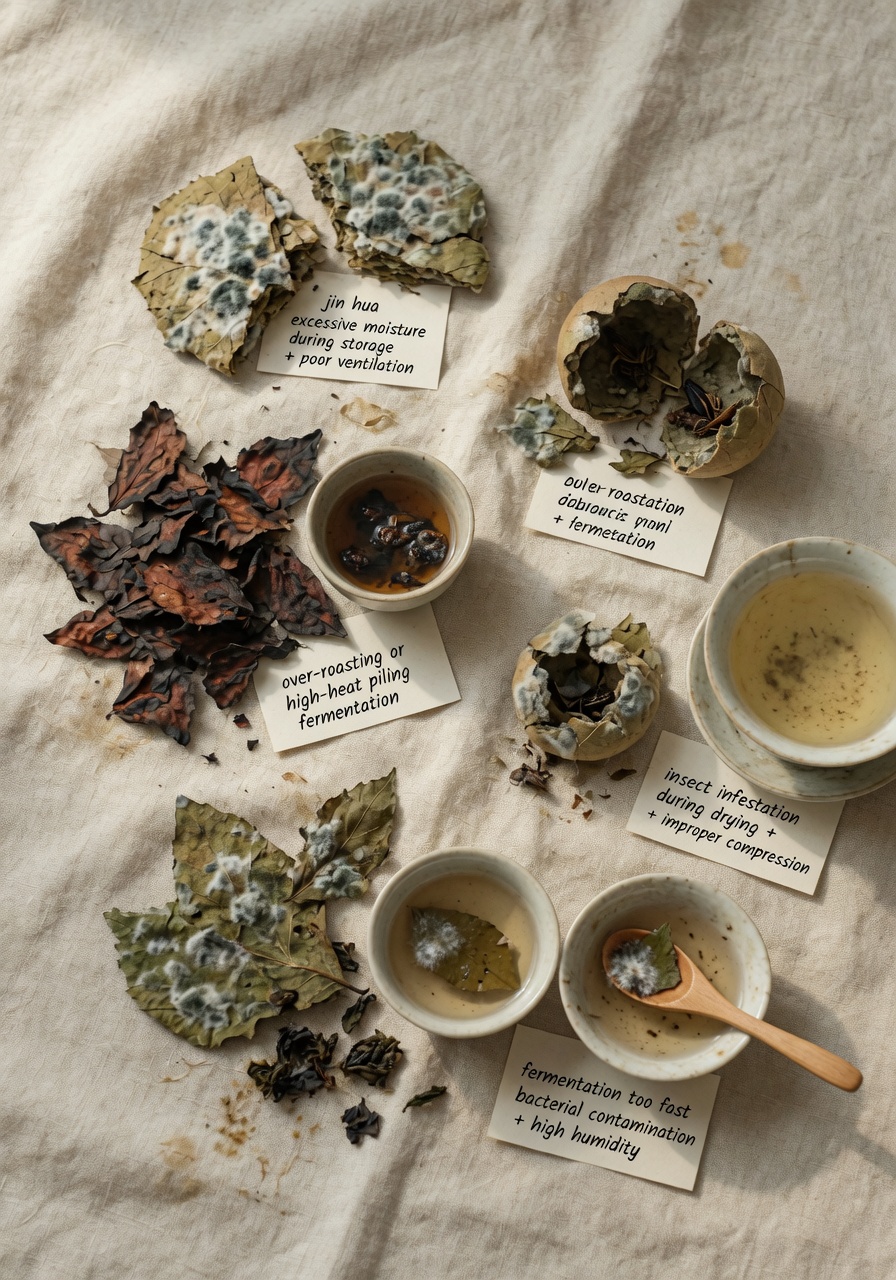
A defect in pu’er is not a matter of taste — it is a diagnosis. When a cake tastes wrong, the wrongness almost always traces to a discrete moment in its life: a basket left too long in a humid courtyard before shāqīng (杀青), a wò duī (渥堆) pile turned one day late, a warehouse in Guangzhou that nudged 85 % relative humidity for three monsoon weeks in 2014. Learning to name these faults is the slower half of learning to taste pu’er well. The faster half — recognising what is good — gets most of the writing, but in a category where a cake may sit in a tong for fifteen years before anyone opens it, the ability to detect early-stage spoilage is what protects a collection.
This article is a working defect catalogue. It draws on the GB/T 22111-2008 geographical indication standard for pu’er, on sensory protocols from the Yunnan Agricultural University tea department, and on roughly two decades of cupping notes from importers shipping pressed tea across the Russian and Mongolian borders — where temperature swings from −35 °C to +30 °C reveal storage flaws faster than any laboratory. The defects below are grouped by where they originate: raw material, processing (máochá and pressing for sheng; pile fermentation for shu), and storage. For each, the article gives the smell, the cause, and — where possible — whether the fault will fade with airing or is permanent.
Why defects matter more in pu’er than in other tea
Most teas are finished products at the moment they leave the factory. A Lóngjǐng (龙井) green tea picked in early April is best in May, acceptable in October, tired by the following spring — its arc is short and the producer controls almost all of it. Pu’er is the opposite. A 357 g cake of sheng pressed in Menghai in March 2010 may be drunk in 2010, 2025, or 2055, and during those decades it will pass through warehouses, wholesalers, private collections, and at least two climates. Every one of those environments can introduce a fault, and the cake cannot tell you in advance which it has acquired.
This is why defect vocabulary in pu’er is unusually granular. A Wuyi oolong drinker has perhaps four or five fault names to learn — scorched, sour, flat, over-roasted, stale. A serious pu’er taster carries twenty. The granularity is not pedantry; it is the only way to read a cake’s history backwards from the cup. A faintly fishy note in young shu points to incomplete pile turning; the same note in fifteen-year-old shu points to a different failure entirely — usually anaerobic storage. Same smell, different cause, different verdict on whether the tea will recover. For a broader vocabulary of positive descriptors, the companion piece on tea.school covers the cupping lexicon used in our training rooms.
Defects from raw material
Before pressing, before fermentation, before storage, the leaf itself can carry faults that no later process will remove. These are the hardest defects to detect in a finished cake because pressing and ageing partly mask them — but they are also the most common, especially in budget tea sold as single-mountain gǔshù (古树) when it is in fact plantation material blended with wild offcuts.
Pesticide and fertiliser carry-over
A metallic, slightly numbing finish on the tongue, often paired with a chemical sharpness in the empty cup once it cools, points to residual agrochemicals. Yunnan plantation tea from lower elevations — below roughly 1,400 m, where pests are heavier — has historically used acetamiprid and imidacloprid; both are water-soluble and survive shāqīng. The 2016 EU rejection rates for Chinese pu’er, documented by the RASFF database, were dominated by these two compounds. The defect is permanent: ageing does not break the molecules down meaningfully within human timescales.
Over-pruned or summer-flush leaf
A thin, papery body and a fast-fading aftertaste indicate leaf picked from heavily pruned bushes or from the summer flush (xià chá, 夏茶), which is generally too tannic and too thin in soluble sugars to age well. Bulang summer material in particular develops a flat, slightly cardboard finish after five years where spring material from the same bushes would have deepened. The producer Dayi historically excluded summer leaf from its 7542 recipe for exactly this reason, though pressure on raw-material costs has eroded that practice across the industry since around 2018.
Processing defects in sheng
Sheng pu’er processing is deceptively simple — wither, kill-green, roll, sun-dry, press — and each step has a narrow window. The defects below are what happens when the window is missed, and they are diagnostic: an experienced taster can usually name which step failed within the first two infusions.
Red stems (hóng gěng, 红梗)
If the picked leaf sits piled too long before shāqīng — more than about six hours in warm weather — oxidation begins at the stem, producing reddish discolouration and a honeyed, slightly stewed aroma that resembles a light hóngchá (红茶). In a young sheng this can be mistaken for character; in a ten-year-old sheng it presents as a hollow, prematurely sweet body with no sour-bright top notes left. The cake has effectively been partly oxidised at birth and will never develop the camphor and medicinal depths of properly processed sheng.
Under-fired kill-green (qīng wèi, 青味)
A persistent green-bean, grassy, almost raw smell that does not fade after several years signals incomplete shāqīng — the wok was too cool, the pan-firing too brief, and residual enzymes continue limited oxidation in storage. Zhou Xiang, our Hunan green-tea specialist, notes that the same defect in Mò Gàn Huáng Yá would be called qīng cǎo qì and rejected outright; in sheng it is sometimes tolerated because some buyers mistake it for youth. It is not youth — it is damage, and the tea will sour rather than mature.
Over-fired kill-green (gāo huǒ, 高火)
The reverse: a wok run too hot scorches the leaf surface, producing a roasted-grain, slightly burnt aroma that pu’er should not have. Sheng is meant to be sun-dried at low temperature, and any baked character points to either over-firing during shāqīng or — more commonly in cheap factory tea — drying the máochá in a heated chamber instead of sunlight. Cakes processed this way age poorly because the high heat denatures the enzymes and polyphenol oxidases that drive slow fermentation. They taste reasonable at three years and then stall.
Processing defects in shu
Shu pu’er is the more industrially complex product — wò duī pile fermentation involves stacking máochá with water to roughly 30 % moisture, then turning the 1,000 kg+ pile every five to seven days over 45 to 70 days while internal temperatures climb to 60 °C. The microbiology is dominated by Aspergillus niger, with contributions from Blastobotrys adeninivorans and several Penicillium species. When this ecology goes wrong, it goes wrong in characteristic ways.
Fishy / piscine (xīng wèi, 腥味)
The notorious defect of young shu. A thin, slightly marine aroma — sometimes described as wet aquarium or pond — comes from incomplete fermentation: the pile was either too cool, too dry, or turned too aggressively, and the Aspergillus population never fully outcompeted the early-stage bacteria. Most fishy notes in shu from the first two years are mild and air off with six to twelve months of dry storage. Persistent fishiness at five years means the pile was structurally under-fermented and the tea will remain thin.
Sour (suān wèi, 酸味)
A sharp, vinegar-edged sourness in the broth or in the empty cup signals lactic and acetic acid accumulation from anaerobic conditions deep in the pile — usually because the pile was over-watered or turned too infrequently. Sourness in shu is one of the few defects that can worsen rather than improve with age, because the acids are stable. The 2007–2008 wave of cheap shu that flooded the market after the pu’er price crash contained a great deal of sour stock, and much of it remains sour today.
Pile odour (duī wèi, 堆味)
A dusty, earthy, vaguely composted smell that all young shu carries to some extent — the question is whether it fades. Properly fermented shu sheds duī wèi within twelve to eighteen months of dry, ventilated storage; the Aspergillus metabolites volatilise and the underlying tea emerges. Shu that still smells of pile at three years was probably wet-stored to accelerate the visual appearance of age, which traps the off-aromas.
Storage defects
Storage is where most collectible cakes are damaged. The two failure modes are opposite: too humid (wet storage, shī cāng / 湿仓) and too dry-and-still (anaerobic or oxygen-starved). Both produce diagnostic faults.
Wet-stored mustiness (méi wèi, 霉味)
A cellar, mushroom, wet-cardboard smell on the dry leaf and in the first infusion indicates the cake was stored above roughly 75 % relative humidity for extended periods — often deliberately, in Hong Kong and Guangzhou warehouses through the 1980s and 1990s, to accelerate ageing. Light wet storage that has been followed by years of dry airing can produce excellent tea; aggressive wet storage with visible white or yellow mould bloom on the wrapper produces tea that smells of basement even after careful rinses. The rule of thumb from importers shipping to Mongolia: if the mustiness survives three rinses with boiling water, the cake is compromised.
Smoke (yān wèi, 烟味)
Smoke is ambiguous — some Xiaguan tuocha and some traditional Yiwu material carry intentional, gentle wood-smoke from indoor shāqīng over pine fires, and this is character, not defect. Smoke becomes a defect when it is acrid, ashy, or chemical — usually from leaf dried near diesel heaters or stored next to smoked goods. Acrid smoke does fade, but slowly: figure ten years for noticeable reduction and twenty before it disappears.
Flat and lifeless (wú wèi, 无味)
The defect of over-dry, over-sealed storage. A cake kept below 45 % relative humidity in vacuum wrap for a decade emerges with no fault you can name — and no character either. The aromatic compounds have not transformed; the tea is essentially frozen at its pressing-day profile, minus the volatile top notes that escaped anyway. This is the modern failure mode, especially among Western collectors who over-correct against wet storage. Pu’er needs to breathe; the storage guide at puerh.app/guide/storage covers the working ranges of 60–70 % RH and 20–28 °C that the Yunnan tradition has settled on.
Defects that are not defects
A short list of characteristics that newer drinkers often flag as faults but which are not. Bitterness (kǔ, 苦) in young Bulang or Bada sheng is structural and necessary — it is the precursor to the long huí gān (回甘) returning sweetness that defines the category, and a cake without it will not age into anything interesting. Astringency (sè, 涩) in the same young sheng is similarly load-bearing. A faint cooling, menthol-like finish in aged sheng that some taste as medicinal or even soapy is the camphor-wood note (zhāng xiāng, 樟香) prized by Hong Kong collectors. And the slightly cereal, grainy aroma in well-aged shu — sometimes called zǎo xiāng (枣香), jujube — is a virtue, not the duī wèi of an under-fermented young pile.
The distinction between fault and character is where pu’er tasting becomes difficult, and where written descriptions reach their limit. The only reliable training is comparative cupping: a clean cake and a faulty cake side by side, both from the same region and roughly the same age, with someone who can name what you are smelling. The tea.community cupping circles and the regional sessions at tea.events are the practical route in for most drinkers; books can name the defects but cannot teach the threshold at which they become disqualifying.
References
- GB/T 22111-2008 — Geographical indication product: Pu'er tea — Standardization Administration of China
- Microbial succession during pile-fermentation of pu-erh tea — Lv, H.P. et al., Food Research International, 2013
- RASFF — Rapid Alert System for Food and Feed, annual reports 2014–2018 — European Commission
- Sensory evaluation methods for dark tea — research notes — Yunnan Agricultural University, Tea Science Department
- Aspergillus niger and the chemistry of wo dui — Zhang, L. et al., Journal of Agricultural and Food Chemistry, 2011
- Cupping notes 2008–2024, import lots Kunming → Ulaanbaatar — Amgalan Chin, internal records
Read next
Related articles
Wo dui — the pile fermentation that defined shu
In 1973, a team at Kunming Tea Factory wet-piled maocha under wool blankets and waited. Forty-five days later, the leaves were black, sweet, and unmistakably new. This is the story of how a chemical accident became a category.
Does shu age? A measured answer
Shu was engineered in 1973 to taste like aged sheng without the wait. So does it still benefit from time in the jar — or is the work already done? A technical look at what actually changes after the pile.
Young sheng — drink now or wait?
The question every collector asks within their first year. Some cakes are radiant at eighteen months; others need a decade before they stop biting. Here is how to tell which is which.
Menghai 7572 — the recipe that anchors the category
A four-digit code stamped on a paper wrapper has done more to define what shu tastes like than any single mountain or master. This is how 7572 became the reference point.