home · The <em>raw</em> leaf, and the long wait it asks for
Sheng pu'er — material
Gushu / 'old tree' tea — what's real, what's marketing
Gǔ Shù · 古树
The term *gǔshù* (古树) sells more cake than any other two characters in Yunnan. Most of what's labelled gushu is not. Here's how to read the claim — botanically, contractually, and in the cup.
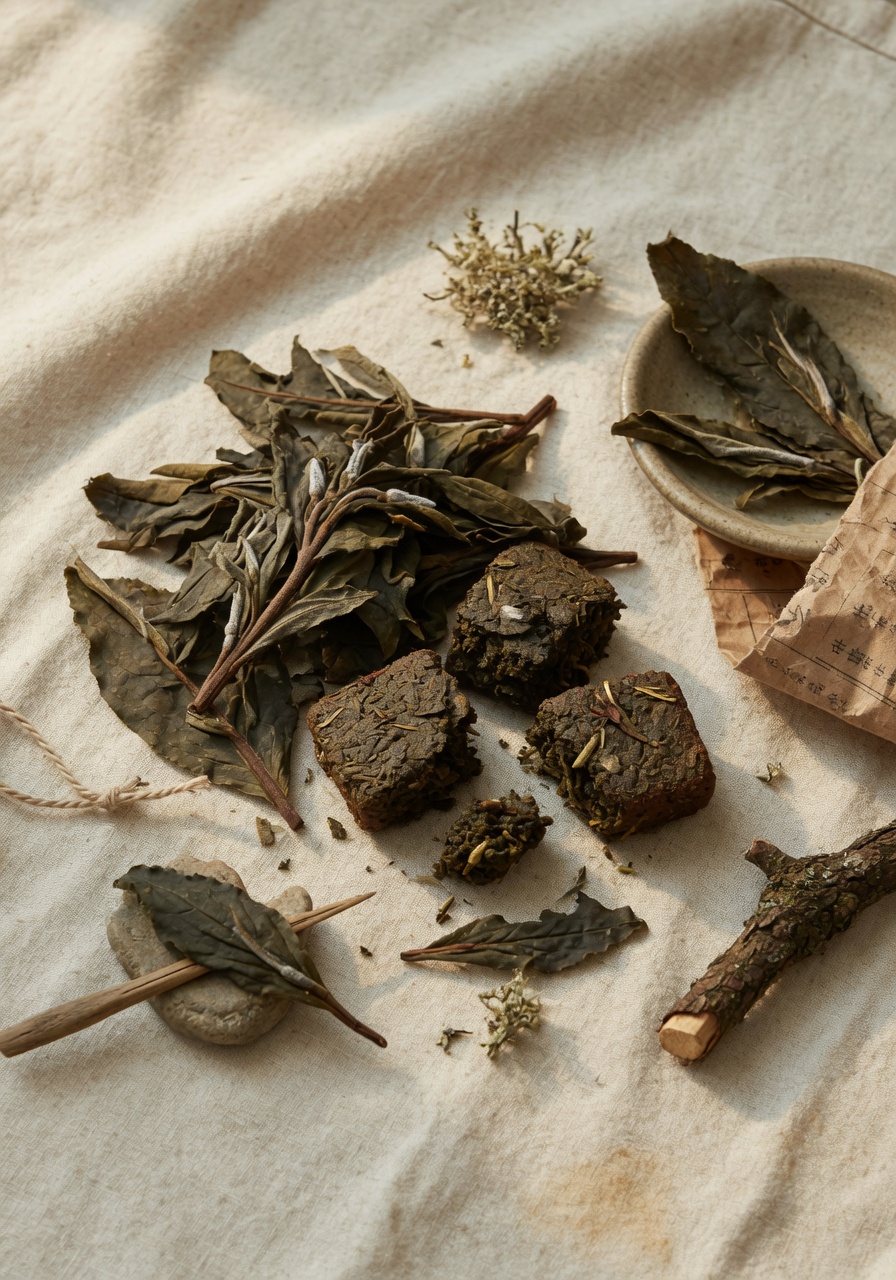
Walk into any tea market from Kunming to Guangzhou and you will see the same word stamped on neifei after neifei: gǔshù (古树), ‘old tree’. The implication is straightforward — leaves from ancient, large-leaf Camellia sinensis var. assamica trees, often presented as 100, 300, even 800 years old, grown in semi-wild forest gardens rather than terraced plantations. The price differential is anything but straightforward. A spring 2024 cake of claimed Lao Banzhang gushu retailed in Kunming between ¥4,800 and ¥38,000 per 357 g, while the village’s recorded fresh-leaf output for the entire spring harvest was, by the local government’s own 2023 figure, around 60 tonnes — enough to make perhaps 168,000 standard cakes. Domestic sales of cakes labelled ‘Lao Banzhang gushu’ that same year almost certainly exceeded that figure by more than tenfold. Something in the chain is fictional.
This article is not a debunking. Gushu material is real, it is genuinely distinctive in the cup, and a serious sheng drinker should understand what they are paying for. But the term has become a marketing layer detached from the trees underneath it, and the most useful thing a long-form encyclopedia can do is separate three questions that the market deliberately blurs: what counts as an old tree botanically, what ‘gushu’ means contractually, and what — if anything — you can detect by tasting. I have bought, brewed, and resold pressed sheng across the Russia–Mongolia corridor for fifteen years; the cakes I trust came with answers to all three.
What ‘old tree’ actually means — the botanical floor
There is no national standard in China that legally defines gǔshù. GB/T 22111-2008, the geographical indication standard for Pu’er tea, recognises Pu’er as a product of Yunnan made from large-leaf sun-dried material (dà yè zhǒng shài qīng máo chá), but it makes no reference to tree age, tree form, or cultivation density. The closest thing to an official taxonomy comes from Yunnan provincial agricultural extension documents and from the work of the late Yú Fúshēng (虞富生) and Xú Yàjūn at the Yunnan Academy of Agricultural Sciences, which divide Yunnan tea trees into roughly four classes by age and form: tái dì chá (台地茶, terraced plantation, usually post-1980), xiǎo shù (小树, small tree, ~30–80 years), dà shù (大树, big tree, ~80–200 years), and gǔshù (古树, ~200+ years). A fifth category, yě shēng or yě fàng (wild or feral), sits adjacent and is botanically different — often C. taliensis or C. crassicolumna, not sinensis.
These age ranges are conventions, not measurements. Outside a handful of celebrated trees that have been formally dendro-aged — the Bāngwěi ‘tea king’ on Lancang, the Jǐnxiù tea tree on Fèngqìng claimed at 3,200 years — almost no commercial gushu has been individually dated. Village figures of 300 or 500 years are oral tradition, sometimes ethnobotanically defensible and sometimes invented for the market after 2005. The honest reading is that ‘gushu’ in trade language means: a tree of mature trunk diameter, propagated by seed rather than cutting, grown without irrigation or chemical input, in a polyculture stand. The number of years is a story attached to that form, not a verified fact.
Why old trees do taste different — and why they shouldn’t always be preferred
Old-tree material does behave differently in the cup, and the difference is not imaginary. Three things change with tree age and root system: yield, leaf chemistry, and what one might call cup architecture. Yield drops sharply — a mature gǔshù in Yiwu might produce 0.8–1.5 kg of dry máochá per spring harvest, against 8–15 kg from a same-footprint section of terraced plantation. Leaf chemistry shifts because deeper, older root systems access mineral fractions that surface-rooted bushes cannot, and because the leaves themselves are shaded by canopy and develop more slowly. A 2017 paper from the Kunming Institute of Botany (Liu et al., Journal of Food Composition and Analysis) measured higher total polyphenol-to-amino-acid ratios in same-cultivar leaves from forest-grown old trees versus terraced plantings, with notably elevated theanine and gallic acid.
What this delivers in the cup is the hóu yùn (喉韵) — throat-feel — and huí gān (回甘) that defines serious sheng: a lingering mineral sweetness that returns 30 to 60 seconds after swallowing, and a thickness on the palate that survives ten or more infusions. Young gushu from a 2024 spring Yiwu I tasted last May arrived with a soft camphor-and-honey opening, no edge of astringency despite 95 °C water, and a salivating finish that lasted into the eleventh steep. That is what people are buying.
But — and this matters — ‘gushu’ is not a synonym for ‘better’. Terraced material from a good producer in Menghai, processed cleanly, can outperform mediocre gushu from a careless picker. Tree age is one input among five or six. Processing — particularly shā qīng (杀青, kill-green) temperature and sun-drying conditions — can erase any advantage the leaf came in with. The single most expensive cake I have ever regretted buying was a 2019 Bīngdǎo gushu with a scorched kill-green that no amount of aging will repair.
The arithmetic of the fraud
The mathematics of gushu supply have been worked out repeatedly, most rigorously by independent tea writer Yáng Kǎi (杨凯) and by the Pu’er-focused journal Pǔ’ěr Cháyì (普洱茶艺) in their 2019 and 2022 surveys. The numbers everyone in Yunnan knows, and few outside it want to hear, run roughly as follows.
Lao Banzhang — the canonical example
Lǎo Bānzhāng (老班章) village, in Bùlǎng Shān, has approximately 4,700 mu (~313 hectares) of recognised old-tree gardens according to the 2019 Menghai county forestry survey. Annual spring máochá output from genuine gushu trees in the village is around 50–70 tonnes, depending on weather. At an average compression of 357 g per cake, that ceiling is roughly 140,000–195,000 cakes per year of authentic Lao Banzhang gushu spring material. Industry estimates of cakes sold annually under that name run 1.5 to 3 million. The remainder is some combination of: leaf from surrounding villages (Xīnbānzhāng, Lǎomàn’é, Bādá) sold as Lao Banzhang; terraced or small-tree leaf from within the village itself sold as gushu; and outright blending with material from other townships. The village government installed checkpoint weighing stations in 2018 specifically to certify outgoing máochá, and the certificates are themselves now forged.
Yiwu, Bingdao, Xikong — same pattern, different terrain
Yìwǔ’s named micro-zones — Mahēi, Luòshuǐdòng, Guāfēngzhài, Wǎngzhī — face identical arithmetic. Guāfēngzhài, on the Laos border, produces perhaps 8–12 tonnes of máochá total per spring across all grades; the volume of ‘Guafengzhai gushu’ on the Guangzhou market alone in 2023 was multiples of that. Bīngdǎo’s five villages (Bīngdǎo Lǎozhài, Dìjiē, Nánpō, Bànuò, Nuòwǔ) collectively yield 30–40 tonnes; international sales suggest five to eight times that volume. The pattern is consistent: the more famous the name, the wider the arbitrage gap, and the more sophisticated the laundering through certificates, nèifēi (内飞, internal label), and forged QR-traceability tags.
Reading a gushu claim — what to ask, what to ignore
Once you accept that the label cannot be trusted on its own, the question becomes how to evaluate a specific cake. Three things matter, in this order: who pressed it, what they will tell you about the source, and what the leaf and the brew say independently. The age claim — ‘300-year’, ‘500-year’ — is the least useful piece of information on the wrapper, because it is unverifiable and rarely contractual. I treat any specific year number as decorative.
Producer matters more than village. A small workshop pressing 200 kg of máochá per spring, owned by a maker who lives in or adjacent to the village, with a multi-year track record visible across vintages, is worth more than a generic factory claim of the same village name. The names that come up repeatedly in serious Russian and European collector circles — Chén Shènghé’s workshop in Yiwu, the Hé family in Mahēi, certain small operations in Nánnuò and Bùlǎng — are not always cheaper, but they are answerable. When I have called producers I trust to ask where this specific batch of leaf was picked, on what date, by which household, I have always gotten an answer. When a vendor cannot provide that chain, the cake is decorative.
For catalog cross-references on individual mountains and their material profiles, see the Bulang Shan and Yiwu entries; for the underlying processing question that determines whether gushu material survives into the pressed cake, the sha qing entry is the next stop. Vendor-side context lives at shop.puerh.app, and the broader buying-discipline framework at tea.school.
What you can — and cannot — taste
There is a stubborn romanticism in the gushu market that says a trained palate can identify old-tree material blind. In my experience, and that of every honest taster I have worked with from Ulan-Ude to Petersburg, this is half true. You can reliably distinguish good forest-garden material from terraced plantation material in a blind flight. The forest leaf shows a thicker mouthfeel, slower flavour release across more infusions, a huí gān that arrives later and stays longer, and an absence of the sharp green-vegetable note that terraced spring material often carries. That distinction is real and trainable.
What you cannot do is distinguish 200-year-old material from 80-year-old material from the same garden, blind. You cannot tell Lao Banzhang from neighbouring Lǎomàn’é reliably in a five-cake flight. You cannot identify ‘wild arbor’ versus ‘old tree’ without prior context. I have watched experienced buyers, including a Menghai factory technical director, fail these tests in controlled tastings. The cup tells you about forest versus terrace, careful processing versus careless, and broadly about region. It does not tell you specific village or specific age, and any vendor or critic who claims otherwise is selling confidence, not information.
A practical consequence: do not pay a premium for an age claim. Pay a premium for documented provenance, a producer you can name, and material that performs across ten to fifteen infusions with the hallmarks above. If those align with a credible village story, fine. If not, the story is the cheapest part.
A working definition for the serious buyer
After fifteen years of buying sheng for a clientele that includes people who can taste the difference between a 2003 and a 2005 Yiwu blind, I have settled on a working definition of ‘gushu’ that has nothing to do with the wrapper. A cake earns the label, in my private accounting, when four things are true: the material comes from seed-propagated trees grown in polyculture without irrigation or chemical input; the producer is named, reachable, and has been pressing under the same identity for at least five years; the pricing is internally consistent with the producer’s other releases of the same vintage; and the cup shows the structural markers — thickness, late huí gān, sustained mineral finish across many infusions — that distinguish forest-garden leaf from plantation leaf.
Note what is absent: a specific year of tree age, a claim of a single famous village, a QR code, a ‘tea king tree’ photograph. None of these correlate with quality in the data I have. They correlate, if anything, slightly negatively, because the most marketed cakes are the most adulterated. The best gushu I have sold in the last three years carried a hand-stamped neifei from a workshop most readers have never heard of, and cost a third of what comparable Lao Banzhang fetched on the open market. That asymmetry is the actual opportunity in the category, and it is only available to buyers who have stopped reading the wrapper as evidence.
The gushu debate is not really a debate about old trees. It is a debate about whether a category can sustain integrity when its premium is detached from anything verifiable. The trees are real. The chemistry is real. The cup is real. The label, mostly, is not — and the encyclopedia’s job is to say that clearly, so the drinker can do the harder work of finding the producer who still tells the truth.
References
- GB/T 22111-2008 — Geographical indication product: Pu'er tea — 国家标准化管理委员会 (Standardisation Administration of China)
- Comparative analysis of polyphenols and amino acids in Yunnan large-leaf tea from old arbor and plantation cultivation — Liu et al., Journal of Food Composition and Analysis, Kunming Institute of Botany, 2017
- 普洱茶——经典之味 (Pu'er tea — flavour of the classics) — Yáng Kǎi 杨凯, Yunnan Science and Technology Press, 2019
- Menghai County Forestry Survey: ancient tea tree gardens, 2019 — 勐海县林业和草原局 (Menghai County Forestry and Grassland Bureau)
- 古树茶产量与市场流通量调查 (Survey of old-tree tea production vs market circulation) — 普洱茶艺 Pǔ'ěr Cháyì journal, issue 04/2022
- Ancient tea trees of Yunnan: classification and conservation — Xú Yàjūn, Yunnan Academy of Agricultural Sciences, monograph 2014
Read next
Related articles
Young sheng — drink now or wait?
The question every collector asks within their first year. Some cakes are radiant at eighteen months; others need a decade before they stop biting. Here is how to tell which is which.
Bulang Shan — the bitter that becomes sweet
On the southern edge of Menghai county, the Bulang people have tended tea for over a thousand years. Their leaf opens the throat with bitterness — then turns sweet, slowly, and refuses to leave.
Yiwu — forest gardens of the Laos border
On the southern edge of Xishuangbanna, where the forest crosses into Laos, *Yì Wǔ* (易武) grows the softest, most aromatic *shēng* in Yunnan — a tea that built an empire, vanished for fifty years, and rebuilt itself from village memory.
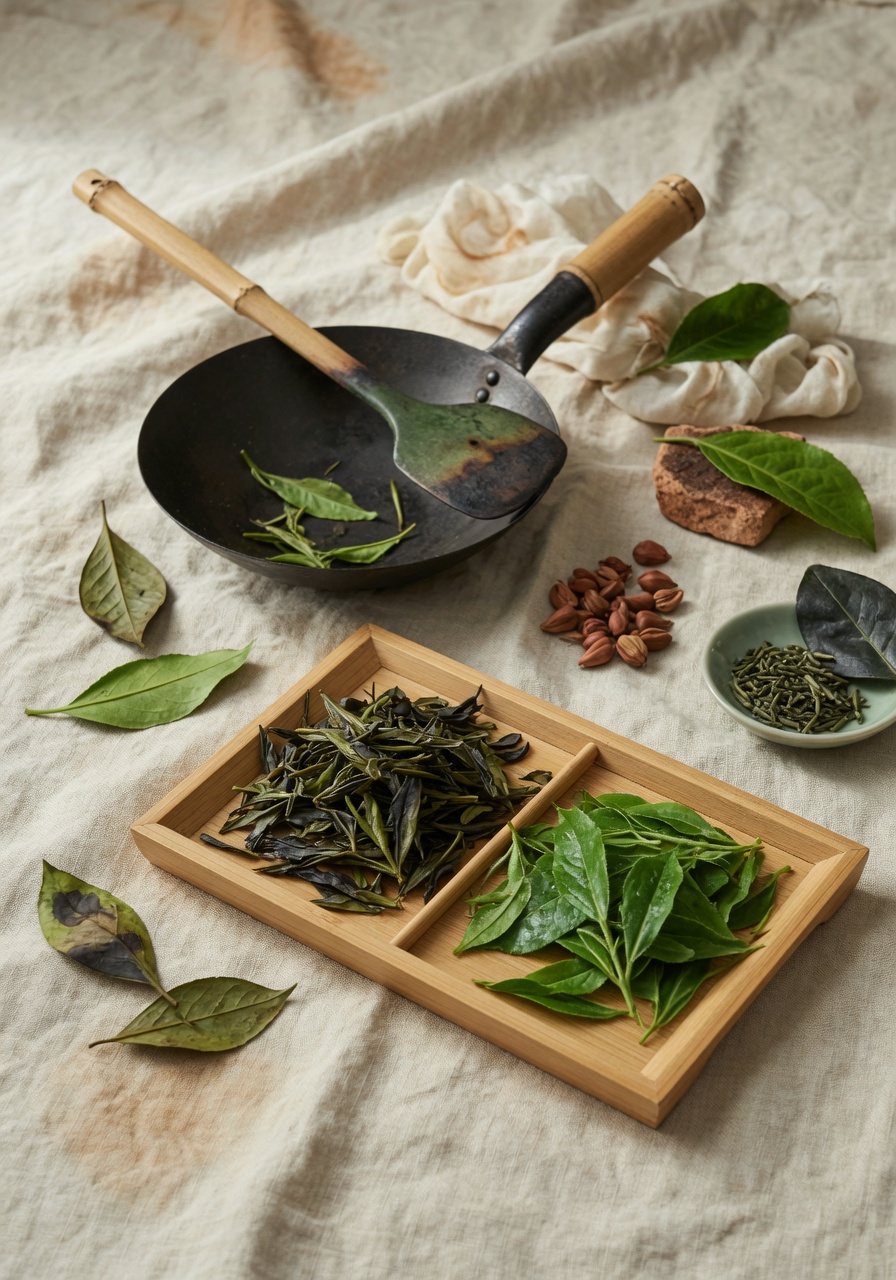
Sha qing — kill-green for pu'er vs green tea
The pan-firing step that defines pu'er is not the same as the one that defines Longjing. Same name, same wok — different temperature, different intent, different future.