home · From fresh leaf to <em>bǐng</em> — the craft behind pu'er
Processing & craft
Sha qing — kill-green for pu'er vs green tea
Shā Qīng · 杀青
The pan-firing step that defines pu'er is not the same as the one that defines Longjing. Same name, same wok — different temperature, different intent, different future.
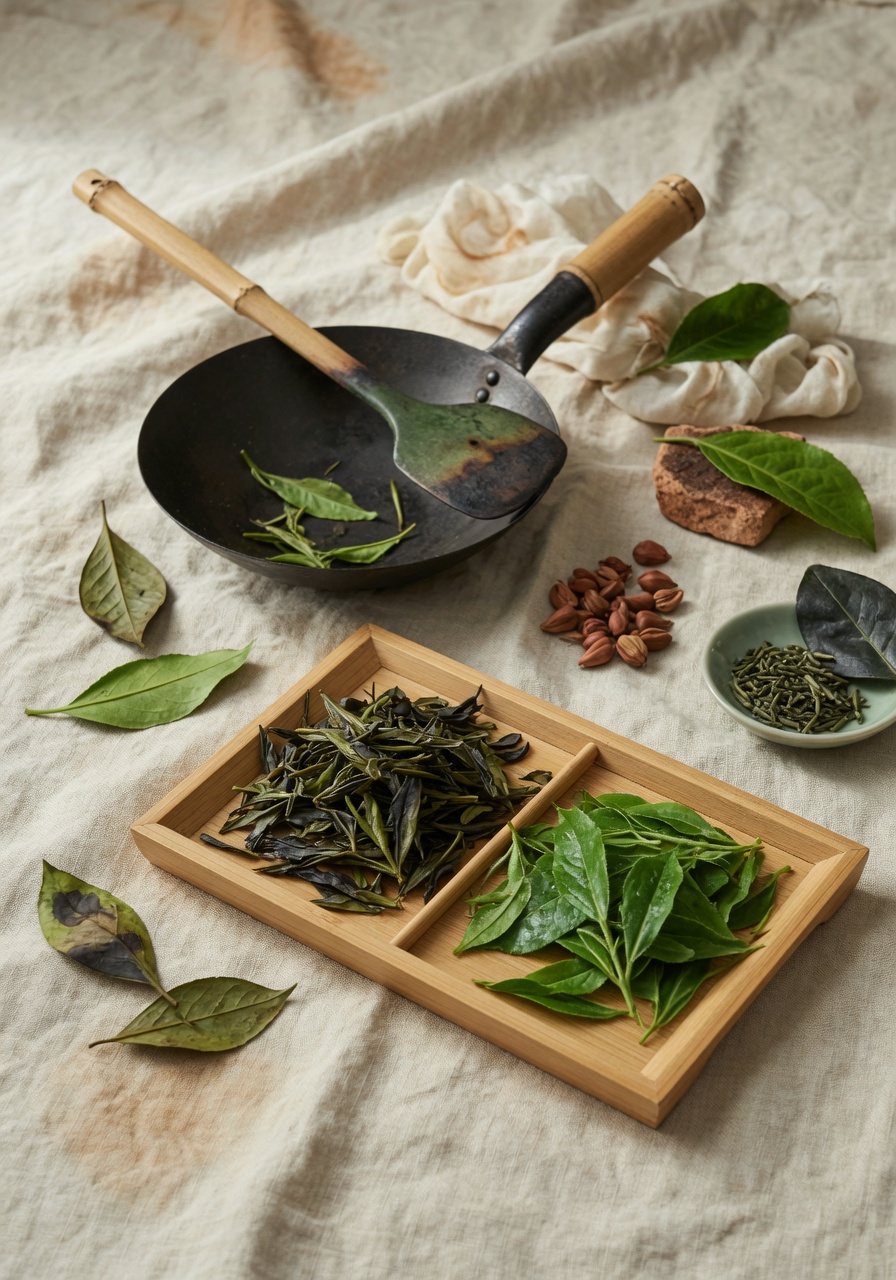
Shā Qīng (杀青) translates literally as ‘kill the green’ — the heat-treatment step that arrests enzymatic oxidation in fresh tea leaves. Every non-oxidised and partially-oxidised Chinese tea passes through some form of it: pan-firing for most green teas, steaming for Japanese green tea and a few Hunan dark teas, tumble-drying for industrial volumes. The phrase is the same across categories, which is why it gets quietly assumed that the step itself is the same.
It is not. The shā qīng applied to máo chá (毛茶) destined for shēng pu’er is deliberately, almost dangerously incomplete. The leaf is heated enough to soften the cell walls and bend the chemistry, but not enough to destroy the enzymes that will keep working — slowly, for decades — inside a pressed bǐng. A Longjing master in Hangzhou would call the same leaf under-fired and reject it. A Yiwu zhì chá shī (制茶师) would call a properly-fired Longjing leaf dead — incapable of becoming anything more than what it already is.
This article walks through what actually differs: temperature ranges, wok time, residual moisture, enzyme activity, and the way each choice locks in or unlocks the leaf’s future. It draws on the Yunnan provincial standard DB53/T 103-2014, on GB/T 22111-2008 for geographic-indication pu’er, and on field notes from small-batch producers in Menghai and Lincang who still pan-fire by hand in iron woks over wood fire.
What kill-green is actually doing
Inside a freshly-plucked tea leaf there are two enzymes that matter for processing: polyphenol oxidase (PPO) and peroxidase (POD). Left alone, they catalyse the oxidation of catechins into theaflavins and thearubigins — the chemistry that turns a green leaf into a black-tea leaf over a few hours. Shā qīng applies heat to denature these enzymes before that browning can proceed. The thermal threshold for irreversible PPO denaturation in Camellia sinensis is roughly 65 °C sustained; POD is tougher, requiring closer to 75-80 °C in the leaf core for full inactivation.
For a green tea like Xī Hú Lóng Jǐng (西湖龙井) the goal is total enzyme shutdown. The leaf must be stable — chemically inert in any way that would alter flavour after firing. Wok temperatures run 200-260 °C at the iron surface, leaf-core temperature climbs past 80 °C within seconds, and a fixed-and-shaped Longjing leaf can sit on a shelf for a year and taste nearly identical at the end of it (apart from gentle staling of aromatics).
For pu’er máo chá the goal is the opposite of total. The processor wants enough heat to halt obvious oxidation — to prevent the leaf from going black on the bamboo mat — but not so much that the slow microbial and enzymatic reactions of aging are foreclosed. Residual PPO activity in well-made shēng máo chá is consistently measurable years after firing; this is one of the few hard chemical markers that separates pu’er base material from green tea base material. Lu Jianliang’s group at the Yunnan Agricultural University documented residual PPO activity of 18-32 % in commercial Menghai máo chá samples one year post-processing, versus <2 % in Longjing of comparable age.
Temperature and time — the actual numbers
The Yunnan provincial standard DB53/T 103-2014 specifies wok-surface temperatures of 180-220 °C for pu’er shā qīng, with leaf throughput of roughly 4-6 kg per charge and total contact time of 5-8 minutes. In practice, small producers in Yiwu and Bulang work at the cooler end of that band — many old-tree pickers I spoke to in spring 2023 fire at 160-180 °C — and they often pull the leaf at six minutes or less. The pan-firing is followed by rolling on bamboo (róu niǎn, 揉捻), then sun-drying on flat racks until residual moisture falls to ~10 %.
Compare with GB/T 18650-2008 for West Lake Longjing: wok temperatures climb in three phases (qīng guō, huī guō, huí guō) from 80 °C up to 220-240 °C, with a total leaf-in-wok time of 25-40 minutes spread across the phases. A Longjing leaf spends four to six times as long in contact with hot iron as a pu’er leaf, and the cumulative thermal load on the enzyme system is far higher.
The difference is not subtle. A six-minute, 180 °C kill-green leaves the leaf core somewhere between 70-75 °C at peak — right on the edge of POD denaturation, below the threshold for full deactivation. A Longjing’s 30-minute firing pushes the core well past 80 °C multiple times. The first leaf can age. The second cannot.
Why too hot kills pu’er’s future
Over-firing of máo chá — what Yunnan producers call shā qīng tài gāo (杀青太高) or simply ‘green-tea style firing’ — is one of the most common faults in mid-tier commercial shēng. The cake tastes bright and pleasant in year one: floral, clean, almost like a roasted green tea. By year five it is hollow. The catechin pool that should have been slowly polymerising into the soft, dark-fruit sweetness of aged shēng was instead frozen in place, and what remains is a fading green-tea note over thin liquor.
This is why experienced collectors are sceptical of shēng that drinks too well too young. Amgalan Chin, who has been cellaring sheng since the early 2000s, puts it bluntly in a 2022 interview with Global Tea Hut: ‘If a two-year cake already tastes like fruit, ask what they did to it. Probably the wok was too hot.’ The Henan-trained masters I work with use a tactile test — the leaf should come out of the wok still slightly tacky and pliable, not crisp. Crisp means dead.
Why too cool produces hóng biān
Under-firing is the opposite fault. If the wok is below 150 °C or the leaf is not turned properly, oxidation proceeds along the leaf edges — producing the hóng biān (红边, ‘red edge’) defect familiar from poorly-made oolong. In máo chá this shows as brownish-red rims on the dry leaf and a slightly sour, fermented note in the cup. Small amounts are tolerated, even prized by some Yiwu drinkers as a marker of hand-firing over wood fire. Large amounts indicate the processor lost control of leaf temperature, usually because the charge was too big for the wok.
Hand wok versus machine drum
Until the 1980s nearly all Yunnan shā qīng was done by hand in shallow iron woks over wood fire — the tiě guō shǒu chǎo (铁锅手炒) method. The processor turns the leaf with bare hands or a short bamboo paddle, reading temperature by the sound of the leaf hissing and the smell of the steam. A skilled operator handles 3-5 kg per charge and produces perhaps 20-30 kg of fired leaf per day.
From the mid-1990s onwards, rotating drum machines (gǔn tǒng shā qīng jī, 滚筒杀青机) took over the commercial supply. A drum runs continuously, taking fresh leaf in at one end and discharging fired leaf at the other; throughput is 80-200 kg per hour. Temperature is set on a dial. Modern Menghai Tea Factory production for recipes like 7542 and 7572 is entirely drum-fired — the scale of the operation makes hand-firing economically impossible.
The quality argument cuts both ways. Drum firing is more uniform, more reproducible, and better at avoiding the scorched-leaf defect that even good hand-fryers produce occasionally. Hand firing, when done well, gives more aromatic complexity — the slight unevenness leaves pockets of differently-treated leaf that broaden the flavour profile. It also tends to leave higher residual enzyme activity, which favours long aging. The premium small-batch market in Yiwu, Bulang, and Jingmai has swung firmly back to hand-firing since around 2010, with some workshops marketing the tiě guō method as a quality marker on the wrapper. For a deeper look at how these processing choices propagate through the aging curve, see the companion piece on sheng vs shu at puerh.app and the storage explainers on tea.school.
The steaming question — why pu’er also gets steamed
There is a second heat-treatment in pu’er processing that confuses outsiders: the brief steaming that happens just before pressing. After máo chá has been sorted, blended, and weighed for a cake, it is hung in a cloth bag over a steam jet for 8-15 seconds to soften the leaves so they will compress and bond. Steam temperature is around 100 °C and contact is short.
This is not a second shā qīng. The leaf-core temperature in the centre of a 357 g loose pile barely rises above 60 °C, and the duration is far too short to denature enzymes that survived the wok. What it does do is introduce a small pulse of moisture into the cake — roughly 12-15 % water content at pressing, drying back to 9-10 % over the following weeks. That moisture is what allows microbial succession to begin inside the cake during the early years of aging; without it the cake would be too dry for the slow-fermentation chemistry that defines aged shēng.
For shú pu’er the picture is different again. Shú máo chá has already been through wō duī (渥堆) pile fermentation, which involves weeks of heat and moisture at 50-65 °C — chemistry far more aggressive than anything in green-tea processing. The kill-green step still happens at the start, on fresh leaf, before the leaf becomes pile-fermentation feedstock; the wō duī itself is a separate transformation discussed in detail elsewhere on this site.
What to taste for in the cup
If you want to read a young shēng for its kill-green quality, brew it gongfu style at 95 °C with about 7 g in a 100 ml gaiwan, short rinses, then 10-15 second infusions. Pay attention to three things across the first four steeps.
First, the dry-leaf aroma after the rinse: properly-fired máo chá smells of fresh hay, white flowers, and a faint sweet smoke. Over-fired leaf smells toasty, almost like roasted chestnut — that is green-tea character bleeding through. Under-fired leaf smells slightly fermented, vinous, sometimes faintly sour.
Second, the soup body in steeps two and three: a well-fired young shēng has a noticeable thickness, almost oily, with bitterness that resolves quickly into sweetness in the throat (huí gān, 回甘). Thin, hollow soup with persistent flat bitterness is a kill-green failure.
Third, the wet-leaf colour at the end: a uniform olive-green with intact, pliable leaves and stems indicates good firing. Brownish or reddish leaves indicate oxidation that slipped through. Charcoal-grey or brittle leaves indicate over-firing. Mei Yang, who teaches processing at a workshop in Phoenix Mountain, summarises it as: ‘The wet leaf tells you what the wok did. It does not lie.’ For drinkers building a long-term cellar, learning to read these signals at year one saves disappointment at year ten.
Why the same word means different things
Shā qīng is one of those Chinese tea terms that travels across categories and quietly changes meaning at every border. In Longjing it means total enzymatic shutdown and permanent flavour fixation. In Tieguanyin oolong it means partial deactivation after controlled oxidation. In pu’er it means a deliberate threshold-state — enough heat to halt obvious browning, little enough to leave the chemistry alive.
This is not a quirk of translation. It reflects a different view of what a tea leaf is for. The green-tea tradition treats the leaf as something to be captured at peak freshness and preserved. The pu’er tradition treats it as a starting point — a seed of future tea, to be processed in a way that opens the door to transformation rather than closing it. Both are legitimate. Both produce extraordinary tea. But conflating them — assuming that ‘kill-green’ is one technique with one purpose — is the single most common mistake outsiders make when trying to understand why pu’er exists as a separate category at all.
References
- DB53/T 103-2014 — Yunnan provincial standard for sun-dried green tea (pu'er máo chá) — Yunnan Provincial Bureau of Quality and Technical Supervision
- GB/T 22111-2008 — Geographic indication product: Pu'er tea — Standardisation Administration of the People's Republic of China
- GB/T 18650-2008 — Geographic indication product: Longjing tea — Standardisation Administration of the People's Republic of China
- Lu Jianliang et al., 'Residual polyphenol oxidase activity in Yunnan large-leaf máo chá and its correlation with aging potential', Journal of Tea Science, 2018, 38(4): 412-421 — Yunnan Agricultural University, Tea Science Department
- Interview with Amgalan Chin, 'Twenty years of cellaring sheng — what the wok decides' — Global Tea Hut, June 2022
- Zhou Hongjie, 'Pu'er Tea Processing — Theory and Practice' (普洱茶加工理论与实践), Yunnan Science & Technology Press, 2014 — Zhou Hongjie, Yunnan Agricultural University
Read next
Related articles
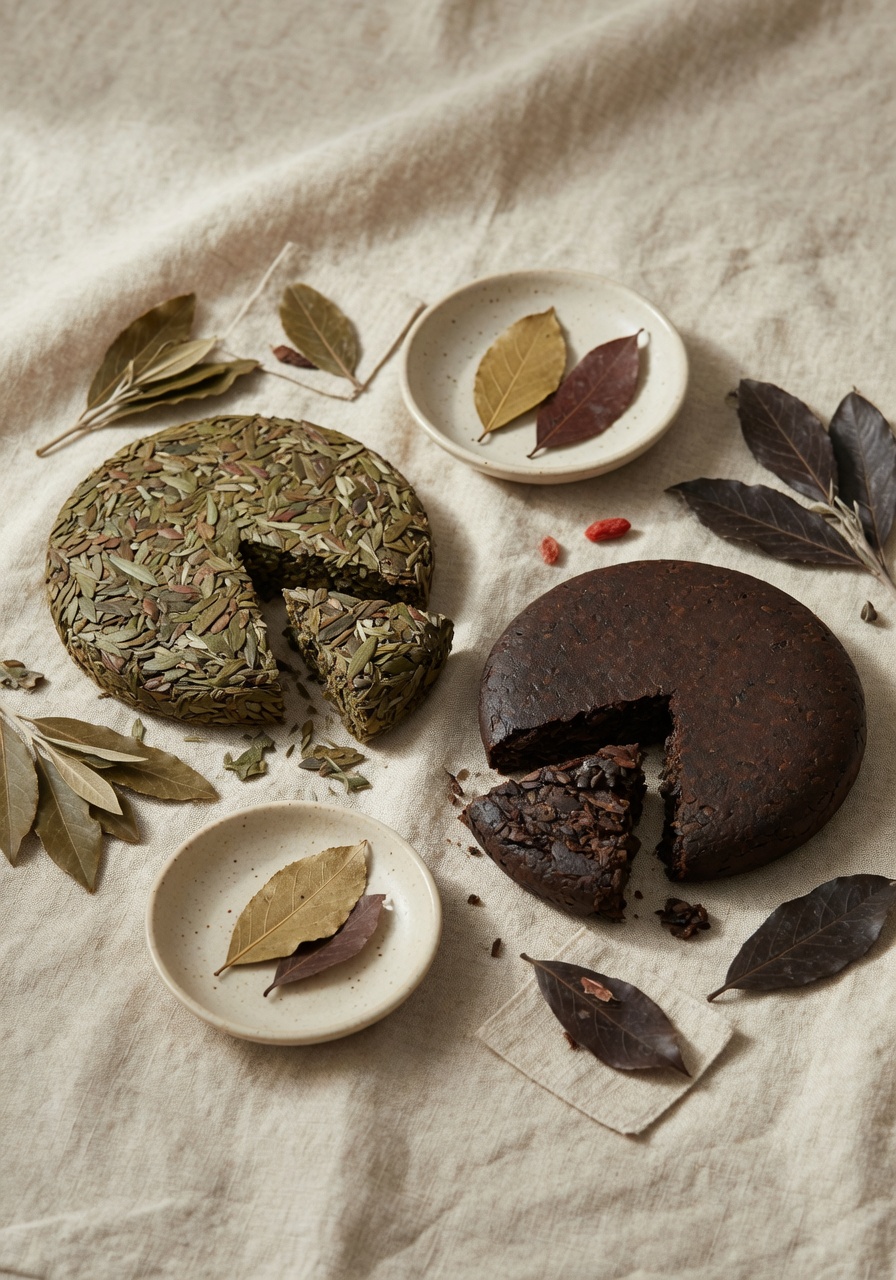
Sheng vs shu — what actually changes
Two teas share a name, a region, and a leaf — and almost nothing else. The 1973 invention of *wò duī* (渥堆) split pu'er into raw and ripe, and the chemistry of that split still defines every cake pressed today.
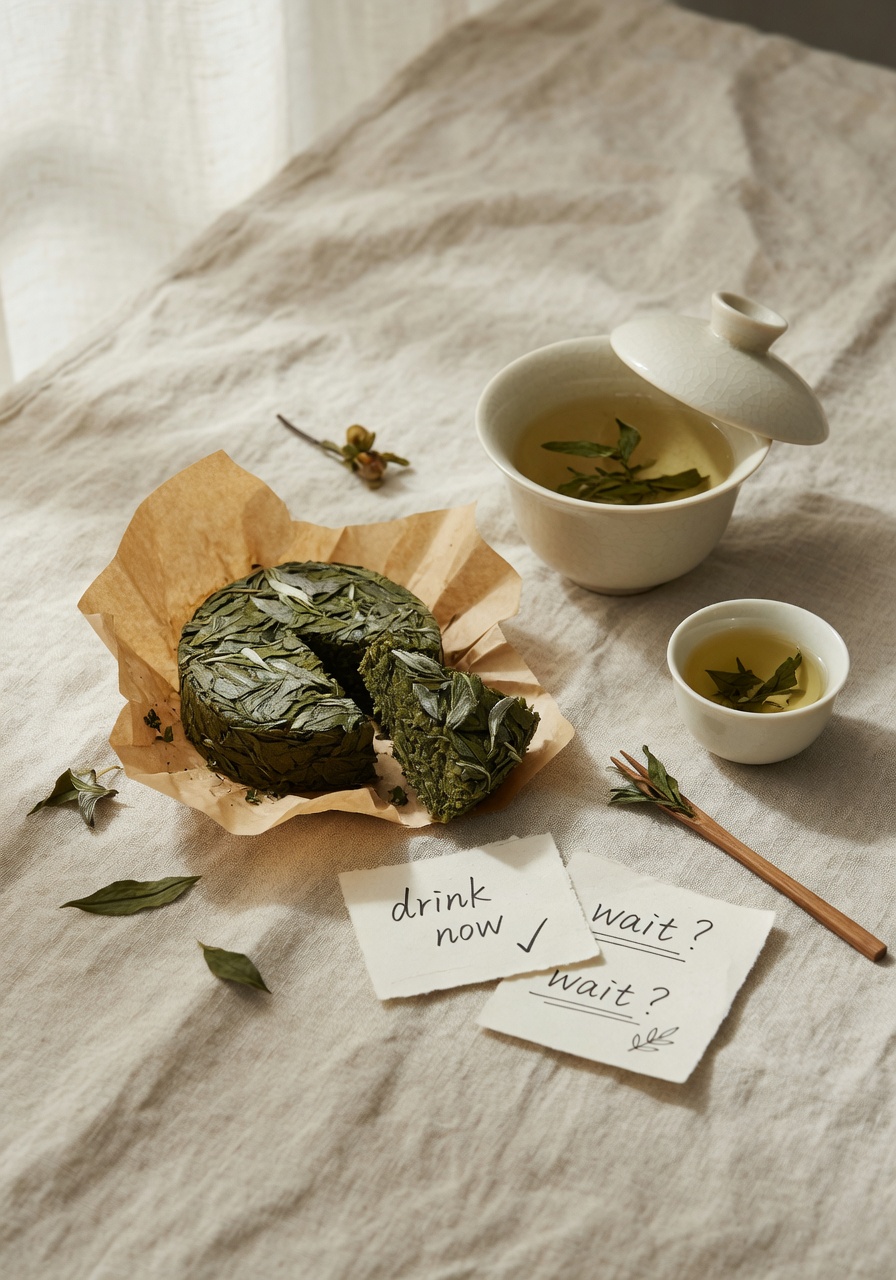
Young sheng — drink now or wait?
The question every collector asks within their first year. Some cakes are radiant at eighteen months; others need a decade before they stop biting. Here is how to tell which is which.
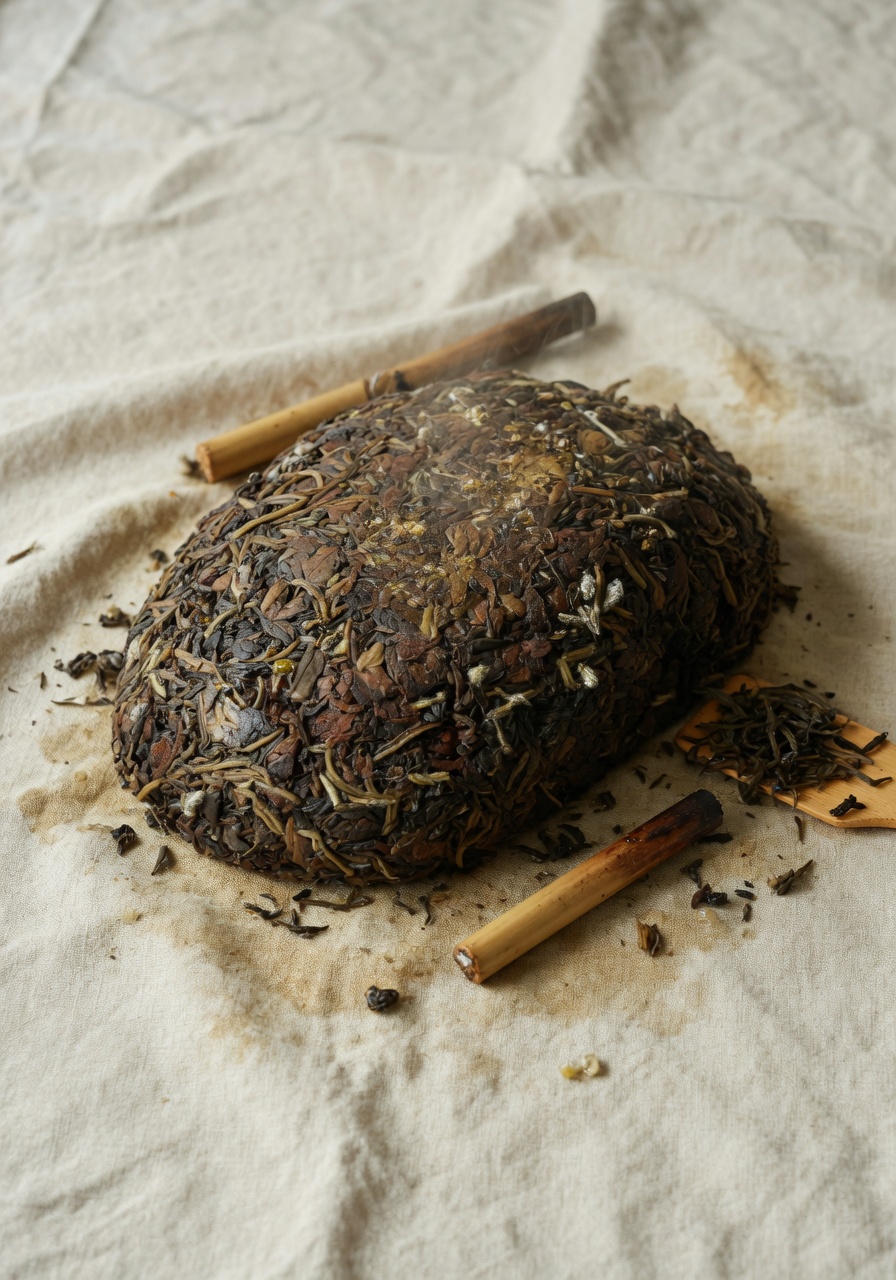
Wo dui — the pile fermentation that defined shu
In 1973, a team at Kunming Tea Factory wet-piled maocha under wool blankets and waited. Forty-five days later, the leaves were black, sweet, and unmistakably new. This is the story of how a chemical accident became a category.
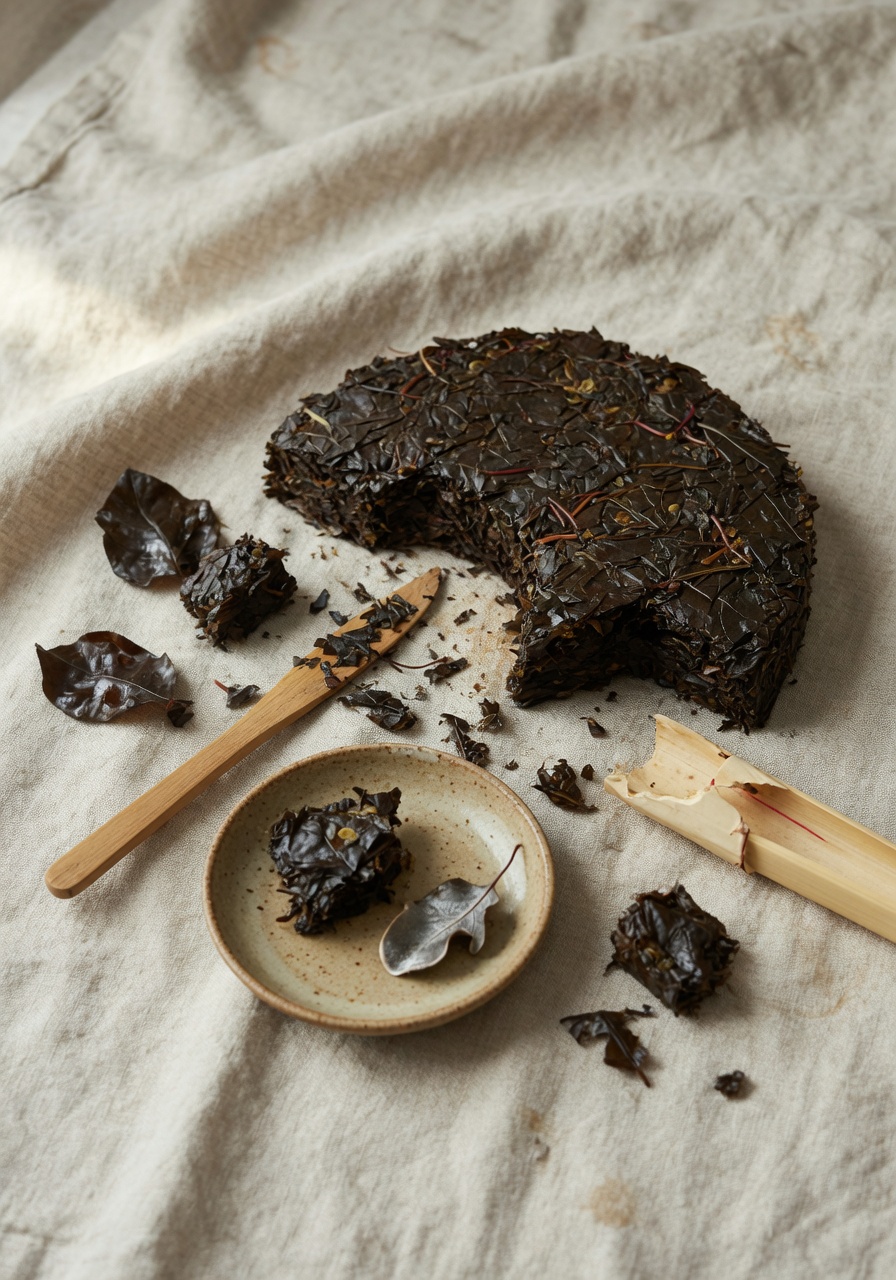
Menghai 7572 — the recipe that anchors the category
A four-digit code stamped on a paper wrapper has done more to define what shu tastes like than any single mountain or master. This is how 7572 became the reference point.