home · Six mountains, six <em>flavours</em> — terroir in pu-erh
Yunnan regions
Menghai county — birthplace of modern shu
Měng Hǎi · 勐海
A flat-bottomed valley at 1,200 m, ringed by Bulang and Nannuo mountains, where in 1973 a state factory perfected pile fermentation and changed pu-erh forever.
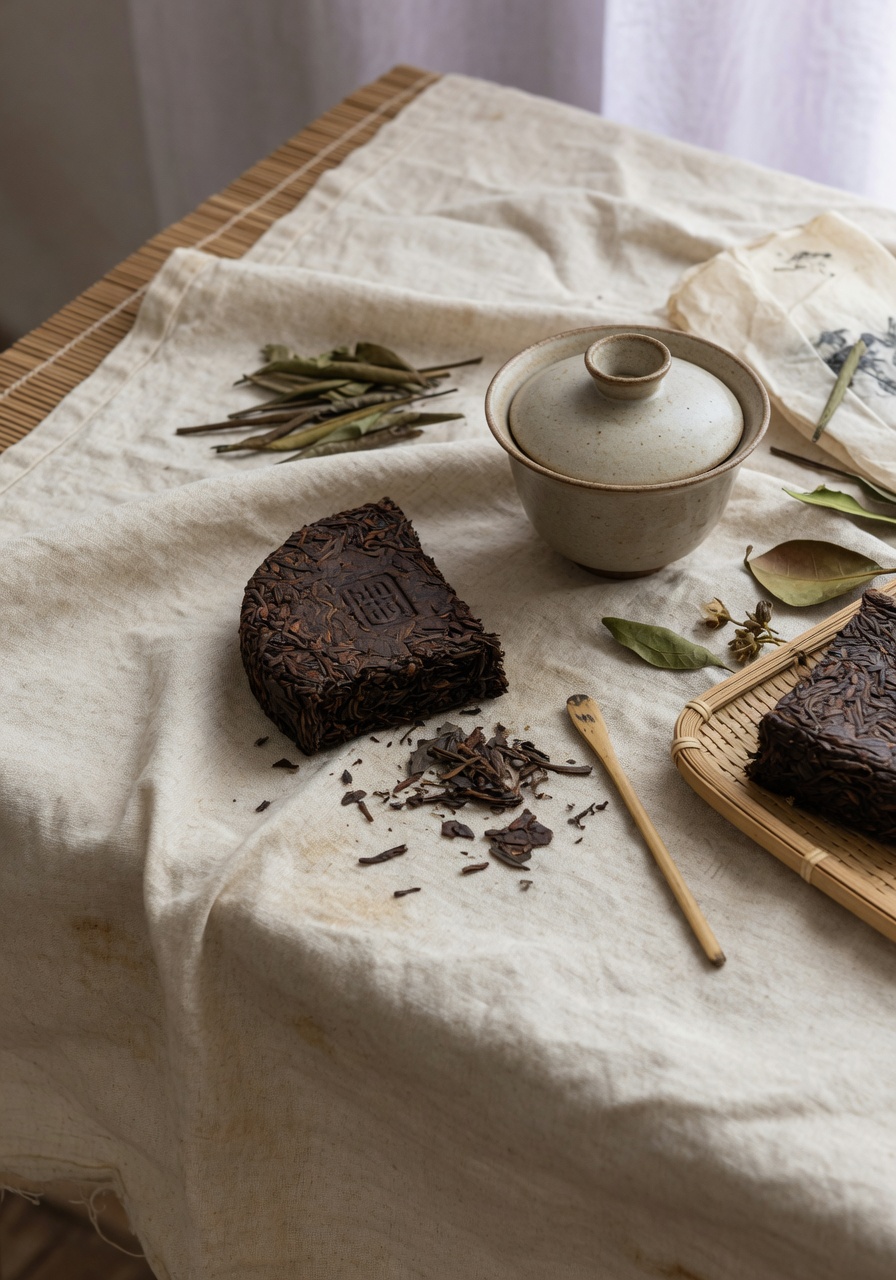
Menghai county sits in the southwestern corner of Xishuangbanna prefecture, a half-day drive from the Myanmar border and a long afternoon from Laos. On a map it looks unremarkable — a wedge of land between the Mekong and the hills — but inside that wedge lives nearly every variable that matters for pu-erh. Elevations run from roughly 900 m on the valley floor near Menghai town to over 2,400 m at the summit of Nannuo. Annual rainfall sits around 1,400 mm. The soil is mostly weathered red laterite with patches of yellow-brown loam in the higher villages. Old assamica trees — some genuinely over two centuries old, many planted in the Republic period — share slopes with cleared, terraced gardens of the 1980s. And in the middle of the county, beside the road to Jinghong, stands the Menghai Tea Factory: the institution that in 1973 industrialised wō duī (渥堆), pile fermentation, and made shu pu-erh a category. To talk about Menghai is to talk about both the wild end of the trade — Bù Lǎng (布朗), Nán Nuò (南糯), Banzhang — and the most disciplined factory blends in Chinese tea. This article maps the county geographically, then walks through what each sub-region tastes like, and finally returns to the factory that gave its name to the place.
Geography and climate of the basin
Menghai county covers roughly 5,500 km² and lies between 21°28′ and 22°28′ north — well within the tropics, but the elevation pulls it back into a subtropical monsoon zone. Mean annual temperature on the valley floor is about 18.5 °C, with a dry season from November to April and a wet season that delivers more than 80 percent of yearly rainfall between May and October. For tea trees this matters in two ways. First, the dry-cool season concentrates aromatics and slows growth, which is why spring picking (春茶, chūn chá) in late March and early April produces the most prized maocha. Second, fog. The basin traps morning mist against the south-facing slopes of Nannuo and the western flanks of Bulang, and that diffuse light — combined with thin laterite soils — drives the leaf chemistry that pu-erh drinkers recognise as Menghai character: thick mouthfeel, persistent bitterness that turns to huí gān (回甘) on the back of the tongue, a faint camphor note in older sheng. The county is also fortunate in its biodiversity. Tea gardens here are rarely monocultures in the strict sense; even the cleared, terraced plots usually sit within walking distance of broadleaf forest, and the older village gardens at Nannuo and Hekai are interplanted with camphor, fig, and wild banana. This biodiversity feeds back into flavour, but it also matters for soil microbiology — relevant later when we get to fermentation.
The mountains — Bulang, Nannuo, and the rest
Menghai’s reputation rests on a handful of named mountains, each with its own house style. Bù Lǎng Shān (布朗山) anchors the southern tier of the county, climbing toward the Myanmar border and reaching nearly 2,000 m at its highest gardens. Bulang tea is famously bitter — green-bitter when young, almost herbal — and that bitterness is the engine of its long aging arc. Lao Banzhang, the village that everyone has heard of, sits inside Bulang township; the actual administrative village holds maybe 140 households, which is part of why authentic Banzhang maocha is so rare and so faked. North of Bulang, across the valley, Nán Nuò Shān (南糯山) is the gentler counterpart — sweeter, more floral, with cooler high-altitude gardens around the Banpo and Gulan villages. Between them sit Hekai, Pasha, and Mengsong, each producing recognisable but less-marketed leaf. To the west, closer to Menghai town itself, are the lower-elevation production zones that historically fed the state factory: Bada, Brangrong, and the valley gardens where most 7542 and 7572 base material has been sourced since the 1970s.
Bulang — bitterness as architecture
A spring 2019 Lao Banzhang maocha, brewed at 95 °C in a 120 ml gàiwǎn (盖碗), opens with a slap of green-bean bitterness that flattens the palate for three or four seconds before yielding to a cool, mineral sweetness that lingers in the throat. That progression — bitter, transition, gān — is what producers in Bulang are paid for. Without the bitterness, the long aging curve does not exist; bitter polyphenols are what convert, over fifteen to twenty years of dry storage, into the camphor and dried-fruit notes of mature sheng. For more on this arc, see ‘Young sheng — drink now or wait?’ in this encyclopedia.
Nannuo — the floral counterweight
Nannuo is often called the queen of Menghai’s mountains, partly for marketing and partly because the leaf actually behaves like one. A typical Banpo spring sheng smells of orchid and wet stone, brews thinner than Bulang in the first three infusions, then thickens in the middle of a session as the leaf opens. Nannuo’s old tree gardens are well documented — the Half-Slope ancient tea tree (半坡老茶树), at about 800 years old, was the historical poster child for Yunnan gushu before storms damaged it in the 1990s. The mountain remains the textbook starting point for anyone tasting Menghai sheng for the first time.
The 1973 experiment — how shu was born here
Pile fermentation did not appear out of nowhere. Hong Kong and Guangzhou warehouses had been producing partially-fermented, aged-tasting pu-erh by accident — and then deliberately — for decades before 1973. What happened in 1973 was that the Menghai Tea Factory, together with Kunming Tea Factory and the provincial tea import-export company, sent a team led by Zou Bingliang and Wu Qiying to Guangzhou to study the wet-storage processes used by Guangdong factories. They returned to Yunnan with the technique and adapted it. By 1974, Menghai had a working pile-fermentation room. By 1975, the factory had standardised the recipes that still anchor the category: 7572 (a blended shu) and 7542 (its sheng counterpart). The shorthand reads: 75 for the recipe year, 7 or 4 for the blend grade, 2 for the factory code (Menghai = 2, Kunming = 1, Xiaguan = 3, Pu’er = 4). For a longer treatment of the recipe system, see the dedicated article on 7572 elsewhere in this catalogue. The reason Menghai succeeded where others copied less successfully is partly water — the soft, low-mineral water of the local aquifer — and partly the resident microbial community. Studies published in Food Microbiology have repeatedly identified Aspergillus niger, Blastobotrys adeninivorans, and various Rhizopus and Penicillium species as dominant in Menghai piles, with strain compositions that differ measurably from piles fermented in Kunming or Xiaguan.
Why Menghai water and air matter
Wo dui is, fundamentally, a managed solid-state fermentation. You pile maocha to about one metre, wet it to 30–40 percent moisture by weight, cover it with cloth, and let temperature and microbial activity do the rest over roughly 45 to 60 days. The Menghai factory has run this process in the same physical rooms, with the same brick floors and roof angles, since the mid-1970s. The microbial communities living in those rooms are not portable. Several producers have tried to replicate Menghai-style shu elsewhere in Yunnan and elsewhere in China; the results are recognisable as shu but rarely confused with the original. Amgalan Chin, our cross-regional specialist, notes from Mongolian and Russian dark-tea comparisons: ‘You can copy the parameters. You cannot copy the room. The same maocha piled in Menghai and in Xiaguan in the same week will diverge by week three of fermentation, and at sixty days they are different teas.‘
Producers beyond the state factory
Menghai Tea Factory was privatised in 2004 and is now operated by Dayi (大益), which remains the volume leader. But the county is no longer a one-factory story. Since the early 2000s, smaller producers have built reputations that travel internationally. Haiwan (海湾), founded in 1999 by Zou Bingliang — the same Zou who had led the 1973 pile-fermentation study — produces the Lao Tong Zhi line and emphasises classical recipes. Chen Sheng Hao (陈升号) has staked the Lao Banzhang claim aggressively, controlling significant garden contracts since 2008. Liu Da Cha Shan, Xinghai, Longyuan Hao, and Mengku-based factories that source from Menghai gardens round out a producer ecosystem that now numbers over two hundred registered enterprises in the county. For collectors, this means provenance matters more than ever: a 2010 Dayi 7572 and a 2010 boutique-factory shu from Bulang material are entirely different propositions, even if both are labelled Menghai. The shop side of the constellation — shop.puerh.app — tracks current production from named factories with batch-level transparency.
Tasting Menghai across the county
If you set up a comparative tasting of six teas — Bulang spring sheng, Nannuo spring sheng, Hekai spring sheng, a Menghai Tea Factory 7542 from the same year, a Menghai Tea Factory 7572 from the same year, and a small-factory shu from Bulang material — you will hear the geography clearly. Bulang carries weight and bitterness; Nannuo brings florals and a faster huí gān; Hekai sits between them with a honey note. The 7542 sheng smooths the regional edges into a recognisable house style — what blenders call ‘Dayi flavour’ — which is essentially the average of Menghai’s vegetal range, processed for consistency rather than expression. The 7572 shu, in turn, smells of damp wood, sweet earth, and the faintest cocoa, with no fishy or stale notes if it has been rested for at least three years post-production. The boutique Bulang shu, finally, often carries a clearer fruit note — dried longan or date — because the source material was stronger and the pile shorter. This kind of comparative session is the fastest way to internalise what ‘Menghai character’ means; we cover the methodology in detail at tea.school’s tasting curriculum.
Brewing notes for the county
For Menghai sheng of any age, a 110–130 ml gaiwan, 7 g of leaf, 95 °C water, and aggressive flash rinses for the first two infusions reliably produce a five-to-twelve-step session. For Menghai shu, the same vessel and weight but a full one-minute first rinse — and a slightly longer initial steep — pulls the earth notes forward without releasing the muddy bottom of the pile. Older shu, ten years and up, tolerates and rewards longer steeps; younger shu does not.
What to read next
Menghai is the densest single county in pu-erh. To understand it fully you need to read laterally — into the processing decisions that shape what a Menghai factory does with its maocha, into the recipe system that codifies the blends, and into the neighbouring mountains whose leaf flows into and out of the county. The articles linked below trace those threads. For travel — actually walking the Bulang villages, visiting the factory museum at Menghai town, sitting in a Nannuo farmer’s kitchen during spring picking — tea.travel runs a Yunnan itinerary that puts Menghai at the centre rather than as a side trip from Jinghong.
References
- GB/T 22111-2008 Geographical Indication Product: Pu-erh Tea — Standardisation Administration of China
- Microbial community succession during pile-fermentation of Pu-erh tea — Food Microbiology, Lyu et al. 2013
- Pu-erh Tea: Ancient Caravans and Urban Chic — Zhang Jinghong, University of Washington Press, 2014
- Menghai Tea Factory production history, 1940–2004 — Yunnan Tea Import & Export Corporation internal archive, cited in Wu Qiying interview, 2008
- Annual climate data for Xishuangbanna prefecture, 1990–2020 — China Meteorological Administration
Read next
Related articles
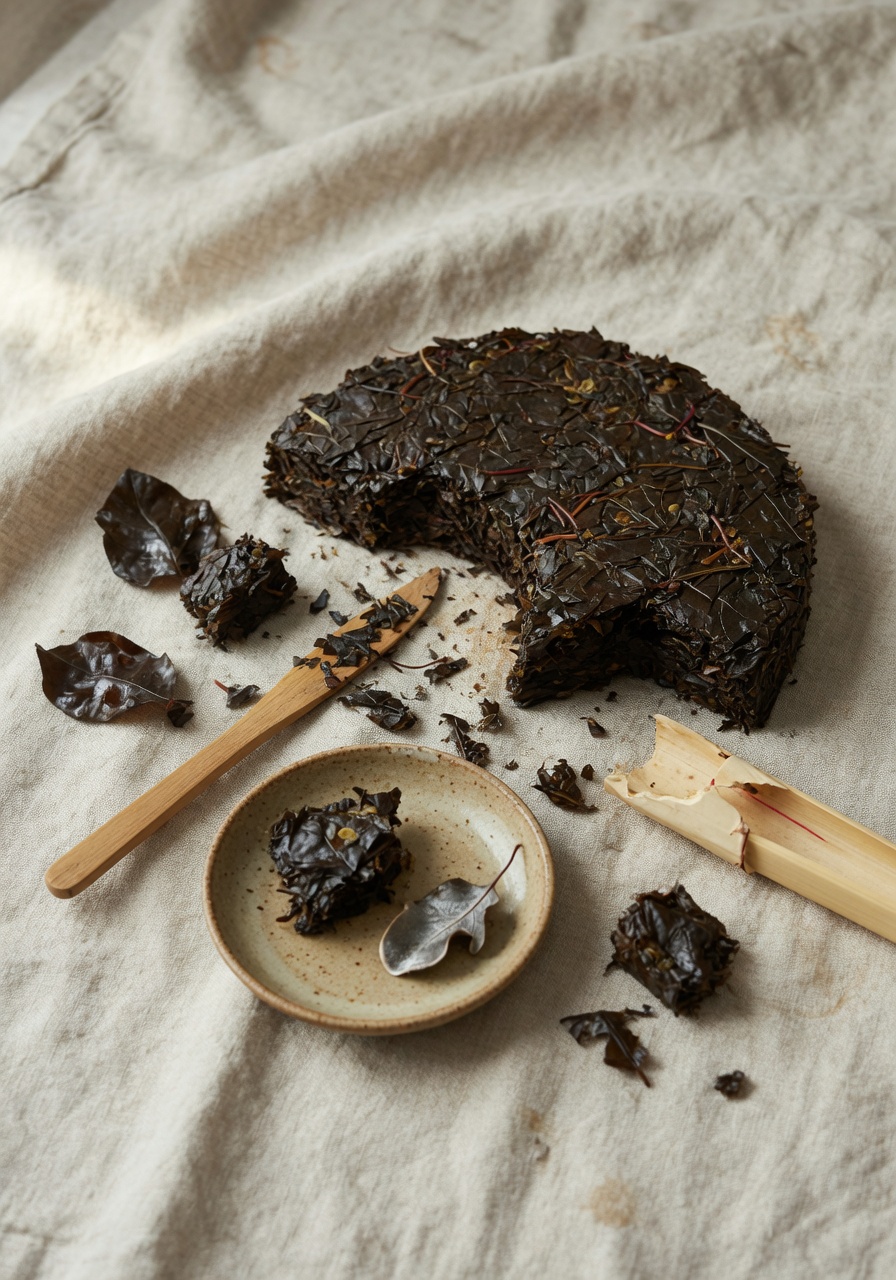
Menghai 7572 — the recipe that anchors the category
A four-digit code stamped on a paper wrapper has done more to define what shu tastes like than any single mountain or master. This is how 7572 became the reference point.
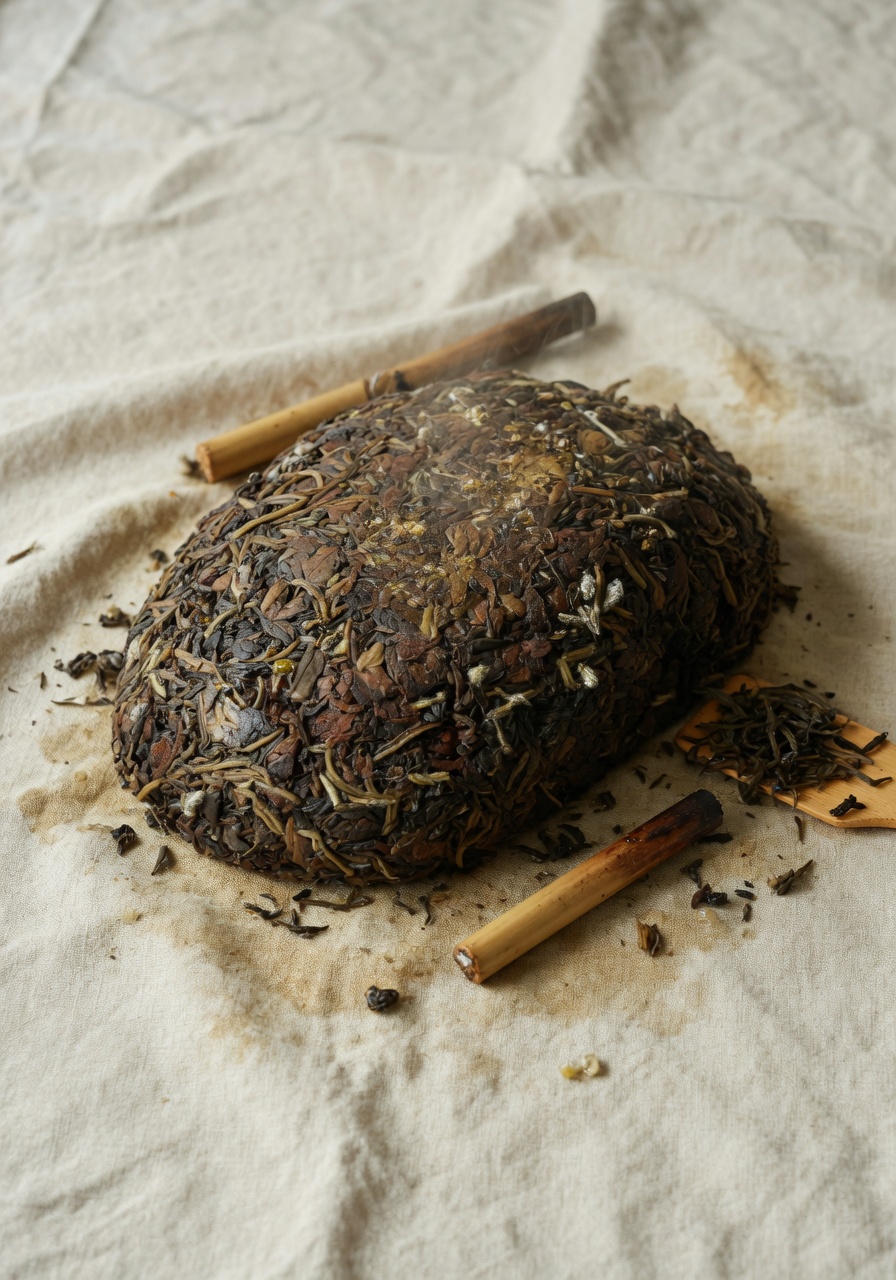
Wo dui — the pile fermentation that defined shu
In 1973, a team at Kunming Tea Factory wet-piled maocha under wool blankets and waited. Forty-five days later, the leaves were black, sweet, and unmistakably new. This is the story of how a chemical accident became a category.
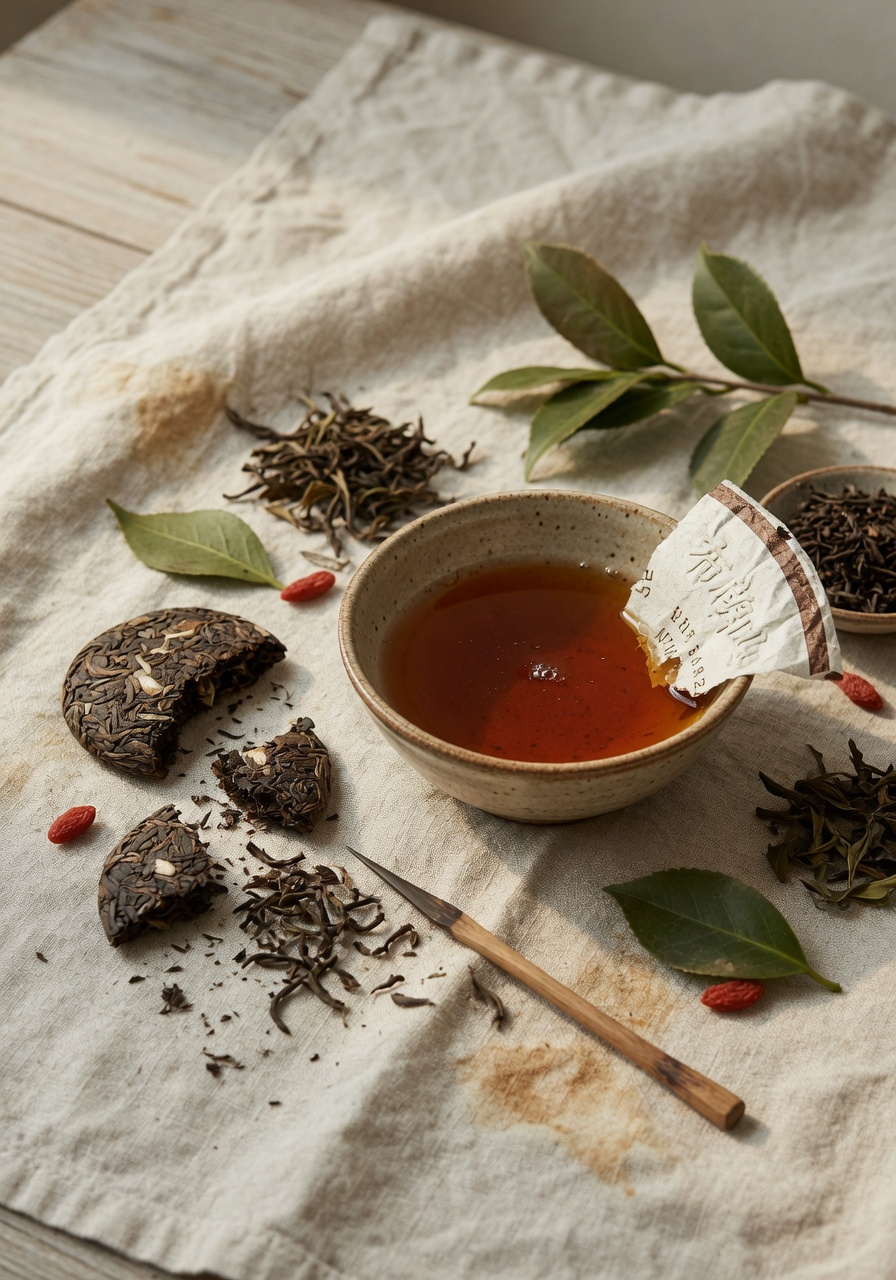
Bulang Shan — the bitter that becomes sweet
On the southern edge of Menghai county, the Bulang people have tended tea for over a thousand years. Their leaf opens the throat with bitterness — then turns sweet, slowly, and refuses to leave.
Nannuo Shan — the queen of Menghai's mountains
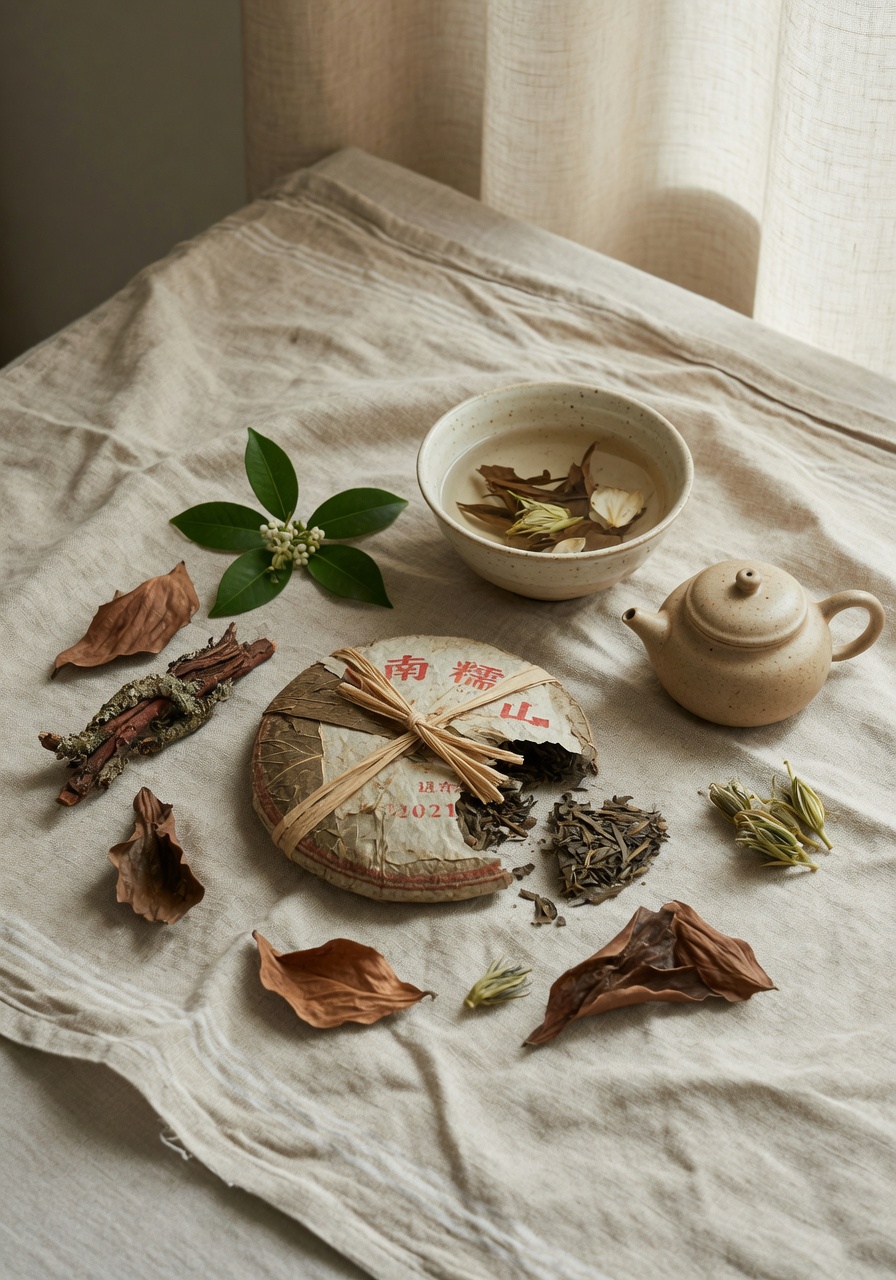
Nannuo is the most documented tea mountain in Xishuangbanna — Hani villages above 1,400 m, an 800-year-old tea tree felled in 1994, and a flavour profile that anchors what 'classic Menghai sheng' means.