home · Six mountains, six <em>flavours</em> — terroir in pu-erh
Yunnan regions
Nannuo Shan — the queen of Menghai's mountains
Nán Nuò Shān · 南糯山
Nannuo is the most documented tea mountain in Xishuangbanna — Hani villages above 1,400 m, an 800-year-old tea tree felled in 1994, and a flavour profile that anchors what 'classic Menghai sheng' means.
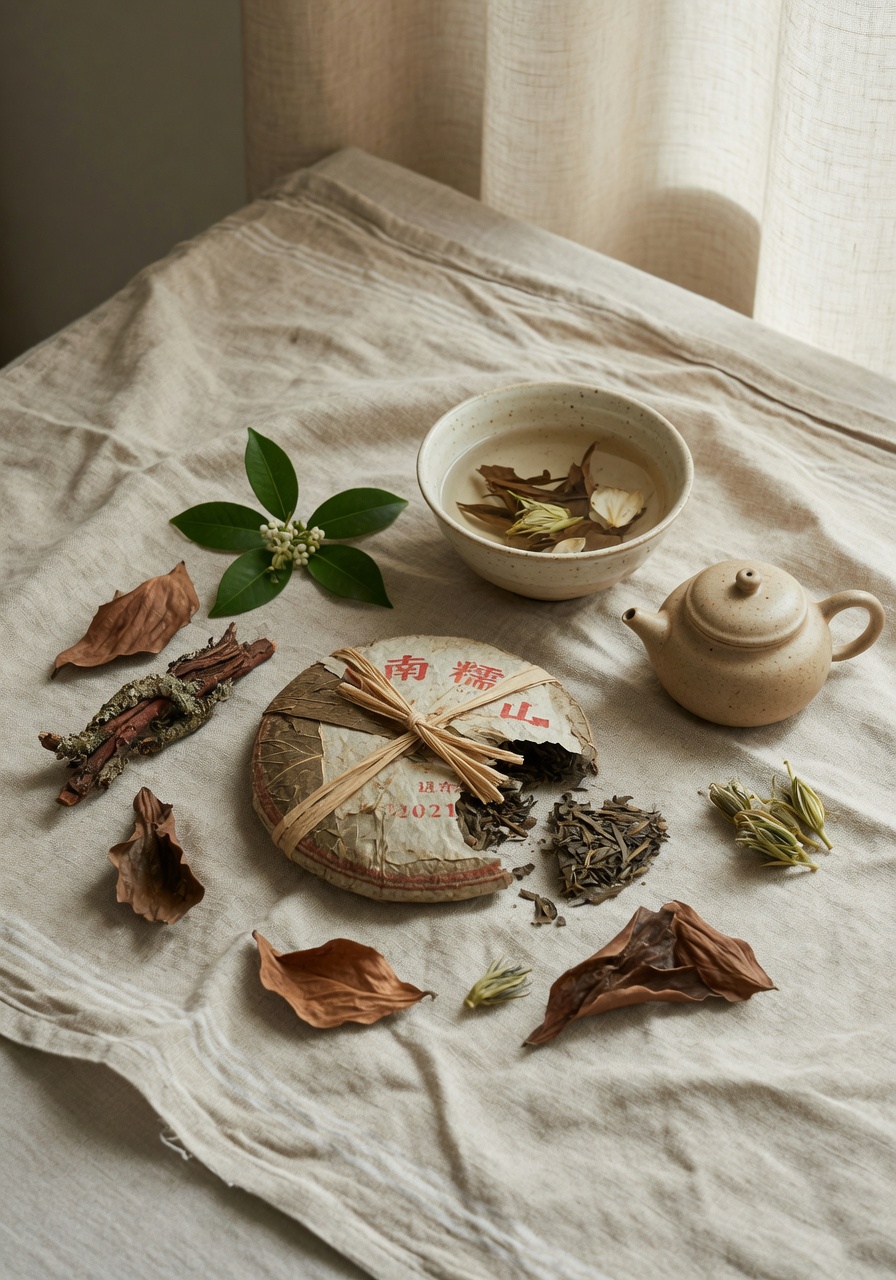
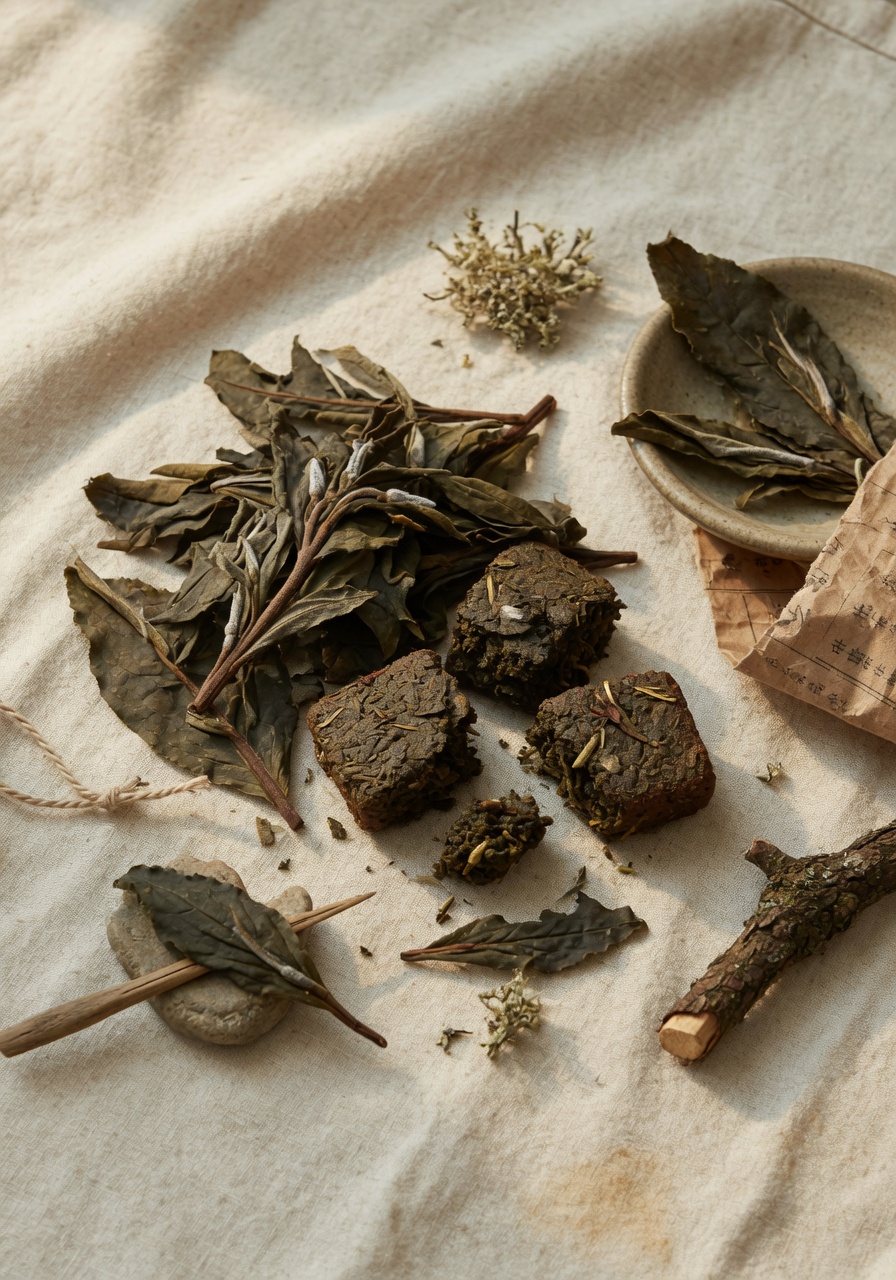
If Bulang Shan is the bitter shoulder of Menghai and Yiwu is the silken forest across the river, Nannuo Shan (南糯山) is the middle voice — fragrant, balanced, sweet enough to drink young yet structured enough to age for thirty years. The mountain rises north-east of Menghai town, across the Lancang river basin, and its ridges form the spine that Hani (爱尼) villagers have terraced and gardened since at least the Tang. For most of the twentieth century Nannuo material was the backbone of Menghai Tea Factory’s recipes — the Mèng Hǎi Chá Chǎng (勐海茶厂) bought from Nannuo, Bulang and Bada in rotation, and Nannuo’s role was to give roundness and aroma where Bulang gave power. That position made it the first ‘name mountain’ that western drinkers learned, and the first to face the consequences of fame: price pressure, planted clonal gardens crowding the old trees, and a complicated argument about what ‘Nannuo gǔshù (古树)’ now means. This article takes the mountain seriously — its geography, its Hani village structure, the famous 800-year tea tree, the processing conventions that shape Nannuo character, and what an experienced drinker should expect in the cup. For the broader regional context, see the Menghai county overview and the comparative pieces on Bulang and Yiwu; the wider Yunnan map lives on thetea.app.
Geography and the Hani villages
Nannuo Shan sits roughly 20 km north-east of Menghai town in Xishuangbanna Dai Autonomous Prefecture, on the eastern bank of the Lancang river. Elevations rise from around 800 m at the foot to over 1,800 m at the highest ridges, with the productive tea belt concentrated between 1,300 and 1,700 m. The soil is the red-yellow ferralitic loam typical of southern Yunnan — acidic (pH 4.5–5.5), iron-rich, and well drained on the slopes where camellia thrives. Annual rainfall averages 1,500 mm, concentrated in the May–October monsoon, and mean temperatures sit around 18 °C with cool nights that slow leaf metabolism and concentrate aromatics. The mountain is administratively divided into two halves — Bàn Pō Lǎo Zhài (半坡老寨) on the western slope and the eastern villages around Yā Kǒu (丫口), Duō Yī Shù (多依树), Gū Niáng Zhài (姑娘寨) and Shí Tóu Lǎo Zhài (石头老寨). Roughly thirty natural villages, predominantly Hani (a sub-group of the Aini people), maintain tea gardens; the Hani brought tea cultivation here from the north over many generations, and their settlement pattern — long-house villages above their gardens, with forest reserved on the ridges — is what gives Nannuo its mixed canopy character.
Bàn Pō Lǎo Zhài and the western face
Bàn Pō Lǎo Zhài (半坡老寨, literally ‘half-slope old village’) is the single most-quoted xiǎo chǎn qū (小产区, micro-origin) on Nannuo. Its gardens sit between 1,500 and 1,700 m on the western slope, where morning mist lingers until mid-morning and direct afternoon sun is filtered by mature shade trees. Buyers pay a premium here because the density of older trees — eighty to two hundred years for the working gardens, with isolated specimens older still — remains higher than on the eastern side, where 1980s state-encouraged replanting produced more clonal terraced rows. A spring 2023 maocha from Bàn Pō typically traded at 1,800–2,800 RMB per kilo at the village, against 600–900 RMB for ordinary Nannuo xiǎo shù (小树, small-tree) material — a four-fold spread that is itself the best evidence of how seriously the market reads micro-origin here.
The 800-year tree and the gushu question
Nannuo’s claim to international attention was sealed by a single tree. In 1951, Yunnan Agricultural Research Institute surveyors led by Zhōu Péng Jǔ (周鹏举) documented a cultivated tea tree in Bàn Pō Lǎo Zhài whose girth and growth-ring estimate suggested an age of around 800 years. It was named the Nán Nuò Shān Chá Wáng Shù (南糯山茶王树, the Nannuo Tea King) and became the standard textbook proof that tea was cultivated in Xishuangbanna in the Song dynasty, long before British or Japanese tea histories acknowledged Chinese origins outside Fujian and Zhejiang. The original tree died in 1994 — accounts differ on whether from age, root disease or excessive sampling by visiting researchers — and a ‘second tea king’, also in Bàn Pō at around 1,500 m and estimated at 500–800 years, now carries the name. This history matters because Nannuo became the case study for everything the gǔshù (古树, old tree) debate touches: what counts as ancient, how age is estimated without coring, and how a name premium reshapes a village economy. For a fuller treatment of those questions see the gushu debate article; the short version is that Nannuo has more genuinely old trees than its market reputation alone would suggest, but also more tea sold under ‘Nannuo gushu’ labels than its old trees could possibly produce.
Trees, gardens, and what ‘old’ means here
Field surveys by the Xishuangbanna Tea Industry Association in 2015 estimated roughly 12,000 mu (约 800 hectares) of tea on Nannuo classified by villagers as gǔ chá yuán (古茶园, old tea garden) — meaning gardens with a significant proportion of trees older than a hundred years, not gardens where every tree is ancient. The same survey counted around 18,000 mu of post-1980s planted terraces. The arithmetic is unforgiving: if the old gardens yield 20–40 kg of maocha per mu per year, total honest gushu production is in the low hundreds of tonnes annually, against a market that absorbs several thousand tonnes labelled ‘Nannuo gushu’. This is not a Nannuo-specific problem — it is the entire Menghai famous-mountain pattern — but Nannuo, being closest to the county town and the most accessible by road, feels it first.
Cultivar and processing
The dominant cultivar across Nannuo is the local Nán Nuò Shān dà yè zhǒng (南糯山大叶种), a large-leaf Assamica-type registered as a provincial liáng zhǒng (良种, approved cultivar) in 1981. Leaves are broad, lance-shaped, with pronounced serration and a leathery surface; bud-and-two-leaves picks in early April typically weigh 0.18–0.22 g per set, against 0.10–0.13 g for Yiwu small-leaf material picked the same week. Processing follows the standard Yunnan shēng (生) sequence — wěi diāo (萎凋, withering) for three to six hours on bamboo, shā qīng (杀青, kill-green) in wok at 220–260 °C surface temperature for six to ten minutes, róu niǎn (揉捻, rolling) for thirty to forty-five minutes, and shài qīng (晒青, sun-drying) on bamboo mats to roughly 10 % residual moisture. The interesting Nannuo-specific variables are timing and wok depth: Hani producers in Bàn Pō traditionally use deeper iron woks and a slightly cooler, longer shā qīng than the Bulang convention, which preserves more floral high notes at the cost of slightly less storage robustness. The trade-off is audible in the cup at three years versus thirteen — Nannuo at three years is the more immediately seductive tea; at thirteen, well-stored Bulang often catches up and overtakes. See sha qing for pu’er vs green tea for the technical fork.
Spring, autumn, and the rains between
Nannuo is picked in three main flushes. Míng qián (明前, pre-Qingming, early April) buds are tight, hairy, intensely aromatic but lower in extract; gǔ yǔ qián (谷雨前, pre-Grain Rain, mid–late April) is the volume spring pick and what most ‘spring Nannuo’ cakes are pressed from; qiū chá (秋茶, autumn, late September–October) produces a lighter, less stratified tea that some long-term drinkers prefer for daily drinking. Summer rains tea (yǔ shuǐ chá, 雨水茶) is largely sold into blend-grade markets and rarely labelled Nannuo. A spring 2024 Bàn Pō Lǎo Zhài míng qián maocha I tasted in Kunming in May 2024, processed by a third-generation Hani producer named Sānzǐ (三梓), showed the textbook profile — 8.3 g in 110 ml gaiwan, boiling water, six-second steeps — opening with white-flower and sugarcane on infusions one to three, broadening to a stone-fruit middle on four to seven, and finishing with the shēng jīn (生津, mouth-watering return) and faint resin that signals real old-garden material.
What Nannuo tastes like — and how it ages
If I had to compress Nannuo character into one sentence for a student at tea.school, I would say: Nannuo is the mountain that smells like orchid and tastes like honey water with a quiet bitterness underneath. Young Nannuo shēng (one to three years from pressing) presents pale yellow-green liquor, immediate aroma of lán huā xiāng (兰花香, orchid fragrance) and crushed grass, light to medium body, and a kǔ (苦, bitterness) that resolves within ten to fifteen seconds into sweetness — distinctly faster than Bulang’s thirty-second linger. Sè (涩, astringency) is moderate and clean, not gripping. The throat-feel (hóu yùn, 喉韵) is the diagnostic: real Nannuo gushu produces a cool, slightly minty descent that reaches the upper chest, while ordinary plantation Nannuo stops at the back of the tongue. With seven to ten years of dry Kunming storage, the tea darkens to amber-gold, the orchid retreats and a stone-fruit and dried-longan note emerges; with fifteen years and reasonable storage, Nannuo develops a chén xiāng (陈香, aged fragrance) that is gentler and more ‘feminine’ than the heavier camphor-and-leather of aged Bulang. It does not become a powerhouse — it becomes a graceful old tea. For the broader young-versus-aged calculation, see young sheng — drink now or wait?.
Producers, prices, and how to buy honestly
The producer landscape on Nannuo is mixed. State and large-private factories — Menghai Tea Factory (Dayi), Haiwan, Chen Sheng Hao via contracted villagers, and Mengku to a lesser extent — buy maocha at the village level and press in Menghai town. Smaller name-makers like Douji and Xizi work with specific Bàn Pō or Duō Yī Shù families on multi-year contracts. The most interesting tier, for a serious buyer, is the Hani family pressings sold direct from village — small cakes (200–357 g) under household labels, often without a registered brand, traceable to a named producer and a specific garden. Prices in spring 2024 ranged from roughly 800 RMB/357 g for honest blended-Nannuo xiǎo shù cakes to 6,000–9,000 RMB/357 g for documented Bàn Pō Lǎo Zhài single-garden gushu. As a rule of thumb developed over fifteen years of buying Nannuo for clients in Russia and Mongolia: anything labelled ‘Nannuo gushu’ under 1,500 RMB/357 g at retail is either blended with younger material, mislabelled, or both. That does not make it bad tea — much of it drinks honestly as good Menghai-region sheng — but the gushu claim is the problem, not the tea. For sourcing comparison see shop.puerh.app.
Why Nannuo still matters
There is a temptation among collectors who have followed the Yunnan market for a decade to dismiss Nannuo as the ‘first mountain you outgrow’ — too accessible, too commercial, too crowded. I think that view is wrong, and it is wrong for the same reason that dismissing Burgundy’s village-level wines in favour of grand cru is wrong: the middle tier is where you actually learn the region. Nannuo’s flavour vocabulary — orchid aroma, honey-water sweetness, fast bitterness resolution, mid-depth throat-feel — is the reference grammar against which Bulang’s power, Yiwu’s silk, and Lincang’s mineral edge can be read. A drinker who has spent three years sitting with seven or eight different Nannuo cakes — a Bàn Pō, a Yā Kǒu, a Duō Yī Shù, a generic Menghai factory press, an autumn pick, a fifteen-year-old aged example — has built the calibration that the rest of the Xishuangbanna map requires. The mountain has been called the queen of Menghai not because she is the strongest voice in the room but because the room is organised around her register. That is still true in 2024, and it is the reason this entry is the longest in the regional series.
References
- GB/T 22111-2008 地理标志产品 普洱茶 (Geographical Indication Product — Pu-erh Tea) — Standardization Administration of China
- 云南省茶叶进出口公司志 (Yunnan Tea Import-Export Company Gazetteer), 1993 — Yunnan Provincial Tea Company, Kunming
- Zhōu Hóng Jié — 普洱茶记 (Notes on Pu-erh Tea), Yunnan People's Press, 2004 — Zhōu Hóng Jié (周红杰), Yunnan Agricultural University
- Xishuangbanna Tea Industry Association — 西双版纳古茶园资源调查报告 (Survey of Ancient Tea Garden Resources), 2015 — Xishuangbanna Dai Autonomous Prefecture Tea Industry Association
- Interview with Sānzǐ (三梓), Hani tea producer, Bàn Pō Lǎo Zhài, May 2024 — Field notes, Amgalan Chin
- Zhōu Péng Jǔ field survey records 1951, archived at Yunnan Agricultural Research Institute, Menghai station — Yunnan Agricultural Research Institute (云南省农业科学院)
Read next
Related articles
Menghai county — birthplace of modern shu
A flat-bottomed valley at 1,200 m, ringed by Bulang and Nannuo mountains, where in 1973 a state factory perfected pile fermentation and changed pu-erh forever.
Bulang Shan — the bitter that becomes sweet
On the southern edge of Menghai county, the Bulang people have tended tea for over a thousand years. Their leaf opens the throat with bitterness — then turns sweet, slowly, and refuses to leave.
Yiwu — forest gardens of the Laos border
On the southern edge of Xishuangbanna, where the forest crosses into Laos, *Yì Wǔ* (易武) grows the softest, most aromatic *shēng* in Yunnan — a tea that built an empire, vanished for fifty years, and rebuilt itself from village memory.
Gushu / 'old tree' tea — what's real, what's marketing
The term *gǔshù* (古树) sells more cake than any other two characters in Yunnan. Most of what's labelled gushu is not. Here's how to read the claim — botanically, contractually, and in the cup.