home · From fresh leaf to <em>bǐng</em> — the craft behind pu'er
Processing & craft
Bing, zhuan, tuo — the shapes and why they exist
*Bǐng, zhuān, tuó* · 饼, 砖, 沱
Why does pu-erh come pressed into discs, bricks and bowls instead of loose? The answer is older than the tea itself — and it shapes how the leaf ages in your cupboard.
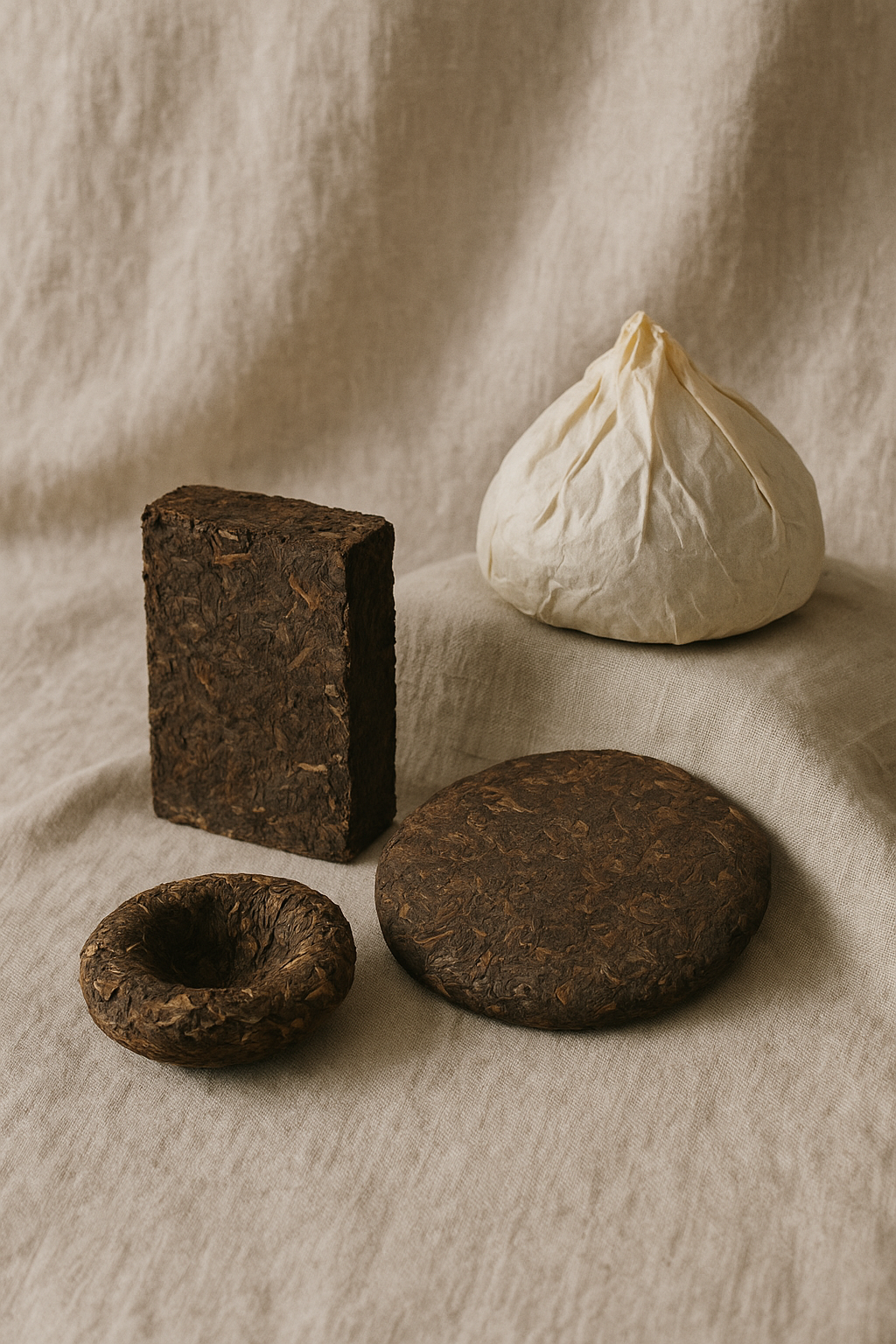
Walk into any pu-erh shop in Kunming or Menghai and the first thing you see is geometry. Stacks of seven-disc bamboo tubes — qī zǐ bǐng chá (七子饼茶) — leaning against the wall. Bricks the size of a paperback, wrapped in plain paper. Mushroom-shaped jǐn chá (紧茶) bound in fives. Small bowl-shaped tuó (沱) the size of a fist, and giant ones the weight of a newborn. To the outsider it looks decorative, almost folkloric. It is not. Each shape is a freight-and-storage solution that hardened, over three centuries, into a flavour decision.
The shapes exist because the leaf had to travel. From the sub-tropical forests of Xishuangbanna and Lincang, raw maocha had to reach Tibet, Mongolia, Beijing — caravan routes of two to nine months across passes above 4,000 m. Loose tea would have powdered to dust in the saddlebags. Compressed tea would not. Once the Qing court formalised the gòng chá (贡茶) tribute system in 1729, the dimensions were standardised by edict — and those dimensions are, with small modifications, what we still buy today. This article walks through the major forms, the reasons behind them, and what the geometry does to the tea once it sits in your shelf for a decade. For the chemistry of what happens during pressing itself, see the companion piece on processing on thetea.app; for the storage side, the modules at tea.school go deeper than I will here.
The freight problem that made pu-erh pu-erh
Before there was a style called pu-erh, there was a logistics problem. Yunnan grew tea; the people who paid for it lived a long way north. The Tea-Horse Road — chá mǎ gǔ dào (茶马古道) — ran from Pu’er prefecture up through Dali, Lijiang and Shangri-La, then across the Hengduan mountains into Lhasa, a journey caravan-masters timed at 100 to 120 days in good weather. Mules carried about 60 kg each. Loose maocha at the bulk density of around 110 kg/m³ would have meant absurd volume per animal; pressed cakes at roughly 600 kg/m³ cut that by more than five times. The economics were not subtle.
The second pressure was breakage. Yunnan large-leaf material — Camellia sinensis var. assamica — has long, brittle leaves that shatter when dry. A loose-tea caravan arriving in Kangding after three months would be selling dust. Steam-softening the leaf and pressing it locked the strips into a matrix that survived the journey. The third pressure was tax. Qing-dynasty tribute records from the Yongzheng era specify weights, not volumes — a tribute bǐng (饼) was 357 g, seven of them to a tǒng (筒, bamboo tube) weighing 2.5 kg, twelve tubes to a jiàn (件) of 30 kg. Customs officers counted shapes, not leaves. The 357 g disc you can buy in 2024 is, almost to the gram, the disc the Qing taxman weighed in 1735.
Bǐng — the seven-son disc
The qī zǐ bǐng — literally ‘seven-son cake’ — is the canonical pu-erh shape and the one most drinkers meet first. A standard bǐng weighs 357 g, measures 19 to 20 cm across, and is roughly 2 to 3 cm thick at the centre, tapering at the rim. The name has two folk explanations — that seven cakes per tube symbolised seven blessings for a Dai bride, or that seven was simply the count that fit the standard bamboo tube of the period. The accounting explanation is probably the real one, but the wedding story is more often told in shops.
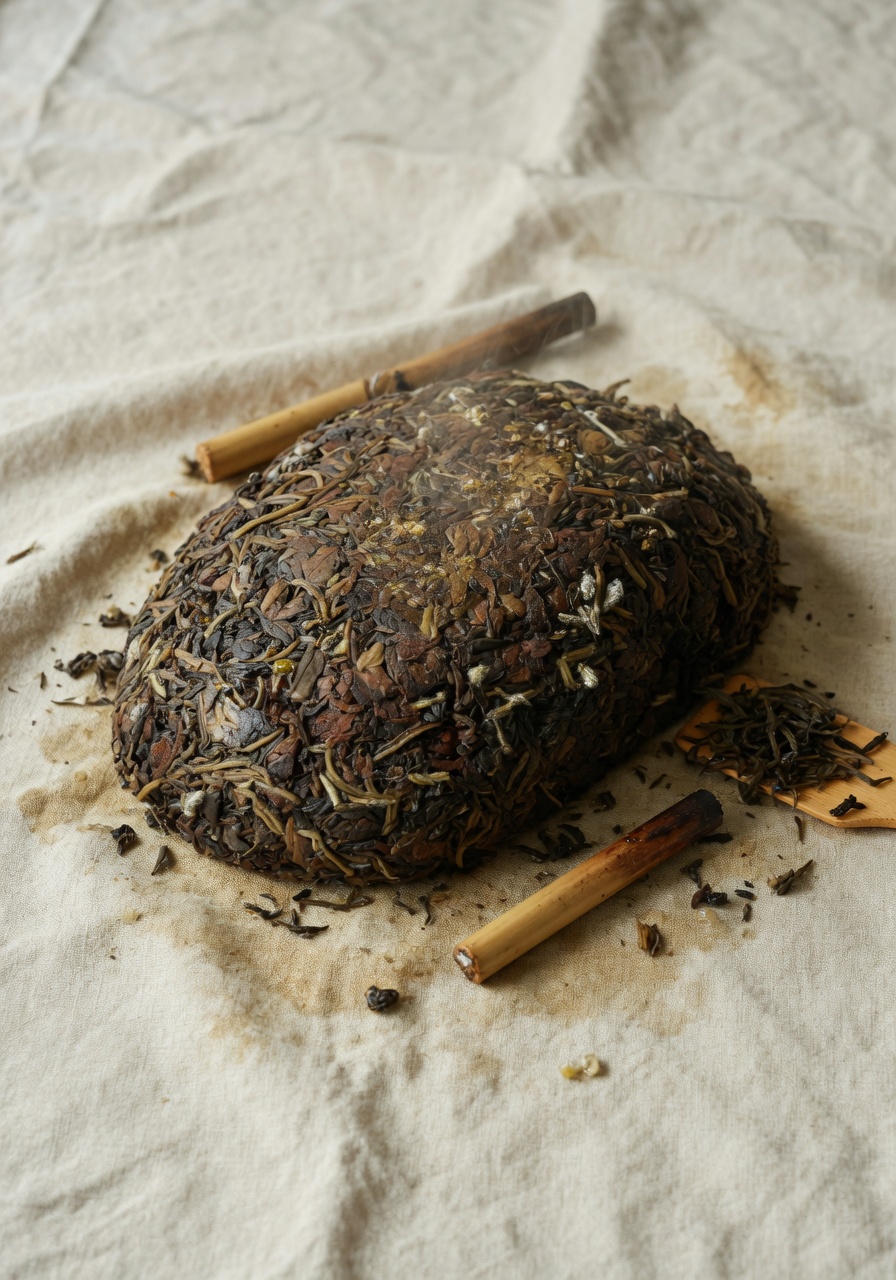
The disc is the most aging-friendly of the major shapes. Its surface-to-mass ratio is moderate — high enough that humidity and oxygen reach the interior over years, low enough that the centre develops the slower, deeper notes that collectors value. When I cut into a 2003 Menghai 7542 last winter in Ulan-Ude, the rim leaves were already the colour of dark honey while the heart leaves still showed the green-grey of younger sheng. That gradient — same cake, different ages within it — is the bǐng’s signature.
Why 357 grams
The figure looks arbitrary until you do the Qing-era arithmetic. The tribute unit was the jīn (斤), and a tǒng of seven cakes had to come to five jīn, or 2,500 g. Five divided by seven is 357.14 g per cake, rounded down. Twelve tubes made a jiàn of 30 kg, the load one half of a mule could carry balanced against an identical jiàn on the other side. The whole number system is built backwards from mule capacity. State standard GB/T 22111-2008 preserves 357 g as the reference weight for bǐng, though factories also press 200 g, 250 g, 400 g and 500 g variants for retail.
Tight pressing vs stone pressing
Until the 1950s every cake was pressed by foot on a granite stone — the presser stood on a cloth bag of steamed leaf laid in a shallow mould, and his weight produced a relatively loose cake, around 1.3 to 1.5 g/cm³. Mechanical hydraulic presses, introduced at the Menghai factory in 1973, can hit 1.7 g/cm³ or higher. Loose stone-pressed cakes breathe and age faster; tight machine-pressed cakes age slower and preserve aromatics longer but resist prying with a pick. Most boutique workshops today have returned to stone pressing — Xizihao, Yang Qing Hao, Bā Wǔ — and the difference is audible when you break a cake: stone gives a soft crumble, hydraulic gives a sharp snap.
Zhuān — the brick that went to the steppe
The brick — zhuān chá (砖茶) — is older than the bǐng by a wide margin. Compressed brick teas were already moving along the northern Silk Road in the Tang dynasty, and by the Ming the format was the dominant export to Mongolia and the Russian Trans-Baikal. A standard pu-erh brick today is 250 g, rectangular, roughly 15 × 10 × 2.3 cm — though the Hunan dark-tea fú zhuān I grew up watching my grandmother shave into the kettle in Buryatia is larger, 1 to 2 kg, and a different category of tea.
The brick exists because flat surfaces stack. On a camel, on a railway car, in a yurt’s wooden chest, rectangles waste no space. A caravan-load of zhuān could be palletised in a way that a load of round bǐng could not. Pu-erh bricks were also pressed harder than discs — densities of 1.6 to 1.8 g/cm³ are common — because they were designed to be boiled, not steeped. You shave off a piece with a knife, drop it in milk and salt for a Mongolian süütei tsai or into a brass samovar for zatuvran chay, and the slow extraction handles the dense pressing. As a result, brick pu-erh ages slowly and unevenly — the centre can take twenty years to soften — and most experienced drinkers treat it as a rougher, more rustic format than the disc.
Tuó — the bowl, the bird’s nest, the saddlebag
The tuó (沱) is the strangest shape and the one with the clearest origin story. A tuó looks like a small thick-walled bowl, or, depending on size, a bird’s nest — concave on one side, convex on the other, with an indentation in the back that lets air circulate even when stacked. The standard xià guān tuó from the Xiaguan factory weighs 100 g, measures 8 cm across and 4.5 cm tall. Larger ceremonial tuó run to 500 g; the miniature xiǎo tuó for travel and gift weigh 3 to 8 g — single-serving pellets, essentially.
The Xiaguan factory in Dali began pressing the modern tuó shape in 1902, but the form is older. The Tuo River — Tuó Jiāng (沱江) in Sichuan — gave its name to a regional bowl-shape of compressed tea sent down it from Yunnan to Chongqing for onward sale. The concave back was practical: it shortened the diffusion path for steam during pressing (a flat disc cools and dries unevenly in the centre; a hollowed bowl dries evenly) and it created a self-ventilating stack when ten tuó were tied in a row.
The sensory consequence of the tuó shape is the most pronounced of any format. The dense rim ages slowly and keeps its bitterness; the thin walls age quickly and turn sweet within four to six years; the concave back develops a faint mushroom-and-cellar note from greater air contact. A well-aged Xiaguan jiǎ jí tuó from the late 1990s, broken apart, will give you three different teas from the same 100 g pellet.
Minor formats — mushroom, melon, square, heart
Beyond the three majors there is a family of regional and ceremonial shapes that survive in smaller volumes. Jǐn chá (紧茶) — the ‘tight tea’, mushroom-shaped with a stubby handle — was developed in the 1910s specifically for the Tibetan market; the handle let yak-herders tie the pieces onto pack-saddles without netting. The Bāzhōng factory and later Xiaguan pressed these in 250 g and 300 g units, and the shape was briefly banned in the 1960s for being ‘feudal’ before being reinstated in 1986 at the request of the Panchen Lama’s office.
Jīn guā (金瓜) — the ‘golden melon’ — is a pumpkin-shaped tribute form, ribbed, weighing anywhere from 100 g to 5 kg. The most famous example is the Forbidden City gōng chá discovered in 1963 in storage at the Palace Museum, dated to the Guangxu reign (1875–1908) and pressed from Yiwu material; small samples have changed hands at auction in the millions of yuan. Fāng chá (方茶), the square cake of 100 to 250 g, is mostly a 1970s factory format used for export to Hong Kong. Xīn chá (心茶), the heart-shape, is a modern boutique novelty with no historical pedigree.
How shape changes aging
Shape is not cosmetic. The geometry of a pressed pu-erh determines two physical variables that govern its aging: the surface-to-mass ratio (how much leaf contacts ambient air) and the internal density gradient (how compressed the centre is relative to the edge). A loose 100 g tuó and a tight 357 g bǐng from the same maocha, stored side by side for ten years, will not taste alike — the tuó will be sweeter, lighter, more developed; the bǐng will retain more of its original character with deeper bass notes.
The practical rule, which I have watched borne out in storage rooms from Guangzhou to Kunming to my own cellar at 52° N, is that smaller and looser ages faster, larger and tighter ages slower but eventually deeper. A 250 g brick at 1.7 g/cm³ is the slowest of the common formats — twenty years is the minimum to soften the heart. A 3 g xiǎo tuó at 1.4 g/cm³ is essentially done in three. Most collectors hedge by buying the same recipe in two formats: a tuó to drink at five years and a bǐng to drink at twenty. For climate-specific aging curves, the calculator at puerh.app/calculator/aging is more useful than my prose here.
Buying by shape — what to actually look for
When you pick up an unfamiliar cake, four things tell you whether the pressing was done well. First, edge integrity — the rim should be clean, neither crumbling nor glazed. A glazed rim means the steam was too hot and the surface leaves were partially scalded; a crumbling rim means insufficient pressing. Second, the nèi fēi (内飞) — the small paper ticket pressed into the cake, traditional since the Qing — should be partly visible on the surface and partly embedded. A ticket lying flat on top is a sign of post-hoc insertion, sometimes used in counterfeits. Third, the back indentation on a bǐng should be neat and centred, not torn. Fourth, when you press your thumb into the centre, a good cake gives slightly and springs back; a brittle, glassy resistance means over-pressing and slow aging ahead.
For specific recipes and what shape they traditionally come in — 7542 as 357 g bǐng, 7572 as 357 g bǐng of shu, the 8653 brick, the jiǎ jí tuó of Xiaguan — see the producer profiles on this site and the related guides below. And if you find yourself in Yunnan in spring, the markets of Menghai and Yiwu sell maocha unpressed by the kilogram; you can watch your own cake go from leaf to disc in an afternoon, which is the fastest way to understand why these shapes exist at all.
References
- GB/T 22111-2008 — Geographical indication product: Pu-erh tea — Standardization Administration of China
- The Tea-Horse Road: China's Ancient Trade Road to Tibet — Jeff Fuchs, Michael Freeman (2008)
- Puer Tea: Ancient Caravans and Urban Chic — Jinghong Zhang, University of Washington Press (2014)
- Menghai Tea Factory historical archive — pressing records 1973–1989 — Dayi Group internal publication, Menghai (2006)
- Interview with Zou Bingliang, former Xiaguan technical director — Pu'er Magazine, issue 47 (2012), Kunming
- Qing dynasty tribute tea regulations — Yongzheng 7th year (1729) — First Historical Archives of China, Beijing
Read next
Related articles
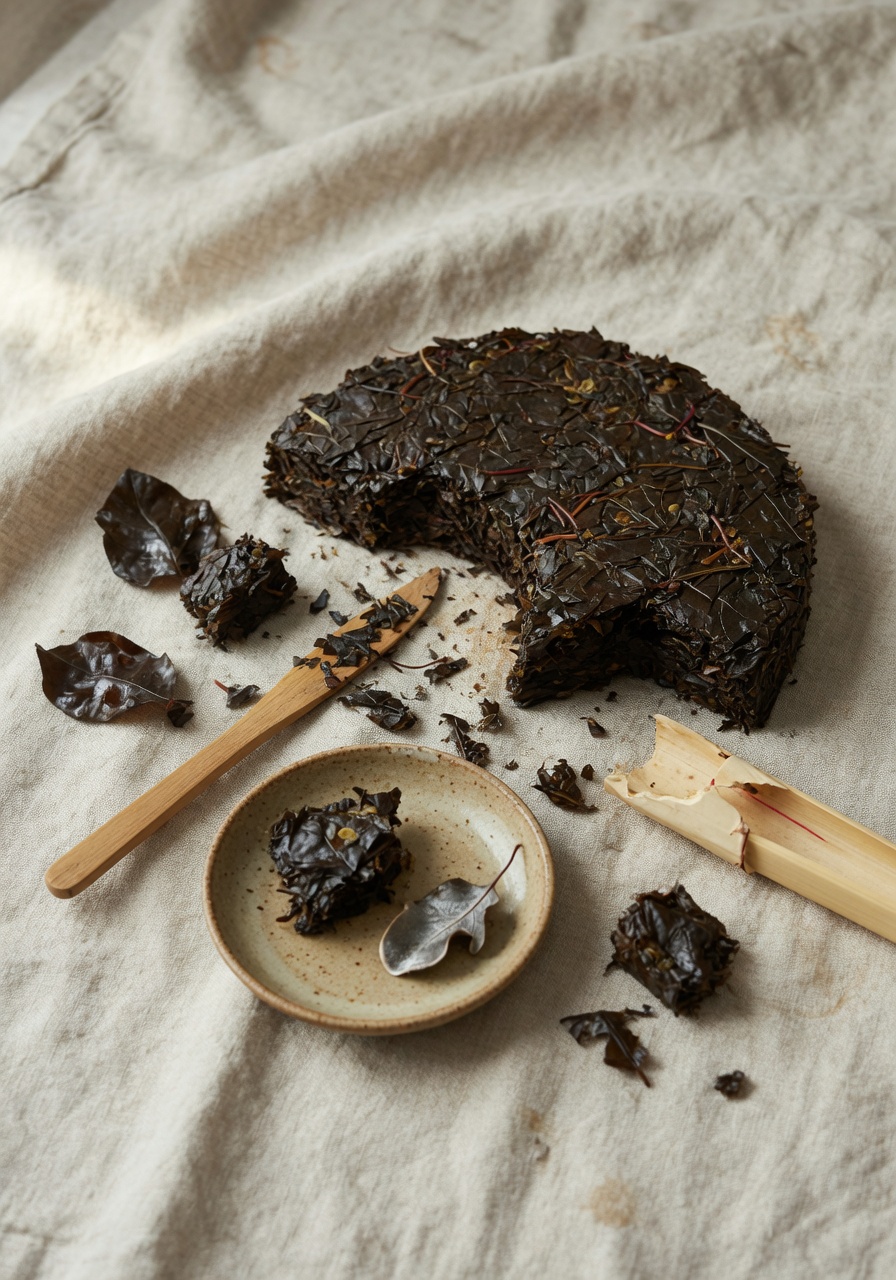
Menghai 7572 — the recipe that anchors the category
A four-digit code stamped on a paper wrapper has done more to define what shu tastes like than any single mountain or master. This is how 7572 became the reference point.
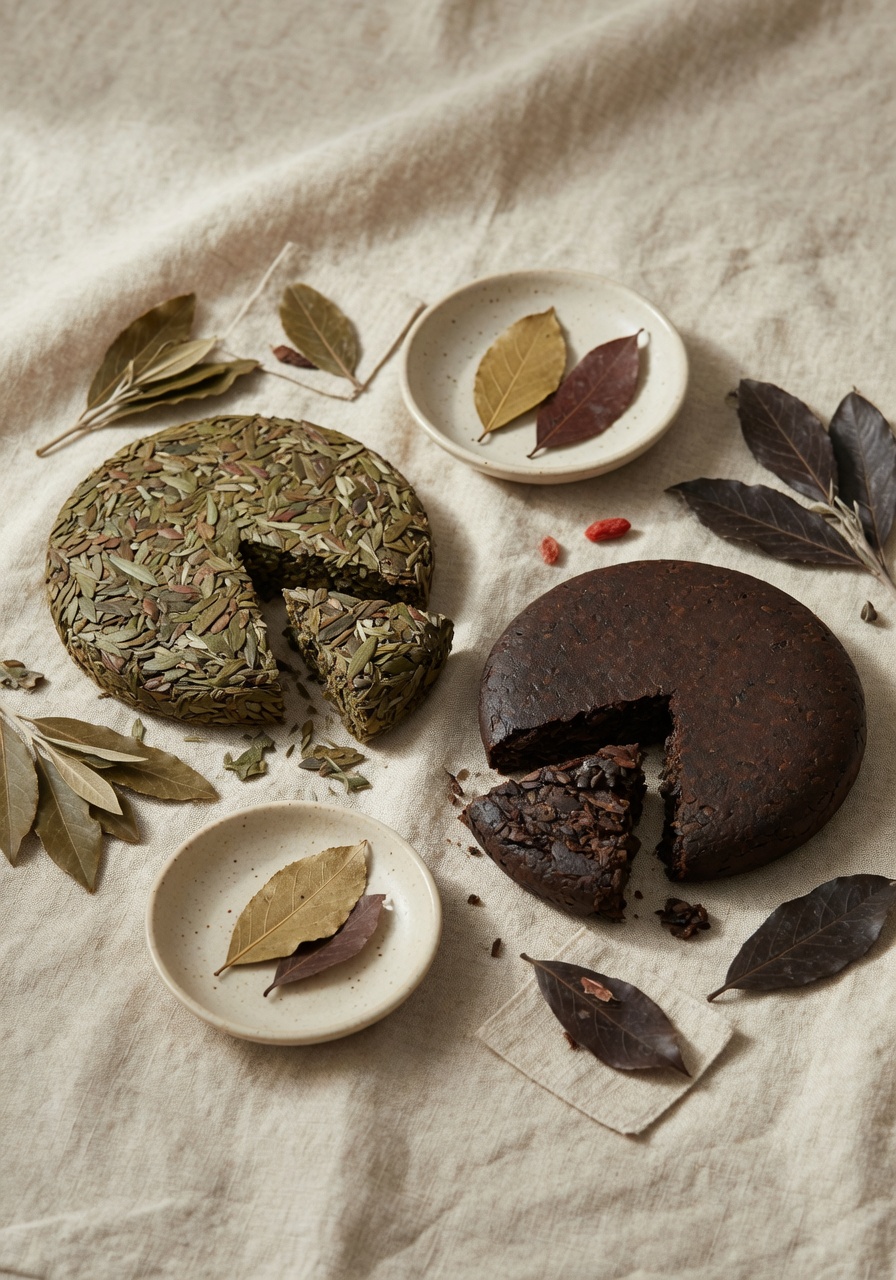
Sheng vs shu — what actually changes
Two teas share a name, a region, and a leaf — and almost nothing else. The 1973 invention of *wò duī* (渥堆) split pu'er into raw and ripe, and the chemistry of that split still defines every cake pressed today.
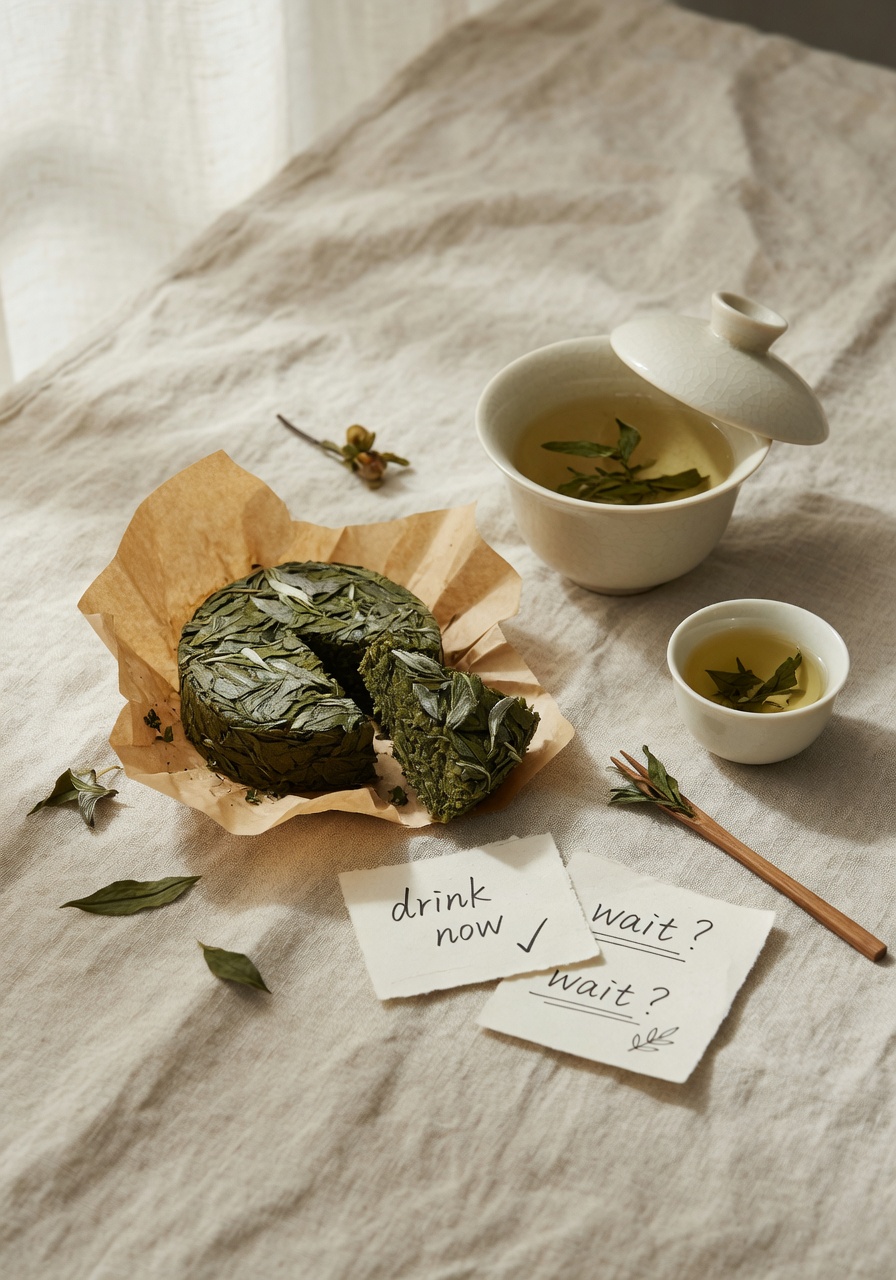
Young sheng — drink now or wait?
The question every collector asks within their first year. Some cakes are radiant at eighteen months; others need a decade before they stop biting. Here is how to tell which is which.
Wo dui — the pile fermentation that defined shu
In 1973, a team at Kunming Tea Factory wet-piled maocha under wool blankets and waited. Forty-five days later, the leaves were black, sweet, and unmistakably new. This is the story of how a chemical accident became a category.