home · Where pu-erh <em>sleeps</em> shapes what it becomes
Aging & storage
Traditional wet storage — Hong Kong and Guangdong
shī cāng · 湿仓
Before Kunming dry storage was a concept, before climate-controlled warehouses, there was a basement in Sheung Wan and a sealed room in Foshan. Wet storage made aged pu-erh a category — and remains the most misunderstood practice in the tea world.
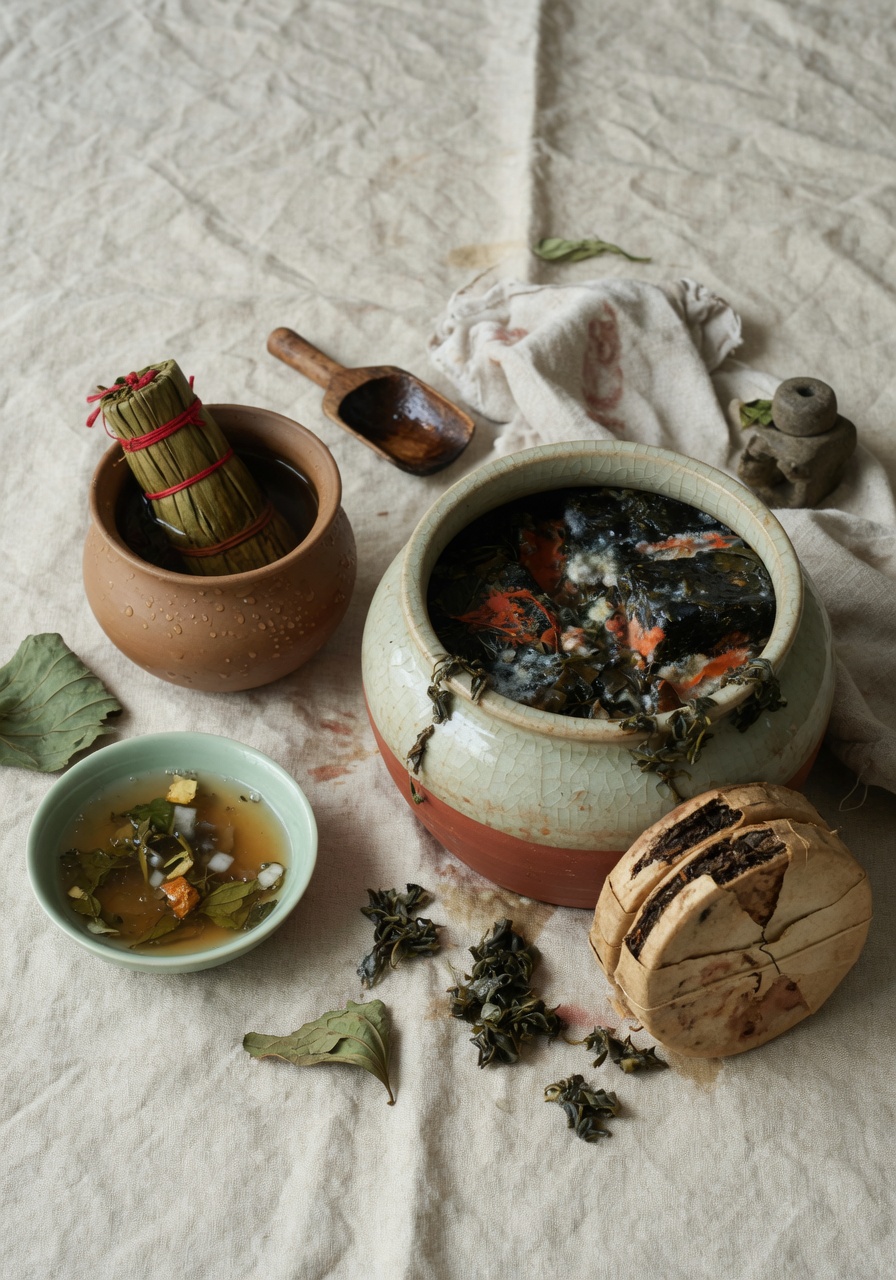
The phrase 湿仓 (shī cāng) carries a heavy load. In English-language tea forums it has become a slur — shorthand for mould, basement smell, ruined cakes. Among older Hong Kong merchants it means something far more specific: a controlled, multi-stage warehousing protocol developed between roughly 1950 and 1980 that turned raw, astringent Yunnan máo chá into the soft, woody, chén xiāng (陈香) tea that defined the entire concept of aged pu-erh for two generations of drinkers. Every collector who has ever paid serious money for a 1970s Guǎng Yún Gòng Bǐng or an 8582 from the early 1990s is, whether they admit it or not, drinking the legacy of traditional wet storage.
This article is not a defence of wet storage, nor an attack on it. It is an attempt to describe — region by region, decade by decade — what the practice actually looks like when done by people who have spent their working lives doing it. I have spent the better part of fifteen years buying tea from the warehouses of Sheung Wan, Foshan, and Dongguan, and the gap between what is written about wet storage online and what the warehouse owners actually do is wider than for almost any other topic in tea. The shop.puerh.app catalogue and the broader thetea.app encyclopedia treat wet-stored tea as a legitimate category with its own evaluation criteria — not a defective version of dry-stored tea, but a different finished product made from the same starting material, by a different method.
Why wet storage existed in the first place
Pu-erh as we know it — compressed, aged, traded as a vintage commodity — was an artefact of the southern Chinese diaspora. Until the 1990s, almost no one in mainland China drank aged pu-erh on purpose. The market was Hong Kong, Macau, Guangzhou, Chaozhou, Penang, Kuala Lumpur, Singapore. These cities share a climate: subtropical maritime, with summer humidity routinely above 85% and winter humidity rarely below 65%. Tea stored in ordinary commercial premises in these latitudes ages quickly whether the merchant wants it to or not.
The key insight credited to the post-war Hong Kong merchants — Yáng Kè Tián of Yam Lam Tea Co., the Lam family of Lam Kie Yuen, and the warehouses around Sheung Wan and Sai Ying Pun — was that this fast ageing could be standardised. Cha lóu (茶楼) culture in Hong Kong demanded cheap, dark, smooth tea by the pot at yum cha. Fresh sheng was too bitter, too green, too active on the stomach for a morning of dim sum. Tea older than fifteen years naturally was too expensive. So the warehouses learned to push two or three years of basement humidity through a cake and produce, in 1958, the kind of cup that would otherwise have required 1948.
This is the historical fact that gets lost in the modern debate. Wet storage was not a corner-cutting trick invented by unscrupulous dealers. It was the production method for an entire downstream product category, refined over thirty years, with its own quality grades, its own master practitioners, and its own price structures. The invention of wò duī shou pu-erh at Menghai in 1973 was, in many ways, a factory-scale attempt to replicate in 45 days what the Hong Kong warehouses had been doing for decades in 36 months.
The Hong Kong protocol — three rooms, three stages
Traditional Hong Kong storage is not a single environment. The mature practice, which I learned from conversations with the late Mr. Chan of Best Tea House and from subsequent visits to warehouses still operated by the Lam and Yip families in the 2010s, uses a three-stage rotation. New cakes from Yunnan enter the rù cāng (入仓) phase — the wet room. They leave through the tuì cāng (退仓) phase — a dry, ventilated finishing room where the warehouse character softens before sale.
The ratios matter. A typical Hong Kong warehouse from the 1970s onward kept the wet room at 28-32°C and 80-90% relative humidity for approximately 18 to 30 months. The cakes were stacked on bamboo or rattan platforms 30 cm off a concrete floor, in unsealed corrugated boxes or in open bamboo zhú lóu baskets, with airflow restricted but not eliminated. Inspection happened roughly every six weeks: a warehouse master would pull a cake, sniff, sometimes brew, and decide whether to advance it, return it, or reposition the stack.
The wet room — rù cāng
The defining sensory marker of a properly run wet room is not mould — it is a smell that older Cantonese tea men describe as cāng wèi (仓味), warehouse aroma, distinct from spoilage. It is the smell of damp wood, of old paper, of a library basement in Shanghai in July. White fuzz on the wrapper is normal and is wiped off before sale; black or green spotting is a failure and the cake is discarded or downgraded. The leaves themselves should never go wet to the touch; the humidity is in the air, not in the tea. A 357 g cake might gain 3-5% in mass during the wet phase and lose most of that gain during finishing.
The finishing room — tuì cāng
What separates a master warehouse from an amateur basement is the tuì cāng phase. After the wet room, cakes move to a ventilated space at 22-26°C and 55-65% RH, ideally with cross-ventilation from sea air, for another 12 to 36 months. During this finishing, the volatile, sharp warehouse notes dissipate; the geosmin and 2-methylisoborneol that produce the basement smell evaporate or are metabolised by the remaining microflora. What is left is the chén xiāng — aged aroma — that Hong Kong drinkers will pay genuine money for: camphor, dry wood, old books, a faint sweetness like dried longan.
The Guangdong tradition — Foshan, Guangzhou, and the rise of Dongguan
Guangdong storage is often discussed as a single tradition, but it is really three. Foshan and Guangzhou developed in parallel with Hong Kong, supplying the same Cantonese clientele but operating under mainland conditions. The warehouses around Fāngcūn (芳村) Tea Market, the largest wholesale tea market in China, ran a slightly milder version of the Hong Kong protocol — 75-85% RH rather than 85-90%, and longer cycles, often four to six years from raw cake to finished product. The slightly cooler winters in Guangzhou compared to Hong Kong meant the warehouse masters compensated with time rather than temperature.
Dongguan is the third tradition and the most important commercially. From the late 1990s onward, as pu-erh prices began their long climb and Hong Kong real estate priced warehouses out of the city, Dongguan emerged as the principal storage city for Cantonese collectors. By 2007 industry estimates put the total weight of pu-erh stored in Dongguan warehouses at over 300,000 tonnes — more than the annual production of Yunnan at the time. Dongguan warehousing is generally drier than classical Hong Kong, running 65-75% RH, and many operators today refuse the label shī cāng entirely, preferring zì rán cāng (自然仓), natural storage. The distinction matters: a well-run Dongguan warehouse in 2024 is closer to a humid dry storage than to the active wet storage of 1975.
The Fangcun market sample tradition
At Fangcun, the practice of kāi tāng (开汤) — opening a sample brew on the shop counter — became the standard quality assurance method for warehoused tea. A buyer expects to taste any cake older than five years before purchase, often through six or seven infusions, and to inspect the wet leaves afterwards. Wet leaves from properly stored Guangdong tea should still flex without breaking — a brittle, blackened leaf is a marker of overheated or oxygen-starved storage. The infusion colour at the eighth steep should still be deep mahogany, not the flat brown of exhausted tea.
The microbiology — what the humidity actually does
The chemistry of wet storage is now reasonably well documented, largely thanks to research published from Yunnan Agricultural University and Sun Yat-sen University in the 2010s. Wet storage accelerates two largely separate processes. The first is non-enzymatic — oxidation of polyphenols and slow Maillard-type reactions between sugars and amino acids — which would happen in any storage condition but proceeds roughly three to five times faster at 30°C and 85% RH than at 18°C and 55% RH. The second is microbial. The dominant organisms in traditional wet storage are species of Aspergillus, particularly A. niger and A. cristatus, along with various Penicillium species and yeasts of the Blastobotrys genus.
The microbial work is what distinguishes wet storage from accelerated dry storage. A. niger metabolises catechins, particularly EGCG, into theabrownins and simpler phenolic acids — the same transformation that defines wò duī shou processing, only running at perhaps 1/30th the rate. This is why deeply wet-stored sheng from the 1970s shares a flavour vocabulary with well-aged shou: both have travelled, by different routes, toward the same chemical destination. The crucial difference is that wet-stored sheng retains a significantly higher proportion of intact catechins and a more complex aromatic profile, because the process is slower and never reaches the high-temperature pile phase of shou.
How to recognise traditional wet storage in the cup
Evaluating wet-stored tea requires recalibrating expectations built on dry-stored or fresh sheng. The dry leaf of a properly wet-stored cake from the 1980s or 1990s should be dark chestnut to near-black, with intact compression and clear leaf edges visible. White surface bloom is acceptable on cakes that have not been recently brushed; uniform grey-green powder is not. The smell of the dry cake should be sweet and woody — if it smells distinctly of damp basement, the tea has not been adequately finished and needs further tuì cāng time in the buyer’s own storage, typically six to eighteen months in a ventilated room.
In the cup, the first three infusions of a well-stored Hong Kong tradition cake should be a clear, deep red-brown — not the muddy opacity of poorly stored tea. The taste should open with a slight earthiness that yields, by the third or fourth steep, to camphor, aged wood, and a sweetness that fills the back of the throat (hóu yùn, 喉韵). The wet leaves should be uniformly dark brown, supple, and should give off a smell of damp forest floor rather than ammonia or sourness. A simple field test: the cup, once empty, should retain a sweet, slightly camphoraceous aroma for several minutes. A wet-stored tea that leaves a sour or ashy empty-cup smell has been badly handled.
Why the tradition is dying — and what is replacing it
The classical Hong Kong wet storage tradition is, in 2024, in genuine decline. The reasons are economic, generational, and aesthetic. Hong Kong warehouse rents rose roughly 12-fold between 1990 and 2015; the last of the great Sheung Wan warehouses, operated by the Yip family on Wing Lok Street, downsized in 2018. The mainland Chinese market that drove pu-erh prices from 2003 onward developed a strong preference for dry storage — partly aesthetic, partly because mainland Kunming-based collectors had no historical reason to prefer the Cantonese style. By 2010, auction prices in Beijing and Shanghai for dry-stored 1990s cakes routinely exceeded prices for wet-stored equivalents of the same vintage by 40-60%, reversing the historical relationship.
What is replacing the classical tradition is something I would call jì shù cāng — technical storage. New facilities in Dongguan, Heshan, and increasingly in Malaysia operate with humidity and temperature controls, microbial monitoring, and documented protocols. The best of these aim for a managed middle path: warmer and more humid than Kunming, drier and more controlled than the old Hong Kong basements. Whether they will produce tea that drinks like a properly aged Sheung Wan cake in thirty years is a question only thirty years can answer. For collectors interested in the historical product, the window for buying authentic Hong Kong tradition tea — stored by people who learned the craft before 1990 — is closing. There are, by my count, fewer than fifteen warehouse operators still working in the unbroken pre-1990 tradition. The category they created may outlive them; the practice probably will not.
References
- GB/T 22111-2008 Geographical Indication Product — Pu-erh Tea — Standardization Administration of China
- Microbial diversity and dynamics during the solid-state fermentation and storage of pu-erh tea — Zhang et al., Food Microbiology, 2013
- Pu-erh Tea: Ancient Caravans and Urban Chic — Zhang Jinghong, University of Washington Press, 2014
- The Profound Mist — interviews with Hong Kong tea masters — Vesper Chan / Best Tea House oral history archive, recorded 2007-2012
- Chemical changes during the storage of Yunnan pu-erh tea — Lv et al., Journal of Agricultural and Food Chemistry, 2013
- Dongguan warehouse industry survey 2018 — Guangdong Tea Industry Association annual report
Read next
Related articles
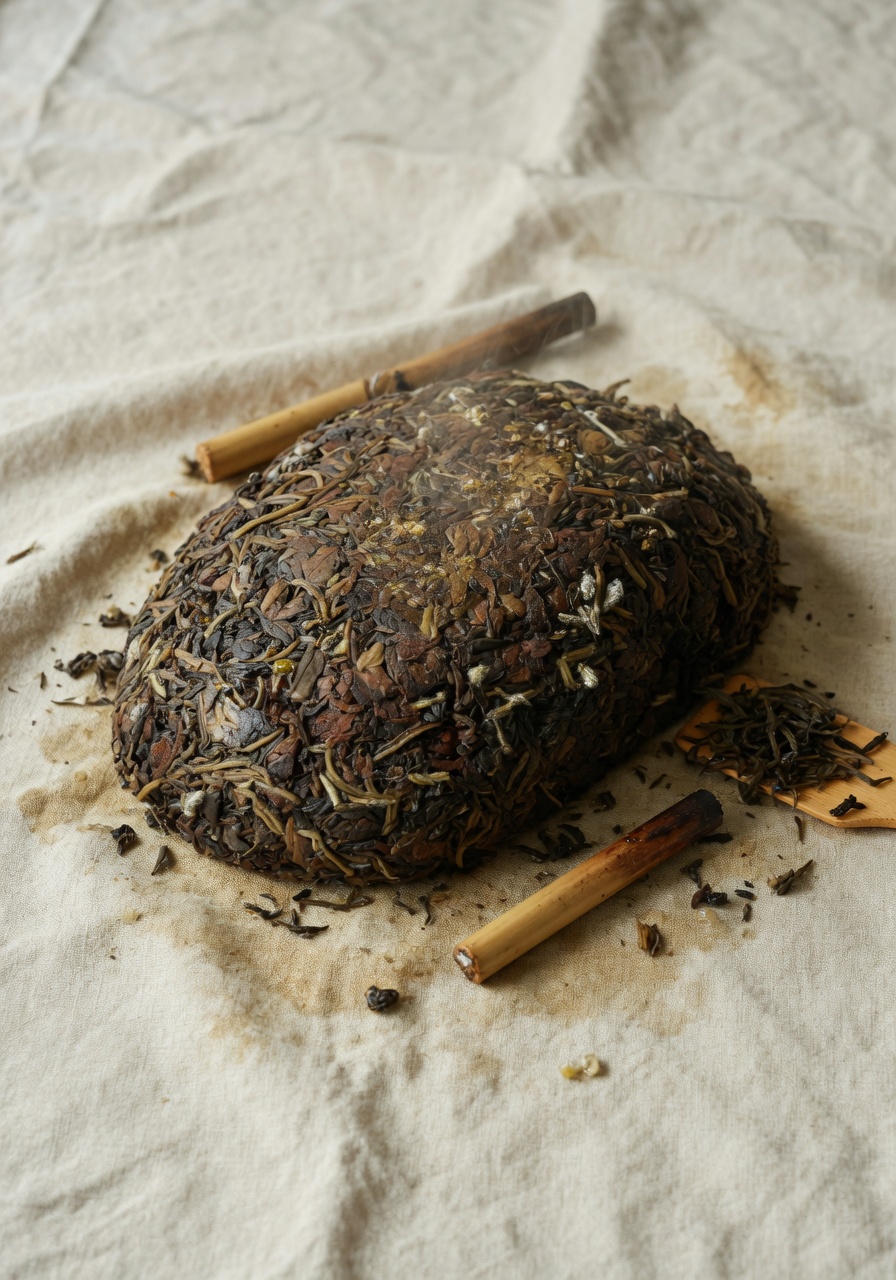
Wo dui — the pile fermentation that defined shu
In 1973, a team at Kunming Tea Factory wet-piled maocha under wool blankets and waited. Forty-five days later, the leaves were black, sweet, and unmistakably new. This is the story of how a chemical accident became a category.
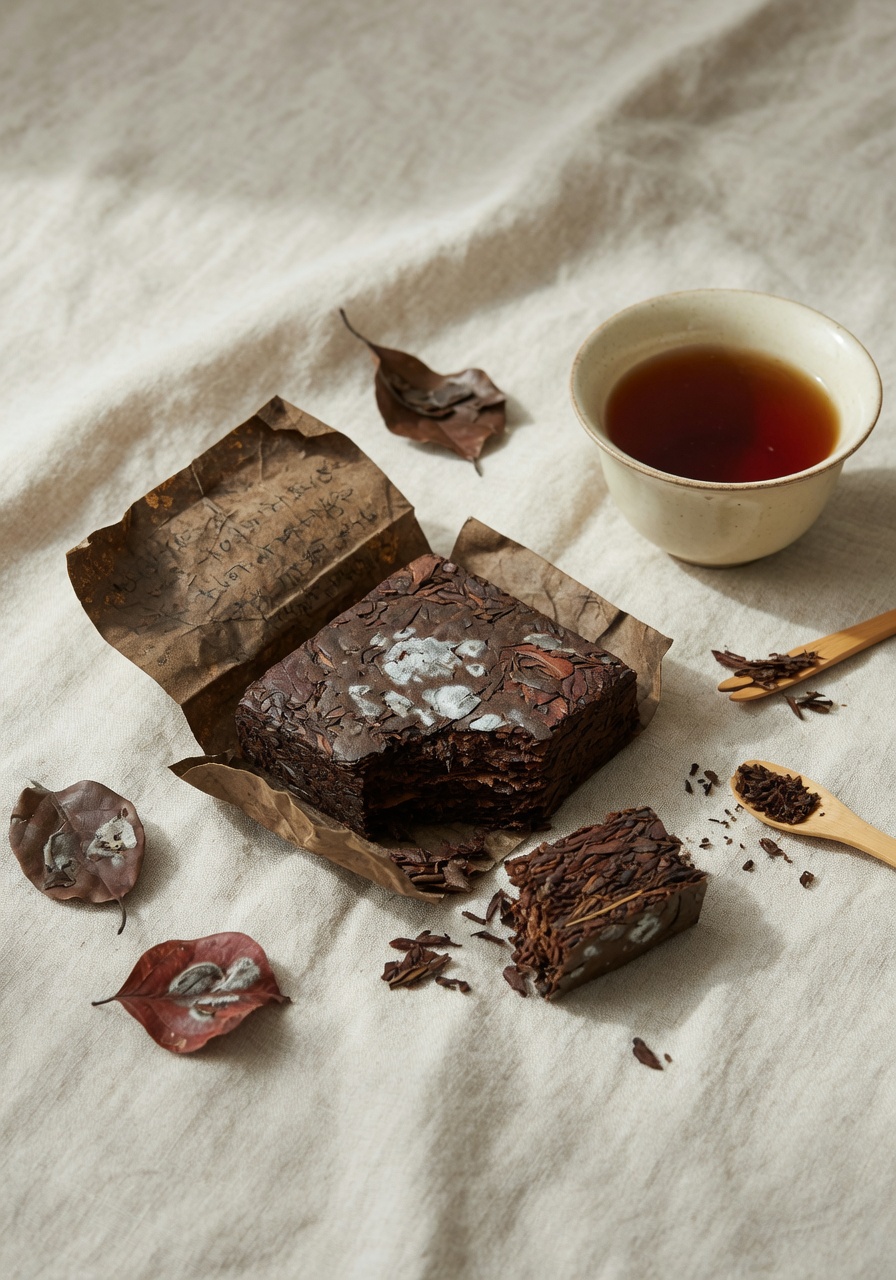
Does shu age? A measured answer
Shu was engineered in 1973 to taste like aged sheng without the wait. So does it still benefit from time in the jar — or is the work already done? A technical look at what actually changes after the pile.
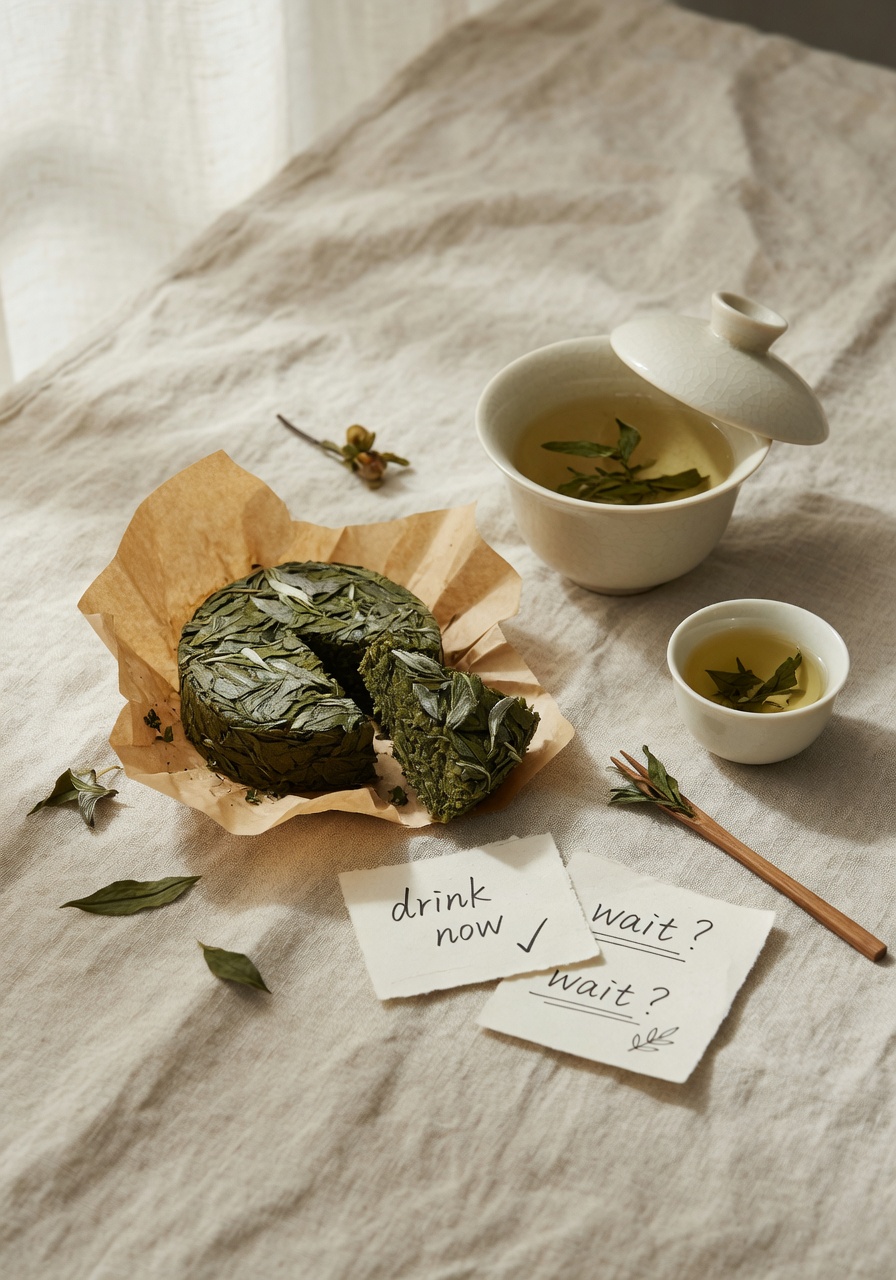
Young sheng — drink now or wait?
The question every collector asks within their first year. Some cakes are radiant at eighteen months; others need a decade before they stop biting. Here is how to tell which is which.
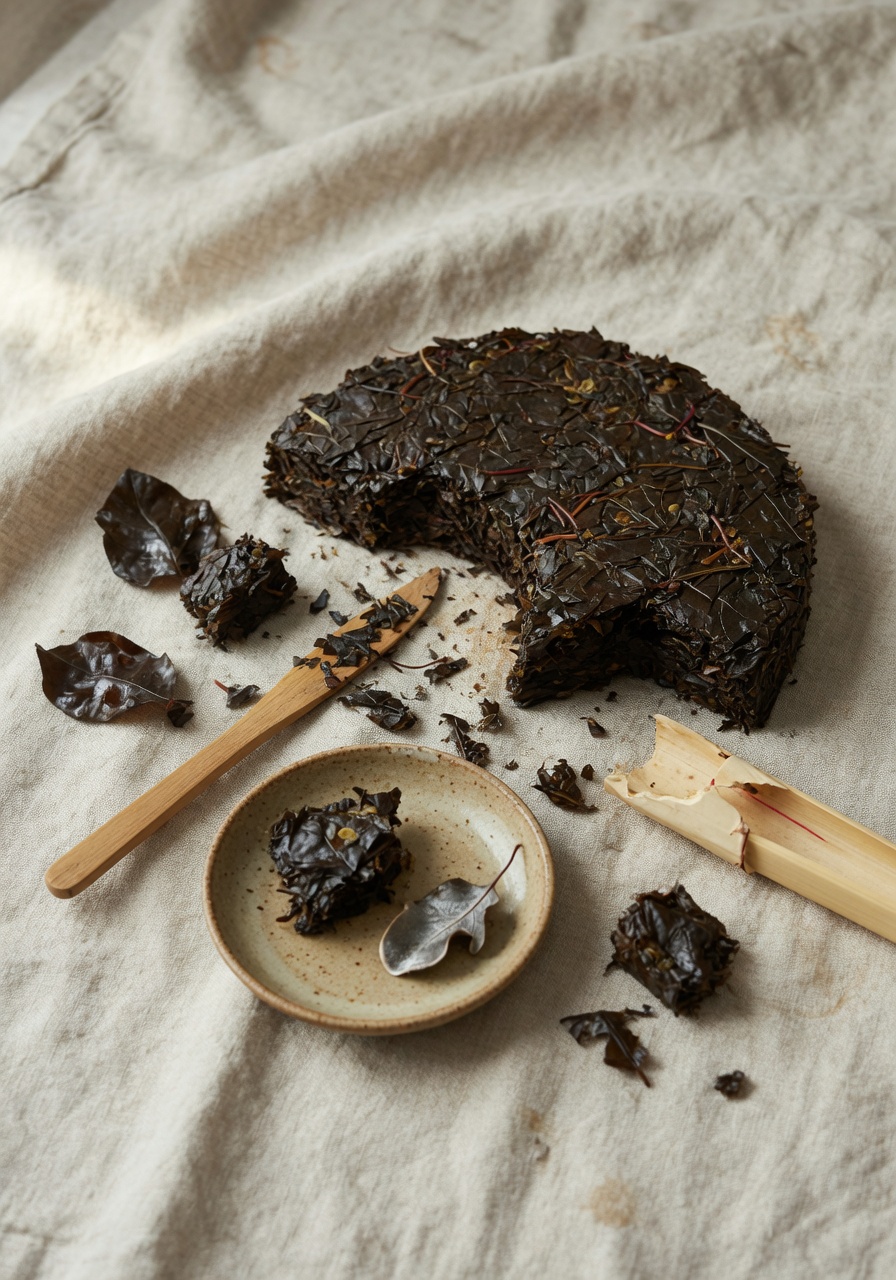
Menghai 7572 — the recipe that anchors the category
A four-digit code stamped on a paper wrapper has done more to define what shu tastes like than any single mountain or master. This is how 7572 became the reference point.