home · Six mountains, six <em>flavours</em> — terroir in pu-erh
Yunnan regions
Yiwu — forest gardens of the Laos border
Yì Wǔ · 易武
On the southern edge of Xishuangbanna, where the forest crosses into Laos, *Yì Wǔ* (易武) grows the softest, most aromatic *shēng* in Yunnan — a tea that built an empire, vanished for fifty years, and rebuilt itself from village memory.
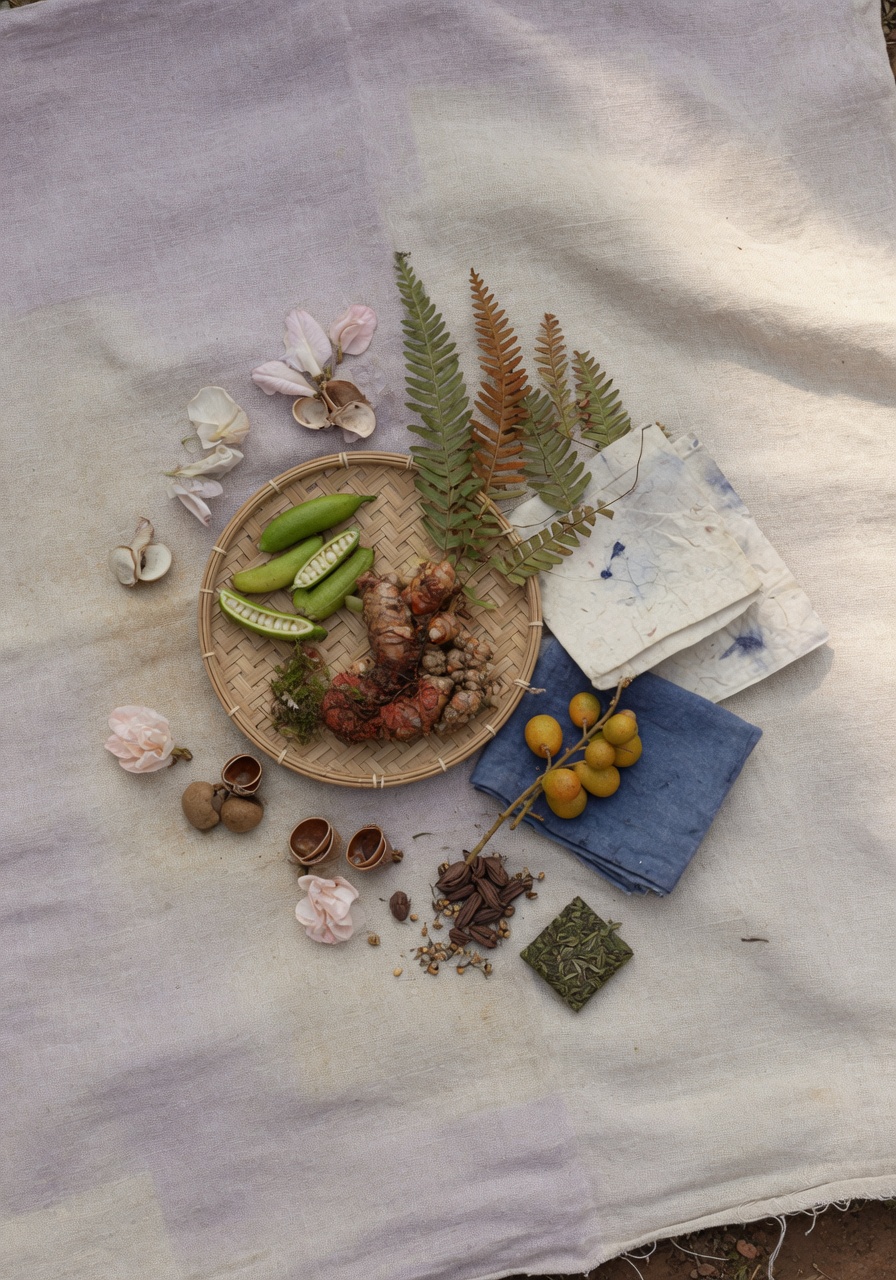
Yì Wǔ sits in the southeastern corner of Xishuangbanna prefecture, about 90 km from Mengla county seat and pressed against the Laotian border at roughly 21.7° N. The town itself is unremarkable — a single main street, a Qing-era stone road, a few tea factories that were guesthouses thirty years ago. What matters is the forest around it: the Yì Wǔ Chá Shān (易武茶山), a band of mid-elevation broadleaf forest between 900 and 1,400 m where Camellia sinensis var. assamica has been cultivated, abandoned, and re-cultivated across at least three centuries. Yiwu is the gentlest of the famous shēng regions. Where Bulang gives you bitterness that resolves into sweetness, and Lincang gives you a hard mineral spine, Yiwu offers something closer to honey and orchid — a tea that opens early, ages slowly, and rewards patience without ever being aggressive. This softness has made Yiwu both beloved and suspect. Beloved, because the 1990s Taiwanese revival of pu’er was largely a Yiwu story: the so-called Hào Jí Chá (号级茶) of the late Qing — Tóng Qìng Hào (同庆号), Sòng Pìn Hào (宋聘号), Fú Yuán Chāng (福元昌) — were Yiwu cakes, and when collectors looked for the next 1920s, they looked here. Suspect, because Yiwu’s name is now stamped on more cakes than its forests could ever produce. This article is about what Yiwu actually is — the villages, the trees, the processing choices that define the profile — and how to think about it without buying the marketing whole.
Geography and the seven villages
Yiwu is not one place. The administrative town of Yiwu sits at about 1,300 m, but the tea-producing area extends across a forested plateau cut by streams that drain south into the Mekong tributary system. Historically, the Qing dynasty grouped the eastern Six Famous Tea Mountains (Liù Dà Chá Shān 六大茶山) along this corridor, and Yiwu was the largest and most productive of them. In the modern reading, what dealers and drinkers call “Yiwu tea” comes from a cluster of villages spread across roughly 50 km², each with its own microterroir, tree population, and pricing tier. The seven names that matter most — Mǎhēi (麻黑), Luòshuǐdòng (落水洞), Gāoshān (高山), Dīngjiāzhài (丁家寨), Wāngōng (弯弓), Báichákāizhài (白茶园), and Bóhélín (薄荷塘) — are not a closed list. They are reference points. Mahei is the workhorse: relatively accessible, planted at 1,100–1,300 m, with the classic Yiwu honey-and-orchid profile and a moderate price ceiling. Luoshuidong and Gaoshan sit higher and yield smaller, denser leaves. Wangong, Baichayuan, and Bohetang are the so-called guóyǒulín (国有林) — state-owned forest gardens, where tea trees grow scattered through old-growth broadleaf canopy rather than in planted rows. Bohetang in particular has become the price benchmark for top-tier Yiwu, with single-tree maocha quoted in the tens of thousands of yuan per kilogram in recent harvests.
The two histories — Qing caravans and the 1990s revival
Yiwu’s first golden age ran from the late 18th century through the 1930s. The Qing court designated it as a source of tribute tea, and the town became the southern terminus of the Chá Mǎ Gǔ Dào (茶马古道) — the tea-horse road that ran north through Pu’er town, Dali, and into Tibet. The stone road through the old quarter of Yiwu town, still partially intact, dates to this period. Family-run hào (号) workshops — Tongqing, Songpin, Fuyuanchang, Tongxinghao — pressed yuán chá (圆茶, round cake) wrapped in bamboo husk and shipped them by mule. The Sino-Japanese war and then collectivisation under the PRC ended this trade. By the 1950s, processing moved to the state factories in Menghai and Kunming, and Yiwu’s family workshops closed. Tea trees were not uprooted — many simply went semi-feral, growing through the forest understory for forty years without pruning, fertilisation, or harvest pressure. The second history begins in 1994, when a delegation of Taiwanese collectors led by Lü Lìzhēn (吕礼臻) of the Chinese Tea Art Association visited Yiwu looking for the source of the Hào Jí Chá they had been drinking from Hong Kong storage. They commissioned a small batch of cakes pressed in traditional stone-mould style by Zhāng Yì (张毅), then the village head, using leaf from the old gardens around Mahei. Those 1996 Zhēn Chún Yǎ Hào (真淳雅号) cakes are now collector pieces, but their real significance is that they re-established Yiwu as a category. Within a decade, the entire premium shēng market had reoriented around village-named tea, and Yiwu was the template.
Why the old gardens survived
The survival of pre-collectivisation tea trees in Yiwu is not accidental. Three factors mattered. First, the terrain — Yiwu’s tea grows scattered through forest on slopes too steep and too remote for mechanised conversion to other crops during the 1958–78 push. Second, the local Han and Yi populations, descended from Qing-era tea-merchant families, retained knowledge of which trees were planted and where, even when they couldn’t process tea commercially. Third, the absence of state factory infrastructure in Yiwu itself meant no incentive to clear-cut and replant in the dense rows that tái dì chá (台地茶, terrace plantation) requires. When the 1990s revival came, the raw material was still there — overgrown, low-yielding, but genetically intact. This is the foundation of every claim Yiwu makes today.
What Yiwu tastes like — and what it doesn’t
Brewed young — within the first two years after pressing — a well-made Yiwu shēng gives a pale yellow-green soup, slightly viscous, with aromatics that lean toward honey, lily, and a specific orchid note that experienced drinkers call lánxiāng (兰香). The bitterness is low and short, the astringency moderate, the huí gān (回甘, returning sweetness) prompt and lingering. The aftertaste sits in the throat — what the Chinese tasting vocabulary calls hóu yùn (喉韵) — rather than on the tongue, and this throat-feel is the single most cited marker of authentic Yiwu. What Yiwu does not give you is the upfront bitter-power of Bulang, the smoke and stone of some Lincang teas, or the camphor-cool of high-altitude Mengku material. A Yiwu that is sharply bitter, heavily astringent, or aggressively floral on the nose is almost certainly either blended with Lincang or Menghai leaf, or processed with a too-hot shā qīng (杀青) that has driven off the volatile esters. The flip side is that Yiwu can read as thin or watery to drinkers used to harder profiles, particularly when made from lower-elevation plantation leaf marketed under the Yiwu name. The honest test is durability across infusions. A genuine forest-garden Yiwu should hold structure for 12 to 15 gōngfū steepings, with the throat-feel deepening rather than fading in the middle rounds. Plantation Yiwu collapses by round six.
The Bohetang phenomenon
Bóhétáng (薄荷塘) — “mint pond” — is a small parcel within the Mansa state forest, perhaps 50–60 productive trees, first marketed seriously around 2010. Spring 2015 máochá (毛茶) sold at roughly 8,000 yuan/kg. By spring 2021 the same trees were quoted at over 50,000 yuan/kg, and the 2023 harvest reportedly cleared 70,000 for the best lots. Whether Bohetang is genuinely the best parcel in Yiwu or simply the most successful brand is contested even among Yiwu producers. What is not contested is that the market for top-tier Yiwu has decoupled from the market for ordinary Yiwu by a factor of fifty or more — and that almost every cake labelled “Bohetang” sold at retail outside of a tiny circle of vetted producers is some form of blend or fraud.
How Yiwu ages
Yiwu’s reputation for graceful ageing is real but slower than the market sometimes implies. Because the source leaf is relatively low in bitter catechins and high in soluble sugars, the dramatic transformation that hard-bitter Menghai shēng undergoes in the first decade — bitterness folding into sweetness, astringency softening into body — is less pronounced in Yiwu, because the starting point is already softer. What develops instead is depth: the orchid note moves toward dried longan, then toward old-wood and faint medicinal herb, then, after 20+ years in Guangdong-humid storage, toward the camphor-and-ginseng spectrum of the surviving Hào Jí Chá. Drunk too young, Yiwu can feel finished before it has started. The five-to-eight year mark is where most modern Yiwu opens up in earnest — see the linked piece on the five-year question for the broader argument.
Processing — why the maocha matters more than the village
Yiwu’s softness is built into the leaf, but it is preserved or destroyed in processing. The standard sequence — withering, shā qīng in a wok, rolling, sun-drying to máochá, then later steam-pressing into cake — sounds simple, and isn’t. Three decisions define the outcome. First, the wither: Yiwu producers tend to wither longer than Menghai practice, often 6–10 hours on bamboo trays, to develop the floral aromatics. Under-withered leaf gives a grassy, green-bean note that masks the honey character. Second, the shā qīng temperature: too hot (above ~280 °C wok-surface) and the volatiles flash off; too cool and the leaf doesn’t denature properly, leaving enzymatic activity that will turn the máochá sour over the next year. Skilled Yiwu producers run cooler and longer than the Menghai standard. Third, the sun-drying: Yiwu’s traditional practice is full sun on bamboo mats, but humidity here is high — frequently 75–85 % during spring harvest — and incomplete drying is the most common single fault in commercial Yiwu máochá. According to the national standard GB/T 22111-2008 for geographical-indication pu’er, finished máochá moisture should not exceed 10 %, but field measurements at village level often run higher. The cross-link from our colleagues at tea.school on processing fundamentals covers the wider context.
Authenticity — how to read a Yiwu cake
Yiwu fraud is not crude. Nobody sells Fujian green tea pressed into bing and calls it Yiwu. The fraud is granular: blending 20 % Yiwu leaf with 80 % cheaper Mengku or Jinggu máochá and labelling the cake by the dominant village name; mixing spring and autumn material to lower cost; sourcing from Laotian border villages that are botanically and climatically identical to Yiwu but legally outside the geographical indication. The defensive reading involves four checks. First, the dry leaf: genuine forest-garden Yiwu shows long, slightly twisted leaves with visible internodes and a pale grey-green colour, not the dark, tightly rolled appearance of plantation leaf. Second, the wet leaf after brewing: should unfold to show whole, soft, pliable leaves with intact stems and the occasional yellow leaf (huáng piàn 黄片) — see our piece on huangpian for why this matters. Third, the soup: pale gold to light amber for young material, never green or cloudy. Fourth, and most important, the throat-feel: real Yiwu produces a slow, deep hóu yùn that develops 30–60 seconds after swallowing. Cakes that taste “Yiwu-like” on the front palate but produce no throat sensation are usually blends. Provenance documentation — GPS coordinates, village name on the nèi piào (内票, interior ticket), producer name and pressing date — is now standard for cakes above ~2,000 yuan retail. Below that price point, treat the label as a suggestion. For broader context on the region see Yunnan regions and the sibling pieces on Bulang, Nannuo, and Lincang.
The Laos border question
Yiwu’s tea forest does not stop at the international boundary. The same tree population — same assamica genetics, same elevation, same soil, same climate — extends ten or fifteen kilometres into Phongsali province in northern Laos. Some of this leaf is processed in Lao villages by ethnically Han or Akha producers with family ties across the border, and some crosses the border as fresh leaf and is processed in Yiwu itself. The Chinese GB/T 22111-2008 standard restricts the “pu’er” geographical indication to leaf grown and processed within the defined Yunnan zone, so technically Lao-origin material cannot be sold as pu’er inside China. In practice, the porosity is well known among producers and rarely visible to consumers. This is not necessarily a quality problem — the leaf itself is often genuinely good, and Lao tea forests have suffered less from agrochemical pressure than some Yunnan parcels — but it is a transparency problem. If you are paying Bohetang prices, you are paying for a parcel of land, and the parcel matters.
Drinking Yiwu — a practical note
Yiwu rewards restraint. The classical gōngfū setup — porcelain gàiwǎn (盖碗), 8 g of leaf to 100 ml of water, water just off boil at around 95 °C, rinses of 5 seconds and first infusion of 8–10 seconds — works well, but the temperature is the variable to watch. Boiling water on young Yiwu drives the bitter compounds forward and flattens the floral high notes. A 90–93 °C pour gives a more honest reading of the leaf. For older Yiwu — 10 years and up — full boiling is appropriate, and a small unglazed zhū ní (朱泥) Yixing pot will deepen the body usefully. Avoid clay that is overly absorbent for young material; the floral character is what you are paying for, and porous clay will eat it. Drink Yiwu in quiet sessions, with attention. It is not a tea that announces itself, and drinkers coming from Bulang or Lao Banzhang sometimes dismiss it on first encounter as underwhelming. Give it the second infusion, then the fifth, then the ninth. The throat-feel that defines this region builds across a session in a way that no single sip can preview. That patience is the price of admission — and it is, in the end, the same patience the leaf itself requires to age.
References
- GB/T 22111-2008 — Geographical indication product: Pu'er tea — Standardization Administration of China
- Pu'er Tea: Ancient Caravans and Urban Chic — Zhang Jinghong, University of Washington Press, 2014
- The Tea Horse Road: China's Ancient Trade Road to Tibet — Michael Freeman & Selena Ahmed, River Books, 2011
- Interview with Zhang Yi, Yiwu village head 1994–2008 — Recorded by Lü Lìzhēn for the Chinese Tea Art Association, Taipei, 2003
- Yunnan da ye zhong cha shu zi yuan diao cha (Survey of Yunnan large-leaf tea tree resources) — Yunnan Agricultural University, Tea Research Institute, 2017
- GB/T 23776-2018 — Methodology for sensory evaluation of tea — Standardization Administration of China
Read next
Related articles
Bulang Shan — the bitter that becomes sweet
On the southern edge of Menghai county, the Bulang people have tended tea for over a thousand years. Their leaf opens the throat with bitterness — then turns sweet, slowly, and refuses to leave.
Nannuo Shan — the queen of Menghai's mountains
Nannuo is the most documented tea mountain in Xishuangbanna — Hani villages above 1,400 m, an 800-year-old tea tree felled in 1994, and a flavour profile that anchors what 'classic Menghai sheng' means.
Gushu / 'old tree' tea — what's real, what's marketing
The term *gǔshù* (古树) sells more cake than any other two characters in Yunnan. Most of what's labelled gushu is not. Here's how to read the claim — botanically, contractually, and in the cup.
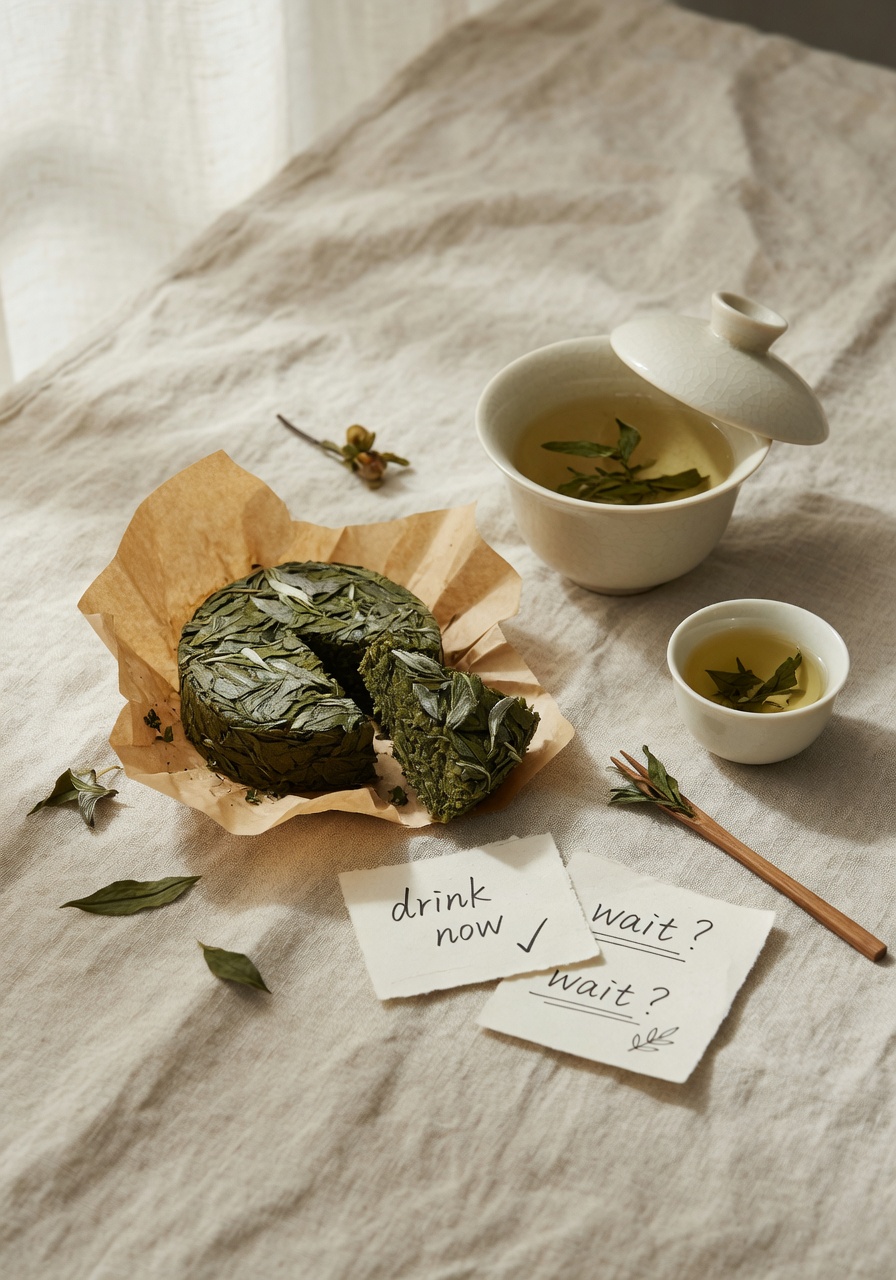
Young sheng — drink now or wait?
The question every collector asks within their first year. Some cakes are radiant at eighteen months; others need a decade before they stop biting. Here is how to tell which is which.