home · Where pu-erh <em>sleeps</em> shapes what it becomes
Aging & storage
Dry storage — the Kunming standard
*Kūnmíng gān cāng* · 昆明干仓
Kunming sits at 1,890 metres, averages 14°C, and rarely crosses 70% humidity. For three decades that climate has defined what dry-stored pu-erh tastes like — and what it does not become.
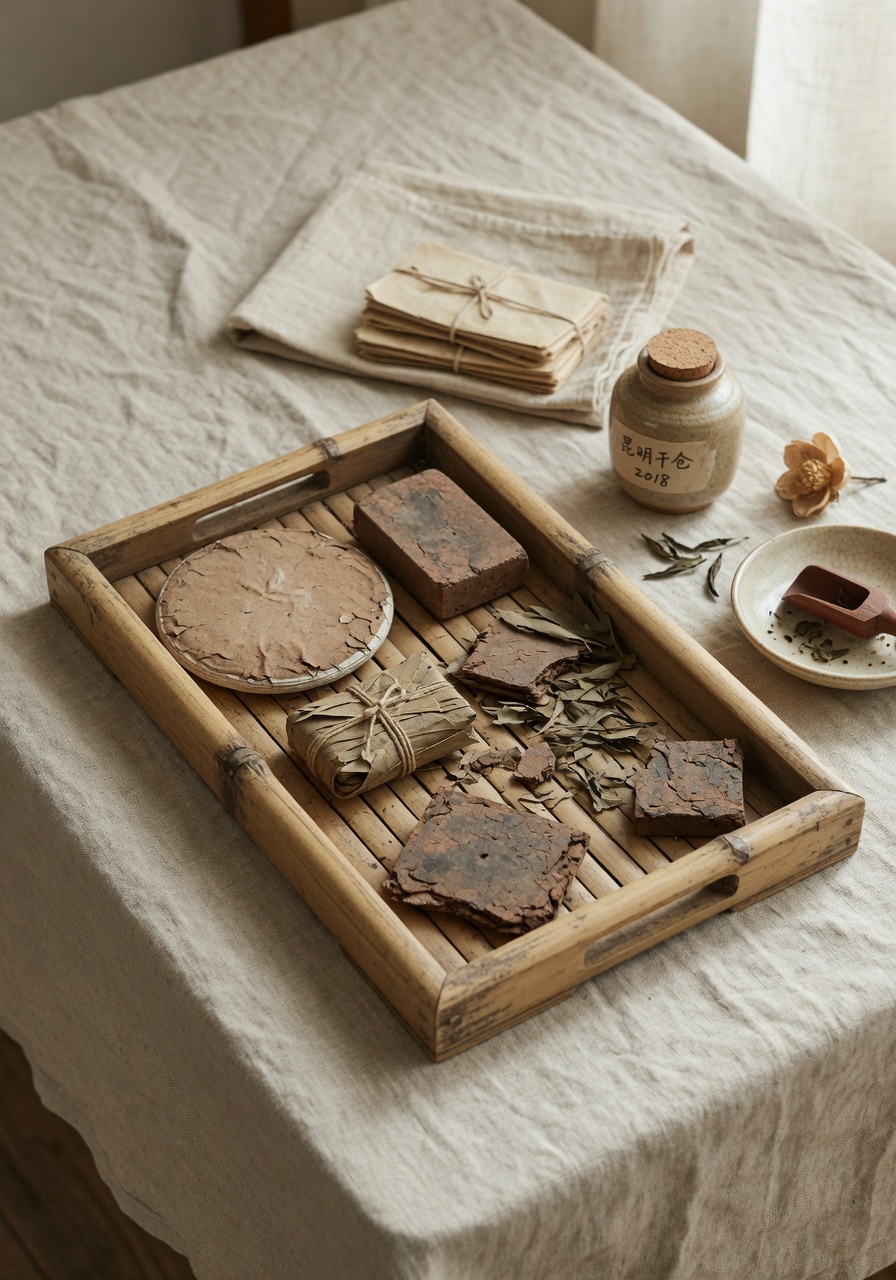
Ask ten collectors to define dry storage and you will get ten answers, but most will reach for the same shorthand — Kunming. The Yunnan capital became the reference point for gān cāng (干仓) almost by accident. Factories in Menghai and Xiaguan pressed the cakes; Kunming warehouses stored the surplus that nobody had yet learned to age on purpose. By the time the Hong Kong and Taiwan markets began chasing aged sheng in the late 1980s, the cakes that had quietly sat in Kunming for fifteen or twenty years tasted unmistakably different from the same recipes pulled out of Kowloon basements. They were lighter, more aromatic, slower to transform — and to a generation of drinkers raised on traditional Hong Kong storage, they were also strange. That difference, codified through the 1990s and standardised in trade language by the early 2000s, is what we now call the Kunming standard. This article looks at what the standard actually means in numbers — temperature, relative humidity, airflow, light — and what it does and does not do to a cake over ten, twenty, and thirty years. It is written from the perspective of a continental drinker. In Ulan-Ude and Irkutsk, where I store most of my own cakes, winter humidity drops to 35% and the apartments are over-heated. Kunming, by comparison, is generous. Understanding the standard means understanding both its ceiling and its floor.
What the Kunming climate actually looks like
Kunming is called the spring city — chūn chéng (春城) — for a reason. The plateau sits at 1,890 metres above sea level, and the annual mean temperature is 14.7°C according to the China Meteorological Administration’s 1991–2020 normals. Monthly means range from 8.3°C in January to 20.2°C in July. Relative humidity averages 68% across the year, with a dry winter dipping into the low 50s and a summer monsoon that pushes humidity into the mid-70s for roughly ten weeks. Compare that to Guangzhou, where annual mean RH sits at 78% and summer months routinely cross 85%. The difference is not subtle. A cake stored in Kunming sees, in round numbers, half the absolute moisture exposure of the same cake stored in the Pearl River Delta. Light is also different — Kunming has 2,200 hours of annual sunshine, but warehouses are deliberately shuttered, so this matters mostly for the moments cakes are moved or photographed. The plateau’s other quiet advantage is diurnal swing. A summer day in Kunming may run 23°C in afternoon and 14°C at night. That nine-degree breath, repeated daily, ventilates a warehouse passively in ways that flatland coastal storage simply cannot. This is the climate the standard rests on, and any attempt to replicate Kunming storage outside Yunnan needs to wrestle with all three variables, not just the headline humidity number.
How the standard was codified
There is no single GB/T standard titled ‘Kunming storage’. Instead, the dry-storage parameters were assembled piecemeal across three documents and a decade of trade practice. GB/T 22111-2008, the national standard for geographical-indication pu-erh tea, sets the broad envelope — clean, odour-free, ventilated, no direct sunlight, no contact with the ground. DB53/T 103-2006, a Yunnan provincial standard, narrows that to temperature below 28°C and relative humidity below 75%. The 2013 revision of the Yunnan dark-tea storage guideline (DB53/T 171.7-2013) tightens further, recommending 20–30°C and 60–75% RH as the operational target for long-term aging. Those numbers were not chosen in a laboratory — they describe what Kunming warehouses had already been doing for thirty years. As Zou Jiaju of the Yunnan Agricultural University put it in a 2011 China Tea interview, the standard ‘follows the city, not the other way around’. For drinkers, the practical takeaway is that ‘dry storage’ in catalogue copy almost always means a cake that has lived inside roughly those bounds — never above 75% RH for sustained periods, never above 30°C, and never deliberately humidified.
The 75% line
The 75% RH threshold is not arbitrary. Below that ceiling, the dominant microbial actors on a pressed sheng cake are slow-growing Aspergillus niger and Penicillium strains, working anaerobically inside the cake at a measured pace. Above 75%, and particularly above 80%, faster moulds — including Aspergillus glaucus — colonise the surface and drive the rapid, sweet, slightly funky transformation that traditional Hong Kong storage was built around. Neither path is wrong. But the Kunming standard is explicitly the slower one. A 2018 study by Lü Haipeng and colleagues at the Tea Research Institute, CAAS, measured the fungal community on cakes stored at 65% versus 85% RH over thirty months and found genus-level divergence within the first year. The two paths do not converge.
What dry storage does to a cake
On a sheng cake, the first decade of dry storage is mostly subtractive. Volatile grassy notes — the qīng wèi (青味) that defines a fresh maocha — fade. Astringency from un-oxidised catechins softens, though more slowly than in humid storage. Aroma migrates from the top of the nose to the middle and back, picking up notes that Yunnan drinkers describe as chén xiāng (陈香) — aged fragrance, often compared to dried apricot, old wood, and a faint medicinal sweetness. The cake’s colour shifts from spring green through olive to a dusty brown over fifteen to twenty years, but the leaves remain pliable and the compression stays tight. Brewed liquor moves from pale yellow to deep gold to amber, rarely crossing into the red-brown that humid storage produces by year ten. The bitterness of a young Bulang or Lao Banzhang cake does not disappear in dry storage — it relocates. After fifteen years in Kunming, the bitterness sits lower in the palate and arrives later in the sip, but it is still recognisably there. This is one of the reasons Kunming-stored cakes age longer before reaching what collectors call their drinking window. A Menghai 7542 from 1999 stored in Guangzhou is often considered ready by 2015. The same cake stored in Kunming is frequently described as still adolescent at twenty years. See our companion piece on sheng vs shu — what actually changes for the underlying chemistry.
Shu in dry storage
Shu pu-erh behaves differently. The pile fermentation — wò duī (渥堆) — has already done most of the microbial work before pressing, so dry storage primarily refines rather than transforms. Over five to ten years a well-stored shu loses the duī wèi (堆味) pile aroma that fresh shu carries, gains a cleaner sweetness, and develops a more transparent soup. After that, gains are subtle. Amgalan’s own 2003 Menghai V93 brick, stored continuously in Kunming until 2019 and then moved to Ulan-Ude, tastes today almost identical to a sample drawn in 2018 — clean, woody, slightly camphorous. Shu is the easier tea to dry-store, and arguably the tea for which the Kunming standard demands the least vigilance.
What dry storage does not do
Dry storage will not rescue a flawed cake. If the maocha was over-roasted during shā qīng (杀青), the kill-green step, no amount of patient aging will return the missing enzymatic activity. If the cake was pressed too tightly — a recurring complaint with certain Xiaguan iron cakes from the late 1990s — Kunming’s low humidity will compound the problem by keeping the interior leaves dry and inert. Dry storage also will not produce the deep, sweet, almost date-like character that defines a well-aged Hong Kong cake. Drinkers who chase that profile and store dry will be disappointed; the path simply does not lead there.
Setting up dry storage outside Yunnan
The Kunming standard is portable in principle and difficult in practice. Replicating it in Moscow, Berlin, or Vancouver requires attention to three variables that most home storers underestimate. First, humidity floor. Continental winters with central heating routinely drop indoor RH below 30%, well under Kunming’s winter minimum of around 50%. Cakes left in such conditions for years develop what Russian collectors call sukhost’ — a dryness that strips aroma and leaves the brewed soup thin. A passive humidifier in a sealed cabinet, or a Boveda-type two-way humidity pack calibrated to 62–65%, prevents this. Second, temperature stability. Kunming’s diurnal swing is gentle. A garage that runs 4°C in January and 32°C in August is not dry storage by any meaningful definition, even if the annual average looks correct. Third, neighbouring odours. Pu-erh absorbs aromatics aggressively, and a cake stored next to coffee, leather, or cedar for two years will carry those notes forever. The Yunnan warehouses I have visited all share a deliberate emptiness — bare brick, wood shelving, nothing else. The discipline matters. For a more detailed walkthrough of home setups, tea.school hosts a free module on continental storage, and thetea.app covers humidity-pack calibration in its equipment section.
The cabinet versus the room
Most home collectors run out of room before they run out of cakes. A sealed cabinet — pine or paulownia, never cedar or aromatic woods — is the standard compromise. Pine is mildly hygroscopic and buffers humidity swings; paulownia (tóng mù, 桐木) is the traditional Yunnan choice for tea storage and was the wood used in the original Menghai factory aging rooms before they shifted to brick in the 1980s. A 200-cake cabinet in a continental apartment, with a single 65% humidity pack and a digital hygrometer checked monthly, will hold within the Kunming envelope for years. The trade-off is airflow — cabinets need to be opened weekly, not daily, to refresh air without dragging in winter dryness.
Reading a Kunming-stored cake
There are tells. A Kunming-stored cake from the 1990s typically shows uniform colour across the bǐng (饼) face — no dark blotches, no surface bloom, no mineral crust where humidity condensed. The wrapper paper is dry to the touch, often slightly brittle at the edges, and rarely shows the foxing spots that Guangdong storage produces. Compressed leaves retain visible silver tips on aged Yiwu or Nannuo material, where humid storage would have darkened those tips to bronze. The dry leaf aroma is restrained — woody, faintly floral, with none of the wet-cellar sweetness of Hong Kong storage. Brewed, the soup runs clear and golden rather than red-amber, and the chá qì (茶气) arrives slowly across multiple infusions rather than in a single early wave. Auction records bear this out in price: a 2002 Da Yi 7542 with documented Kunming provenance sold at Beijing Poly’s spring 2022 sale for ¥38,000, while a comparable cake with traditional Hong Kong storage cleared at ¥27,500. The market reads the difference. Whether you prefer one over the other is a question of palate, not quality — both are legitimate paths, and both have shaped what pu-erh means in the 21st century.
Where the standard is heading
The Kunming standard is not static. Two pressures are pushing it. First, climate change — Kunming summer mean temperatures have risen 0.9°C since 1990, and the monsoon is becoming less predictable. Yunnan warehouses are beginning to install active dehumidification for the first time, something that would have been unthinkable in 1995. Second, the rise of so-called Kūn cāng (昆仓) branded warehouses — purpose-built, climate-controlled facilities outside the city that aim to lock storage parameters to the historical Kunming envelope rather than the drifting current one. Whether these engineered environments will produce cakes that age identically to the unconditioned warehouses of the 1980s is, frankly, unknown. We will find out around 2035. In the meantime, the standard remains what it has always been — a description of a place, a set of numbers, and a generation of cakes that taste a particular way because they were stored in a particular city at a particular altitude. That is both its strength and its limit.
References
- GB/T 22111-2008 Geographical Indication Product — Pu-erh Tea — Standardization Administration of China
- DB53/T 171.7-2013 Yunnan Dark Tea Storage Guideline — Yunnan Provincial Bureau of Quality and Technical Supervision
- Fungal community succession on pu-erh tea during long-term storage at differing relative humidity — Lü Haipeng et al., Tea Research Institute, Chinese Academy of Agricultural Sciences, 2018
- The Kunming model — interview with Zou Jiaju — *China Tea* (中国茶叶), issue 4, 2011
- Kunming climate normals 1991–2020 — China Meteorological Administration
- Beijing Poly Spring Auction 2022 — Pu-erh Tea Results — Poly Auction House, Beijing, May 2022
Read next
Related articles
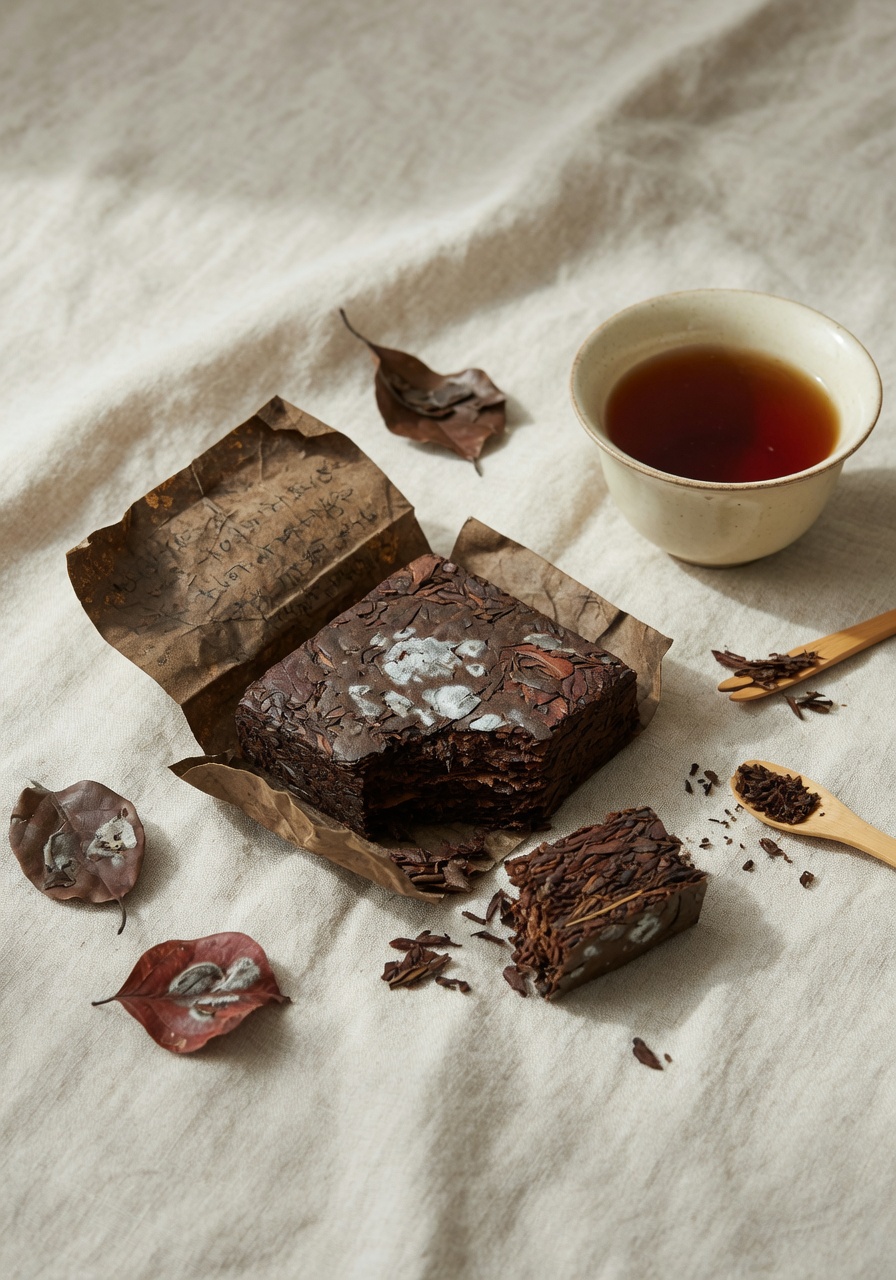
Does shu age? A measured answer
Shu was engineered in 1973 to taste like aged sheng without the wait. So does it still benefit from time in the jar — or is the work already done? A technical look at what actually changes after the pile.
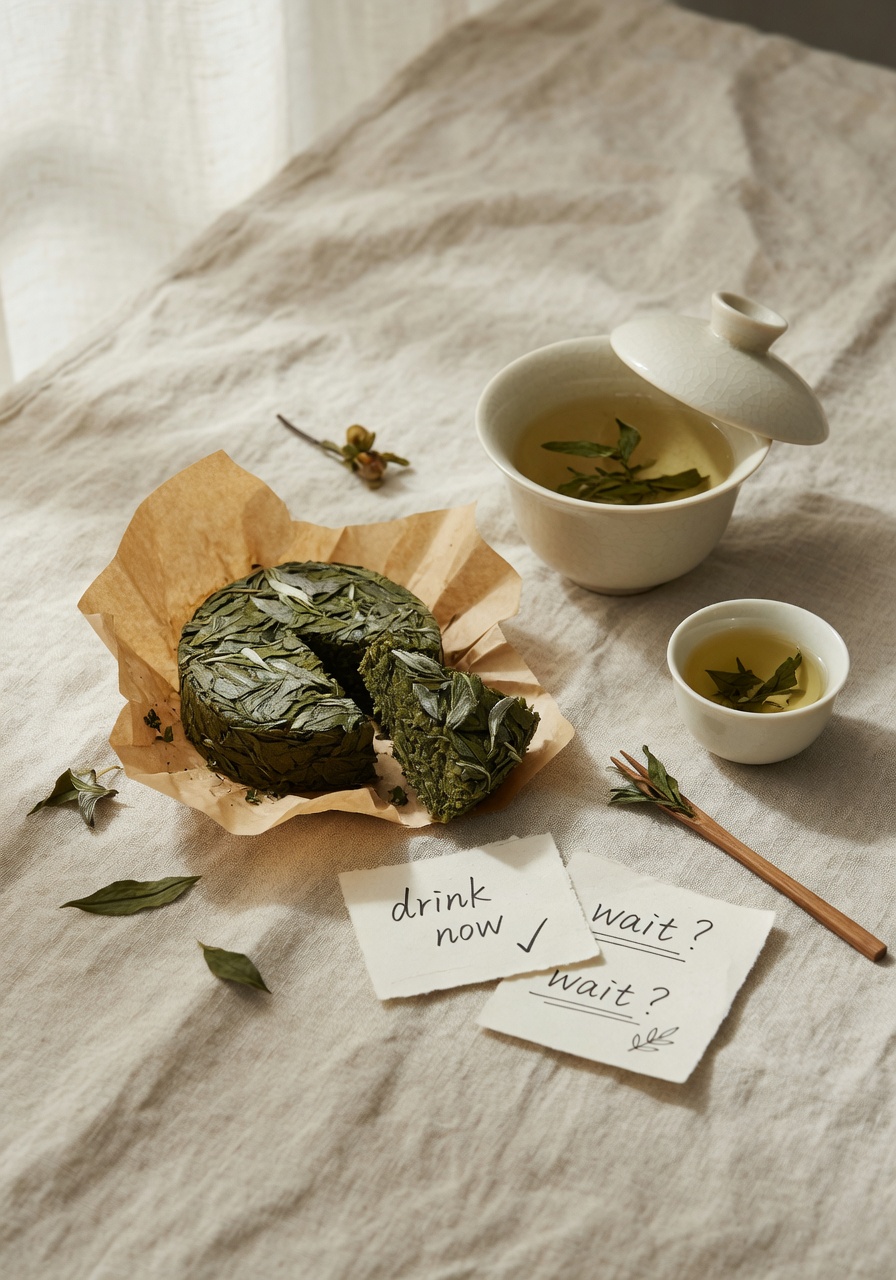
Young sheng — drink now or wait?
The question every collector asks within their first year. Some cakes are radiant at eighteen months; others need a decade before they stop biting. Here is how to tell which is which.
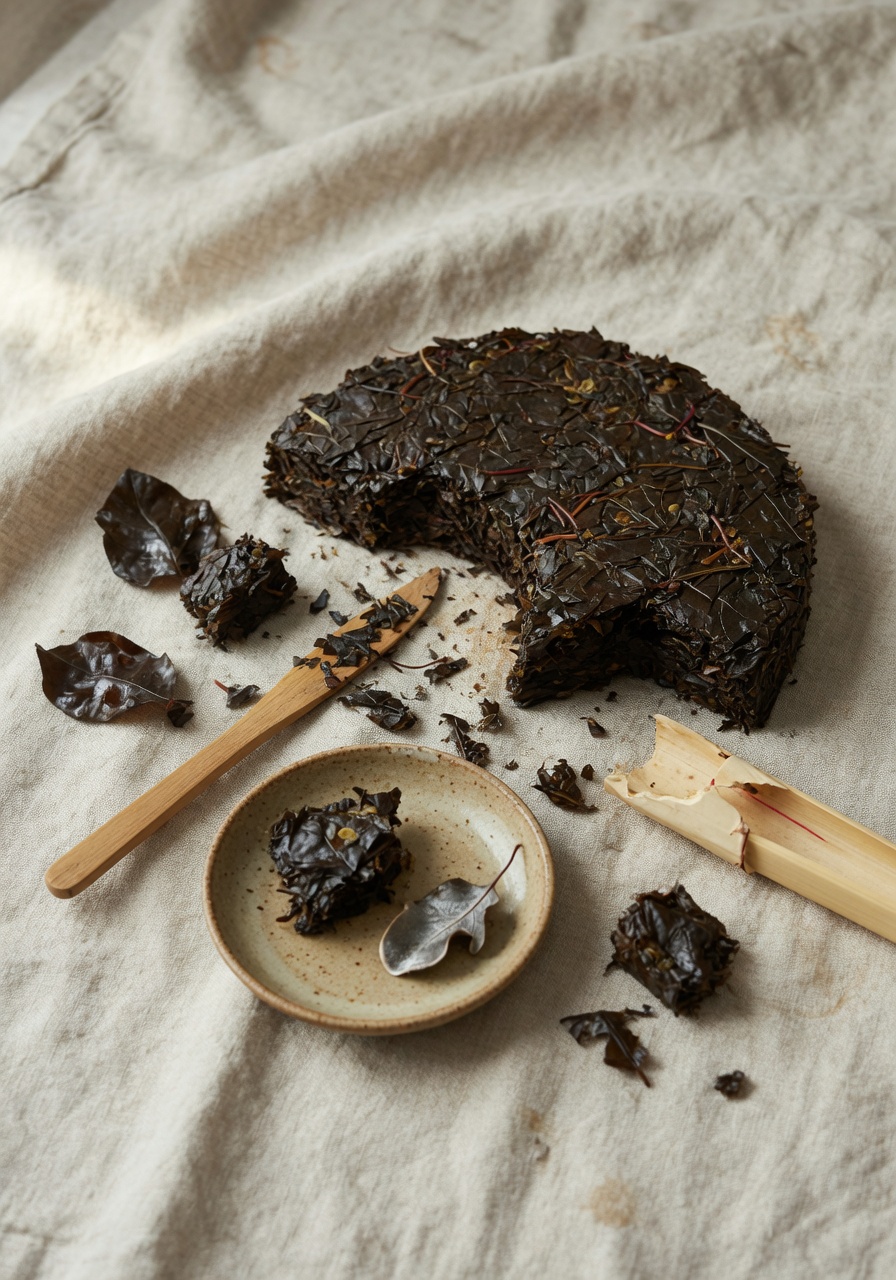
Menghai 7572 — the recipe that anchors the category
A four-digit code stamped on a paper wrapper has done more to define what shu tastes like than any single mountain or master. This is how 7572 became the reference point.
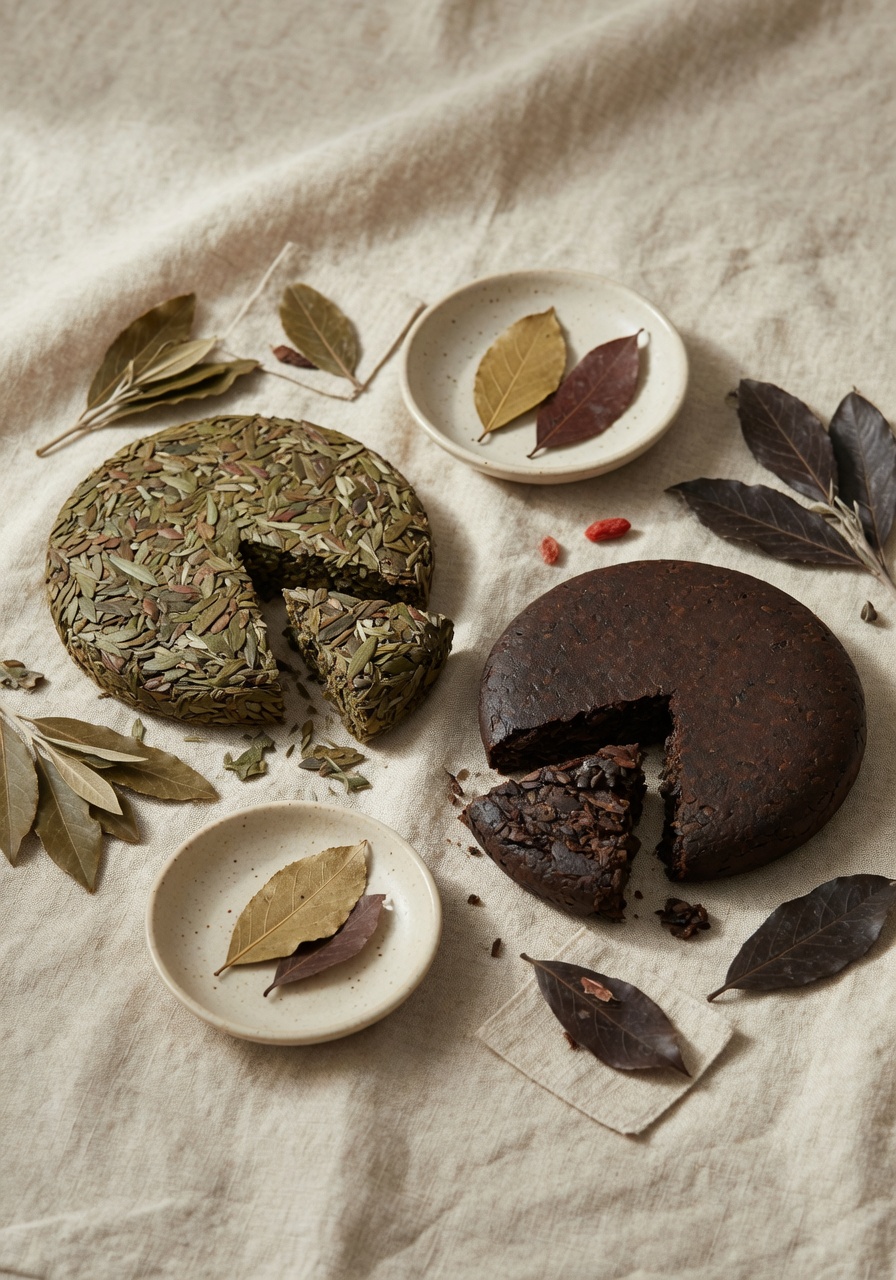
Sheng vs shu — what actually changes
Two teas share a name, a region, and a leaf — and almost nothing else. The 1973 invention of *wò duī* (渥堆) split pu'er into raw and ripe, and the chemistry of that split still defines every cake pressed today.