home · Brewing pu'er — <em>method follows the leaf</em>
Brewing
Yixing for pu'er — when clay matters, when it doesn't
Yí Xìng · 宜兴
Unglazed clay from a single county in Jiangsu shapes how pu'er tastes — sometimes profoundly, sometimes barely. Knowing which is which saves money and improves the cup.
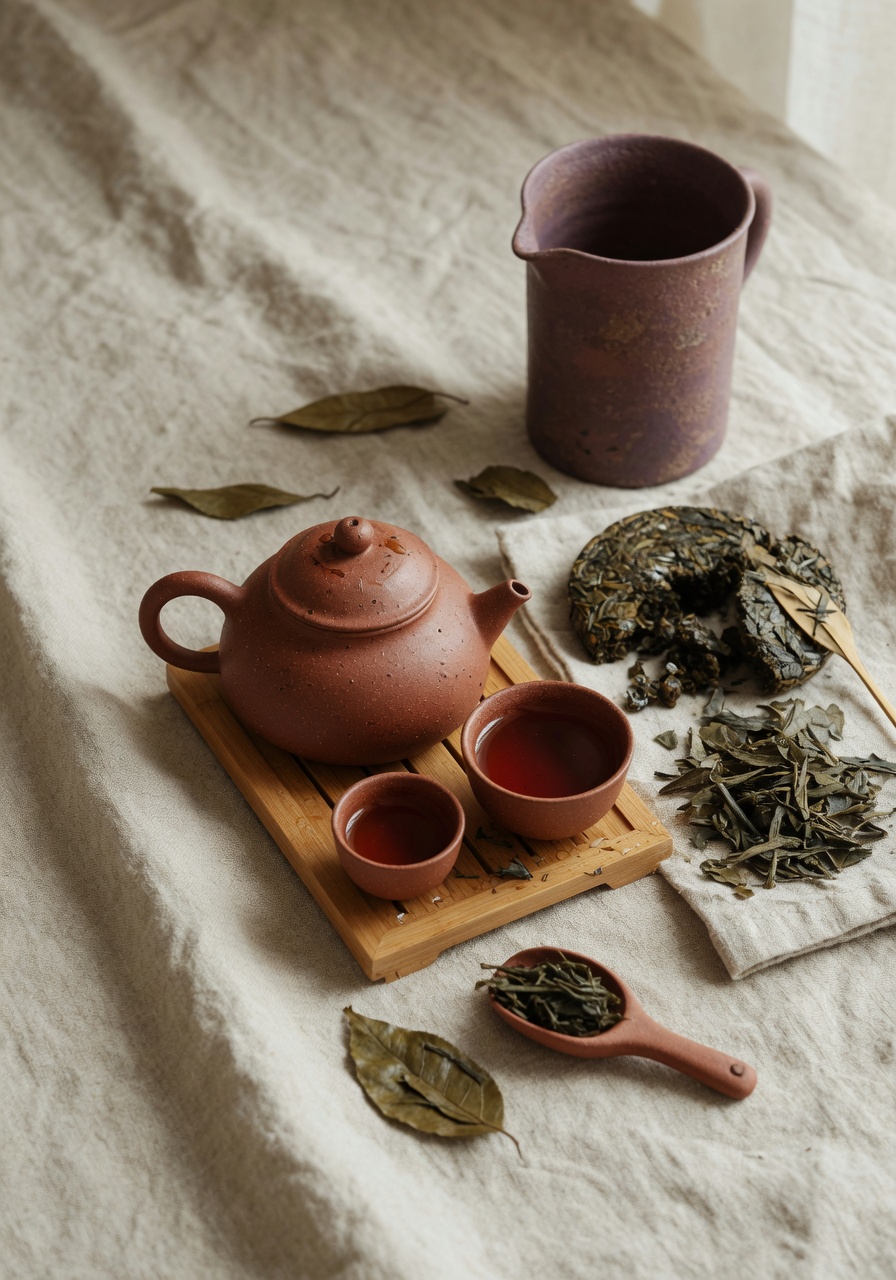
Walk into any tea market from Kunming to Ulaanbaatar and you will see the same scene — small reddish-brown teapots lined on a shelf, prices ranging from forty yuan to forty thousand. The seller will tell you that Yí Xìng (宜兴) clay is essential for pu’er, that it breathes, that it softens bitterness, that it remembers tea. Some of that is true. Some of it is repeated so often it has become true by consensus rather than by evidence. The question I want to answer in this article is narrow and practical — for which pu’er, in which brewing context, does the clay actually change the cup enough to matter, and when is a porcelain gaiwan (盖碗) the better instrument? I have brewed the same cake in five vessels side by side, dozens of times, in Irkutsk apartments and Ulaanbaatar tea rooms where the water is hard and the air is dry. I have also seen collectors spend a month’s salary on a pot that did nothing measurable for the tea inside it. The clay matters. It matters in specific ways, for specific teas, and the cost-to-benefit curve is steeper than most vendors admit. What follows is what I trust, what I doubt, and what I tell students at the tea workshops we run with tea.school when the topic comes up — which is every time.
What Yixing clay actually is
Yixing (Yí Xìng, 宜兴) is a county-level city in southern Jiangsu province, about 180 km west of Shanghai. The clay extracted from the hills around Huanglongshan and Zhaozhuang is called zǐ shā (紫砂) — purple sand — and it is geologically unusual. It contains roughly 7 — 11 % iron oxide, a high proportion of kaolinite and mica, and when fired between 1100 °C and 1200 °C it sinters into a body that is dense yet riddled with a microporous network. Chinese ceramic studies published by the Nanjing Institute of Geology (Lu, 1982; revised 2007) measured apparent porosity at 3 — 5 % and a double-pore structure invisible to the naked eye — closed cells inside the wall, open channels at the surface. This is what gives Yixing its two practical properties — thermal retention better than porcelain, and a surface that holds and slowly releases aromatic compounds. There are three principal clay families. Zǐ ní (紫泥) — purple clay — is the workhorse, brown-violet, neutral, the safest default. Zhū ní (朱泥) — vermilion clay — fires bright orange-red, has finer particles, higher shrinkage, holds heat hardest, and tends to brighten high notes. Duàn ní (段泥) — segment clay — is a paler beige-yellow blend, more open in structure, gentler on the cup. Each behaves differently with pu’er, and lumping them together as ‘Yixing’ is the first mistake a beginner makes.
The two real effects clay has on tea
Strip away the romance and Yixing does two measurable things. First, it buffers temperature. A 150 ml zǐ ní pot with 4 mm walls, preheated, will hold water above 92 °C for the full 30-second infusion of a young sheng — a porcelain gaiwan of the same volume drops to about 86 °C in the same window. For shu pu’er, where extraction depends on near-boiling contact with compact leaf, this temperature floor changes the cup audibly. The soup is thicker, the hóu yùn (喉韵) — throat resonance — extends further. Second, the microporous wall absorbs a small fraction of volatile aromatics during brewing and releases them on the next steep, while also adsorbing some of the harsher pyrazines and certain catechins. The result, with shu and with aged sheng, is a softening — slightly less bite at the top, slightly more roundness at the finish. Whether this softening is desirable depends entirely on the tea.
When softening helps
Wet-stored sheng from the 1990s, mid-tier shu from Menghai or Xiaguan, pile-fermented cakes still carrying that wet-pile note in their first three years — these benefit unambiguously from clay. The pot rounds the edges. A 2006 qī zǐ bǐng (七子饼) shu that tastes muddy from a gaiwan often tastes clean from a well-fired zǐ ní pot, because the worst of the geosmin-adjacent compounds bind to the wall instead of reaching the cup. This is also where the so-called seasoning effect — the yǎng hú (养壶) tradition of dedicating one pot to one tea type — has real basis. A pot used exclusively for shu for two years develops a perceptibly different interior surface.
When softening hurts
Single-estate young sheng — the kind of tea where you paid a premium specifically to taste Yiwu’s honey-floral lift or Bulang’s aggressive bitterness resolving into huí gān (回甘) — does not want softening. It wants transparency. Brewed in clay, a 2022 spring Yiwu can lose the very top-end florals that justified the price. I have watched a collector in Ulan-Ude pour the same tea side by side from a zhū ní pot and a thin-walled porcelain gaiwan and conclude, audibly disappointed, that he had been muting his best tea for a year.
Matching clay to tea — a working table
After roughly eight years of A/B brewing for myself and for clients, the matching I trust is this. Zǐ ní (purple clay) is the most forgiving and the right default if you can own only one pot for pu’er — pair it with shu of any age, with aged sheng past about fifteen years, and with mid-quality sheng of any age where transparency is not the point. Zhū ní (vermilion) is narrower in use — its high thermal mass and bright character suit aged sheng with delicate aromatics still surviving, and it is excellent for wet-stored Hong Kong style cakes where you want to lift the soup out of its storage profile. Duàn ní (segment) is gentler and more porous — useful for younger sheng that you still want to brew in clay rather than gaiwan, because it softens less aggressively than zǐ ní. None of these are rules. They are starting points. Wall thickness matters as much as clay family — a 2 mm thin zǐ ní pot behaves more like a gaiwan than a 5 mm zhū ní. Pot volume matters too. For two drinkers, 110 — 150 ml is the standard range; below 80 ml the leaf-to-water ratio becomes hard to manage with compressed pu’er. Above 200 ml the pot cools faster relative to its content and the thermal-buffer argument weakens.
When the gaiwan is simply better
For evaluation, for tasting new purchases, for any sheng under about ten years of age where you are still learning what the tea is — use a porcelain gaiwan. There is no honest argument for clay here. A thin-walled gaiwan of 100 — 130 ml fired from Jingdezhen porcelain is chemically inert, releases the leaf transparently, costs between 200 and 600 yuan for a perfectly serviceable example, and can be rinsed clean between teas in seconds. Every serious tea buyer I know in Yunnan tastes from a gaiwan first and brings out the clay only after the tea is understood. The vendors at the Kunming Xiongda market do the same. Clay is a tool for the relationship phase — once you know a tea and want to spend an afternoon with it, the pot helps. For the first date, porcelain is more honest. This is also why our colleagues at thetea.app recommend gaiwan as the first vessel for any pu’er student, and why tea.school’s brewing curriculum delays clay until the second module.
Authenticity, price, and what you are actually paying for
The market for Yixing pots is, to put it carefully, complicated. Genuine Huanglongshan zǐ ní ore was officially closed to extraction by the Yixing municipal government in 2005, with restricted access continuing in limited quotas since. The clay you buy in 2024 is almost always blended, often with ore from neighbouring counties, sometimes with iron oxide and manganese added to fake the colour of the older material. This does not make the pot useless — much of the blended clay still sinters into a perfectly functional double-pore body. It does mean that the difference between an 800-yuan pot and an 8000-yuan pot from the same workshop is rarely a difference you will taste. It is a difference in maker, in handwork versus slip-cast, in artistic provenance.
Three honest tests before you buy
First, weight in the hand — a properly fired zǐ ní pot of 150 ml weighs between 150 and 200 g; significantly lighter often means under-fired and over-porous, significantly heavier suggests added mineral fillers. Second, sound — tap the lid against the body gently; a clean, slightly metallic ring indicates good vitrification, a dull thud suggests cracks or poor firing. Third, water test — fill with boiling water and smell after thirty seconds; the pot should smell faintly of clay and warm stone, not of chemicals, dye, or scorched plastic. I have rejected pots at every price point on the third test alone. For most drinkers buying their first or second pot, the 600 — 1500 yuan range from a known workshop — not a known artist — gives you everything the clay can actually do for the tea.
Seasoning, dedication, and the long view
The Chinese phrase yī hú yī chá (一壶一茶) — one pot, one tea — is older than the pu’er market itself and applies more strictly here than to almost any other tea category. Because Yixing’s microporous wall genuinely retains aromatic compounds, brewing shu in a pot that has previously seen young sheng will produce muddled results for several months. The reverse is worse — pile-ferment notes embedded in clay will haunt every subsequent steep of a delicate sheng. In practice this means owning at least two pots if you drink both sub-categories seriously — one for shu and aged sheng, one for younger sheng if you choose to brew it in clay at all. Seasoning a new pot takes time. The traditional method — boiling the empty pot in water with tea leaves, then brewing the dedicated tea daily for several weeks — has practical justification beyond ritual. The first dozen brews leach residual kiln dust and clay particulates; the next fifty deposit enough of the tea’s aromatic profile into the wall to begin the buffering effect. After roughly two years of daily use, a zǐ ní shu pot acquires a soft dark patina inside and a measurable change in cup character — the hóu yùn deeper, the finish longer. This is the slow reward Yixing offers, and it is real. It is also the reason a serious pu’er drinker should not be in a hurry to buy many pots — better to spend two years truly knowing one.
Practical recommendation
If you are starting out and own no clay yet — buy a 120 ml Jingdezhen porcelain gaiwan first, drink your pu’er from it for at least six months, and learn what your teas actually taste like. Then, if and only if you have settled into a consistent shu habit or are collecting aged sheng, add one zǐ ní pot of 120 — 150 ml from a reputable Yixing workshop in the 800 — 1500 yuan range. Dedicate it. Use it. After two years, evaluate whether you want a second pot — by then you will know exactly which tea it should be for, and the question of clay will no longer feel mysterious. The vessel is part of the brewing equation, not the whole of it. Water, leaf, temperature, time and attention all weigh more than the pot. Anyone who tells you otherwise is selling pots.
References
- GB/T 10816-2008 — Purple sand pottery for daily use — Standardization Administration of China
- Mineralogical study of Yixing zisha clays — Huanglongshan and Zhaozhuang deposits — Lu Bin, Nanjing Institute of Geology, 1982 (rev. 2007)
- Porosity and thermal behaviour of double-pore zisha bodies — Journal of the Chinese Ceramic Society, vol. 38, 2010
- Interview with Gu Jingzhou workshop apprentices on post-2005 clay sourcing — Yixing Ceramic Museum oral history project, 2018
- Aromatic compound retention in unglazed stoneware — comparative study — Tea Science (Cha Ye Ke Xue), vol. 41, no. 3, 2021
Read next
Related articles
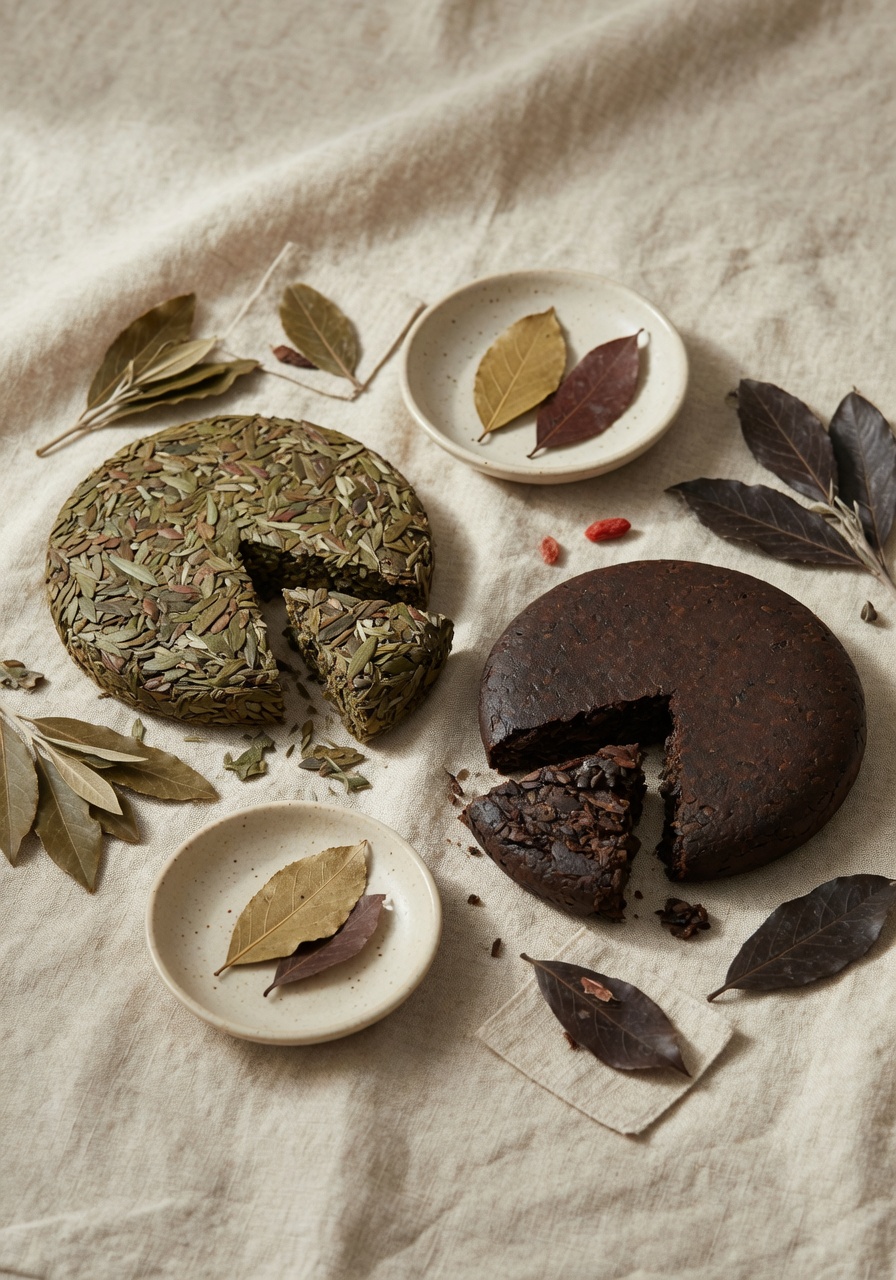
Sheng vs shu — what actually changes
Two teas share a name, a region, and a leaf — and almost nothing else. The 1973 invention of *wò duī* (渥堆) split pu'er into raw and ripe, and the chemistry of that split still defines every cake pressed today.
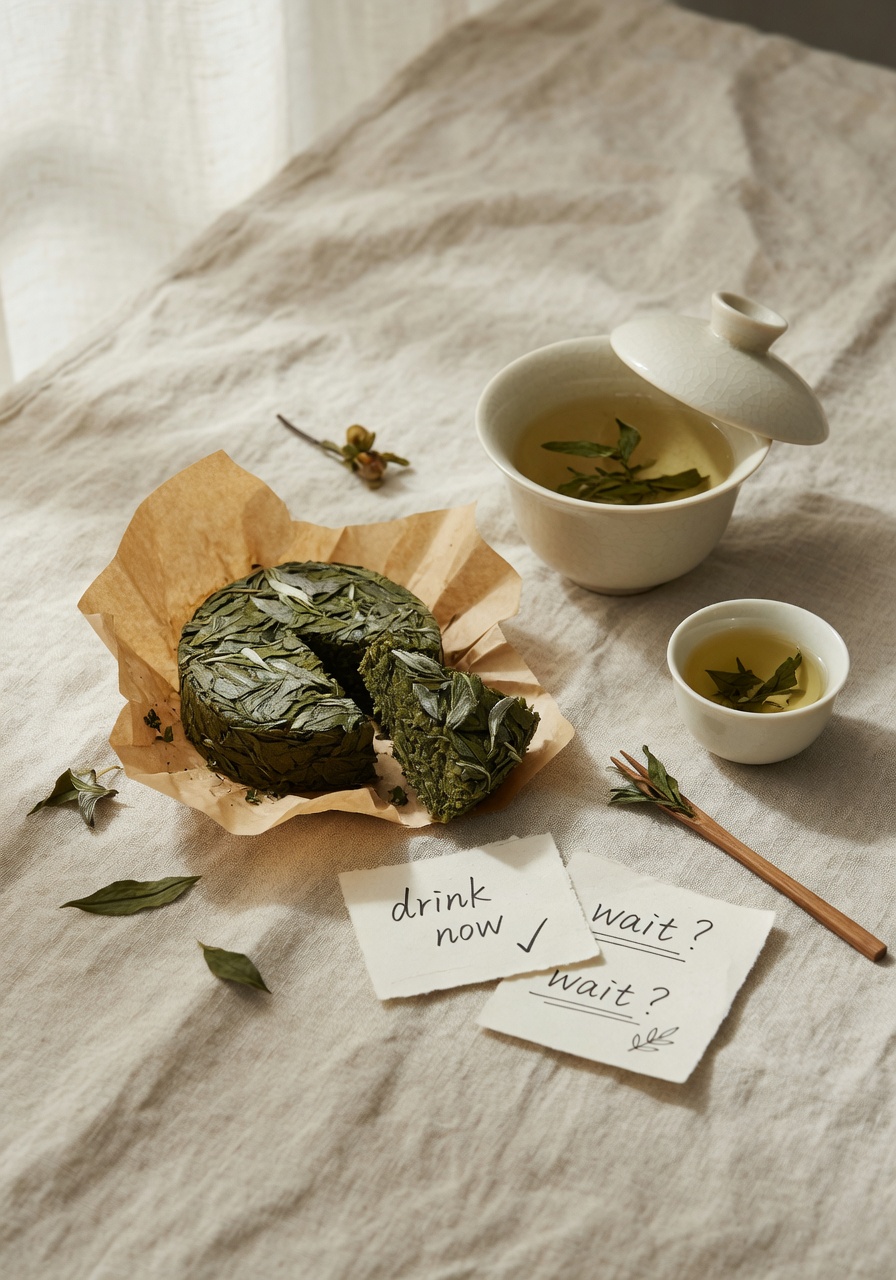
Young sheng — drink now or wait?
The question every collector asks within their first year. Some cakes are radiant at eighteen months; others need a decade before they stop biting. Here is how to tell which is which.
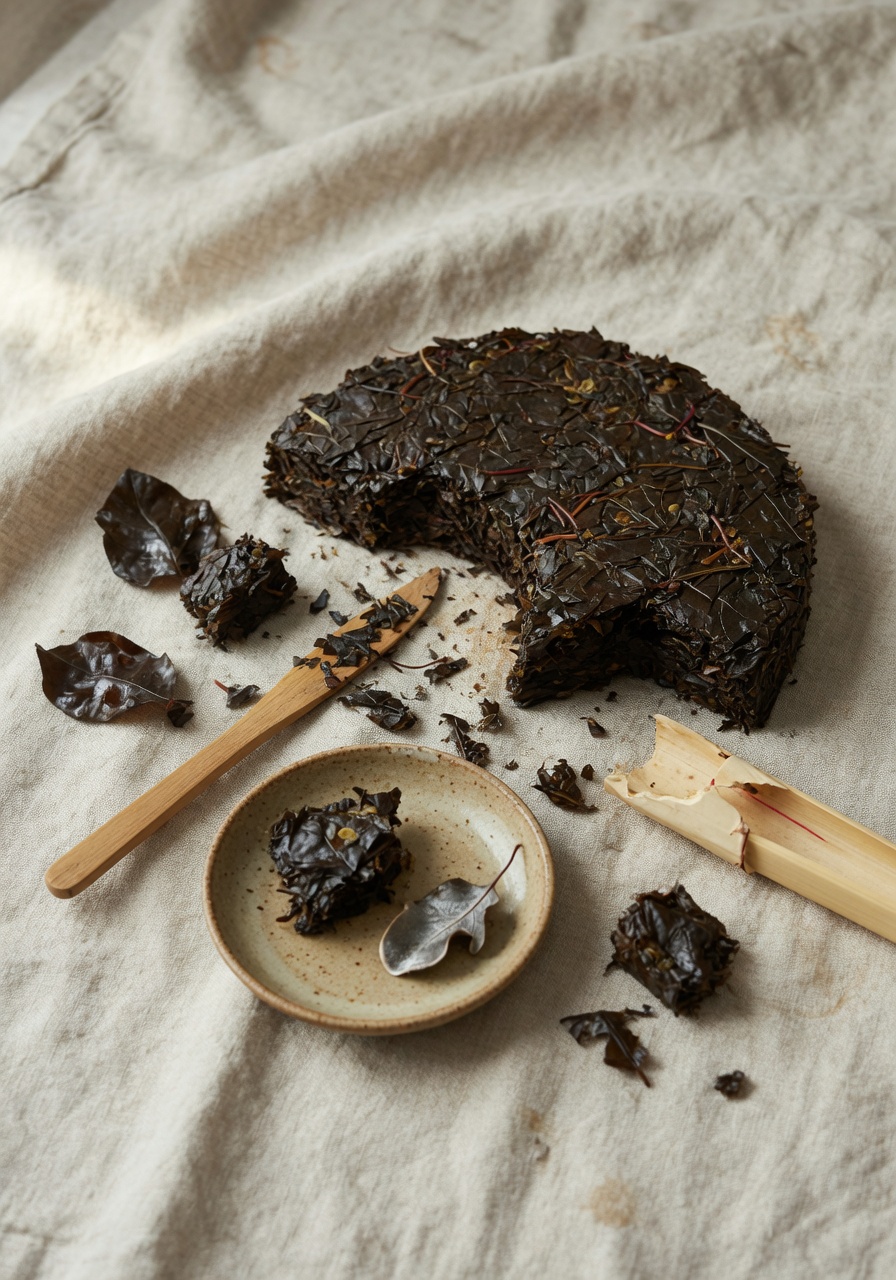
Menghai 7572 — the recipe that anchors the category
A four-digit code stamped on a paper wrapper has done more to define what shu tastes like than any single mountain or master. This is how 7572 became the reference point.
Does shu age? A measured answer
Shu was engineered in 1973 to taste like aged sheng without the wait. So does it still benefit from time in the jar — or is the work already done? A technical look at what actually changes after the pile.