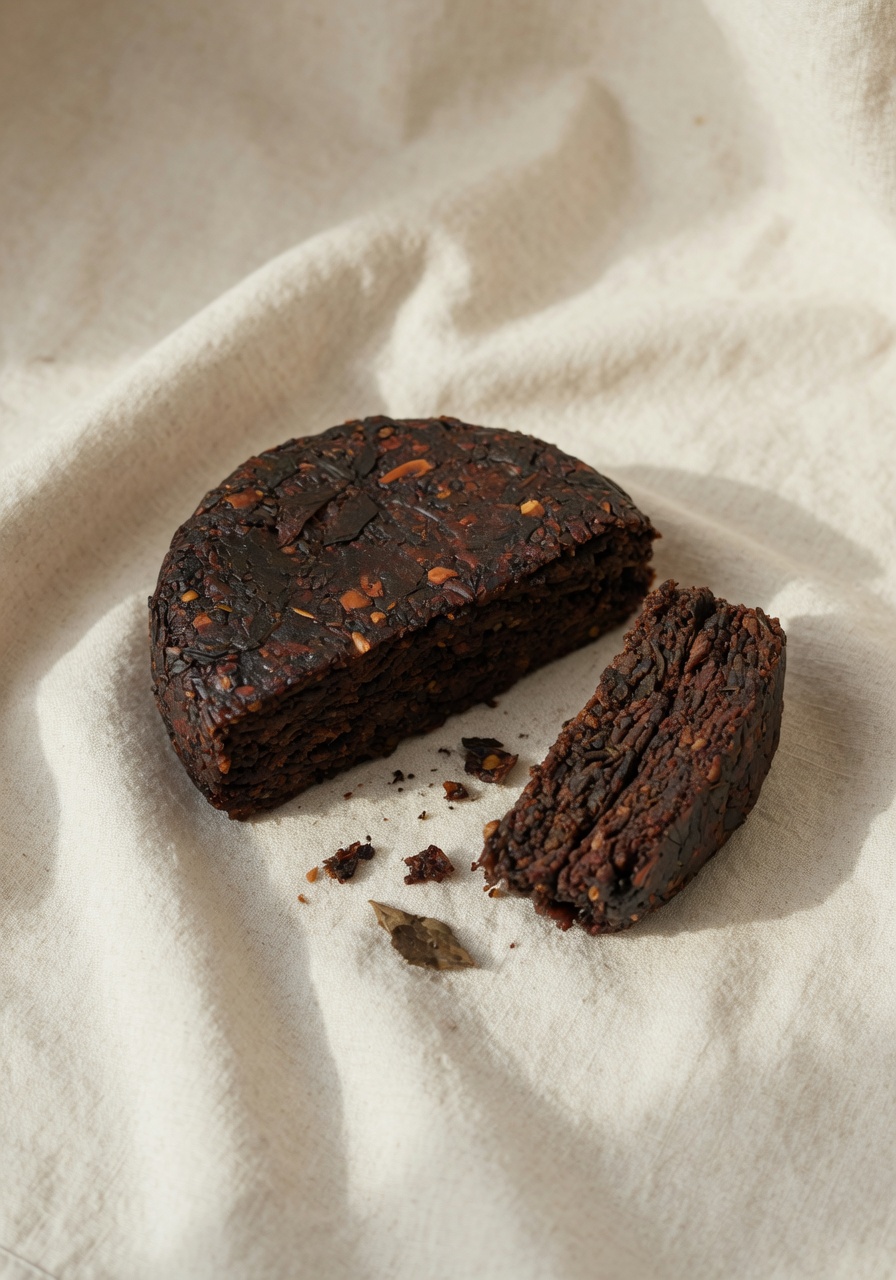
From a 1973 experiment to a category of its own
Shu pu’er is the youngest major category in Chinese tea. Until the early 1970s, all pu’er was sheng — green-processed maocha pressed into cakes and bricks, then left to ferment slowly through transit and storage. Hong Kong and Guangdong wholesalers had long known that humid warehouses produced a darker, smoother cup, and by the late 1950s some were quietly damp-storing cakes to meet demand. The Kunming Tea Factory was sent to study these techniques, and in 1973 a team led by Wú Qǐyīng (吴启英) ran the first formal wò dūi (渥堆) trials on a batch of Yunnan maocha. The pile worked. By 1975 the Menghai Tea Factory had its own line, and the recipe that would become 7572 — covered in Menghai 7572 — the recipe that anchors the category — was codified the same year.
The process itself is deceptively simple and technically demanding. Maocha is heaped on a concrete or bamboo-matted floor, sprayed with clean water to roughly 30–40% moisture, and turned on a schedule the master determines by smell, touch and the internal temperature of the pile — usually held between 55 and 65 °C. Over 40 to 70 days, thermophilic fungi (notably Aspergillus niger) and bacteria break down polyphenols, soften the tannic spine of the leaf, and generate the brown-sugar, damp-wood, camphor notes that define the cup. Wo dui — the pile fermentation that defined shu walks through this in detail, including the modern variants — small-pile, basket, and the so-called ‘light fermentation’ styles now popular in Menghai and Lincang.
Regional taxonomy followed quickly. Menghai built the category’s backbone with 7572, 7262 and the Dayi V93 tuocha. Xiaguan in Dali pushed toward firmer, smokier profiles suited to its tuocha tradition. Kunming, the birthplace, retained a cleaner, less earthy house style. Lincang and Pu’er city joined later, and by the 2000s private workshops in Menghai county were producing shu from single-village maocha — Bulang, Bāng Pén (邦盆), Lao Man’e — at prices that would have been unthinkable in the state-factory era. Grading runs from gōng tíng (宫廷, palace grade, smallest buds) down through grades 1–9, with the looser grades typically blended for cakes.
The question of aging is the category’s quiet controversy. The pile has already done what decades of sheng storage would attempt, so what is left for time to do? Does shu age? A measured answer takes this on directly: the short version is that 3–5 years of dry storage softens the pile odour (堆味 dūi wèi) that fresh shu carries, and 10–15 years can develop a deeper chén xiāng (陈香) — but the curve flattens far earlier than sheng’s does.
For drinkers, shu rewards a different attention than sheng. It is the everyday tea of southern Chinese restaurants, the after-meal digestive, the cake you open without ceremony. For collectors, it is a smaller and more legible market — recipes, factories, and years are well documented, and the downside risk of a bad cake is lower than gambling on young sheng. Producer profiles on puerh.app and pairing notes on tea.community cover the practical end; serious purchases route through shop.puerh.app.