home · Brewing pu'er — <em>method follows the leaf</em>
Brewing
Brewing young sheng without the bitterness
*Shēng Pǔ'ěr* · 生普洱
Young raw pu'er punishes the lazy and rewards the precise. A short guide to leaf ratio, water, and timing — written from a decade of brewing two-year-old Bulang and Yiwu in cold Ulaanbaatar kitchens.
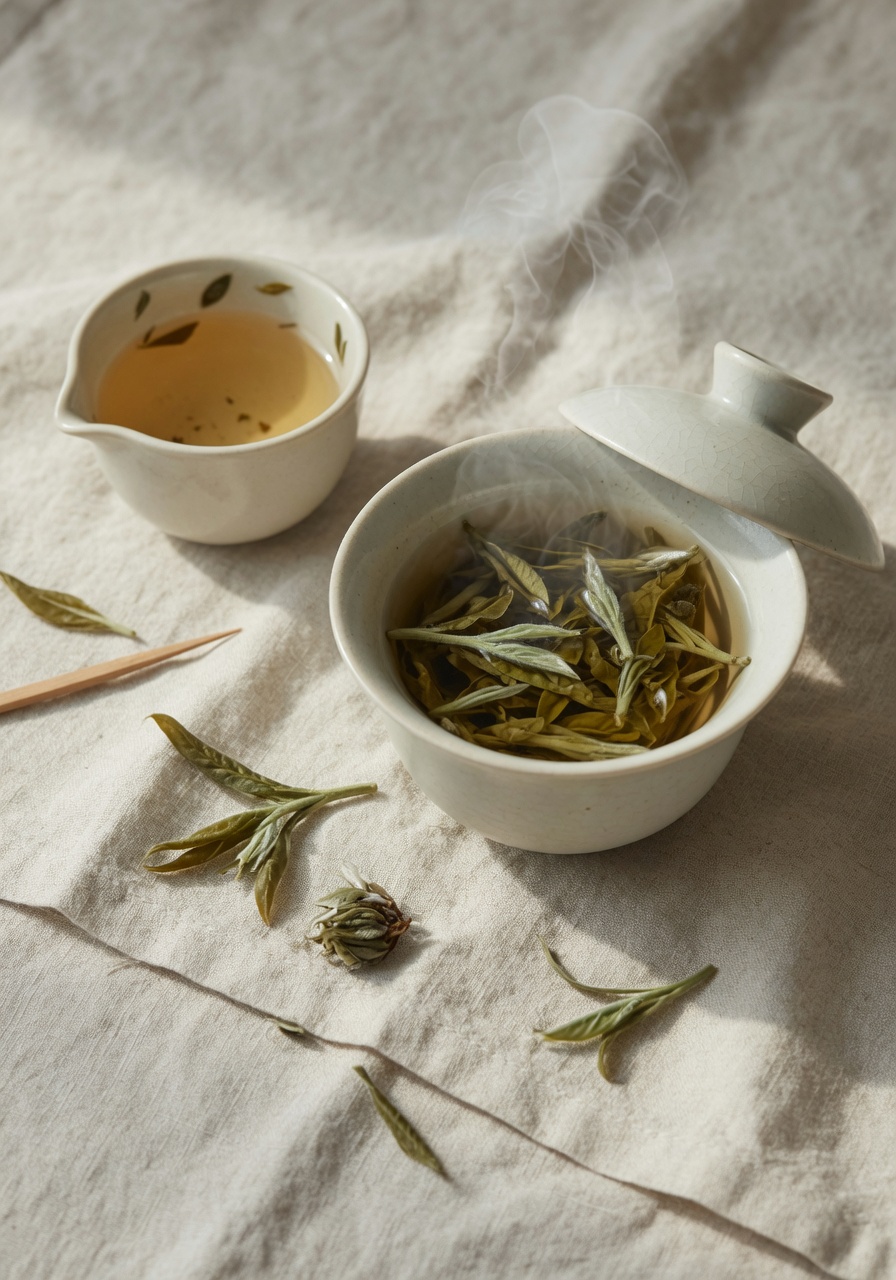
Young shēng pǔ’ěr (生普洱) — anything roughly under five years from press date — is the most unforgiving tea I brew. The leaves carry the full load of catechins and caffeine that aging slowly moderates, and a careless pour turns a Bulang cake into something closer to aspirin than tea. Drinkers blame the tea. Usually it is not the tea.
This matters because a great deal of interesting shēng — small-batch single-village pressings from 2022 and 2023, the kind you find through specialist vendors and at festivals listed on tea.events — is meant to be drunk young, at least in part. Waiting fifteen years for a Yiwu to soften is a luxury. Drinking the same tea well at two years is a skill, and like most skills it comes down to four variables you can actually control: leaf weight, water temperature, vessel, and time. Everything else is folklore.
What follows is the protocol I teach at workshops in Ulan-Ude and Irkutsk, refined on a few hundred sessions with cakes from Lao Banzhang, Nannuo, Manzhuan and the more affordable Mengku material I keep on the shelf for daily drinking. The goal is not to remove bitterness entirely — a young Bulang without any kǔ (苦) is a young Bulang stripped of its character — but to keep bitterness in conversation with sweetness, throat-feel, and the cooling huí gān that arrives thirty seconds after you swallow. When those four are in balance, even a two-year-old cake drinks like a finished tea.
Why young sheng turns bitter
Bitterness and astringency in young shēng come from two distinct chemical families that brewers often conflate. Bitterness is driven mostly by caffeine and certain catechin gallates — EGCG above all. Astringency, the drying grip on the tongue and gums, comes from polyphenol–protein binding, which intensifies with both temperature and contact time. Chinese national standard GB/T 22111-2008 specifies a polyphenol content for shēng raw material typically between 28 and 36 percent dry weight, with old-tree material at the high end. That is roughly double a finished oolong. The chemistry is simply more concentrated, and concentrated chemistry is unforgiving of overextraction.
A second factor is shā qīng (杀青) — the kill-green step that fixes the leaf. Shēng is pan-fired at a lower temperature than green tea, typically 180–220 °C for six to eight minutes, which deliberately leaves a small fraction of polyphenol oxidase active so the cake can age. The trade-off: enzymes continue to nudge the leaf chemistry for the first two to three years after pressing, a phase pressers in Menghai call xīn chá qī (新茶期), the new-tea period. During this window the tea is at its most volatile and most easily pushed into bitterness by hot water sitting on leaf for even ten seconds too long.
The practical implication is that young shēng requires brewing parameters closer to a delicate green than to a finished pu’er. Treat a 2023 Bulang like a 2008 Bulang and you will taste the difference within the first infusion.
Leaf-to-water ratio
The single biggest lever, and the one most people get wrong, is the dose. Vendors and brewing guides routinely recommend 1 g per 15 ml of water — the standard ratio for aged or shu material. For young shēng this is roughly thirty percent too much. After several years of side-by-side testing with a kitchen scale, I settled on 1 g per 20–22 ml for any shēng under five years old. For a 110 ml gàiwǎn (盖碗) that means 5.0–5.5 g, not 7. The lower dose lets you keep infusions short enough to be controllable without sacrificing later steeps.
The second adjustment is leaf selection. A good cake is heterogeneous — buds, stems, huángpiàn (黄片) yellow leaves, fragments. If you break off a chunk and brew it whole, you are at the mercy of whatever the cleaver landed on. I separate roughly half the leaf into looser, larger pieces and crumble the rest finer, then mix. This evens out extraction across infusions, which is more important for a young tea than for an aged one because the early flavor compounds are so front-loaded.
Weighing matters more than guessing
A 0.1 g jeweler’s scale costs less than a single cake of decent Yiwu. Use one. The difference between 5.2 g and 6.4 g in a 110 ml gàiwǎn is the difference between a tea you finish and a tea you abandon after three steeps. Once you have brewed the same cake five or six times at a measured dose, you can eyeball it — but build the muscle memory with numbers first. Zhou Xiang, my colleague who runs the green and yellow tea programs at puerh.app, makes the same point about Jūn Shān Yín Zhēn: precision early, intuition later.
Water temperature — the contested variable
There is a long-running argument in Yunnan tea circles about water temperature for young shēng. The traditional Menghai answer is full boil, every time, no exceptions — the logic being that shēng is shēng, and a tea that cannot stand boiling water is not worth drinking. The opposing camp, which includes a number of Taiwanese collectors and most Western specialists, brews young material at 85–92 °C and finds the resulting cup cleaner and less harsh.
My position, after brewing the same Bulang cake at five-degree increments from 80 °C to 100 °C across a single afternoon, is that the boiling-water camp is half right. Full boil works for old-tree material from Yiwu and parts of Yibang where the leaf chemistry is mellow and the kǔ fades quickly. For Bulang, Lao Banzhang, Mengku, and most of Lincang, 90–95 °C produces a noticeably more balanced cup with longer huí gān and less throat-scratch. The difference is most pronounced in steeps three through six, where lower-temperature brewing extends the flavor curve instead of crashing it.
A practical method: boil, then pour the water into a fairness pitcher and let it sit twenty to thirty seconds before pouring onto the leaf. This drops the temperature by roughly five to eight degrees depending on ambient conditions, and it adds a useful pause to the rhythm of the session.
Vessel choice
Young shēng belongs in porcelain or thin-walled gàiwǎn, not in yīxīng (宜兴) clay. This is not snobbery — it is thermodynamics. Yīxīng clay retains heat, which is precisely what you do not want when you are trying to keep extraction under control. Clay also absorbs and mutes the high aromatic top notes — the orchid, the camphor, the green-melon character — that distinguish a good young shēng from a mediocre one. Save the yīxīng for shu and aged material, where its softening effect is a feature.
The vessel I use most often is a 110 ml thin-porcelain gàiwǎn from Jingdezhen, fired thin enough that I can feel the water temperature through the lid. Glass is also fine and has the advantage of letting you watch the leaf unfurl, which is its own pleasure with old-arbor material. Avoid anything with a narrow opening — young shēng needs to be poured out fast and completely, and a constricted lip is the enemy of a clean separation between leaf and liquor.
The forgotten variable — pouring speed
Most brewing guides ignore decant time. They should not. The interval between starting to pour and getting the last drop out of the gàiwǎn is part of the steep — and for a young shēng brewed at five-second flash infusions, a slow pour can double the effective contact time. Pour fast, pour completely, and turn the gàiwǎn upside down on the strainer for a final two seconds. Leaving even a teaspoon of liquor on the leaf between steeps is the most common cause of progressive bitterness across a session.
Timing — a working protocol
For 5.0–5.5 g of young shēng in a 110 ml gàiwǎn at 92 °C, the timing I recommend is: rinse for two seconds and discard; first steep five seconds; second steep three seconds; third five seconds; fourth seven; fifth ten; sixth fifteen, then add roughly ten seconds per subsequent infusion. The second steep is shorter than the first because the leaf is now fully wet and surface-active — this is counterintuitive but consistent across every cake I have tested.
A decent young shēng gives ten to fourteen infusions on this schedule. Old-arbor material from Yiwu or Bulang will go fifteen or more, with the later steeps often the most interesting — the kǔ recedes, a honeyed sweetness comes up, and the huí gān lingers longer in the throat. If your tea collapses at steep six, it is either a poor cake or you have been brewing it as if it were aged. Try again the next day with a lower dose, lower temperature, and shorter early steeps.
When boiling water is actually right
All of the above applies to gongfu brewing in small vessels. For the Mongolian-style süütei tsai I grew up with, and for grandpa-style brewing in a tall glass at a desk, the rules invert. With a 300 ml mug and 3 g of leaf, the dilution does most of the work that timing does in a gàiwǎn — you can pour boiling water directly and the cup will still be drinkable forty minutes later. This is the brewing style for shēng cakes you do not love quite enough to brew gongfu, or for offices where ceremony is not an option.
For a deeper dive into the cultural side of grandpa-style and the history of pu’er moving north along the tea-horse road, the regional histories on tea.travel and the brewing fundamentals course at tea.school are both worth a read. The chemistry is the same; the choreography is different.
References
- GB/T 22111-2008 — Geographical indication product: Pu-erh tea — Standardization Administration of China
- Chen, Z. M. & Lin, Z. — Tea and human health: biomedical functions of tea active components — Journal of Zhejiang University Science B, 2015
- Zhou Hong-jie — Pu'er Tea (普洱茶), revised edition — Yunnan Science and Technology Press, 2004
- Interview with Zhang Jian, Menghai Tea Factory technical advisor — Menghai county, March 2019 — author's field notes
- Chan, K. — Brewing parameters for young raw pu-erh: a controlled comparison — Global Tea Hut Magazine, issue 78, 2018
Read next
Related articles
Young sheng — drink now or wait?
The question every collector asks within their first year. Some cakes are radiant at eighteen months; others need a decade before they stop biting. Here is how to tell which is which.
Bulang Shan — the bitter that becomes sweet
On the southern edge of Menghai county, the Bulang people have tended tea for over a thousand years. Their leaf opens the throat with bitterness — then turns sweet, slowly, and refuses to leave.
Yiwu — forest gardens of the Laos border
On the southern edge of Xishuangbanna, where the forest crosses into Laos, *Yì Wǔ* (易武) grows the softest, most aromatic *shēng* in Yunnan — a tea that built an empire, vanished for fifty years, and rebuilt itself from village memory.
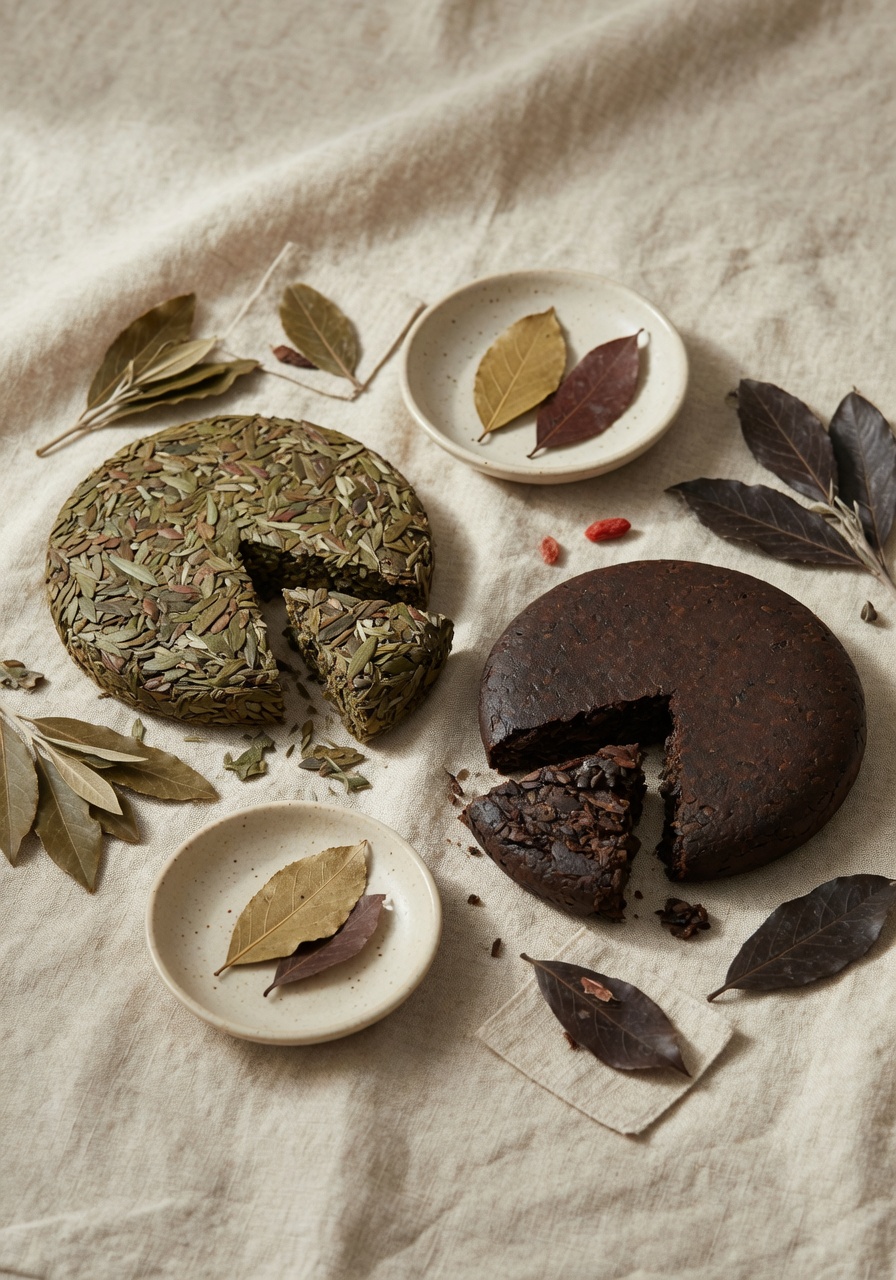
Sheng vs shu — what actually changes
Two teas share a name, a region, and a leaf — and almost nothing else. The 1973 invention of *wò duī* (渥堆) split pu'er into raw and ripe, and the chemistry of that split still defines every cake pressed today.