home · Learning to <em>taste</em> a cake before you trust it
Tasting & evaluation
A working vocabulary for tasting pu'er
Pǔ'ěr Chá · 普洱茶
Tasting notes are useless if two drinkers cannot agree on what *huí gān* means. This is a working glossary — the words I actually use at the table, with the sensations that anchor them.
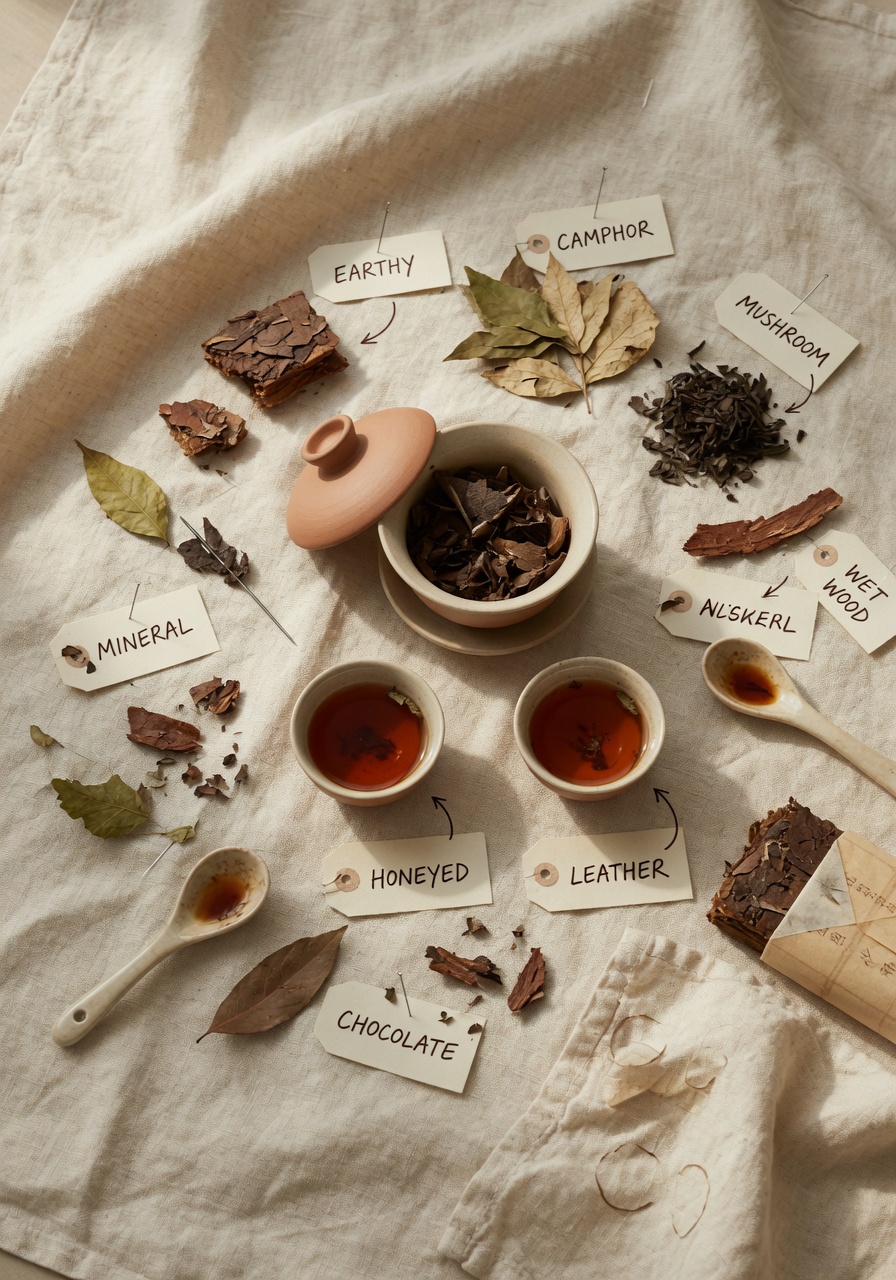
Most tasting language for pu’er has been borrowed twice — first from Chinese tea-evaluation manuals translated into English in the 1990s, then from the wine vocabulary that Western drinkers grafted on top. The result is a working pidgin where chá qì (茶气) can mean anything from caffeine jitters to a vague mystical claim, and where ‘astringency’ covers three or four distinct mouth sensations that a trained taster in Menghai would never confuse.
This article is the glossary I hand to apprentices in Ulan-Ude before we cup an unfamiliar cake together. It is deliberately narrow. I have stripped out terms that sound impressive but do no analytical work, and kept the words that let two people sitting across a gàiwǎn (盖碗) describe the same liquor and agree on what they tasted. Most of the vocabulary is rooted in the GB/T 23776-2018 sensory-evaluation standard and in the working notes of factory cuppers at Menghai and Xiaguan, with the addition of a few terms that have become unavoidable in international markets — huí gān, kǔ, sè — even where the standard does not formalise them.
You will notice the list is organised by where the sensation occurs: the nose first, then the front of the mouth, then the back of the throat, and finally the aftertaste and body response. This mirrors the order a Menghai cupper works through a sample, and it is the order I recommend you build muscle memory in. Skip the metaphors until the mechanics are stable.
Why vocabulary matters before sensitivity
I have watched experienced drinkers taste blind alongside a first-year Tea School student (tea.school) and produce identical raw perceptions but wildly divergent notes. The student wrote ‘bitter, dry, woody’; the senior taster wrote ‘kǔ opens at second steep, sè is film-only on the upper palate, huí gān arrives at twelve seconds.’ Same liquor. The senior taster had not tasted more sharply — they had simply partitioned the sensation into categories that could be checked against memory.
This is the practical case for vocabulary. A tasting note that says ‘smooth and pleasant’ tells you nothing six months later when you open the tong again. A note that says ‘tāng (汤) thick at 95°C, huí gān slow but durable past minute three, no suān at any steep’ is a measurement you can verify. The Chinese cupping tradition — codified in GB/T 23776 and earlier in Chen Zongmao’s evaluation manuals from the Hangzhou Tea Research Institute — has always treated sensory analysis as quasi-quantitative. Western tasting culture is slowly catching up.
The glossary that follows assumes you can already distinguish the four basic Pu’er categories — young sheng, aged sheng, shu, and the long middle period — and that you have a baseline reference. If you do not, drink a fresh 2023 Menghai 7542 and a 2010 7542 side by side three or four times before continuing. Without an anchor, the words slide.
Aroma — xiāng qì
Xiāng (香) is the family of words for aroma, and pu’er evaluators distinguish at least three locations where you assess it: dry leaf in a warmed cup, wet leaf in the lid of the gàiwǎn, and the empty cup after drinking (the bēi xiāng, cup aroma). Each location reveals different volatiles. Dry leaf is dominated by storage and processing; wet leaf is the most diagnostic for raw material origin; empty cup tells you about the heavier, slower-evaporating compounds and is where ageing markers show up cleanest.
Common aroma descriptors
Qīng xiāng (清香) — fresh, vegetal, hay-like. Dominant in young sheng under three years.
Mì xiāng (蜜香) — honeyed. Common in mid-aged sheng from Yiwu and in well-made huangpian.
Zǎo xiāng (枣香) — date or jujube. A marker of mid-life shu, usually 8 — 15 years after pressing.
Chén xiāng (陈香) — ‘aged aroma.’ A specific compound profile — slightly woody, faintly camphorous, never musty. This is the word you reserve for ageing done correctly.
Yào xiāng (药香) — medicinal, herbal, sometimes camphor-like. Older Yiwu, certain Bulang.
Hé xiāng (荷香) — lotus leaf. Found in some loose-stored sheng from Yunnan dry-storage.
If you cannot place an aroma in one of these categories, do not invent a metaphor — write ‘unidentified, sweet-warm’ and move on. Pattern-matching improves; over-confident notes do not.
Defective aromas
Cāng wèi (仓味) — ‘warehouse smell.’ The catch-all for storage faults. Subdivides into shī cāng (湿仓, wet-storage, mushroom-cellar note), méi wèi (霉味, frank mould), and mèn wèi (闷味, the airless dull note from a sealed cake stored too tight). Most cāng faults clear with two to three months of airing on a shelf. Frank mould does not — discard.
Yān wèi (烟味) — smoke. Sometimes a deliberate stylistic choice (older Xiaguan iron cakes); sometimes a fault from shā qīng (kill-green) done over wood that wasn’t dry. Acceptable in small amounts, intrusive over time.
Taste — the four primary sensations
The Chinese sensory tradition recognises five tastes, but in pu’er evaluation four do the analytical work: bitter (kǔ), sweet (tián), sour (suān), and umami/savoury (xiān). Saltiness almost never appears. Each of these is a distinct receptor response, not a metaphor, and you should be able to point to where on the tongue you perceive it.
Kǔ (苦) — bitterness
Bitterness in sheng comes primarily from caffeine and from the more aggressive catechins (EGCG, ECG). It is not a defect — it is raw material. A good Bulang-area cake will hit hard with kǔ at the first two steeps and then transform into sweetness. The diagnostic question is not ‘is it bitter?’ but ‘does the bitterness resolve?’ Bitterness that lingers without conversion to huí gān indicates either young leaf processed too aggressively or, in older cakes, oxidation damage.
Sè (涩) — astringency
Often translated as ‘astringency’ but technically distinct from bitterness — sè is a tactile sensation, the puckering and drying caused by polyphenols binding to salivary proteins. The key diagnostic is location and duration. Sè on the front of the tongue that releases within ten seconds is normal in young sheng. Sè that coats the upper palate and persists past thirty seconds usually indicates over-extraction or stressed bushes. Aged sheng should show minimal sè — if a fifteen-year-old cake is still astringent, ageing has stalled.
Tián and xiān
Tián (甜) — sweetness — is the most over-claimed sensation in marketing. Real tián in pu’er is rarely sugar-bright; it is more like the residual sweetness of well-cooked rice or the inside of a chestnut. Xiān (鲜) — savoury, broth-like — appears in fresh sheng with high amino-acid content and in some carefully made shu. Both are positive markers, but neither should dominate; a tea that is only sweet is usually a young, low-character cake from plantation material.
Mouthfeel — kǒu gǎn
Kǒu gǎn (口感) is the umbrella for everything that is not taste or aroma but is felt in the mouth — the physical character of the liquor. This is where pu’er separates itself most clearly from other tea categories, and where vocabulary lags hardest in English. The factory-cupper terms below come from the working sheet used at Menghai Tea Factory in the 1990s, as recorded in Deng Shihai’s Pǔ’ěr Chá (1995) and revised in later editions.
Hòu (厚) — thick, dense. The liquor coats the mouth and feels substantial, almost broth-like. Diagnostic of high-elevation, mature-tree material.
Bó (薄) — thin. The opposite — the liquor feels like water with flavour suspended in it. Common in fast-flushed plantation material.
Huá (滑) — slippery, smooth. The liquor moves across the tongue without resistance. A marker of correctly processed, well-aged material.
Zhì (滞) — sticky, viscous in a heavy way. Sometimes positive (well-made shu), sometimes a sign of over-fermentation.
Lì (利) — sharp, cutting. A young-sheng descriptor — the liquor has edges.
Róu (柔) — soft, rounded. The mature form that lì should age into.
A cake’s evolution can be tracked almost entirely through kǒu gǎn terms. The shift from lì to róu, from bó to hòu, from sè to huá — these are the changes ageing produces when storage is correct.
The throat and after-effect
If a single category of vocabulary separates serious pu’er drinkers from casual ones, it is the language of throat sensation and aftertaste. The mouth is shared territory with every other tea category. The throat is where pu’er does most of its distinctive work.
Huí gān and shēng jīn
Huí gān (回甘) — ‘returning sweetness.’ After swallowing, a sweetness rises in the throat and the back of the mouth. This is not an aftertaste of the sugar kind — it is a perceptual rebound, possibly related to the contrast against earlier bitterness, possibly to slow-acting compounds. The diagnostic questions are: how quickly does it arrive (5 — 30 seconds is normal), how long does it last (good cakes carry past two minutes), and how deep does it sit (throat, not just tongue).
Shēng jīn (生津) — ‘producing fluid.’ Saliva generation under the tongue and along the cheeks, independent of the liquor itself. You feel your own mouth watering after the cup is empty. This is one of the more reliable markers of mature-tree material and good processing — it is hard to fake and almost absent in poor cakes.
Hóu yùn and yùn
Hóu yùn (喉韵) — ‘throat rhyme.’ A sustained sensation deep in the throat after swallowing — sometimes coolness (liáng), sometimes a sweet open feeling, sometimes a slight tingle. Yiwu cakes are prized for a smooth, expanding hóu yùn; Bulang for a sharper, deeper one.
Yùn (韵) on its own — ‘resonance’ or ‘rhyme’ — is the most abused word in pu’er vocabulary. In responsible use it refers to the overall harmony and persistence of the tea’s character through the session — the way a single cake develops a coherent identity across fifteen steeps. If you cannot point to specific sensations producing the yùn, do not use the word.
Body response — chá qì
Chá qì (茶气) is where vocabulary becomes contested. The factory-evaluation standard does not formalise it. Some respected tasters dismiss it entirely as mysticism; others — including most senior Yunnan tea-masters I have worked with — treat it as a real and discussable phenomenon.
My working definition is narrow and physiological: chá qì refers to the somatic effects of drinking the tea — warmth in the chest or upper back, lightness in the head, perspiration on the temples, a settled feeling in the body, occasionally mild euphoria or a flushing across the face. These effects vary by cake, by drinker, by hydration, and by what you ate. They are real but inconsistent. They are probably driven by caffeine, theanine, and other alkaloids in concentrations that vary enormously between mature-tree and plantation material.
What to say in notes: be specific about location and timing. ‘Warmth in the sternum at fifth steep, mild head-lightness, no flushing.’ Avoid claims like ‘powerful qì’ that cannot be verified by anyone else at the table. If you want a fuller treatment of how to evaluate body response responsibly, see the framework in our companion piece Young sheng — drink now or wait?, and the broader ageing context in Sheng vs shu — what actually changes.
How to write the note
After ten years of training apprentices, my recommendation is this: write the note in the order you encountered the sensations, not in a graded checklist. The order matters because pu’er is a sequential experience — what arrives at steep one is not what arrives at steep eight, and a note that flattens this loses the cake’s structure.
A workable template: dry leaf (one line), first rinse aroma (one line), steeps 1 — 3 (taste, mouthfeel, throat — three lines), steeps 4 — 8 (development, one paragraph), late steeps (one line), spent leaf (one line), session summary (two lines including body response). Use the vocabulary above. Resist metaphor until you have done this template fifty times. Metaphor is what you earn after the mechanics are automatic.
For a community archive of notes written in this framework, the discussion threads on tea.community include several thousand cupping sessions from members in Kunming, Guangzhou, Moscow, and Berlin — useful for triangulating your own perceptions against other careful drinkers. The vocabulary above is the same one used there, with minor variations.
References
- GB/T 23776-2018 — Methodology for sensory evaluation of tea — Standardization Administration of China
- GB/T 22111-2008 — Geographical indication product: Pu'er tea — Standardization Administration of China
- Pǔ'ěr Chá (普洱茶), revised edition — Deng Shihai, Yunnan Science and Technology Press, 2004
- Tea Sensory Evaluation Manual — Chen Zongmao, Hangzhou Tea Research Institute, 1991
- Author's cupping notebooks and interviews with Menghai Tea Factory cuppers, 2014 — 2022 — Amgalan Chin, field notes
Read next
Related articles
Young sheng — drink now or wait?
The question every collector asks within their first year. Some cakes are radiant at eighteen months; others need a decade before they stop biting. Here is how to tell which is which.
Sheng vs shu — what actually changes
Two teas share a name, a region, and a leaf — and almost nothing else. The 1973 invention of *wò duī* (渥堆) split pu'er into raw and ripe, and the chemistry of that split still defines every cake pressed today.
Bulang Shan — the bitter that becomes sweet
On the southern edge of Menghai county, the Bulang people have tended tea for over a thousand years. Their leaf opens the throat with bitterness — then turns sweet, slowly, and refuses to leave.
Yiwu — forest gardens of the Laos border
On the southern edge of Xishuangbanna, where the forest crosses into Laos, *Yì Wǔ* (易武) grows the softest, most aromatic *shēng* in Yunnan — a tea that built an empire, vanished for fifty years, and rebuilt itself from village memory.